The Ultimate Guide to HILIC Column Selection: Optimizing Glycan Analysis for Biopharmaceuticals
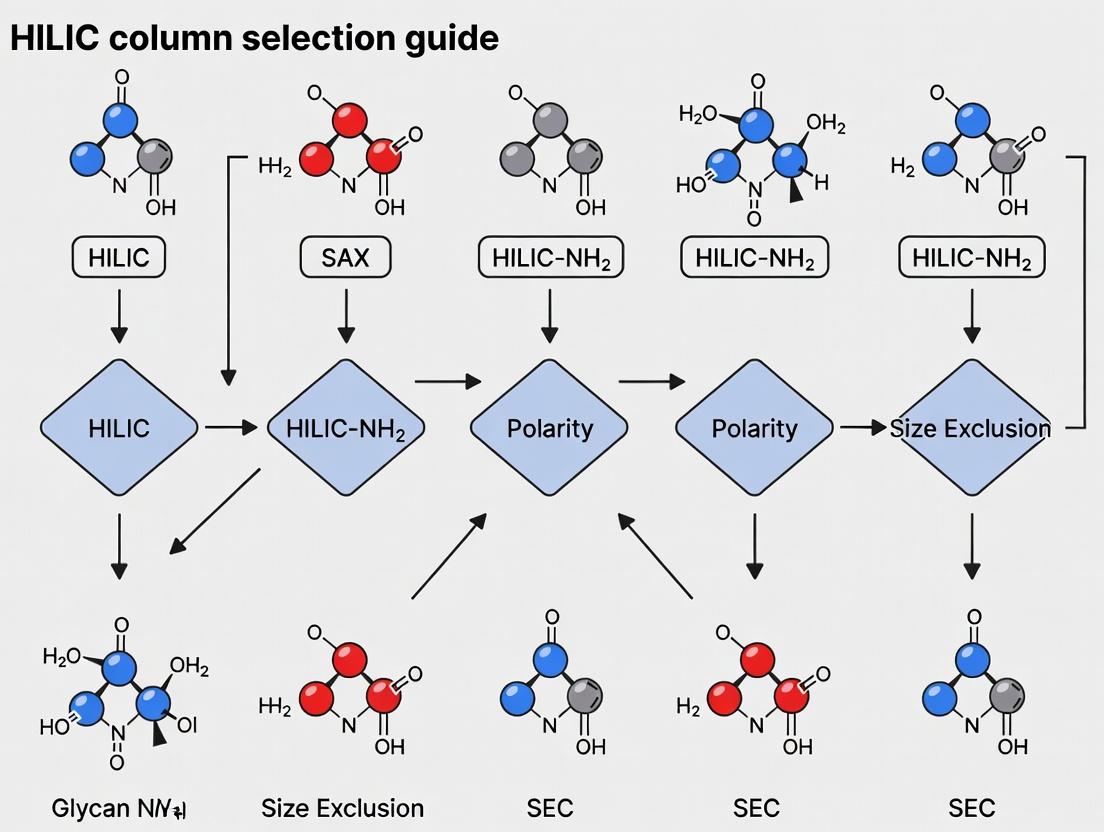
This comprehensive guide provides researchers and drug development professionals with a strategic framework for selecting and applying Hydrophilic Interaction Liquid Chromatography (HILIC) columns for glycan analysis.
The Ultimate Guide to HILIC Column Selection: Optimizing Glycan Analysis for Biopharmaceuticals
Abstract
This comprehensive guide provides researchers and drug development professionals with a strategic framework for selecting and applying Hydrophilic Interaction Liquid Chromatography (HILIC) columns for glycan analysis. It covers the foundational principles of HILIC separation mechanisms for glycans, details practical methodologies for method development with specific column chemistries, addresses common troubleshooting and optimization challenges, and provides guidance for method validation and comparative performance assessment. The guide synthesizes the latest advancements to empower scientists in achieving robust, reproducible, and high-resolution glycan profiling critical for biopharmaceutical characterization and quality control.
Understanding HILIC Fundamentals: The Science Behind Glycan Separation
Hydrophilic Interaction Liquid Chromatography (HILIC) is a powerful mode of liquid chromatography used for the separation of polar and hydrophilic analytes. It functions on a polar stationary phase (e.g., bare silica, amide, or diol) with a mobile phase typically consisting of a high proportion of organic solvent (usually acetonitrile >70%) and a small amount of aqueous buffer. Retention is governed by a complex partitioning mechanism where analytes partition into a water-enriched layer on the surface of the polar stationary phase. Additional mechanisms, such as hydrogen bonding, dipole-dipole interactions, and weak electrostatic interactions, contribute to selectivity. This makes HILIC particularly suited for the analysis of glycans, amino acids, nucleotides, and other challenging polar compounds.
HILIC Troubleshooting and FAQs
This technical support center addresses common issues encountered during HILIC method development, with a specific focus on glycan analysis research.
FAQ 1: Why is my glycan retention time unstable, with poor reproducibility?
- Cause: Insufficient column equilibration in HILIC mode. The formation of the critical, stable water-enriched layer on the stationary phase requires significant time.
- Solution: Extend the column equilibration time. After mobile phase preparation or switching from a reversed-phase method, equilibrate with at least 10-15 column volumes of the starting mobile phase before starting a sample run. Monitor system pressure and baseline for stability.
- Prevention: Always follow a standardized start-up and equilibration protocol. For glycan analysis, consistency in the water content of the mobile phase is paramount; use freshly prepared, high-purity solvents and buffers.
FAQ 2: I am observing peak tailing for my charged glycans. What could be the reason?
- Cause: Uncontrolled secondary ionic interactions between charged glycans (e.g., sialylated species) and charged silanol groups or charged functional groups on the stationary phase.
- Solution: Increase the buffer concentration (e.g., ammonium acetate or formate) in the aqueous portion of the mobile phase (typically 10-50 mM). The buffer ions will effectively suppress these ionic interactions. Adjusting pH can also help; for acidic glycans, a pH ~4.5-5.5 (ammonium formate) is often used.
- Prevention: Select a column chemistry designed to minimize ionic interactions (e.g., amide, zwitterionic) for complex glycan mixtures containing charged species.
FAQ 3: My peaks are very broad or show a "split peak" appearance. How can I fix this?
- Cause: Sample solvent incompatibility. Injecting a sample dissolved in a solvent stronger than the mobile phase (e.g., a high-water content sample into a high-ACN mobile phase) can cause on-column focusing issues and band broadening.
- Solution: Reconstitute or dilute your glycan sample in a solvent that closely matches or is slightly weaker than the starting mobile phase composition (e.g., 75-80% acetonitrile). For 2-AB labeled glycans, ensure the labeling reagent is thoroughly removed.
FAQ 4: I have low sensitivity and poor peak response for my glycans. What should I check?
- Cause 1: Evaporation of the volatile organic component (ACN) in the mobile phase reservoir, leading to a gradual increase in water percentage and a shift in retention.
- Solution: Use mobile phase bottle caps with septa and ensure tubing is submerged. Prepare fresh mobile phase daily for critical work.
- Cause 2: Mass spectrometry issues when using HILIC-MS for glycan analysis. HILIC mobile phases often contain non-volatile salts.
- Solution: For LC-MS, use only volatile buffers (ammonium formate/acetate). Avoid phosphate or other non-volatile buffers. Ensure proper desolvation in the MS source, as high organic flows can affect ionization.
Key Data for HILIC Column Selection in Glycan Analysis
The selection of an appropriate HILIC column is critical for resolving complex glycan mixtures. The following table summarizes the properties of common HILIC chemistries relevant to glycan profiling.
Table 1: Common HILIC Stationary Phases for Glycan Analysis
| Stationary Phase Chemistry | Key Interaction Mechanisms | Best For Glycan Analysis | Considerations |
|---|---|---|---|
| Underivatized (Bare) Silica | Hydrogen bonding, dipole-dipole, some ionic | Neutral oligosaccharides, simple mixtures | pH sensitive (typically 2-8), can show strong ionic interactions with charged glycans. |
| Amide | Strong hydrogen bonding, dipole-dipole | Comprehensive profiling (neutral & sialylated), 2-AB labeled glycans | Excellent stability, minimal ionic interaction, widely used standard for HILIC-glycan work. |
| Diol | Hydrogen bonding, weaker than amide | Larger, labile glycans | Very hydrophilic and stable; often provides different selectivity than amide columns. |
| Zwitterionic (ZIC-HILIC) | Electrostatic, hydrogen bonding | Charged glycans (sialylated, sulfated), complex separations | Excellent for separating isomers, handles a wide pH range. |
| Mixed-Mode (e.g., BEH Amide) | Hydrogen bonding with underlying hybrid strength | Robust, high-pH compatible methods | BEH technology provides high pH stability and longevity. |
Table 2: Typical HILIC Method Parameters for 2-AB Labeled N-Glycans
| Parameter | Recommended Setting | Purpose & Notes |
|---|---|---|
| Column | 2.1 x 150 mm, 1.7 µm BEH Amide | Common format for UHPLC separations. |
| Temperature | 40 - 60°C | Increases efficiency, reduces backpressure. |
| Mobile Phase A | 50-100 mM Ammonium Formate, pH 4.5 | Volatile buffer for MS compatibility; suppresses charge effects. |
| Mobile Phase B | 100% Acetonitrile | Primary organic solvent. |
| Gradient | 75-80% B to 50-60% B over 20-40 min | Elutes glycans in order of increasing hydrophilicity/size. |
| Flow Rate | 0.3 - 0.5 mL/min | Optimized for column dimension and particle size. |
| Injection Solvent | ≥ 75% Acetonitrile | Matches initial mobile phase to prevent peak distortion. |
Experimental Protocol: HILIC-UHPLC Analysis of 2-AB Labeled N-Glycans
Objective: To separate and profile fluorescently labeled N-glycans released from a monoclonal antibody. Materials: See "The Scientist's Toolkit" below.
Procedure:
- Sample Preparation: Release N-glycans from the protein using PNGase F. Clean up released glycans using solid-phase extraction (SPE) cartridges. Label the glycans with 2-aminobenzamide (2-AB) via reductive amination. Purify the labeled glycans to remove excess dye.
- Mobile Phase Preparation: Prepare 500 mL of 100 mM ammonium formate, pH 4.5 (Mobile Phase A). Filter through a 0.22 µm nylon membrane. Use HPLC-grade acetonitrile as Mobile Phase B.
- System Equilibration: Connect the appropriate HILIC column (e.g., BEH Amide, 2.1 x 150 mm, 1.7 µm) to the UHPLC system. Set the column temperature to 45°C. Prime lines with the prepared mobile phases. Set a flow rate of 0.4 mL/min and equilibrate the column at an initial condition of 80% B / 20% A for at least 15 column volumes (≈12 minutes) until a stable baseline and pressure are achieved.
- Sample Reconstitution: Dissolve the dry, 2-AB labeled glycan sample in 100 µL of 75% acetonitrile (v/v in water). Vortex thoroughly.
- Gradient Elution: Program the following analytical gradient: 0-30 min: 80% B to 55% B (linear), 30-31 min: 55% B to 80% B, 31-35 min: hold at 80% B for column re-equilibration. Total run time: 35 minutes. Use a fluorescence detector (ex: 330 nm, em: 420 nm).
- Injection: Inject 5-10 µL of the reconstituted sample.
- Data Analysis: Process chromatograms using appropriate software. Identify peaks by comparison with external dextran ladder standards or known glycan standards.
The Scientist's Toolkit: Key Reagents for HILIC Glycan Analysis
| Item | Function in HILIC Glycan Analysis |
|---|---|
| BEH Amide UHPLC Column | The workhorse stationary phase, providing robust, reproducible separations of labeled glycans with minimal ionic interactions. |
| Ammonium Formate (MS Grade) | Volatile buffer salt used to prepare Mobile Phase A. Provides ionic strength to control secondary interactions and is compatible with mass spectrometry. |
| Acetonitrile (HPLC Grade) | The primary organic solvent (Mobile Phase B) in HILIC. High purity is critical for low-UV/fluorescence background and consistent retention. |
| 2-Aminobenzamide (2-AB) | Fluorescent tag for glycans. Allows highly sensitive detection and introduces a hydrophobic moiety that improves retention on HILIC phases. |
| PNGase F Enzyme | Enzyme used to enzymatically release N-linked glycans from glycoproteins under non-denaturing conditions. |
| Glycan Clean-up Cartridges | Solid-phase extraction (SPE) cartridges (e.g., hydrophilic-modified silica) for desalting and purifying released or labeled glycans. |
| Dextran Hydrolysate Ladder | A standard mixture of linear glucose oligomers used as a hydrolytic molecular weight ladder to assign Glucose Units (GU) to unknown glycan peaks. |
Visualizing the HILIC Retention Mechanism and Workflow
Hydrophilic Interaction Liquid Chromatography (HILIC) is widely recognized as the premier technique for separating and analyzing glycans. Unlike Reverse-Phase Liquid Chromatography (RPLC), which relies on hydrophobic interactions, HILIC separates polar analytes like glycans based on their hydrophilicity and charge using a hydrophilic stationary phase and a hydrophobic organic-rich mobile phase (typically acetonitrile). This mechanism provides superior retention and resolution for highly polar, often charged, underivatized or labeled glycans.
Key advantages over RPLC and other modes include:
- Retention of Polar Analytes: RPLC often shows little to no retention for very polar glycans, leading to co-elution near the void volume. HILIC provides strong, predictable retention.
- MS Compatibility: The high organic mobile phases used in HILIC promote efficient desolvation and ionization in electrospray ionization-mass spectrometry (ESI-MS), significantly enhancing sensitivity.
- Orthogonal Selectivity: HILIC offers a separation mechanism orthogonal to RPLC and other techniques like PGC (Porous Graphitic Carbon), providing complementary information for complex analyses.
- Native Analysis: HILIC effectively separates underivatized glycans, preserving their native state, whereas RPLC often requires derivatization (e.g., permethylation, labeling with hydrophobic tags) to achieve retention.
Troubleshooting Guides & FAQs
Q1: I am experiencing poor retention of glycans on my HILIC column. What could be the cause? A: Poor retention in HILIC is primarily a function of insufficiently strong eluent conditions. Ensure the mobile phase contains a high percentage of a strong organic solvent (typically >70% acetonitrile). Also, verify that the aqueous portion contains the appropriate volatile buffers (e.g., 10-50 mM ammonium formate/acetate) at a pH that ensures the glycan's charge state is consistent.
Q2: Why do I get broad or split peaks for my glycan samples? A: Peak broadening or splitting is frequently due to inadequate sample solvent compatibility. The sample injection solvent must be as strong or stronger in organic composition than the initial mobile phase. Dissolving samples in a high percentage of acetonitrile (>80%) is recommended. A mismatch causes poor focusing at the column head. Another cause can be column overloading; ensure you are within the column's loading capacity.
Q3: My HILIC column pressure is increasing rapidly. How can I resolve this? A: A sudden pressure increase indicates a potential blockage. HILIC phases are sensitive to precipitation of salts or analytes in high organic conditions. First, flush the column with a high-water content mobile phase (e.g., 50:50 water:acetonitrile) to dissolve any precipitates, followed by re-equilibration. Always filter samples (0.22 µm or 0.45 µm) and use in-line filters. If the issue persists, back-flushing the column may help dislodge particulate matter at the inlet frit.
Q4: How can I improve the separation resolution between isomeric glycans? A: Optimizing the gradient slope (a shallower decrease in organic solvent) is the primary tool. Additionally, fine-tuning column temperature (often between 30-60°C) can affect selectivity and resolution. Using a column with smaller particle size (e.g., 1.7-1.8 µm vs. 3-5 µm) will also increase peak capacity and resolution, albeit at higher backpressure.
Q5: I observe poor MS signal for my glycans eluting from the HILIC column. What should I check? A: First, ensure your MS source parameters are optimized for the high organic mobile phase flow. Check for ion suppression from non-volatile salts or buffers; switch to volatile ammonium salts. Consider using a make-up solvent with a higher percentage of water or acid to improve post-column ionization efficiency. Also, verify that your glycan label (if used) is MS-compatible (e.g., 2-AB, Procainamide).
Data Presentation: HILIC vs. Other Modes for Glycan Analysis
Table 1: Comparison of Chromatographic Modes for Glycan Analysis
| Feature | HILIC | RPLC | PGC | Anion Exchange (HPAEC) |
|---|---|---|---|---|
| Primary Mechanism | Hydrophilic partitioning & charge | Hydrophobic interaction | Charge-induced & planar adsorption | Ionic interaction |
| Typical Phase | Amide, Diol, Zwitterionic | C18, C8 | Porous Graphitic Carbon | Quaternary Ammonium |
| MS Compatibility | Excellent (High Organic) | Good | Good | Poor (Requires Desalting) |
| Retention of Polar Glycans | Excellent | Poor (Requires Derivatization) | Good | Excellent for Charged |
| Separation Drive | % Organic Solvent (ACN) | % Organic Solvent (ACN/MeOH) | % Organic & Ionic Strength | Ionic Strength (Salt Gradient) |
| Isobaric Separation | Good | Moderate | Excellent | Good for Sialylated |
| Common Application | Released N/O-Glycans, Labeled Glycans | Permethylated/Labeled Glycans | Isomeric Separation (Native/Labeled) | Sialylated Glycan Profiling |
Table 2: Troubleshooting Common HILIC Issues
| Symptom | Possible Cause | Recommended Solution |
|---|---|---|
| No/Very Low Retention | Mobile phase too aqueous | Increase %ACN (e.g., to >75%) in starting eluent. |
| Broad/ Tailing Peaks | Sample solvent weaker than mobile phase | Re-dissolve sample in >80% ACN. |
| Column overloading | Reduce injection volume or sample concentration. | |
| Peak Splitting | Sample solvent stronger than mobile phase | Dilute sample with starting mobile phase. |
| Rising Backpressure | Blocked column frit (salt/particulates) | Flush with 50:50 Water:ACN, use in-line filter. |
| Poor Reproducibility | Insufficient column equilibration | Equilibrate with 10-20 column volumes of starting eluent. |
| Low MS Response | Non-volatile buffers present | Use volatile buffers (Ammonium Formate/Acetate). |
| Poor ionization | Optimize ESI source for organic flow; consider make-up solvent. |
Experimental Protocols
Protocol 1: Standard HILIC-UHPLC Analysis of 2-AB Labeled N-Glycans This protocol is for the separation of 2-aminobenzamide (2-AB) labeled N-glycans using a BEH Amide column (1.7 µm, 2.1 x 150 mm).
- Column: BEH Glycan or similar HILIC amide column.
- Mobile Phase A: 50 mM Ammonium Formate, pH 4.4 (adjust with formic acid).
- Mobile Phase B: 100% Acetonitrile.
- Sample Prep: Dry labeled glycans and re-dissolve in ≥ 85% Acetonitrile (e.g., 20 µL).
- Gradient: 75% B to 50% B over 40-60 minutes (optimize for complexity).
- Flow Rate: 0.4 mL/min.
- Temperature: 40-60°C.
- Detection: Fluorescence (Ex: 330 nm, Em: 420 nm) and/or MS.
- Equilibration: Re-equilibrate column at initial conditions (75% B) for 15-20 column volumes before next injection.
Protocol 2: HILIC-MS Analysis of Underivatized Glycans This protocol is suitable for native glycan analysis with direct coupling to MS.
- Column: Zwitterionic (ZIC-cHILIC) or Amide column.
- Mobile Phase A: 10 mM Ammonium Acetate in Water, pH 5.5.
- Mobile Phase B: 10 mM Ammonium Acetate in 90% Acetonitrile.
- Sample Prep: Desalt native glycans using solid-phase extraction (e.g., graphitized carbon). Re-dissolve in 80-90% Acetonitrile.
- Gradient: Start at 95% B, ramp to 50% B over 30-45 min.
- Flow Rate: 0.2-0.3 mL/min.
- Temperature: 30°C.
- MS Interface: Use a post-column make-up flow (e.g., 50/50 IPA/Water with 0.1% Formic Acid at 0.1 mL/min) to stabilize the ESI spray if sensitivity is low.
Diagrams
Diagram 1: HILIC vs RPLC Separation Mechanism for Glycans
Diagram 2: HILIC Glycan Analysis Workflow
The Scientist's Toolkit: Research Reagent Solutions
Table 3: Essential Materials for HILIC-based Glycan Analysis
| Item | Function & Description | Example/Vendor |
|---|---|---|
| HILIC Column | Stationary phase for separation. Key parameter: ligand type (e.g., amide, zwitterionic). | Waters ACQUITY UPLC BEH Amide, Merck SeQuant ZIC-HILIC |
| Volatile Salts | Provides ionic strength and pH control in mobile phases without MS interference. | Ammonium Formate, Ammonium Acetate |
| HPLC-Grade Solvents | Low-UV absorbance, low particle content. Critical for mobile phase and sample prep. | Acetonitrile (Optima LC/MS grade), Water (LC/MS grade) |
| Fluorescent Labels | Tags glycans for highly sensitive fluorescence detection. | 2-Aminobenzamide (2-AB), Procainamide |
| Glycan Release Enzymes | Cleaves N- or O-glycans from glycoproteins. | PNGase F (N-glycans), O-Glycosidase (O-glycans) |
| Solid-Phase Extraction (SPE) | For desalting and purifying released/labeled glycans. | Graphitized Carbon Cartridges, HILIC Microplates |
| MS Calibration Standard | For accurate mass determination in glycan MS analysis. | ESI Tuning Mix, Defined Glycan Standard (e.g., dextran ladder) |
| In-line Filter | Protects the analytical column from particulate matter. | 0.2 µm Stainless Steel or PEEK In-line Filter Unit |
Technical Support Center
Troubleshooting Guides & FAQs
Q1: My glycan peaks are broad and show poor resolution on my HILIC column. What could be the cause and how can I fix it? A: Broad peaks often indicate suboptimal interaction kinetics or column overloading.
- Check Sample Solvent: Ensure your sample is dissolved in a solvent with higher organic content (e.g., ≥75% acetonitrile) than the starting mobile phase. A mismatch can cause on-column focusing issues.
- Optimize Temperature: Increase column temperature (typically 40-60°C). This reduces viscosity and improves mass transfer, sharpening peaks.
- Evaluate Gradient: Flatten the gradient slope. For complex samples, a shallower increase in aqueous phase can improve resolution.
- Reduce Load: Inject less sample to rule out overloading.
Q2: I am seeing excessive peak tailing for sialylated glycans. How should I address this? A: Peak tailing for charged species is commonly due to secondary interactions with stationary phase silanols.
- Increase Buffer Concentration: Use a higher concentration of ammonium acetate (e.g., 50-100 mM) in the mobile phase to better shield silanol groups.
- Adjust pH: For acidic glycans, a lower pH (e.g., pH 4.5) can suppress ionization of silanols and reduce ionic interactions.
- Use Amine Modifiers: Add 0.1% diethylamine or triethylamine to the mobile phase to passivate the column surface. Note: Ensure compatibility with your detection method (e.g., MS).
Q3: I suspect my HILIC separation is not resolving isomeric glycans. What experimental parameters are most critical to optimize? A: Isomer separation relies heavily on maximizing subtle differences in interaction time.
- Prioritize Shallow Gradients: Use a very shallow gradient (e.g., 0.1-0.2% B/min) to amplify small differences in hydrophilicity.
- Lower Temperature: Contrary to broadening issues, slightly lower temperatures (30-40°C) can enhance selectivity for isomers by tightening the equilibrium.
- Column Selection: Some stationary phases (e.g., bridged ethylene hybrid (BEH) amide) offer superior isomer separation over others. Consider column screening.
Q4: My glycans are not retaining at all, eluting in the void volume. What should I do? A: This indicates insufficient hydrophilic partitioning.
- Increase Organic Phase: Start with a mobile phase containing a higher percentage of strong organic solvent (acetonitrile). For HILIC, starting conditions are often 70-80% acetonitrile.
- Verify Mobile Phase: Ensure you are using the correct water/organic proportions and that buffers are prepared accurately.
- Check Column Health: Test with a known standard to rule out column degradation.
Q5: I am using HILIC-MS and observe poor sensitivity. How can I improve my signal? A: This is often related to ionization efficiency in the presence of non-volatile buffers or high buffer concentrations.
- Use Volatile Buffers: Ammonium formate or ammonium acetate are standard. Avoid phosphate or sulfate buffers.
- Optimize Buffer Concentration: Start with 10-20 mM. Higher concentrations can suppress ionization in MS.
- Post-column Splitting: If using high flow rates, consider a post-column split to direct only a fraction to the MS source.
- Ensure Dryness: HILIC eluents must be free of water contamination in the organic phase. Use fresh, anhydrous acetonitrile in sealed bottles.
Experimental Protocols
Protocol 1: Standard HILIC-UPLC/FD Method for 2-AB Labeled N-Glycans Objective: To separate and profile released, fluorescently labeled N-glycans. Materials: HILIC column (e.g., Waters ACQUITY UPLC Glycan BEH Amide, 1.7 µm, 2.1 x 150 mm), UPLC system with FLD, 2-AB labeling kit. Procedure:
- Mobile Phase: (A) 50 mM ammonium formate, pH 4.5 (adjust with formic acid). (B) 100% Acetonitrile.
- Gradient: 75% B to 62% B over 25 min at 0.6 mL/min, 40°C.
- Column Equilibration: Re-equilibrate at starting conditions for 15 column volumes.
- Detection: Fluorescence, Ex λ 330 nm, Em λ 420 nm.
- Sample Prep: Dissolve dried 2-AB labeled glycan sample in 75% acetonitrile (v/v). Inject 1-5 µL.
Protocol 2: HILIC-MS Method for Native Glycan Analysis Objective: To separate and identify underivatized glycans by mass spectrometry. Materials: HILIC column (e.g., Thermo Scientific Accucore 150 Amide HILIC, 2.6 µm, 2.1 x 150 mm), LC-MS system. Procedure:
- Mobile Phase: (A) 10 mM ammonium bicarbonate in water, pH ~8.0. (B) 10 mM ammonium bicarbonate in 90% acetonitrile.
- Gradient: 85% B to 55% B over 30 min at 0.4 mL/min, 45°C.
- MS Settings: ESI negative ion mode preferred for native glycans. Sheath gas: 40, Aux gas: 15. Capillary temp: 300°C.
- Sample Prep: Dissolve native glycans in 85% acetonitrile. Inject 2-5 µL.
Protocol 3: Screening Method for Isomer Separation Objective: To maximize resolution of structural isomers (e.g., mannose-6 vs mannose-3 isomers). Materials: HILIC column with high selectivity (e.g., Tosoh Amide-80, 3 µm, 2.0 x 150 mm), HPLC system with high-precision pumps. Procedure:
- Mobile Phase: (A) 200 mM ammonium formate, pH 4.5. (B) Acetonitrile.
- Gradient: Use an ultra-shallow gradient: 78% B to 72% B over 60 min at 0.3 mL/min, 35°C.
- Detection: Use online MS or collect fractions for offline analysis.
- Key: Extended run times and shallow gradients are critical.
Table 1: Impact of Glycan Property on HILIC Separation Parameters
| Glycan Property | Primary Influence on Retention | Key Method Adjustment | Typical Effect on Elution Order |
|---|---|---|---|
| Size (DP) | Increases with molecular weight/DP. | Gradient slope. | Larger glycans elute later (more hydrophilic). |
| Charge (Sialylation) | Strongly increases retention (negative charge). | Buffer pH & concentration. | Higher sialylation elutes later. Neutral>Mono>Di>Tri-sialylated. |
| Isomerism | Subtle changes in interaction strength. | Gradient slope, temperature. | Isomers have near-identical RTs; shallow gradients required. |
| Hydrophilicity | Core property; increases with polarity. | Starting %B (organic). | More hydrophilic (e.g., high mannose) elutes later than complex type. |
Table 2: Optimized HILIC Conditions for Different Glycan Classes
| Glycan Class | Recommended Column | Starting %ACN | Buffer (mM, pH) | Key Temperature | Application Note |
|---|---|---|---|---|---|
| Neutral N-Glycans (2-AB) | BEH Amide | 75-80% | 50 mM AmFm, pH 4.5 | 40°C | Standard biopharma profiling. |
| Sialylated Glycans | BEH Amide | 75% | 100 mM AmAc, pH 4.5 | 50°C | High buffer conc. reduces tailing. |
| O-Glycan Isomers | Amide-80 | 78% | 200 mM AmFm, pH 4.5 | 35°C | Ultra-shallow gradient for core vs. extended isomers. |
| Native/Underivatized | ZIC-HILIC | 85% | 10-20 mM AmBi, pH 8.0 | 45°C | MS-compatible, volatile buffer at high pH. |
Diagrams
Diagram 1: HILIC Separation Decision Workflow
Diagram 2: Key Glycan Properties & HILIC Interactions
The Scientist's Toolkit: Research Reagent Solutions
Table 3: Essential Materials for HILIC-based Glycan Analysis
| Item | Function in HILIC Glycan Analysis | Example Product/Brand |
|---|---|---|
| HILIC Column (Amide) | Stationary phase providing primary hydrophilic interactions. | Waters ACQUITY UPLC Glycan BEH Amide, 1.7 µm. |
| Anhydrous Acetonitrile | Primary organic mobile phase; critical purity for reproducibility. | Honeywell Burdick & Jackson LC-MS Grade. |
| Ammonium Acetate | Volatile buffer salt for pH control and ion pairing. | Sigma-Aldrich, LC-MS Ultra grade. |
| Ammonium Formate | Alternative volatile buffer, often used at lower pH. | Fluka, MS grade. |
| Formic Acid | For mobile phase pH adjustment, especially for acidic glycans. | Thermo Scientific, LC-MS grade. |
| 2-AB Labeling Kit | Fluorescent tag for sensitive detection of released glycans. | LudgerTag 2-AB Labeling Kit. |
| PNGase F Enzyme | For releasing N-glycans from glycoproteins. | Promega, recombinant. |
| Glycan Standard | Mixture of known glycans for system suitability and calibration. | Procainamide-labeled N-glycan standard (Waters). |
| Vial Inserts | Low-volume inserts to minimize sample volume in autosampler vials. | Polymeric, 100-250 µL volume. |
Troubleshooting Guides & FAQs
FAQ 1: Why is my glycan retention time decreasing over consecutive runs on a bare silica column?
- Answer: This is typically caused by the accumulation of charged analytes or buffers on the active silanol sites, changing the stationary phase's character. Ensure a 10-20 column volume equilibration with the starting mobile phase after gradient elution. Implement a weekly or bi-weekly stringent column cleaning protocol (see Experimental Protocol 1).
FAQ 2: I am using an amino (-NH2) column for glycan separation and notice peak tailing and some degradation products. What could be the issue?
- Answer: Amino columns are susceptible to Schiff base formation (reaction between the primary amine and reducing sugars) and oxidation. This causes poor peak shape and column degradation. Solution: Use mobile phases with a higher organic content (>85% ACN) to minimize Schiff base formation. Always include a reducing agent like 0.05% (v/v) triethylamine in your aqueous buffer. Store the column in ACN-rich solvent (e.g., 90% ACN) and avoid acidic conditions.
FAQ 3: My amide column shows high backpressure. What steps should I take?
- Answer: High backpressure in HILIC, especially with amide columns, is often due to precipitation of salts or buffers in the high-organic mobile phase. Ensure your aqueous buffer and organic solvent (ACN) are thoroughly miscible. Filter all buffers through a 0.22 µm filter. Start troubleshooting by checking for system blockage before the column. If the column is blocked, follow the cleaning procedure in Experimental Protocol 1.
FAQ 4: How do I improve the reproducibility of my zwitterionic sulfoalkylbetaine column for sialylated glycans?
- Answer: Zwitterionic phases are highly sensitive to buffer ionic strength and pH, which control the electrostatic interactions with charged glycans. For reproducible separation of sialylated species, prepare buffers fresh daily using high-purity salts (e.g., ammonium acetate). Precisely control pH (±0.05 units). Use a minimum of 10 mM ammonium acetate; for complex mixtures, 20-50 mM may be needed. Ensure column temperature is controlled (±1°C).
FAQ 5: My diol column is not providing the expected selectivity for isomeric glycans. What parameters should I optimize?
- Answer: Diol phases primarily offer hydrogen-bonding interactions. To enhance selectivity for isomers, fine-tune the following: 1) Water content: Adjust the % of aqueous buffer (typically 3-10%) in ACN. Slightly more water increases hydrogen bonding competition. 2) Buffer pH: Operate near the pKa of your glycans; small pH changes can alter their hydrogen-bonding capacity. 3) Temperature: Lower temperatures (e.g., 25°C vs 40°C) can enhance resolution of isomers by strengthening hydrogen bonding interactions.
Experimental Protocols
Experimental Protocol 1: Standard Cleaning and Regeneration for HILIC Columns
Purpose: To remove strongly adsorbed ionic and polar contaminants.
- Disconnect the column from the detector.
- Flush with 10 column volumes (CV) of a 50:50 mixture of water and acetonitrile.
- Flush with 10 CV of pure water.
- Flush with 10 CV of 100 mM ammonium acetate buffer (pH 5.0).
- Flush with 10 CV of pure water.
- Re-equilibrate with 20 CV of the starting mobile phase used in your method. Note: For silica-based columns, avoid pH extremes. Do not exceed pH 8 for prolonged periods.
Experimental Protocol 2: Standard Method for Screening HILIC Selectivity for Glycans
Purpose: A starting point to evaluate different HILIC chemistries.
- Column: 150 x 2.1 mm, 1.7-3 µm particle size of each chemistry (Bare Silica, Amide, Diol, Zwitterionic).
- Mobile Phase A: 95% Acetonitrile with 5% 200 mM ammonium formate, pH 4.4 (final buffer conc. = 10 mM).
- Mobile Phase B: 50% Acetonitrile with 50% 200 mM ammonium formate, pH 4.4 (final buffer conc. = 100 mM).
- Gradient: 0-15 min, 0-40% B; 15-15.5 min, 40-100% B; 15.5-18 min, hold at 100% B; 18-18.5 min, 100-0% B; re-equilibrate at 0% B for 7 minutes.
- Flow Rate: 0.4 mL/min
- Temperature: 40°C
- Detection: MS or FLD (with appropriate labeling).
Data Presentation
Table 1: Comparison of Common HILIC Stationary Phase Chemistries for Glycan Analysis
| Chemistry | Functional Group | Primary Interaction(s) with Glycans | Typical pH Range | Key Advantages for Glycans | Common Challenges |
|---|---|---|---|---|---|
| Bare Silica | Silanol (Si-OH) | Hydrogen bonding, Dipole-dipole, Cation exchange | 2-8 | Strong retention, good for neutral glycans, robust | Irreversible adsorption, sensitive to [water], tailing for basics |
| Amino (-NH2) | Primary amine | Hydrogen bonding, Anion exchange, Schiff base | 2-9 | Strong for acidic glycans, unique selectivity | Chemically reactive (Schiff base), unstable, oxidizes |
| Amide | Carbamoyl (CONH2) | Strong hydrogen bonding, Dipole-dipole | 2-8 | Excellent for neutral & sialylated glycans, very stable | High backpressure risk, slow equilibration |
| Diol | Cis-diol (CHOH-CH2OH) | Hydrogen bonding, Weak dipole-dipole | 2-8 | Very hydrophilic, stable, low non-specific binding | Weaker retention, limited selectivity for isomers |
| Zwitterionic | Sulfoalkylbetaine | Strong dipole-dipole, Weak electrostatic | 2-8 (high ionic) | Excellent for charged glycans (sialylated), reproducible | Sensitive to buffer type/strength, complex method dev. |
Table 2: Recommended Operating Conditions for Glycan Analysis
| Parameter | Bare Silica | Amino | Amide | Diol | Zwitterionic |
|---|---|---|---|---|---|
| Starting % ACN | 90-98% | 85-95% | 75-85% | 90-97% | 80-90% |
| Buffer (mM) | 10-50 Amm. Acetate/Formate | 5-20 Amm. Acetate/Formate | 10-50 Amm. Acetate/Formate | 10-50 Amm. Acetate/Formate | 20-100 Amm. Acetate |
| Critical Additive | 0.1% Formic Acid | 0.05% Triethylamine | None | None | Control Ionic Strength |
| Optimal Temp. | 30-40°C | 25-30°C | 40-60°C | 25-40°C | 25-40°C |
Diagrams
Title: HILIC Column Selection Logic for Glycan Analysis
Title: HILIC Column Cleaning & Equilibration Workflow
The Scientist's Toolkit
Table 3: Essential Research Reagent Solutions for HILIC Glycan Analysis
| Item | Function/Benefit | Typical Specification/Note |
|---|---|---|
| Acetonitrile (LC-MS Grade) | Primary organic solvent for HILIC mobile phase. Low UV cutoff and MS background. | >99.9% purity, in glass bottles. Ensure low water content. |
| Ammonium Acetate | Volatile buffer salt for pH and ionic strength control. Compatible with MS detection. | LC-MS grade, ≥99.0%. Prepare fresh 200-500 mM stock in HPLC-grade water. |
| Ammonium Formate | Alternative volatile buffer, often provides better MS sensitivity in positive mode. | LC-MS grade, ≥99.0%. |
| Formic Acid | Additive to improve peak shape and provide protons for positive ion mode MS. | LC-MS grade, ≥98%. Use at 0.1% (v/v). |
| Triethylamine (TEA) | Basic additive for amino columns. Reduces Schiff base formation and tailing. | HPLC grade, ≥99.5%. Use at 0.05% (v/v) in mobile phase. |
| 2-AB or 2-AA Labels | Fluorescent tags for sensitive glycan detection and normalization. | >95% purity. Derivatization kits available. |
| PNGase F Enzyme | Standard enzyme for releasing N-linked glycans from glycoproteins for analysis. | Recombinant, glycerol-free, >95% purity. |
Technical Support Center & FAQs
FAQ 1: Why are my glycan peaks tailing or broadening excessively in HILIC?
- Answer: This is often related to improper mobile phase pH or ionic strength. Glycans contain ionizable sialic acids, and their separation is highly sensitive to pH. For sialylated glycans, a buffer pH 1-2 units below the pKa of the sialic acid (typically ~4.5) ensures they are in a single, protonated state, improving peak shape. Use ammonium formate or acetate buffers at 10-50 mM concentration to provide adequate ionic strength and buffering capacity. Insufficient buffer concentration leads to poor peak shape due to secondary interactions with residual silanols.
FAQ 2: My retention times are drifting significantly between runs. What should I check?
- Answer: The primary suspect is the equilibration state of the HILIC column, which is highly sensitive to the water layer. Ensure your starting mobile phase has a consistent, high percentage of acetonitrile (>70%). Equilibrate with at least 10-15 column volumes of the starting mobile phase. Also, verify that your organic solvent (ACN) is HPLC-grade and free of water contamination, and that your buffer pH is accurately prepared and stable. Ammonium formate/acetate buffers are volatile and suitable for MS, but they can evaporate or change pH if not stored sealed; prepare fresh weekly.
FAQ 3: How does changing the acetonitrile (ACN) percentage affect glycan elution in HILIC?
- Answer: In HILIC, retention increases with increasing organic content. Glycans are eluted in a reverse gradient compared to RPLC, starting with a high organic percentage (e.g., 75-85% ACN) and decreasing it to introduce more aqueous content. Higher initial ACN increases retention and resolution for early-eluting, highly polar glycans. A shallower gradient provides better separation of complex mixtures. See Table 1 for typical effects.
FAQ 4: Which is better for MS-coupled HILIC-glycan analysis: ammonium formate or ammonium acetate?
- Answer: Both are volatile. The choice depends on the detection mode and specific glycans.
- Ammonium Formate: Often preferred for negative-mode ESI-MS as it forms formate adducts readily. It can provide slightly lower background noise in some MS systems.
- Ammonium Acetate: More common and suitable for both positive and negative modes. It may offer different selectivity.
- Key Consideration: Maintain a concentration between 10-50 mM. Higher concentrations improve peak shape but can cause ion suppression in MS. Start with 20 mM ammonium formate at pH 4.5 for sialylated glycan analysis.
FAQ 5: What is the optimal pH range for HILIC glycan analysis and why?
- Answer: The optimal pH is typically between 4.0 and 5.0. This range serves two critical functions:
- It protonates sialic acids (pKa ~4.5), neutralizing their negative charge and allowing separation primarily by hydrophilicity rather than ion-exchange.
- It protects the silica-based HILIC columns from dissolution, which occurs rapidly at pH >7. Using ammonium salt buffers in this acidic range is essential for column longevity and reproducible separation.
Data Presentation
Table 1: Effect of Mobile Phase Parameters on HILIC Glycan Separation
| Parameter | Typical Range for Glycans | Effect on Retention | Effect on Selectivity/Peak Shape |
|---|---|---|---|
| ACN % | Start: 75-85%End: 50-60% | Increase %ACN → Increased Retention | Steeper gradients reduce runtime but may compromise resolution of early eluters. |
| Buffer Type | 10-50 mM Ammonium Formate or Acetate | Minimal direct effect on retention. | Formate may offer different selectivity vs. acetate; critical for maintaining consistent ionic strength. |
| Buffer pH | 4.0 - 5.0 (for sialylated glycans) | Slight increase at lower pH for acidic glycans. | Major Impact: pH controls ionization of sialic acids. Incorrect pH causes peak tailing/broadening. |
| Buffer Conc. | 10 - 50 mM | Slight increase with higher conc. due to ionic strength. | Critical: <10 mM leads to poor peak shape; >50 mM may cause MS ion suppression. |
Experimental Protocols
Protocol: Optimizing Mobile Phase for HILIC-Glycan Profiling with Fluorescent Detection
- Objective: To separate 2-AB labeled N-linked glycans from a monoclonal antibody.
- Materials: See "Scientist's Toolkit" below.
- Method:
- Column: Use an amide-bonded HILIC column (e.g., 2.1 x 150 mm, 1.7 µm).
- Mobile Phase A: 50 mM ammonium formate, pH 4.5 (adjust with formic acid). Prepare by weighing ammonium formate, dissolving in HPLC-grade water, adjusting pH, and filtering.
- Mobile Phase B: HPLC-grade acetonitrile.
- Initial Conditions: 80% B, 20% A. Equilibrate column for 15 column volumes at 0.3 mL/min.
- Gradient: 80% B to 60% B over 30 minutes.
- Temperature: 40°C.
- Detection: Fluorescence (Ex: 330 nm, Em: 420 nm).
- Injection: 5 µL of labeled glycan sample.
- Troubleshooting Step: If resolution is poor, modify the gradient slope (e.g., 80% to 60% B over 45 min). If peaks tail, ensure buffer is fresh and pH is accurately 4.5; consider increasing buffer concentration to 30 mM.
Protocol: Method Transfer to HILIC-MS for Glycan Analysis
- Objective: Adapt a HILIC-UV/FLD method for mass spectrometric detection.
- Key Modification: Use MS-compatible volatile buffers.
- Prepare Mobile Phase A: 20 mM ammonium formate, pH 4.5.
- Prepare Mobile Phase B: Acetonitrile with 0.1% formic acid (to aid positive ionization) OR pure acetonitrile for negative mode.
- Reduce flow rate to be compatible with the MS interface (e.g., 0.2 mL/min).
- Use a post-column split if necessary to introduce only ~50 µL/min into the MS source.
- Start with a shallower gradient to improve separation and MS detection: 85% B to 55% B over 40 min.
Diagrams
Title: HILIC Mobile Phase Optimization Workflow
Title: Mobile Phase pH Impact on Sialylated Glycans
The Scientist's Toolkit: Key Research Reagent Solutions
| Item | Function in HILIC-Glycan Analysis |
|---|---|
| HPLC-Grade Acetonitrile (ACN) | The primary organic solvent (>70% of mobile phase). Forms the strong eluent in HILIC. Low UV cutoff and volatility are essential for LC-MS. |
| Ammonium Formate (e.g., 20 mM, pH 4.5) | Volatile buffering salt. Maintains consistent ionic strength and pH, controlling ionization of sialic acids for sharp peaks and MS compatibility. |
| Ammonium Acetate | Alternative volatile buffer. Can offer different selectivity for certain glycan isomers compared to formate. |
| Formic Acid (Optima LC/MS Grade) | Used to adjust mobile phase pH. Provides protons for positive-mode ESI and helps stabilize the pH in the acidic range. |
| 2-Aminobenzamide (2-AB) Labeling Kit | Fluorescent tag for glycan derivatization. Enables highly sensitive detection and introduces a hydrophobic moiety that modulates HILIC retention. |
| Silica-Based Amide HILIC Column | Stationary phase. Provides hydrophilic partitioning surface. The amide bond is stable in the required acidic pH range. |
| Glycan Release Enzymes (PNGase F) | Essential sample prep tool. Cleaves N-glycans from glycoproteins prior to HILIC analysis. |
Technical Support Center: Troubleshooting & FAQs
Troubleshooting Guides
Issue: Poor Resolution of Labeled Glycans on HILIC
- Potential Cause 1: Incorrect labeling reaction efficiency.
- Solution: Verify labeling protocol. Ensure reagent is fresh and in excess. Cleanup step must completely remove excess label. See protocol below.
- Potential Cause 2: Suboptimal HILIC mobile phase.
- Solution: Adjust ammonium formate/acetate concentration (typically 50-200 mM, pH 4.5) and acetonitrile percentage (typically 65-85%). See Table 1.
- Potential Cause 3: Incorrect column temperature.
- Solution: Increase column temperature (e.g., 40-60°C) to improve peak shape and kinetics.
Issue: Low Signal Intensity for Labeled Glycans
- Potential Cause 1: Incomplete labeling.
- Solution: Check dye:glycan molar ratio. Use a 5- to 100-fold excess of label. Confirm reaction time and temperature.
- Potential Cause 2: Quenching or degradation of the fluorescent label.
- Solution: Store labeled glycans in the dark at -20°C. Avoid repeated freeze-thaw cycles.
- Potential Cause 3: Inefficient cleanup post-labeling.
- Solution: Optimize solid-phase extraction (SPE) or use precipitation methods to maximize recovery.
Issue: Shifting Retention Times Between Runs
- Potential Cause 1: Inadequate column equilibration in HILIC.
- Solution: Equilibrate with at least 10-15 column volumes of starting mobile phase. Consider a longer initial hold.
- Potential Cause 2: Batch-to-batch variation in labeling or solvent evaporation.
- Solution: Standardize sample preparation. Use internal retention time standards (e.g., hydrolyzed and labeled glucose ladder).
Frequently Asked Questions (FAQs)
Q1: Why choose 2-AB over procainamide, or vice versa, for HILIC analysis? A: The label's hydrophilicity and charge directly impact HILIC retention. 2-AB is neutral, so retention is governed primarily by the glycan's own hydrophilicity. Procainamide carries a positive charge, adding an electrostatic interaction with the stationary phase, which can enhance resolution of sialylated or other charged glycans. See Table 1 for comparison.
Q2: How does the choice of label affect HILIC column selection? A: The label influences the required selectivity of the HILIC phase. For neutral labels (2-AB), standard amide or zwitterionic sulfobetaine columns work well. For charged labels (procainamide), column choice is critical: a bare silica or a charged zwitterionic phase may offer different selectivity due to ion-exchange interactions. This must be aligned with your thesis goal of developing a column selection guide.
Q3: What is the typical labeling efficiency I should achieve, and how do I measure it? A: Efficiency should be >90%. It can be measured by analyzing the reaction mixture before cleanup via HILIC-FLR/MS to detect unlabeled glycans, or by using a molar excess calculation with known glycan quantities.
Q4: Can I use the same HILIC gradient for 2-AB and procainamide-labeled glycans? A: No. Procainamide-labeled glycans are more hydrophilic and often more retained. A stronger elution buffer (higher aqueous percentage or ionic strength) is typically needed. Gradients must be re-optimized when switching labels.
Data Presentation
Table 1: Comparative Properties of Common Glycan Labels and Impact on HILIC
| Label | Charge at pH 4.5 | Relative Hydrophilicity | Key HILIC Interaction Mode | Typical Elution Strength Required | Best Paired With HILIC Phase Type |
|---|---|---|---|---|---|
| 2-Aminobenzoic Acid (2-AB) | Neutral | Moderate | Partitioning, Hydrogen Bonding | Moderate (e.g., 75%→50% ACN) | Amide, Diol, Zwitterionic |
| Procainamide | Positive (+1) | High | Partitioning + Ion-Exchange | Higher (e.g., 80%→40% ACN) | Bare Silica, Zwitterionic (WAX-like) |
| 2-Aminobenzamide (2-AA) | Neutral | Low | Partitioning, Hydrogen Bonding | Lower (e.g., 70%→55% ACN) | Amide, Zwitterionic |
| RapiFluor-MS | Positive (+1) | Very High | Strong Ion-Exchange + Partitioning | Highest (e.g., 85%→35% ACN) | Charged Surface Hybrid (CSH), Zwitterionic |
Experimental Protocols
Standard Protocol: 2-AB Labeling of N-Glycans via Reductive Amination
- Drying: Dry purified glycans (up to 50 pmol) in a vacuum centrifuge.
- Labeling Mix: Prepare a 2-AB labeling solution: 2-AB (19 mg/mL) and sodium cyanoborohydride (30 mg/mL) in a mixture of DMSO:acetic acid (7:3 v/v).
- Reaction: Resuspend dried glycans in 5-10 µL of labeling solution. Vortex and spin down.
- Incubation: Incubate at 65°C for 2-3 hours.
- Cleanup: Purify labeled glycans using hydrophilic interaction solid-phase extraction (HILIC-SPE) or paper chromatography. Elute with water.
- Analysis: Dry eluent and reconstitute in 80% acetonitrile for HILIC analysis.
Standard Protocol: Procainamide Labeling of N-Glycans
- Drying: Dry purified glycans (up to 50 pmol) in a vacuum centrifuge.
- Labeling Mix: Prepare procainamide solution: Procainamide hydrochloride (5 mg/mL) and sodium cyanoborohydride (15 mg/mL) in a mixture of DMSO:acetic acid (7:3 v/v).
- Reaction: Resuspend dried glycans in 5-10 µL of labeling solution.
- Incubation: Incubate at 65°C for 2-3 hours.
- Cleanup: Purify using HILIC-SPE. Due to higher hydrophilicity, a modified SPE protocol with a lower %ACN wash may be needed.
- Analysis: Dry and reconstitute in 85% acetonitrile for HILIC analysis.
Mandatory Visualization
Title: Glycan Labeling Workflow Impact on HILIC
Title: Label-Determined Interactions with HILIC Phase
The Scientist's Toolkit: Research Reagent Solutions
Table 2: Essential Materials for Glycan Labeling and HILIC Analysis
| Item | Function | Example/Notes |
|---|---|---|
| Fluorescent Label | Tags glycans for sensitive detection (FLR/MS). | 2-Aminobenzoic Acid (2-AB), Procainamide Hydrochloride, RapiFluor-MS. |
| Reducing Agent | Drives reductive amination labeling reaction. | Sodium cyanoborohydride (NaBH3CN). Note: Toxic. |
| Anhydrous Solvent | Reaction medium for labeling. | Dimethyl sulfoxide (DMSO), ensures anhydrous conditions. |
| Acidic Catalyst | Promotes Schiff base formation in labeling. | Acetic acid (glacial), typically in DMSO:AcOH (7:3). |
| HILIC-SPE Microplates | Purifies labeled glycans, removes excess dye. | 2 mg porous graphitized carbon or amide-based plates. |
| HILIC U/HPLC Column | Separates labeled glycans by hydrophilicity. | e.g., BEH Amide, GlycanPac, ZIC-cHILIC. Choice is critical. |
| MS-Compatible Buffer | Mobile phase additive for HILIC-MS. | Ammonium formate or ammonium acetate, 50-200 mM, pH 4.5. |
| Internal Standard | Normalizes retention times and recovery. | Labeled dextran hydrolysate (glucose ladder) or isotopic labels. |
A Strategic Method Development Workflow for Glycan Profiling with HILIC
FAQs & Troubleshooting Guides
Q1: My released glycan peaks show poor resolution and excessive tailing on a standard amide column. What is the likely cause and solution?
A: This is often caused by insufficient interaction between the polar glycan structures and the stationary phase, or by secondary interactions with residual silanols. For complex released glycan pools, a charged surface hybrid (CSH) or mixed-mode amide column can improve resolution. Ensure your mobile phase contains a volatile salt (e.g., 20-50 mM ammonium formate) and a high organic starting point (e.g., 75-85% acetonitrile). Tailing can also be mitigated by increasing column temperature to 40-60°C.
Q2: When analyzing native glycans, I observe low recovery and sample adsorption. How can I address this?
A: Native glycans are larger and more hydrophilic, leading to potential adsorption. Use a hydrophilic interaction liquid chromatography (HILIC) column specifically designed for high retention of highly polar compounds, such as a "bridged ethylene hybrid" (BEH) amide or a polyhydroxyethyl aspartamide phase. Pre-condition the column with multiple injections of your sample to saturate non-specific sites. Include 0.1% trifluoroacetic acid (TFA) in the loading solvent can improve recovery, but ensure it's compatible with your detection method (MS compatibility may be compromised).
Q3: My sialylated glycan separations show poor reproducibility in retention times day-to-day. What should I check?
A: Sialic acids are negatively charged and their ionization state is highly sensitive to mobile phase pH and buffer concentration. First, ensure your buffer has adequate capacity (≥50 mM ammonium acetate or formate) and that the pH is precisely prepared and measured. Use a pH meter, not theoretical calculations. Column temperature must be controlled (±0.5°C). For severe issues, consider a stationary phase with embedded ionic groups (e.g., BEH Amide with CSH technology) which provides more consistent electrostatic interactions.
Q4: What is the primary difference in column selection for released vs. native glycan analysis?
A: The core difference lies in the need for pore size and surface chemistry optimized for molecular size. Released glycans are small (typically <5 kDa) and can be analyzed on columns with ≤ 100Å pores. Native glycans, often attached to peptides or as large free oligosaccharides, require wider pore columns (e.g., 300Å) for full access to the stationary phase surface. Surface chemistry (e.g., amide, zwitterionic) choices are then made based on the specific glycan subtypes (neutral, sialylated, etc.) within each size class.
Table 1: HILIC Column Selection Guide for Glycan Types
| Glycan Type | Recommended Phase Chemistry | Key Column Feature | Optimal Pore Size | Typical Mobile Phase (Aqueous/Organic) | Temp Range |
|---|---|---|---|---|---|
| Released (Fluorescently Tagged) | Standard Amide (e.g., BEH Amide) | High hydrophilicity, reproducible bonding | 100Å | 20-50 mM Amm. Formate pH 4.5 / ACN | 40-60°C |
| Native / Intact | Polyhydroxyethyl A (or similar) | Minimal adsorption, high water retention | 300Å | 50-100 mM Amm. Acetate pH 5.5 / ACN | 30-45°C |
| Sialylated (Negatively Charged) | Zwitterionic (ZIC-cHILIC) or CSH Amide | Charge-controlled separation | 100Å (released) 300Å (native) | 50 mM Amm. Acetate pH 6.5-7.5 / ACN | 25-40°C |
| High-Mannose / Neutral | Amide or Diol | Strong H-bonding interactions | 100Å | 10-20 mM Amm. Formate pH 4.5 / ACN | 50-70°C |
Detailed Experimental Protocols
Protocol 1: Method Development for Released N-Glycan Profiling using 2-AB Labeling
- Labeling: Desalt released glycans. Dry completely. React with 2-aminobenzamide (2-AB) labeling solution (5:15:2 DMSO:Acetic Acid:2-AB reagent) for 2 hours at 65°C.
- Clean-up: Purify labeled glycans using hydrophilic interaction-based solid-phase extraction (SPE) cartridges (e.g., PhyNexus HILIC μElution). Equilibrate with 1 mL water, then 1 mL 95% acetonitrile. Load sample in 95% ACN. Wash with 1 mL 95% ACN. Elute glycans with 200 μL water.
- HILIC-UPLC Analysis:
- Column: BEH Amide, 1.7 μm, 2.1 x 150 mm, 100Å.
- Mobile Phase: A = 50 mM ammonium formate, pH 4.5; B = Acetonitrile.
- Gradient: 75-62% B over 25 min at 0.4 mL/min.
- Temperature: 60°C.
- Detection: Fluorescence (Ex: 330 nm, Em: 420 nm).
Protocol 2: Native Intact Glycoprotein Glycoform Separation
- Sample Prep: Buffer exchange the glycoprotein (e.g., mAb) into 0.5% formic acid in water using a 10 kDa MWCO spin filter. Dilute to ~1 mg/mL.
- HILIC-MS Method:
- Column: PolyHYDROXYETHYL A, 3 μm, 2.1 x 150 mm, 300Å.
- Mobile Phase: A = 0.1% Formic Acid in Water; B = 0.1% Formic Acid in Acetonitrile.
- Gradient: 85-55% B over 20 min at 0.2 mL/min.
- Temperature: 35°C.
- Detection: UV 280 nm coupled to ESI-TOF MS.
Diagrams
Diagram 1: Glycan Analysis Pathway Selection
Diagram 2: HILIC Retention Mechanism for Glycans
The Scientist's Toolkit: Research Reagent Solutions
Table 2: Essential Materials for HILIC-based Glycan Analysis
| Item | Function & Description | Key Consideration |
|---|---|---|
| BEH Amide UPLC Column (1.7 µm, 2.1x150 mm, 100Å) | High-efficiency column for released, tagged glycans. Provides robust, reproducible HILIC separation. | Standard for UPLC profiling. Ensure pH range 2-9 is respected. |
| PolyHYDROXYETHYL A Column (3 µm, 2.1x150 mm, 300Å) | Ideal for native glycan and intact glycoprotein separations due to wide pores and hydrophilic polymer layer. | Use with MS-compatible volatile salts and acids. |
| ZIC-cHILIC Column (3 µm, 2.1x150 mm) | Zwitterionic stationary phase excellent for separating sialylated and neutral glycans with controlled electrostatic effects. | Critical for reproducible sialic acid separations; requires precise buffer control. |
| 2-Aminobenzamide (2-AB) | Fluorescent label for released glycans. Enables high-sensitivity detection (fmol). | Requires a dedicated, optimized labeling and clean-up protocol. |
| Ammonium Formate (LC-MS Grade) | Volatile buffer salt for mobile phase. Provides pH control and ionic strength for partitioning. | Prepare fresh or store frozen aliquots to prevent pH drift. |
| PNGase F (Recombinant) | Enzyme for releasing N-glycans from glycoproteins. Essential for "released glycan" workflows. | Use under denaturing vs. non-denaturing conditions based on protein accessibility. |
| HILIC μElution SPE Plates | For rapid, efficient cleanup of labeled glycans prior to LC. Maximizes recovery and removes excess label. | Condition with correct organic/water ratio. Elution volume is critical for concentration. |
| Acetonitrile (LC-MS Grade) | Primary organic solvent for HILIC mobile phase. Low UV cutoff and MS compatibility are essential. | Use high-purity grade; water content can affect retention time stability. |
Technical Support Center: Troubleshooting & FAQs for HILIC-based Glycan Analysis
This support center addresses common challenges faced when optimizing HPLCHILIC conditions for glycan analysis within a research context focused on therapeutic protein characterization and drug development.
Frequently Asked Questions (FAQs)
Q1: During HILIC glycan separation, my peaks are broad and tailing. What mobile phase factors should I optimize first? A1: Broad, tailing peaks in HILIC often indicate issues with buffer concentration, pH, or stationary phase equilibration. Primary optimizations should be:
- Buffer Concentration: Increase ammonium acetate or formate concentration (e.g., from 10 mM to 50 mM) in the aqueous phase to improve ionic strength and shield residual silanols.
- pH: Ensure the buffer pH is at least one unit below the pKa of your analyte's charged group. For sialylated glycans, a pH of 4.5-5.5 (with ammonium formate) is often optimal.
- Equilibration: Extend the column equilibration time with starting mobile phase conditions (high aqueous) to at least 10-15 column volumes.
Q2: I am experiencing poor reproducibility in retention times between runs for my 2-AB labeled glycans. What could be causing this? A2: Retention time drift in HILIC is frequently due to inadequate control of the mobile phase's water layer on the stationary phase. Key factors are:
- Inconsistent Buffer Preparation: Use precise, gravimetric preparation of volatile buffers. Ensure the same buffer lot is used for a study series.
- Temperature Fluctuation: Implement precise column temperature control (±0.5°C). Increasing temperature generally decreases retention and can improve reproducibility.
- Gradient Delay Volume: Ensure the system's gradient delay volume is properly accounted for and is consistent. Changes in tubing or mixer volume can cause shifts.
Q3: How do I choose between ammonium acetate and ammonium formate for my HILIC-MS glycan analysis? A3: The choice balances MS sensitivity and separation efficiency.
- Ammonium Formate: Preferred for ESI-MS negative mode due to better volatility and lower background. It often provides slightly higher efficiency at low pH (e.g., pH 3.0-4.5).
- Ammonium Acetate: A versatile, near-universal buffer. It can be used in both positive and negative ESI modes but may cause more signal suppression in negative mode compared to formate.
Table 1: Comparison of Common HILIC Buffers for Glycan Analysis
| Buffer | Typical Concentration Range | Preferred pH Range | MS Compatibility (ESI) | Key Advantage for Glycans |
|---|---|---|---|---|
| Ammonium Formate | 10-50 mM | 3.0 - 5.0 | Excellent (Negative mode) | High volatility, low background, good for sialylated glycans. |
| Ammonium Acetate | 10-50 mM | 4.5 - 6.0 | Good (Positive & Negative) | Versatile, stable, widely used for labeled (2-AA, 2-AB) glycans. |
| Ammonium Bicarbonate | 5-20 mM | 8.0 - 9.0 | Moderate | Useful for separations requiring higher pH; less volatile. |
Q4: When increasing the column temperature to improve peak shape, I see a loss of resolution for early eluting peaks. How should I proceed? A4: Temperature increase reduces mobile phase viscosity and can speed up mass transfer, but it also decreases the partitioning coefficient. A combined optimization approach is required:
- Flatten the Initial Gradient: Reduce the steepness of the initial %B (organic) increase to compensate for reduced retention.
- Fine-tune Buffer pH: A slight adjustment in pH (e.g., 0.2-0.3 units) can help re-balance selectivity when temperature is changed.
- Adopt a Segmented Gradient: Use a shallow gradient for the early-eluting, highly polar glycan isomers, then a steeper gradient for later eluting species.
Experimental Protocols
Protocol 1: Systematic Optimization of Gradient and Temperature for a Complex Glycan Pool
Objective: To resolve neutral and sialylated N-glycan isomers from a monoclonal antibody.
Materials: See "The Scientist's Toolkit" below. Method:
- Initial Conditions: 2.1 x 150 mm, 1.7 µm BEH Amide column. Mobile Phase A: 50 mM Ammonium Formate, pH 4.5. Mobile Phase B: Acetonitrile. Flow: 0.4 mL/min. Temp: 40°C. Detection: FLD (Ex 330 nm / Em 420 nm) for 2-AB label.
- Establish a Linear Gradient: Start with 75% B to 50% B over 60 min.
- Temperature Scouting: Run the gradient at 30°C, 40°C, 50°C, and 60°C. Hold all other conditions constant.
- Analyze: Plot resolution of critical isomer pairs (e.g., G0F/G1F isomers) vs. temperature. Identify the temperature providing the best compromise between efficiency and analysis time.
- Gradient Reshaping: At the optimal temperature, modify the gradient shape. If early peaks co-elute, implement a shallow initial segment (e.g., 75% to 72% B over 15 min), followed by a steeper segment to 50% B.
Protocol 2: Buffer Type and pH Scouting for Sialylated Glycan Retention and MS Signal
Objective: To maximize separation and MS sensitivity for tri- and tetra-sialylated glycans.
Method:
- Prepare Buffers: Prepare 25 mM solutions of ammonium formate (pH 4.0 and 5.0) and ammonium acetate (pH 5.0 and 6.0). Adjust pH with formic acid or acetic acid, respectively.
- LC-MS Conditions: Use a fixed, linear gradient (80% to 50% B in 40 min). Column Temp: 45°C.
- Sequential Analysis: Inject the sialylated glycan standard using each buffer/pH combination. Use ESI-MS in negative ionization mode.
- Evaluation Metrics: Calculate (a) peak capacity for the sialylated region, (b) signal-to-noise ratio for the base peak of a tetra-sialylated glycan, and (c) retention factor (k) of the last peak.
Diagrams
Title: Troubleshooting Workflow for Broad HILIC Peaks
Title: Interrelationship of Key HILIC Optimization Parameters
The Scientist's Toolkit: Essential Reagents for HILIC Glycan Optimization
Table 2: Key Research Reagent Solutions for HILIC Method Development
| Item | Function & Role in Optimization |
|---|---|
| Ammonium Formate (MS Grade) | Volatile buffer salt. Primary choice for MS-compatible methods, especially in negative ion mode. Concentration optimizes peak shape. |
| Ammonium Acetate (MS Grade) | Universal volatile buffer. Used for a wide range of labeled glycan separations. pH adjustment controls ionization and retention. |
| Acetonitrile (HPLC Gradient Grade) | Primary organic mobile phase component in HILIC. % in mobile phase is the dominant factor controlling retention. |
| Water (LC-MS Grade) | Aqueous component of mobile phase. Must be high purity to prevent background noise and column contamination. |
| Formic Acid (MS Grade, >98%) | Used to acidify buffer solutions to the desired pH (e.g., 4.0-5.0) for controlling sialic acid charge and column surface chemistry. |
| 2-Aminobenzamide (2-AB) Labeling Kit | Common fluorophore for glycan derivatization. Adds chromophore for FLD detection and influences HILIC retention. |
| Glycan Isomer Standard Mix | Essential standard containing isomeric glycans (e.g., G0/G1/G2, or sialylated isomers) to empirically test resolution under new conditions. |
| HILIC Column (e.g., BEH Amide) | The stationary phase. Core to the separation. Particle size (1.7-3.5 µm) impacts efficiency; ligand chemistry (amide, zwitterionic) dictates selectivity. |
Technical Support Center: Troubleshooting Guides and FAQs
This support center provides targeted solutions for common challenges encountered in HILIC-based glycan analysis, framed within a thesis on HILIC column selection.
N-Glycan Profiling of Monoclonal Antibodies (mAbs)
FAQ 1: Why do I observe poor resolution of isomeric glycan structures (e.g., α2,3 vs. α2,6 sialylated forms) on my HILIC column? Answer: Poor isomer resolution often stems from suboptimal column selection or mobile phase conditions. For sialylated glycan isomers, a charged surface layer, like an amide-based column with ionic functionality (e.g., BEH Amide with 1.7 µm particle size), is superior. Ensure the mobile phase contains a volatile salt (e.g., 50 mM ammonium formate, pH 4.4) to enhance ion-pairing interactions. Column temperature should be maintained at 60°C to improve kinetics.
FAQ 2: My released N-glycans show low recovery from the SPE clean-up step prior to HILIC analysis. What could be the cause? Answer: Low recovery from graphitized carbon (PGC) or HILIC SPE is frequently due to incomplete elution. For PGC, ensure you are using an elution solvent containing acetonitrile (ACN) and water (e.g., 40:60 v/v) with 0.05% trifluoroacetic acid. For HILIC SPE, elute with a high-water content buffer (e.g., 20% ACN in water). Always precondition the cartridge with the loading buffer (typically >75% ACN).
Experimental Protocol: HILIC-UPLC Analysis of Released and Labeled N-Glycans
- Release: Denature 50 µg of mAb with 1% SDS and 50 mM DTT at 60°C for 10 min. Use PNGase F (1000 units) in a non-reductive buffer (e.g., 100 mM phosphate, pH 7.5) for 18 hours at 37°C.
- Labeling: Purify released glycans via PGC solid-phase extraction (SPE). Lyophilize and label with 2-AB fluorescent tag (5 µL of labeling solution in 70:30 DMSO:acetic acid with 50 mM 2-AB and 100 mM NaBH3CN) for 2 hours at 65°C.
- Clean-up: Remove excess label using HILIC SPE (e.g., μElution plate). Condition with water, equilibrate with 95% ACN. Load sample in >85% ACN, wash with 95% ACN, elute with 50 µL of water.
- HILIC-UPLC: Inject on a BEH Glycan column (2.1 x 150 mm, 1.7 µm). Use mobile phase A: 50 mM ammonium formate, pH 4.4; B: ACN. Gradient: 70-53% B over 28 min at 0.4 mL/min, 60°C. Detect by fluorescence (λex 330 nm, λem 420 nm).
Troubleshooting Guide: Broad or Tailing Peaks in N-Glycan Chromatogram
| Symptom | Possible Cause | Solution |
|---|---|---|
| Broad peaks for all analytes | Column overloading or degraded column | Reduce injection volume (≤5 µL of labeled glycans). Test column with a standard mix. |
| Early-eluting peaks tailing | Weak partitioning; mobile phase A too strong | Increase initial %B (e.g., from 70% to 75% ACN). |
| Late-eluting peaks tailing | Strong, non-specific binding | Increase ammonium formate concentration to 100 mM. Ensure mobile phase pH is stable. |
| Peak splitting | Incompatible injection solvent | Reconstitute sample in ≥75% ACN to match initial mobile phase strength. |
O-Glycan Analysis
FAQ 3: During reductive β-elimination for O-glycan release, my sample appears degraded. How can I mitigate this? Answer: Degradation is often due to excessive base concentration or temperature. Use a milder, non-reductive β-elimination with ethylamine (50% v/v in water, 4 hours at 50°C). This preserves the reducing end for subsequent labeling. Immediately neutralize the reaction with acetic acid after cooling.
FAQ 4: Why is my O-glycan profile from HILIC so complex with many small, early-eluting peaks? Answer: This is characteristic of mucin-type O-glycans, which are short and highly polar (e.g., Core 1: Galβ1-3GalNAc). A standard HILIC amide column may not resolve these very early. Consider a more polar stationary phase, such as a zwitterionic (ZIC)-HILIC column, which offers stronger retention for polar compounds. Use a shallow gradient starting at 85% ACN.
Sialic Acid Separation and Linkage Analysis
FAQ 5: I cannot baseline separate Neu5Ac from Neu5Gc (or α2,3- from α2,6-linked sialic acids) after derivatization. What are the critical parameters? Answer: Separation of sialic acid linkages requires a HILIC column with both hydrophilic partitioning and ionic interaction capabilities. A BEH Amide column with 1.7 µm particles is recommended. The key is precise control of mobile phase pH (4.0-4.5) and ionic strength. Use 100 mM ammonium formate at pH 4.4. A shallower gradient (e.g., 75% to 65% ACN over 25 min) at 40°C will improve resolution.
Experimental Protocol: DMB Derivatization and HILIC Analysis of Sialic Acids
- Release: Hydrolyze 50 µg of glycoprotein or 100 µg of released glycans in 100 µL of 2 M acetic acid at 80°C for 2 hours.
- Derivatization: To the dried hydrolysate, add 20 µL of 7 mM DMB (1,2-diamino-4,5-methylenedioxybenzene) in 10 mM sodium hydrosulfite/1.4 M acetic acid/18 mM β-mercaptoethanol. Incubate at 50°C for 2.5 hours in the dark.
- Injection: Stop reaction by cooling on ice. Dilute 1:5 with ACN and centrifuge. Inject supernatant directly.
- HILIC Analysis: Use a BEH Amide column (2.1 x 100 mm, 1.7 µm). Mobile phase A: 0.1% formic acid in water; B: 0.1% formic acid in ACN. Isocratic elution at 78% B for 10 min, then gradient to 70% B over 15 min. Flow: 0.25 mL/min, 40°C. Detect by fluorescence (λex 373 nm, λem 448 nm).
Key Quantitative Data for HILIC Column Selection
Table 1: Performance Comparison of Common HILIC Phases for Glycan Analysis
| HILIC Phase (Column Example) | Best For | Key Advantage | Typical Glycan Resolution (Rs)* | Recommended Particle Size |
|---|---|---|---|---|
| Neutral Amide (BEH Amide) | General N- & O-glycan profiling, sialic acids | Robust, high efficiency, reproducible | >2.0 (for G2F vs. G2FS1) | 1.7 µm |
| Zwitterionic (ZIC-cHILIC) | Very polar O-glycans, sialylated glycans | Strong retention of charged/polar analytes | >1.8 (for polar O-glycans) | 3.5 µm, 5 µm |
| Diol | Underivatized glycans, preparative work | Mild interactions, easy regeneration | ~1.5 | 5 µm |
| Hybrid Amide/Ionic (GlycanPac AXH) | Sialic acid linkage isomers | Charge-based separation of α2,3/α2,6 | >1.5 (for linkage isomers) | 1.9 µm |
*Rs values are representative and depend on exact conditions.
Table 2: Optimized Mobile Phase Conditions for Different Applications
| Application | Recommended Column | Mobile Phase A | Mobile Phase B | Starting %B | Gradient Profile | Temp |
|---|---|---|---|---|---|---|
| 2-AB N-Glycans | BEH Amide | 50-100 mM Amm. Formate, pH 4.4 | ACN | 75% | 75% → 50% in 25-40 min | 60°C |
| Native O-Glycans | ZIC-HILIC | 100 mM Amm. Acetate, pH 5.0 | ACN | 85% | 85% → 60% in 30 min | 40°C |
| DMB-Sialic Acids | BEH Amide | 0.1% Formic Acid in H2O | 0.1% FA in ACN | 78% | Isocratic 78% for 10 min, then to 70% over 15 min | 40°C |
Visualizations
HILIC Workflow for N-Glycan Profiling of mAbs
Glycan Release and Analysis Pathway Selection
The Scientist's Toolkit: Research Reagent Solutions
Table 3: Essential Materials for HILIC-Based Glycan Analysis
| Item | Function & Rationale |
|---|---|
| PNGase F (RPGlycanase) | Enzyme for efficient release of N-linked glycans from proteins. Recombinant, glycerol-free versions are preferred for downstream labeling. |
| 2-AB Labeling Kit | Provides optimized reagents for fluorescent tagging of glycans, essential for highly sensitive fluorescence detection in UPLC. |
| GlycoWorks HILIC μElution Plate | 96-well SPE plate for rapid, efficient cleanup of labeled glycans, removing excess dye with high recovery. |
| BEH Glycan UPLC Column (1.7 µm) | The benchmark HILIC column for glycan separation, offering superior resolution of isomers and robust performance. |
| Ammonium Formate (LC-MS Grade) | High-purity volatile salt for mobile phase preparation. Essential for maintaining consistent ionic strength and pH in HILIC. |
| DMB Derivatization Kit | Complete kit for specific, sensitive labeling of sialic acids (Neu5Ac, Neu5Gc) for fluorescence detection. |
| Glycan Reference Standard (e.g., A2G2/RNase B) | A well-characterized standard for system suitability testing, retention time normalization (GU calibration), and method validation. |
Troubleshooting Guides & FAQs
FAQ 1: Why is my MS signal unstable or absent when using HILIC for glycan analysis?
- Answer: This is often due to incompatible volatile buffers, ion suppression, or source contamination. For ESI-MS, use volatile buffers like ammonium formate or ammonium acetate (typically 10-50 mM) instead of non-volatile salts (e.g., phosphate). Ensure the organic phase (high acetonitrile) is compatible with your ionization source; a post-column make-up liquid of lower organic content may be needed. Clean the source regularly to remove non-volatile additives from samples.
FAQ 2: How do I resolve high background noise and poor peak shape in FLD detection for labeled glycans?
- Answer: This typically indicates fluorescent label (e.g., 2-AB, Procainamide) or reagent excess interfering with the chromatography. Implement a rigorous clean-up step (e.g., using hydrophilic-lipophilic balance (HLB) or cellulose microspin columns) after labeling to remove excess dye. Ensure the HILIC mobile phase pH is optimized for your specific label to enhance separation and fluorescence yield.
FAQ 3: My PAD response is low or drifts during a HILIC glycan run. What should I check?
- Answer: PAD requires consistent post-column basification (with 300-500 mM NaOH) for optimal sugar oxidation. Check that your mixing tee is functioning and that the NaOH delivery is pulse-free and at the correct rate (typically 0.5 mL/min). Ensure your mobile phase is free of contaminants that poison the gold electrode. Use high-purity water and HPLC-grade salts. A dedicated solvent line for the NaOH is recommended.
FAQ 4: How can I improve the separation and detection of sialylated glycans in HILIC-MS?
- Answer: Sialylated glycans are challenging due to their negative charge and potential for metal adduction. Add a volatile acid (0.1% formic acid) to the mobile phase to protonate sialic acids and improve peak shape. Use a chelating agent (e.g., 0.1 mM EDTA) in the aqueous phase to minimize metal adduct formation. Consider using a charged surface hybrid (CSH) HILIC column for better retention of charged species.
FAQ 5: What are the critical considerations for method transfer between FLD and MS detection?
- Answer: The primary considerations are buffer volatility and column loading. Methods developed for FLD often use non-volatile buffers, which are incompatible with MS. You must switch to volatile salts. Furthermore, MS is more sensitive; you may need to dilute samples to avoid overloading the column or saturating the detector. The table below summarizes key compatibility parameters.
Table 1: Mobile Phase Compatibility for HILIC Coupled to Different Detectors
| Detector | Recommended Buffer | Buffer Concentration (mM) | Organic Phase (ACN %) | Critical Post-Column Requirement | Incompatible Additives |
|---|---|---|---|---|---|
| MS (ESI) | Ammonium Formate/Acetate | 10 - 50 | 70 - 90 | Optional make-up liquid (lower ACN) | Non-volatile salts (e.g., phosphate, sulfate), ion-pairing agents |
| FLD | Ammonium Formate/Acetate or Phosphate | 50 - 100 | 75 - 85 | None | Reagents causing fluorescent background |
| PAD | Sodium Acetate | 100 - 200 | 60 - 80 | NaOH addition (300-500 mM) | Any chloride ions, organic contaminants |
Table 2: Troubleshooting Common Detection Issues in HILIC Glycan Analysis
| Symptom | Possible Cause (MS) | Possible Cause (FLD) | Possible Cause (PAD) | Solution |
|---|---|---|---|---|
| Low Signal | Non-volatile buffer, Ion suppression | Incomplete labeling, Wrong λ ex/em | Low NaOH flow, Worn electrode | Switch to volatile buffer (MS), Optimize label clean-up (FLD), Check post-column setup (PAD) |
| High Noise/Drift | Source contamination | Excess fluorescent label | Impure mobile phase, Air bubbles in line | Clean ion source (MS), Improve sample clean-up (FLD), Use high-purity reagents, degas (PAD) |
| Poor Peak Shape | Incompatible pH, Metal adducts | Mobile phase pH suboptimal | Incorrect buffer pH or strength | Adjust pH with volatile acid/base, Add chelator (MS/FLD), Optimize buffer concentration (All) |
Experimental Protocols
Protocol 1: HILIC-FLD Analysis of 2-AB Labeled N-Glycans
- Release & Labeling: Release N-glycans from glycoprotein using PNGase F. Label with 2-Aminobenzamide (2-AB) via reductive amination.
- Clean-up: Remove excess label using HLB solid-phase extraction cartridges. Elute glycans with water and dry under vacuum.
- HILIC-FLD: Reconstitute in 80% acetonitrile. Inject onto a BEH Amide or similar HILIC column (2.1 x 150 mm, 1.7 μm).
- Chromatography: Use a gradient from 75% to 50% Acetonitrile in 50-100 mM ammonium formate, pH 4.5, over 60 min. Flow rate: 0.4 mL/min. Column temp: 40°C.
- Detection: FLD with λ ex = 330 nm, λ em = 420 nm.
Protocol 2: HILIC-MS/MS for Sialylated Glycan Profiling
- Sample Prep: Release and label glycans (optional label: Procainamide for positive-mode ESI). Desalt using microspin columns.
- Mobile Phase Prep: A: 50 mM ammonium formate, pH 4.4, with 0.1 mM EDTA. B: Acetonitrile.
- HILIC-MS: Inject onto a CSH or BEH Amide column. Use a gradient from 80% B to 50% B over 30 min.
- MS Parameters (ESI+): Capillary voltage: 2.8 kV. Source temp: 120°C. Desolvation temp: 350°C. Cone voltage: 40 V. Data acquisition: MSE or targeted MS/MS.
- Post-column: A make-up flow of 50:50 IPA:Water with 0.1% formic acid at 0.1 mL/min can be added via a T-piece to stabilize spray.
Visualizations
Workflow for HILIC-MS Glycan Analysis
HILIC Detector Selection Logic Tree
The Scientist's Toolkit: Research Reagent Solutions
| Item | Function in HILIC-Glycan Analysis |
|---|---|
| PNGase F (R) | Enzyme for releasing N-linked glycans from glycoproteins for subsequent analysis. |
| 2-Aminobenzamide (2-AB) | Common fluorescent label for glycans enabling sensitive FLD detection after HILIC separation. |
| Procainamide | A charged fluorescent tag that improves ESI-MS sensitivity for glycans in positive ion mode. |
| Ammonium Formate (LC-MS Grade) | Volatile salt for preparing HILIC mobile phases compatible with mass spectrometry. |
| BEH Amide HILIC Column | Standard stationary phase for glycan separations, offering robust performance. |
| CSH HILIC Column | Charged surface hybrid column providing improved retention for sialylated (charged) glycans. |
| Hydrophilic-Lipophilic Balance (HLB) Cartridges | For solid-phase extraction clean-up of labeled glycans to remove excess dye and salts. |
| Sodium Hydroxide (50% w/w, Puls-free) | High-purity base for post-column basification in PAD detection systems. |
Troubleshooting Guides & FAQs
Q1: My glycan peaks are broad, split, or show poor retention on the HILIC column. What could be wrong? A: This is most commonly due to injection solvent incompatibility. The sample must be dissolved in a solvent that is weaker than the mobile phase starting conditions. For HILIC, the strong solvent is typically water, and the weak solvent is a high percentage of organic (ACN). Injecting a sample in high aqueous content (>20% water) will cause on-column focusing to fail, leading to peak distortion.
- Solution: Ensure your final sample is dissolved in ≥80% acetonitrile (often 80-90% ACN is optimal). Perform a thorough solvent exchange.
Q2: After desalting, my glycan recovery is very low. How can I improve it? A: Low recovery often stems from incomplete elution from the solid-phase extraction (SPE) material or from sample loss during drying.
- Solution (SPE): For graphitized carbon or mixed-mode SPE, include a stepwise elution. An optimized protocol is provided in the Experimental Protocols section.
- Solution (Drying): Avoid over-drying (complete desiccation) of glycans, as they can become hard to re-dissolve. Use a centrifugal vacuum concentrator and stop when the pellet is just dry.
Q3: I see high background noise or system pressure spikes during my HILIC run. A: This is likely caused by protein or other non-glycan macromolecular carryover from incomplete cleanup. Salts can also cause pressure issues if not adequately removed.
- Solution: Implement a protein precipitation step (e.g., cold ethanol or ACN precipitation) prior to desalting. For stubborn contaminants, pass the sample through a hydrophilic PVDF or cellulose membrane filter (0.45 µm) after solvent exchange.
Q4: How do I know if my desalting method is effective? A: Monitor conductivity of your sample fractions. Effective desalting should show high salts in the flow-through/wash and low conductivity in your glycan elution fraction.
| Desalting Method | Optimal For | Typical Salt Removal Efficiency | Glycan Recovery Benchmark |
|---|---|---|---|
| Graphitized Carbon SPE | N-linked, O-linked glycans | >99% (NaCl, buffers) | 85-95% |
| Porous Graphitic Carbon (PGC) Tip | Small sample volumes, sulfated glycans | >98% | 80-90% |
| Hydrophilic Interaction SPE | Polar glycans, sialylated species | >95% | 75-85% |
| Ethanol Precipitation | High-volume, crude samples | ~90% | Variable (can be low) |
Experimental Protocols
Protocol 1: Desalting & Solvent Exchange via Graphitized Carbon SPE Objective: Remove salts, buffers, and detergents from released glycan samples.
- Conditioning: Load 1 mL of 100% ACN to a 100 mg graphitized carbon cartridge. Follow with 1 mL of HPLC-grade water. Do not let the cartridge dry.
- Equilibration: Equilibrate with 3 mL of 0.1% TFA in water.
- Sample Loading: Dilute your aqueous glycan sample with 0.1% TFA to a final TFA concentration of ~0.1%. Load onto the cartridge slowly (<1 mL/min).
- Washing: Wash with 5 mL of 0.1% TFA in water to remove salts and polar contaminants.
- Elution: Elute glycans with 2-3 mL of 25% ACN / 0.1% TFA in water, followed by 2 mL of 40% ACN / 0.1% TFA in water. Collect both fractions.
- Solvent Exchange (to HILIC-compatible solvent): Combine elution fractions in a low-binding tube. Dry completely in a centrifugal vacuum concentrator. Reconstitute the pellet thoroughly in 100 µL of 85% ACN / 1% formic acid. Vortex and sonicate for 5 minutes. Centrifuge before injection.
Protocol 2: In-Solution Ethanol Precipitation for High-Salt Samples Objective: Rapid bulk removal of salts and proteins prior to fine desalting.
- Precipitation: To your aqueous glycan sample, add 4 volumes of cold (-20°C) 100% ethanol. Vortex and incubate at -20°C for 4 hours or overnight.
- Pelletting: Centrifuge at 14,000 x g for 30 minutes at 4°C.
- Washing: Carefully decant the supernatant. Wash the pellet with 500 µL of cold 80% ethanol. Centrifuge again for 10 minutes and decant.
- Drying: Air-dry or vacuum centrifuge the pellet for 5-10 minutes (do not over-dry).
- Reconstitution: Proceed to reconstitute in water for subsequent SPE desalting (Protocol 1) or directly in 85% ACN if salt content is low.
Visualizations
Diagram 1: HILIC Sample Prep Workflow for Glycans
Diagram 2: Injection Solvent Mismatch in HILIC
The Scientist's Toolkit: Research Reagent Solutions
| Item | Function in HILIC Glycan Prep |
|---|---|
| Graphitized Carbon SPE Cartridges (e.g., 100 mg/1 mL) | Selective retention of glycans over salts; enables buffer exchange. |
| Porous Graphitic Carbon (PGC) Tips | Micro-scale desalting for low-abundance samples (< 5 µg). |
| Acetonitrile (ACN), HPLC/MS Grade | Primary weak eluent for HILIC; used for sample reconstitution (>80%). |
| Formic Acid (FA), LC/MS Grade | Additive (0.1-1%) in reconstitution solvent to improve ionization and peak shape. |
| Trifluoroacetic Acid (TFA), LC/MS Grade | Ion-pairing agent (0.1%) in SPE washes to improve glycan retention on carbon. |
| Ammonium Acetate/Formate, LC/MS Grade | Volatile salts for HILIC mobile phases; compatible with MS detection. |
| 0.45 µm Hydrophilic PVDF Syringe Filter | Final filtration of reconstituted sample to remove particulates. |
| Low-Protein-Bind Microtubes | Minimizes adsorption losses of low-concentration glycan samples. |
| Centrifugal Vacuum Concentrator | For rapid, controlled solvent evaporation without overheating samples. |
Technical Support Center
Troubleshooting Guides & FAQs
Q1: Why is my HILIC separation of 2-AB labeled N-glycans showing poor resolution or broad peaks? A: Poor resolution often stems from suboptimal column equilibration, mobile phase composition, or temperature. HILIC columns require extensive equilibration (typically 10-15 column volumes) due to the slow formation of the aqueous layer. Ensure your mobile phase contains a sufficient concentration of volatile ammonium salt (e.g., 50 mM ammonium formate) and a pH (~4.5) that promotes protonation of sialic acids. Increase the column temperature to 40-60°C to improve kinetics and peak shape.
Q2: How do I address rapid column backpressure increase during a HILIC N-glycan run? A: A sudden pressure increase usually indicates particulate contamination or buffer precipitation. Always:
- Filter all samples and mobile phases through 0.22 µm membranes.
- Avoid pH transitions above 8 with silica-based columns.
- Use a pre-column filter or guard column.
- Prepare fresh ammonium formate/acetate buffers weekly. If pressure remains high, perform a stepwise column cleanup: flush with 10-20 column volumes of water, then 50:50 water:acetonitrile, and finally re-equilibrate.
Q3: What causes poor labeling efficiency with 2-AB, and how can I improve it? A: Incomplete labeling is commonly due to residual solvents from the cleanup step or suboptimal reaction conditions. After PNGase F release and clean-up, ensure the glycan pellet is completely dry before adding the labeling dye. Use a vacuum concentrator, not air drying. The labeling reaction should contain at least a 5-fold molar excess of 2-AB to glycans and occur at 65°C for 2-3 hours in a ~30% acetic acid/DMSO solution.
Q4: Why do I observe excessive peak tailing for sialylated glycans? A: Peak tailing for charged glycans indicates secondary ionic interactions with underivatized silanols on the silica surface. Mitigate this by:
- Ensuring your mobile phase buffer concentration is adequate (≥20 mM).
- Using a column specifically designed for glycan analysis with high-purity, low-silanolic activity silica (e.g., BEH or bridged hybrid technology).
- Adding 0.1% formic acid to the mobile phase to suppress silanol ionization.
Q5: How do I manage batch-to-batch reproducibility issues in retention times? A: HILIC is highly sensitive to ambient temperature and mobile phase water content. For consistent retention times:
- Use a column oven set to a constant temperature (±1°C).
- Prepare mobile phases gravimetrically for precise composition.
- Dedicate solvent lines to specific mobile phases to prevent cross-contamination.
- Implement a system suitability test with a defined glycan standard (e.g., Glucose Homopolymer) at the start of each batch.
Experimental Protocol: N-Glycan Release, Labeling, and HILIC-UPLC Analysis
Materials: Monoclonal Antibody (1 mg), PNGase F (recombinant), 2-Aminobenzamide (2-AB), Sodium cyanoborohydride, DMSO, Acetic acid, Ethanol, Acetonitrile (ACN), Ammonium formate, UPLC HILIC column (e.g., Waters ACQUITY UPLC Glycan BEH Amide, 1.7 µm, 2.1 x 150 mm).
Procedure:
- Denaturation & Release: Denature 100 µg of mAb in 50 µL of 1% SDS, 50 mM DTT at 60°C for 10 min. Add 10 µL of 4% Igepal-CA630 and 5 µL PNGase F in 100 mM ammonium bicarbonate. Incubate at 37°C for 18 hours.
- Clean-up: Apply the digest to a protein-binding membrane (e.g., PVDF). Wash with 1 mL water. Elute glycans with 3 x 200 µL of 50% ACN/water. Dry the eluent in a vacuum concentrator.
- 2-AB Labeling: Reconstitute dried glycans in 10 µL of labeling solution (19:1 v/v 70:30 DMSO:Acetic Acid to 2-AB reagent containing sodium cyanoborohydride). Incubate at 65°C for 2 hours.
- Clean-up of Labeled Glycans: Dilute reaction with 90 µL ACN. Purify using HILIC µElution plates (e.g., Waters Glycan BEH). Condition plate with 200 µL water, equilibrate with 200 µL 96% ACN. Load sample. Wash with 200 µL 96% ACN. Elute glycans with 2 x 50 µL water.
- HILIC-UPLC Analysis:
- Column: BEH Glycan, 1.7 µm, 2.1 x 150 mm.
- Mobile Phase A: 50 mM ammonium formate, pH 4.5.
- Mobile Phase B: 100% Acetonitrile.
- Gradient: 70-53% B over 25 min at 0.56 mL/min.
- Temperature: 60°C.
- Detection: Fluorescence (Ex: 330 nm, Em: 420 nm).
- Injection: 5-10 µL of purified sample.
| Common Issue | Primary Cause | Diagnostic Check | Corrective Action |
|---|---|---|---|
| Poor Peak Resolution | Inadequate equilibration | Retention time drift early in sequence | Extend equilibration to 15 column volumes at initial gradient conditions. |
| Low Signal/Response | Inefficient labeling | Check label incorporation with a standard | Ensure complete dryness of glycans pre-labeling; increase 2-AB excess. |
| Irreproducible Retention Times | Mobile phase variability | Compare retention of a standard across batches | Prepare mobile phases gravimetrically; use a column oven. |
| High Backpressure | Buffer precipitation or clog | Check pressure at 0% B (100% aqueous) | Flush with water; filter all buffers; use in-line filter. |
| Peak Tailing (Sialylated) | Secondary interactions | Compare tailing factor of neutral vs. charged glycans | Increase buffer concentration to 50 mM; use column with high-purity silica. |
The Scientist's Toolkit: Research Reagent Solutions
| Item | Function in N-Glycan Analysis |
|---|---|
| PNGase F (R) | Recombinant enzyme for efficient, high-purity release of N-glycans from the antibody backbone. |
| 2-Aminobenzamide (2-AB) | Fluorescent label enabling highly sensitive detection of glycans via UPLC-FLR. |
| BEH Amide HILIC UPLC Column | Bridged ethylene hybrid particle column offering robust, high-resolution separations at neutral pH. |
| Ammonium Formate, LC-MS Grade | Volatile salt for mobile phase preparation, providing necessary ionic strength without MS interference. |
| Glycan BEH µElution Plate | Solid-phase extraction plate for rapid, efficient cleanup of labeled glycans prior to UPLC. |
| Glucose Homopolymer Standard | Dextran hydrolysate ladder used for system suitability and converting RT to Glucose Units (GU). |
| DMSO, Anhydrous | Solvent for 2-AB labeling reaction, requiring low water content for optimal efficiency. |
Experimental Workflow Diagram
Title: HILIC N-Glycan Fingerprinting Workflow
HILIC Separation Troubleshooting Logic
Title: HILIC Method Troubleshooting Guide
Solving Common HILIC Challenges: Troubleshooting and Advanced Optimization Tips
Diagnosing and Fixing Poor Peak Shape and Resolution in Glycan Separations
Troubleshooting Guides & FAQs
Troubleshooting Guide: Broad or Tailing Peaks
Q: What are the primary causes of broad or tailing peaks in my HILIC glycan separation? A: Poor peak shape typically stems from issues with the column, sample, or mobile phase. Common culprits include column degradation or overload, sample solvent mismatch, inappropriate mobile phase pH, and excessive silanol activity.
Diagnostic Steps & Solutions:
| Symptom | Likely Cause | Diagnostic Test | Corrective Action |
|---|---|---|---|
| All peaks tailing | Strong secondary interactions (e.g., with silica silanols) | Inject a neutral, unretained tracer. If tailing persists, it's a system/extra-column effect. If not, it's a column chemistry issue. | 1. Increase buffer concentration (e.g., Ammonium formate/acetate) to 50-100 mM.2. Lower mobile phase pH (<4.5) to protonate silanols.3. Use a column with enhanced silanol shielding. |
| Early peaks tailing; later peaks sharp | Sample solvent stronger than starting mobile phase | Compare injection of sample in starting mobile phase vs. a stronger solvent (e.g., >90% ACN). | Ensure sample solvent matches or is weaker than the starting mobile phase composition. Reconstitute in 80-85% ACN. |
| Peak splitting | Column damaged or inlet frit clogged | Perform a system suitability test with a standard glycan mixture. Compare to historical data. | 1. Reverse and flush the column according to manufacturer instructions.2. Replace guard column.3. Check/clean sample filters and vial septa. |
| General broadening and loss of resolution | Column degradation over time (loss of stationary phase) | Monitor retention time and peak width of a key glycan standard over successive runs. A steady increase indicates degradation. | 1. Adhere to recommended pH and temperature limits.2. Replace the column.3. Verify that the LC system is not causing excessive extra-column volume. |
Troubleshooting Guide: Poor Resolution Between Glycans
Q: Why is my method failing to resolve critical glycan pairs (e.g., G0F/G1F isomers)? A: Insufficient resolution indicates inadequate selectivity or efficiency for the target analytes under the current conditions. This is often related to gradient, temperature, or buffer selection.
Diagnostic Steps & Solutions:
| Parameter | Effect on Resolution (Rs) | Typical Optimization Range for Glycans | Protocol for Testing |
|---|---|---|---|
| Gradient Slope | The primary control for Rs. Shallower gradients increase Rs but extend run time. | Initial test: 0.5-1.0% B/min over critical region. | Run 3 gradients: 0.75%, 1.0%, and 1.25% B/min. Plot Rs vs. slope for critical pair. Choose the best compromise. |
| Column Temperature | Affects kinetics and selectivity. Lower temp often increases Rs but can broaden peaks. | Test range: 25°C to 60°C. | Equilibrate column at set temps (e.g., 30, 40, 50°C). Run the same gradient. Note Rs and retention of isomer pair. |
| Buffer Type & Concentration | Influences selectivity and peak shape. Ammonium formate is standard; acetate can shift selectivity. | Concentration: 10-100 mM. pH: 3.0-5.5. | Prepare mobile phases with ammonium formate and ammonium acetate (both at 50 mM, pH 4.5). Compare chromatograms. |
| Stationary Phase | Core shell vs. fully porous; different bonded phases (amide, zwitterionic, etc.) offer intrinsic selectivity. | N/A | Follow the HILIC column selection guide thesis. Have 2-3 different column chemistries available for screening. |
Experimental Protocol: Method Optimization Scouting
- Prepare a standard mixture of relevant glycans (e.g., released N-glycans from mAb).
- Set up a generic shallow HILIC gradient (e.g., 75-65% ACN in 30 min) with 50 mM ammonium formate, pH 4.5, at 40°C.
- Run the standard to identify the "critical pair" with the lowest resolution.
- Vary one parameter at a time (OT1):
- Run gradients at 0.8, 1.0, and 1.2% B/min.
- Run at temperatures of 30, 40, and 50°C.
- Run with 25 mM and 100 mM buffer.
- Calculate Resolution (Rs) for the critical pair using the formula: Rs = 2*(tR2 - tR1) / (w1 + w2), where tR is retention time and w is baseline peak width.
- Adopt the condition from Step 4 that gives the highest Rs. If resolution is still inadequate, consider changing the column chemistry.
FAQ: Common Operational Issues
Q: My peaks suddenly doubled in width and retention shifted. What happened? A: This is a classic sign of a mismatch between the sample solvent and the mobile phase. If the sample is in a solvent with higher organic content than the starting gradient condition, it will not focus at the head of the column. Solution: Dry down your glycan sample and reconstitute it in the exact starting mobile phase composition of your gradient (e.g., 75% ACN, 25% 50 mM aqueous buffer).
Q: How often should I replace my HILIC column for glycan work? A: There's no fixed rule. Monitor performance using a system suitability test with a standard mix. A >15% increase in plate number loss or a >5% shift in retention time for a key glycan indicates column aging. With proper care (pH 4-8, avoid temperatures >60°C), a column can last 300-500 injections.
Q: Can I use TFA instead of ammonium salts for better peak shape? A: Not recommended. While TFA can act as an ion-pairing agent and improve peak shape for some analytes, it suppresses ionization in MS detection, which is critical for most modern glycan analyses. It can also be difficult to remove and cause long-term reproducibility issues. Stick with volatile buffers like ammonium formate/acetate.
The Scientist's Toolkit: Key Research Reagent Solutions
| Item | Function in HILIC Glycan Analysis |
|---|---|
| HILIC Column (e.g., BEH Amide, ZIC-HILIC) | The stationary phase providing the hydrophilic interaction. Different chemistries (amide, zwitterionic) offer unique selectivity for challenging separations (e.g., sialylated isomers). |
| Ammonium Formate (LC-MS Grade) | The volatile buffer salt of choice. Provides consistent pH control and ionic strength to manage secondary interactions, without interfering with MS detection. |
| Acetonitrile (LC-MS Grade) | The primary organic solvent in HILIC. High purity is critical for low background noise and consistent retention times. |
| 2-AA or 2-AB Fluorescent Tags | Common labels for released glycans. They allow sensitive UV/FLR detection and introduce a hydrophobic moiety that can aid separation and MS ionization. |
| Glycan Release Enzymes (PNGase F) | High-purity enzyme for liberating N-glycans from glycoproteins. Essential for sample preparation. |
| Solid-Phase Extraction (SPE) Plates (Graphitized Carbon, HILIC) | For post-labeling cleanup of glycan samples to remove excess dye and salts, preventing column contamination and artifact peaks. |
Workflow & Diagnostic Diagrams
Title: Glycan Separation Problem-Solving Flowchart
Title: Optimal Glycan Sample Prep Workflow
Troubleshooting Guides & FAQs
Q1: What are the primary causes of retention time drift in HILIC-based glycan analysis? A: Retention time drift in HILIC glycan analysis is predominantly caused by:
- Insufficient Column Equilibration: The hydrophilic stationary phase requires extensive equilibration with the starting mobile phase conditions.
- Mobile Phase Compositional Changes: Evaporation of volatile solvents (especially acetonitrile) or uptake of atmospheric water and CO2 alters the organic/aqueous balance and buffer pH.
- Temperature Fluctuations: HILIC retention is highly sensitive to even minor changes in column oven temperature.
- Stationary Phase Degradation: Chemical damage from improper pH or high temperatures, or physical degradation from backpressure shocks.
- Sample Solvent Mismatch: Injecting samples in a solvent stronger than the starting mobile phase (e.g., higher aqueous content) causes poor peak shapes and shifted retention.
Q2: How can I diagnose the source of retention time irreproducibility between runs? A: Follow this diagnostic workflow:
Diagram Title: RT Irreproducibility Diagnostic Workflow
Q3: What is a validated protocol for re-equilibrating a HILIC column after method development or a buffer change? A: Use this detailed re-equilibration protocol:
- Step 1: Flush the system and column with 10-15 column volumes (CV) of a strong solvent (e.g., 50:50 Acetonitrile:Water) to remove previous buffers.
- Step 2: Flush with 10-15 CV of your starting organic solvent (e.g., 100% Acetonitrile for high-organic HILIC methods).
- Step 3: Begin pumping the exact starting mobile phase for your method (e.g., 80% Acetonitrile, 20% aqueous buffer). Crucially, do not inject samples yet.
- Step 4: Equilibrate at the method's starting conditions for a minimum of 20-30 column volumes at the intended operational flow rate. For 2.1 mm ID columns, this is typically 15-25 minutes.
- Step 5: Confirm equilibration by injecting a stable, well-characterized glycan standard mixture. Retention times of key analytes should be within ±0.05 min over three consecutive injections before proceeding with experimental samples.
Q4: How does mobile phase buffer choice and preparation affect HILIC retention time stability for glycans? A: Buffer type, concentration, and pH are critical. Ammonium formate or ammonium acetate buffers (e.g., 10-50 mM, pH 4.5-5.5) are standard. Inconsistencies arise from:
- Weighing Errors: Small errors in salt mass lead to significant molarity changes.
- pH Adjustment: Always adjust the pH of the aqueous buffer stock before mixing with organic solvent.
- Freshness: Prepare buffers weekly; store at 4°C. Degradation or microbial growth alters pH.
- Mixing Order: Always add the aqueous buffer to the organic solvent (e.g., Acetonitrile) to avoid heat generation and composition errors.
Data Summary: Impact of Common Factors on RT Stability
| Factor | Change | Typical Impact on Glycan RT (Δmin) | Severity |
|---|---|---|---|
| Acetonitrile % | +1% | -0.2 to -0.5 | High |
| Buffer pH | +0.1 unit | Variable (±0.1-0.3) | High |
| Column Temp. | +1°C | -0.05 to -0.15 | Medium |
| Buffer Conc. | +5 mM | +0.05 to +0.1 | Low-Medium |
| Flow Rate | +0.1 mL/min | Proportional Decrease | Medium |
Q5: What are the best practices for storing HILIC columns to ensure long-term reproducibility? A:
- Short-term (Overnight to 1 week): Store in the starting mobile phase of your method. Seal vial caps.
- Long-term (>1 week): Flush thoroughly with 70:30 Acetonitrile:Water (no buffer), then 100% Acetonitrile. Seal with provided plugs. Store in original box at room temperature, away from direct sunlight.
- Never store a HILIC column in a high-aqueous or pure water buffer, as this can destabilize the stationary phase and cause retention loss.
The Scientist's Toolkit: Essential Research Reagents & Materials
| Item | Function in HILIC Glycan Analysis |
|---|---|
| High-Purity Acetonitrile (LC-MS Grade) | Primary organic solvent. Impurities cause baseline noise and RT shift. |
| Ammonium Formate (MS Grade) | Volatile buffer salt for mass spec compatibility. Provides consistent ionic strength. |
| Formic Acid (Optima LC-MS Grade) | For pH adjustment of aqueous buffer. High purity minimizes ion suppression. |
| 2-AB or Procainamide Labeled Glycan Standards | Fluorescently tagged glycan standards for system suitability and RT monitoring. |
| Deionized Water (18.2 MΩ·cm) | Aqueous component for buffer prep. Low ions prevent contamination. |
| Sealed, LC-MS Certified Vials & Caps | Prevents mobile phase evaporation and atmospheric CO2 uptake. |
| In-Line Degasser & Column Oven | Essential hardware to maintain mobile phase and temperature consistency. |
Experimental Protocol: System Suitability Test for RT Stability Purpose: To verify system performance before a critical glycan analysis batch. Procedure:
- Prepare the mobile phase freshly. Degas for 10 minutes.
- Equilibrate the HILIC column (e.g., BEH Glycan, 2.1 x 150 mm, 1.7 µm) for 25 CV at starting conditions (e.g., 80% ACN, 20% 50mM Ammonium Formate pH 4.5, 0.4 mL/min, 40°C).
- Inject 5 µL of a labeled glycan standard ladder (e.g., 2-AB labeled glucose homopolymer or human IgG N-glycan standard) six times consecutively.
- Calculate the %RSD of the retention time for 3-5 key peaks (e.g., G0, G1, G2 glycans).
- Acceptance Criterion: %RSD of RT for all major peaks must be ≤ 0.5%. If failed, re-equilibrate for 10 more CV and repeat.
Diagram Title: System Suitability Test for RT Stability
Addressing Issues with Sensitivity and Signal-to-Noise Ratio in HILIC-MS and HILIC-FLD
Troubleshooting Guides & FAQs
Sensitivity in HILIC-MS
Q1: Why is my glycan signal so low in HILIC-MS analysis, despite good column efficiency? A: Low sensitivity in HILIC-MS for glycans is often due to suboptimal ionization efficiency, not the chromatographic step itself. Key factors are:
- Ionization Suppression: High concentrations of non-volatile salts (e.g., from sample preparation) or buffer additives can severely suppress ionization in the ESI source.
- Incompatible Mobile Phase: Use of phosphate or other non-volatile buffers makes MS detection impossible. Even with volatile buffers, high concentration (>50 mM) can cause suppression.
- Poor Desalting: Incomplete removal of salts from glycan labeling or cleanup steps.
- Source Conditions: ESI source parameters (nebulizer gas, drying gas temperature, capillary voltage) are not optimized for the HILIC mobile phase composition (typically high organic).
Protocol: Optimizing ESI Source for HILIC-MS Glycan Analysis
- Prepare a standard glycan labeled with your chosen tag (e.g., 2-AB).
- Infuse the standard directly into the MS at a low flow rate (e.g., 5 µL/min) using your standard HILIC starting mobile phase (typically 75-80% ACN with 10-50 mM ammonium formate/acetate, pH 4.5).
- Systematically adjust the following parameters while monitoring the total ion count (TIC) for the protonated/adducted glycan species:
- Capillary Voltage: Adjust in 0.1-0.2 kV steps (typical range 2.5-4.0 kV for positive mode).
- Nebulizer Gas Pressure: Adjust to achieve a stable, fine spray (e.g., 0.5-2.0 bar).
- Drying Gas Temperature and Flow: Increase to aid desolvation of the high-ACN mobile phase (e.g., 250-350°C, 8-12 L/min).
- Use the optimized parameters for your LC-MS method.
Q2: How can I improve the signal-to-noise ratio (S/N) for trace-level glycan species in HILIC-FLD? A: In HILIC-FLD, poor S/N stems from high baseline noise or low fluorescence yield.
- High Baseline Noise/Rising Baseline: This is the most common issue in HILIC-FLD and is typically caused by a temperature mismatch between the column oven and the mobile phase entering the column, or by insufficient mobile phase equilibration.
- Fluorescence Quenching: Contaminants or certain buffer conditions can quench the fluorescent label (e.g., 2-AA, 2-AB).
- Detection Parameters: Suboptimal excitation/emission wavelengths or detector gain settings.
Protocol: Minimizing Baseline Drift in HILIC-FLD
- Thermal Equilibration: Ensure the mobile phase reservoir, autosampler, and column are at the same, controlled temperature. Use a column oven.
- Pre-mix Mobile Phases: Always prepare the aqueous and organic mobile phases separately, then mix them thoroughly before placing them on the system. Do not rely on the HPLC's low-pressure mixing for HILIC methods, as the high-ACN content leads to poor mixing and heat generation.
- Extended Equilibration: Equilibrate the column with the starting mobile phase for at least 10-15 column volumes before starting a batch. Monitor the baseline pressure and UV/Fluorescence signal for stability.
- Post-run Wash: Implement a strong wash step (e.g., high water) at the end of each run to flush out strongly retained, non-glycan material that can cause carryover and noise.
Method Development & Column Issues
Q3: My glycan peaks are broad or tailing. Is this a column problem or a method problem? A: Both are possible. A systematic diagnosis is needed.
| Symptom | Likely Cause | Troubleshooting Action |
|---|---|---|
| All peaks are broad | Column overloading (sample amount too high). | Reduce injection volume or glycan concentration. |
| Extra-column band broadening. | Use minimal connection tubing (0.12-0.13 mm ID). | |
| Later-eluting peaks are broad | Insufficient retention or weak gradient. | Increase initial % organic; steepen gradient slope. |
| Peak tailing | Secondary interactions (e.g., with residual silanols). | Use a better quality HILIC column (e.g., bridged ethylene hybrid silica). |
| Incompatible buffer pH. | For sialylated glycans, use pH ~4.5 to suppress carboxylate group ionization. | |
| Split peaks | Incomplete solubility of glycans in injection solvent. | Critical: Ensure injection solvent is ≥75% ACN to match the starting mobile phase. |
Q4: Which HILIC column chemistry is best for improving S/N in complex glycan separations? A: Column choice is foundational. Performance data for common glycan analysis columns is summarized below.
Table 1: HILIC Column Selection Guide for Glycan Analysis (Prioritizing Sensitivity & S/N)
| Column Chemistry | Key Feature for Sensitivity/S/N | Best For | Glycan Retention Mechanism |
|---|---|---|---|
| Amide (e.g., BEH Amide) | High reproducibility, robust against pH (2-8). Low carryover. | General glycan profiling (N- & O-linked). Gold standard for UPLC-MS/FD. | Partitioning + hydrogen bonding |
| Zwitterionic (ZIC-HILIC) | Excellent for charged species. Reduces ion suppression in MS for sialylated glycans. | Sialylated glycan separation, acidic glycans. | Partitioning + weak electrostatic |
| Cyano | Weak retention, fast analysis. Can improve MS sensitivity for labile glycans. | Quick screening of labeled glycans. | Primarily partitioning |
| Diol | Very hydrophilic surface. Low non-specific binding. | Underivatized glycan analysis. | Partitioning + hydrogen bonding |
The Scientist's Toolkit: Research Reagent Solutions
Table 2: Essential Reagents for High-Sensitivity HILIC Glycan Analysis
| Item | Function & Importance |
|---|---|
| High-Purity Water (LC-MS Grade) | Prevents chemical noise and ion suppression in MS; reduces baseline noise in FLD. |
| Optima-grade Acetonitrile | Minimizes baseline UV absorption and MS chemical noise. Critical for HILIC. |
| Ammonium Formate/Acetate (MS Grade) | Volatile buffers for MS compatibility. Use at 10-50 mM, pH 4.5 for optimal separation and ionization. |
| 2-Aminobenzamide (2-AB) or 2-Aminobenzoic Acid (2-AA) | Fluorescent labels for FLD detection and enhanced MS ionization via proton affinity. |
| Sodium Cyanoborohydride | Reducing agent used in reductive amination labeling of glycans. |
| PNGase F (Glycobiology Grade) | High-purity enzyme for efficient release of N-glycans from glycoproteins with minimal side activity. |
| Porous Graphitized Carbon (PGC) Cleanup Tips | For efficient post-labeling desalting of glycans to remove salts and excess label that harm sensitivity. |
| Appropriate HILIC Column | See Table 1. A 2.1 x 150 mm, 1.7-1.8 µm particle column is ideal for UPLC-MS/FD. |
Diagnostic & Optimization Workflows
Workflow for Diagnosing HILIC Sensitivity Issues
Optimized HILIC Glycan Analysis Protocol
Optimizing Separation of Critical Isomer Pairs (e.g., Lactose vs. Lactulose, Isomeric Glycans)
Technical Support Center: Troubleshooting Guides & FAQs
FAQ 1: Why is my separation of lactose and lactulose poor on my HILIC column, even with a high ACN content?
- Answer: Poor resolution for these isomers is often due to insufficient stationary phase selectivity and suboptimal buffer conditions. Lactulose has a fructose moiety with a ketone group, while lactose has a glucose moiety with an aldehyde. This subtle difference affects hydrogen bonding and interaction with the stationary phase. Ensure you are using an amide- or zwitterionic-bonded HILIC phase known for isomer separation. Increase the buffer concentration (e.g., ammonium formate/acetate) to 50-100 mM to enhance ionic interactions and control silanol activity. Fine-tuning the pH between 4.5 and 5.5 can significantly alter selectivity.
FAQ 2: I am seeing excessive peak broadening or tailing for my isomeric glycans. What could be the cause?
- Answer: Peak broadening in HILIC for glycans typically indicates inadequate column equilibration or mass overload. HILIC columns require thorough equilibration (often 10-20 column volumes) due to the water layer on the stationary phase. Ensure your starting %B (aqueous buffer) is at least 3-5% higher than the elution percentage for at least 10 column volumes before the run. For labeled glycans, reduce the injection amount; overloading is common with sensitive fluorescent tags like 2-AB.
FAQ 3: How do I improve the separation of structural isomers like α2,3- vs. α2,6-sialylated glycans?
- Answer: Separating linkage isomers requires maximizing subtle differences in acidity and spatial interaction. Use a zwitterionic (ZIC-cHILIC) or mixed-mode (e.g., BEH Amide with embedded carboxylic acid) column. Implement a shallower gradient (e.g., 0.1-0.2% buffer increase per minute) starting from a high organic composition (75-85% ACN). Adding a small percentage of TFA (0.01-0.05%) can act as an ion-pairing agent to enhance resolution based on sialic acid linkage细微差别.
Troubleshooting Guide: Common Issues & Solutions
| Observed Problem | Potential Root Cause | Recommended Action |
|---|---|---|
| Low Resolution (Rs < 1.5) | Inappropriate stationary phase | Switch to a specialty isomer-selective phase (e.g., ZIC-cHILIC, XBridge Amide). |
| Gradient too steep | Flatten the gradient slope; extend analysis time. | |
| Buffer concentration too low | Increase ammonium salt buffer to 50-100 mM. | |
| Poor Peak Shape (Tailing) | Column not equilibrated | Flush with starting mobile phase for 15+ column volumes. |
| Injection solvent too strong | Ensure injection solvent organic % is ≥ starting mobile phase %. | |
| Silanol interactions | Use a charged buffer (≥20 mM) and consider a hybrid silica column. | |
| Irreproducible Retention Times | Inconsistent column temperature | Use a column heater set to 30-40°C ± 0.5°C. |
| Evaporation of volatile buffer | Prepare fresh buffer daily; use sealed vials. | |
| Water layer instability | Increase initial equilibration time and volume. |
Experimental Protocol: HILIC Method Development for Isomeric Disaccharides (Lactose/Lactulose)
- Column: Zwitterionic Sulfobetaine (e.g., ZIC-cHILIC, 150 x 2.1 mm, 3.5 µm).
- Mobile Phase A: 100 mM Ammonium Formate in Water, pH 4.5 (adjusted with formic acid).
- Mobile Phase B: Acetonitrile.
- Gradient: 85% B to 65% B over 20 minutes.
- Flow Rate: 0.25 mL/min.
- Temperature: 35°C.
- Detection: ELSD or MS (negative ion mode).
- Sample Prep: Dissolve standards in 80% ACN. Inject 2 µL.
- Equilibration: After gradient, re-equilibrate at 85% B for 15 column volumes (≥12 min).
Quantitative Data Summary: Column Performance for Isomer Pairs Table 1: Comparative Retention (k) and Resolution (Rs) of Isomer Pairs on Different HILIC Phases (Representative Data)
| HILIC Stationary Phase | Lactulose (k') | Lactose (k') | Resolution (Rs) | α2,3-Sialyllactose (k') | α2,6-Sialyllactose (k') | Resolution (Rs) |
|---|---|---|---|---|---|---|
| Standard BEH Amide | 4.2 | 4.5 | 0.8 | 5.1 | 5.3 | 0.5 |
| Zwitterionic (ZIC-cHILIC) | 5.8 | 6.5 | 2.1 | 7.2 | 8.0 | 2.5 |
| Hybrid Amide with Carboxyl | 4.8 | 5.3 | 1.5 | 6.0 | 6.7 | 1.9 |
| Conditions: Gradient elution, 75-55% ACN in 25 min, 50 mM AmFm pH 4.5, 30°C. |
Visualization: HILIC Method Development Workflow
Title: HILIC Method Development Workflow for Isomers
The Scientist's Toolkit: Key Research Reagent Solutions
| Item | Function in Experiment |
|---|---|
| Zwitterionic (ZIC-cHILIC) Column | Provides mixed-mode (hydrophilic & ionic) interactions crucial for separating subtle structural isomers. |
| Ammonium Formate/Acetate (MS-grade) | Volatile buffer salt for mobile phase; controls pH and ionic strength, enhancing selectivity for charged isomers. |
| Acetonitrile (HPLC-gradient grade) | Primary organic solvent in HILIC to establish the water-rich layer on the stationary phase. |
| Formic Acid (Optima LC/MS grade) | Used for precise pH adjustment of mobile phase to fine-tune ionization and selectivity. |
| 2-Aminobenzamide (2-AB) Labeling Kit | Fluorophore for labeling reducing glycans, enabling sensitive UV/FL detection and improved HILIC retention. |
| Sialidase Enzymes (Linkage-specific) | Used to confirm isomer identity by selective cleavage of specific linkages (e.g., α2,3 vs. α2,6). |
| Column Heater/Oven | Provides precise, stable temperature control essential for reproducible HILIC retention times. |
Troubleshooting Guides & FAQs
Q1: Why am I observing peak broadening and loss of resolution for my glycan separations on my HILIC column?
A: This is a classic symptom of column degradation, common in HILIC glycan analysis. Primary causes are:
- Silica Dissolution: Using mobile phase pH ≥8, especially at elevated temperatures, dissolves the silica backbone.
- Stationary Phase Loss: Hydrolysis of the bonded phase (e.g., amide) due to prolonged exposure to aqueous buffers >70-80% v/v.
- Pore Blockage: Accumulation of non-eluted, strongly retained analytes or contaminants from sample matrices.
Q2: My backpressure is steadily increasing. Is this related to column degradation?
A: Yes, increasing backpressure often indicates physical blockage. In glycan analysis, this can result from:
- Particulate Accumulation: Inadequate filtration of samples or mobile phases.
- Strongly Adsorbed Species: Accumulation of proteins or hydrophobic impurities from partially cleaned samples on the column inlet frit.
- Microbial Growth: Using buffered aqueous phases without bacteriostats can lead to growth in the system or column.
Q3: How can I prevent mobile phase-related degradation of my HILIC column for glycan work?
A: Adherence to these best practices is critical:
- pH Control: Maintain mobile phase pH between 2.0 and 7.5 for silica-based columns. Use ammonium formate/acetate buffers.
- Aqueous Content: For amide HILIC columns, avoid storing the column in >80% aqueous. Flush and store per manufacturer guidelines.
- Buffer Concentration: Use moderate buffer concentrations (e.g., 10-50 mM) to minimize viscosity and salt precipitation.
- Filtration: Always filter all mobile phases through 0.22 µm or 0.45 µm filters and centrifuge or filter glycan samples.
Q4: What are the signs that my column needs regeneration, and what protocols can I try?
A: Signs include persistent pressure increase, loss of peak shape, and changes in retention times. Try these sequential protocols:
Protocol 1: For General Contaminants (Reversed-Phase-like)
- Disconnect the column from the detector.
- Flush with 20 column volumes (CV) of water.
- Flush with 20 CV of acetonitrile.
- Flush with 20 CV of isopropanol (note viscosity-induced pressure).
- Flush with 20 CV of acetonitrile.
- Re-equilibrate with your starting HILIC mobile phase (e.g., 75% ACN).
Protocol 2: For Ionic/Salt Build-up
- Flush with 30 CV of 50:50 Water:Acetonitrile with 1% Formic Acid.
- Flush with 30 CV of 50:50 Water:Acetonitrile with 50mM Ammonium Acetate.
- Re-equilibrate to starting conditions.
Protocol 3: For Irreversibly Retained Species (Last Resort)
- Reverse the column (if permissible by manufacturer).
- Flush slowly (0.2 mL/min) with 10-20 CV of a strong solvent like dimethyl sulfoxide (DMSO) or N-methylpyrrolidone (NMP).
- Follow with 30 CV of acetonitrile and re-equilibrate.
Data Presentation: Common Causes & Preventive Actions
| Degradation Symptom | Likely Cause | Preventive Action | Corrective Regeneration Step |
|---|---|---|---|
| Peak Tailing/Broadening | Silica dissolution (high pH), Bonded phase loss | Strictly control pH (2-7.5). Limit aqueous % in storage. | Often irreversible. Attempt Protocol 1. |
| Rising System Pressure | Particulate blockage, Adsorbed macromolecules | Filter all samples & mobiles phases. Use guard column. | Protocol 1, then Protocol 3 if needed. |
| Retention Time Shift | Loss of stationary phase, Pore blockage | Avoid temperature >60°C, high-pH shocks. | Protocol 1 or 2. May not be fully recoverable. |
| Loss of Peak Capacity | Active sites created, Contaminant buildup | Use high-purity reagents. Inject clean samples. | Sequential Protocols 1 and 2. |
Experimental Protocol: Column Performance Check for Glycan Analysis
Objective: Routinely monitor HILIC column health using a standard glycan test mixture.
Materials:
- HILIC column (e.g., 2.1 x 100 mm, 1.7-1.8 µm amide-bonded)
- LC system with PDA/FLD and/or MS compatibility
- Mobile Phase A: 50 mM ammonium formate, pH 4.5 (adjust with formic acid)
- Mobile Phase B: Acetonitrile (HPLC grade)
- Test Mixture: Prepare in 75% Acetonitrile. Include:
- Neutral Marker: Acetone or uracil (t0 marker)
- Acidic Glycan: Sialylated N-glycan standard (e.g., A2G2S2)
- Neutral Glycan: High-mannose N-glycan standard (e.g., Man5)
Method:
- Equilibration: Flush column at 0.4 mL/min with 95% B for 10 CV. Then equilibrate at starting gradient conditions (e.g., 75% B) for 15 CV.
- Gradient Run:
- Time 0 min: 75% B
- Time 20 min: 50% B (linear gradient)
- Time 21 min: 75% B
- Time 30 min: 75% B (re-equilibration)
- Injection: Inject 2 µL of the test mixture.
- Monitoring Parameters:
- Asymmetry Factor (As) at 10% peak height for Man5 peak. Target: 0.8 - 1.4.
- Theoretical Plates (N) for Man5 peak. Compare to column certificate/new column baseline.
- Retention Time Reproducibility for A2G2S2. Drift >2% indicates issues.
- Pressure Baseline. Compare to initial system pressure.
Frequency: Perform this test monthly or every 100-150 injections.
Diagrams
Primary Causes of HILIC Column Degradation
HILIC Column Troubleshooting & Regeneration Workflow
The Scientist's Toolkit: Research Reagent Solutions
| Item | Function in HILIC Glycan Analysis |
|---|---|
| Ammonium Formate (LC-MS Grade) | Volatile buffer salt for mobile phases. Provides required ionic strength without MS signal suppression. |
| Acetonitrile (HPLC Gradient Grade) | Primary organic solvent in HILIC. High purity is critical for low UV background and good peak shape. |
| Formic Acid (Optima LC-MS Grade) | Used for pH adjustment of aqueous buffers to the optimal range (pH 3.5-4.5). |
| High-Purity Water (18.2 MΩ·cm) | Aqueous component of mobile phase. Must be free of organics and particles. |
| 2-Aminobenzamide (2-AB) or RapiFluor-MS | Common fluorescent tags for glycan labeling, enabling sensitive FLD or MS detection. |
| Glycan Reference Standard Mix | Contains known neutral and charged glycans for system suitability testing and column monitoring. |
| In-Line or Guard Column | Contains identical stationary phase. Protects the expensive analytical column from particulates and contaminants. |
| Syringe Filters (0.22 µm, Nylon or PTFE) | For final filtration of glycan samples prior to injection to remove particulates. |
| Regeneration Solvents (IPA, DMSO) | High-purity solvents for washing strongly retained contaminants from the column bed. |
Technical Support Center
Troubleshooting Guides
Issue 1: Poor Retention and Resolution of Sialylated Glycans in HILIC
- Problem: Peaks for sialylated glycans show minimal retention or are co-eluting, leading to inaccurate quantification.
- Diagnosis: This is often due to insufficient ionization suppression or undesirable interactions with free silanols on the stationary phase. The acidic nature of sialic acid groups requires careful mobile phase tuning.
- Solution: Implement ammonium formate or ammonium acetate buffers (e.g., 50-100 mM, pH 4.5) as the aqueous phase. The ammonium cation effectively competes for silanol sites. For further improvement, add 0.1% (v/v) trifluoroacetic acid (TFA) as a strong ion-pairing agent to enhance retention of acidic glycans.
Issue 2: Excessive Backpressure and Column Degradation
- Problem: System pressure is abnormally high and increases rapidly, or column efficiency drops over few runs.
- Diagnosis: Likely caused by the precipitation of non-volatile buffer salts (e.g., phosphate) within the HILIC column pores when using high-organic mobile phases (>70% ACN).
- Solution: Switch to volatile ammonium salts (formate, acetate). Always prepare the mobile phase by adding the aqueous buffer to the organic solvent (ACN) with continuous mixing to prevent local precipitation. Flush the column weekly with a 50:50 mixture of water and acetonitrile (no buffer).
Issue 3: Poor Peak Shape and Tailing for Neutral Glycans
- Problem: Neutral or core-fucosylated glycans exhibit broad, tailing peaks.
- Diagnosis: Incomplete solubilization of glycans in the injection solvent or secondary interactions with metallic impurities in the column hardware/system.
- Solution: Ensure the sample is dissolved in a solvent with high organic content (≥70% ACN) matching the starting mobile phase composition. Add 0.1% (v/v) of a chelating agent like EDTA to the aqueous buffer to sequester metal ions, or use a column certified for low-metal-oxide content.
Frequently Asked Questions (FAQs)
Q1: What is the optimal type and concentration of additive for general glycan profiling? A: For broad applications, 50 mM ammonium formate (pH 4.5) in the aqueous phase is the recommended starting point. It provides good buffering capacity, excellent volatility for MS compatibility, and effective suppression of silanol interactions.
Q2: Can I use methanol or acetone as an alternative to acetonitrile in HILIC for glycan analysis? A: While acetonitrile is standard, methanol can be used but typically requires a higher percentage (e.g., >85%) to achieve similar retention due to its lower eluotropic strength and higher polarity. This can drastically increase backpressure. Acetone is generally not recommended for routine HILIC-MS as it can cause high background noise and interfere with detection. See the table below for a comparison.
Q3: How do I choose between formic acid, TFA, and ammonium hydroxide as mobile phase modifiers? A: The choice depends on the glycans of interest and detection mode.
- Formic Acid (0.1%): Good for MS sensitivity, mild ion-pairing for acidic glycans.
- TFA (0.05-0.1%): Strong ion-pairing agent; significantly increases retention of sialylated and phosphorylated glycans but can suppress MS signal.
- Ammonium Hydroxide (pH adjustment): Used to create basic conditions (pH ~9) to separate isomeric structures like α2,3- vs. α2,6-sialylation, but requires a column stable at high pH.
Table 1: Comparison of Alternative Solvents for HILIC Glycan Separation
| Solvent | Typical % for HILIC | Backpressure (vs. ACN) | Retention Strength (vs. ACN) | MS Compatibility | Key Consideration for Glycans |
|---|---|---|---|---|---|
| Acetonitrile (ACN) | 70-85% | Baseline (Low) | Baseline (Optimal) | Excellent | Standard solvent; optimal balance. |
| Methanol (MeOH) | 85-95% | Significantly Higher | Weaker | Good | Can improve solubility of larger glycans. |
| Acetone | 60-75% | Lower | Stronger | Poor (High noise) | Not recommended for LC-MS. |
| Isopropanol (IPA) | 80-90% | Higher | Weaker | Moderate | Used as a co-solvent (≤5%) to modify selectivity. |
Table 2: Effect of Common Additives on Glycan Retention and MS Response
| Additive | Typical Conc. | Target Glycan Class | Effect on Retention | Effect on MS Signal (ESI+) | Primary Function |
|---|---|---|---|---|---|
| Ammonium Formate | 10-100 mM | All (General) | Moderate Increase | Mild Suppression | Volatile buffer; suppresses silanol effects. |
| Trifluoroacetic Acid (TFA) | 0.05-0.1% | Sialylated, Phosphorylated | Significant Increase | Strong Suppression | Ion-pairing agent for acidic glycans. |
| Formic Acid | 0.1% | All (MS-focused) | Mild Increase | Enhancement | Provides protons for ionization; mild ion-pairing. |
| Ammonium Hydroxide | pH adjust to 9.0 | Sialic Acid Linkage Isomers | Decrease for acidic | Enhancement (de-protonation) | Creates basic conditions for isomer separation. |
Experimental Protocols
Protocol 1: Optimizing Additive Concentration for Acidic Glycan Retention
- Prepare Mobile Phases: Prepare aqueous phases containing 10 mM, 50 mM, and 100 mM ammonium formate, all adjusted to pH 4.5 with formic acid. The organic phase is 100% HPLC-grade acetonitrile.
- Set LC Gradient: Use a standard HILIC column (e.g., BEH Amide, 2.1 x 150 mm, 1.7 µm). Run a linear gradient from 75% to 50% ACN over 30 minutes at 0.4 mL/min, 40°C.
- Inject Sample: Inject a standard glycan mixture containing neutral (e.g., Man5) and sialylated (e.g., A2G2S2) glycans.
- Analyze: Plot the retention time and peak asymmetry factor for the sialylated glycan against additive concentration. The optimal concentration provides the best compromise between retention, peak shape, and MS signal.
Protocol 2: Evaluating Methanol as an Acetonitrile Alternative
- Prepare Mobile Phases: Prepare two solvent systems: (A1) 90% ACN / 10% 50mM AmFm pH4.5; (A2) 95% MeOH / 5% 50mM AmFm pH4.5. Ensure thorough mixing.
- Adjust Method: Modify the gradient to start at a higher organic percentage for MeOH (e.g., from 92% to 70% over 30 min). Adjust flow rate to manage higher viscosity (e.g., reduce to 0.3 mL/min).
- Column Equilibration: Equilibrate the column with at least 10 column volumes of the new MeOH-based starting mobile phase.
- Run and Compare: Inject the same glycan sample. Compare chromatographic profiles, focusing on resolution of critical isomer pairs and overall sensitivity.
Diagrams
Title: Troubleshooting Flowchart for HILIC Glycan Separations
Title: Glycan Analysis Workflow with Optimization Loop
The Scientist's Toolkit: Research Reagent Solutions
| Item | Function & Rationale |
|---|---|
| Ammonium Formate (MS Grade) | A volatile salt for creating pH-stable, MS-compatible mobile phases. Suppresses undesirable ionic interactions with stationary phase silanols. |
| Trifluoroacetic Acid (TFA), HPLC Grade | A strong ion-pairing agent added in low percentages (0.05-0.1%) to significantly increase the retention of acidic, anionic glycans (sialylated, phosphorylated). |
| Ethylenediaminetetraacetic Acid (EDTA) | A chelating agent added to aqueous buffers (0.1%) to sequester trace metal ions from system/column hardware that cause peak tailing for certain glycans. |
| 2-Aminobenzamide (2-AB) | A fluorescent tag for glycan derivatization. Enhances detection sensitivity in HPLC with fluorescence detection and provides a hydrophobic handle for improved HILIC retention. |
| Acetonitrile (ACN), LC-MS Grade | The primary organic solvent for HILIC. Its high eluotropic strength and low viscosity are optimal for creating the required water-rich layer on the stationary phase. |
| Porous Graphitized Carbon (PGC) Cartridges | Solid-phase extraction cartridges used for post-release glycan cleanup to remove salts, detergents, and proteins before HILIC analysis. |
Ensuring Data Integrity: Validation, Benchmarking, and Column Performance Comparison
HILIC Glycan Method Validation Troubleshooting Guide & FAQ
FAQ: Specificity & Separation Issues
Q1: My glycan peaks are co-eluting or poorly resolved. What are the primary method parameters to adjust? A: Poor specificity often stems from suboptimal mobile phase composition or temperature. First, adjust the ammonium acetate concentration (typically 10-100 mM, pH 4.5-5.5) in the aqueous buffer. A higher concentration can improve resolution of charged glycans. Secondly, fine-tune the organic modifier (%ACN) gradient. A shallower gradient (e.g., 72% to 68% over 60 min vs 30 min) can significantly improve separation. Ensure column temperature is stable; increasing it (e.g., from 30°C to 50°C) can enhance peak shape and reproducibility.
Q2: How can I confirm my method is specific for my target glycans in a complex biological sample? A: You must perform a forced degradation or spike-in experiment. Protocol: Prepare your sample and split it. To one aliquot, add a known standard of your target glycan (spike). Analyze both the native and spiked samples. Specificity is confirmed by: 1) A proportional increase in the target peak area in the spiked sample, and 2) No interference from matrix peaks at the same retention time (RT). Using MS detection provides definitive confirmation via mass accuracy.
FAQ: Linearity & Quantitation Issues
Q3: My calibration curve has a poor coefficient of determination (R²). What could be wrong? A: Common causes are injection volume inaccuracy, sample carryover, or insufficient glycan labeling. Protocol: 1) Use a calibrated, precision syringe and ensure consistent injection volumes. 2) Implement a strong wash step in your injection sequence (e.g., 90% ACN) to minimize carryover. 3) Verify your 2-AB or procainamide labeling reaction efficiency is consistent across the concentration range via fluorescence check. Prepare fresh serial dilutions from a single, well-mixed stock solution.
Q4: What is an acceptable linear range for HILIC-glycan analysis, and how many calibration points are needed? A: For fluorescence detection, a dynamic range of 10-1000 fmol/µL is typical. For MS, it can be wider. A minimum of 5 concentration levels (in duplicate) is required, plus a blank. The curve should be prepared in a matrix mimicking your sample (e.g., labeled buffer) to account for matrix effects.
Table 1: Typical Linearity and Precision Benchmarks for 2-AB Labeled Glycans (HILIC-FLR)
| Parameter | Target / Typical Value | Acceptance Criteria |
|---|---|---|
| Linear Range | 10 - 1000 fmol/µL | R² ≥ 0.995 |
| Number of Calibration Levels | 5-6 + blank | Covering entire expected sample range |
| Repeatability (Intra-day RSD of RT) | < 0.5% | For major glycan peaks |
| Repeatability (Intra-day RSD of Area) | < 5% | For major glycan peaks |
| Intermediate Precision (Inter-day RSD of Area) | < 10% | For major glycan peaks |
FAQ: Precision & Reproducibility Issues
Q5: I get high area %RSD for replicate injections. How do I improve precision? A: Focus on sample preparation and column conditioning. Protocol for Robust Sample Prep: 1) Ensure complete and consistent drying of glycan samples after labeling and before reconstitution. Use a centrifugal vacuum concentrator. 2) Reconstitute samples in a precise, constant volume of a high-ACN solvent (e.g., 75-80% ACN) and vortex mix thoroughly for >1 min. 3) Prior to the analytical batch, condition the HILIC column with at least 10-15 initial gradient cycles using a representative sample or standard to establish equilibrium.
Q6: How do I formally test intermediate precision (inter-day variation)? A: Design a study where the same sample set is prepared and analyzed by a second analyst, on a different instrument, on a different day, using a new column from the same manufacturer/series. Use a standardized protocol. Calculate the combined RSD across all variables for key peak areas and retention times.
FAQ: Robustness & Method Transfer Issues
Q7: When I transfer the method to another lab, the retention times shift. Which parameters are most critical to control? A: Robustness testing identifies critical parameters. You must tightly control: 1) Mobile Phase pH (±0.1 unit): Use a calibrated pH meter and adjust with acetic acid, not HCl. 2) Initial %B (Organic) (±0.5%): Small changes in starting ACN% cause large RT shifts. 3) Column Temperature (±1°C). 4) Buffer Concentration (±5%). Document exact preparation methods for mobile phases.
Q8: How do I perform a robustness test? A: Use a Design of Experiments (DoE) approach. Protocol: Select key parameters (e.g., pH, temperature, gradient time, flow rate). Define a normal operating range and a small, deliberate variation range (e.g., pH 5.0 ± 0.2). Run experiments at the extreme combinations. Measure effects on critical attributes like resolution of a critical pair and total run time. Identify which parameters have a statistically significant effect.
Table 2: Example Robustness Test Conditions for a HILIC-Glycan Method
| Variable | Nominal Value | Tested Range | Measured Impact (on Key Peak Pair Resolution) |
|---|---|---|---|
| Buffer pH | 5.0 | 4.8 - 5.2 | High: Resolution changes >15% |
| Column Temp. | 40°C | 38°C - 42°C | Medium: Resolution changes ~8% |
| Initial %ACN | 75% | 74.5% - 75.5% | Very High: RT shifts >2 min, Resolution variable |
| Flow Rate | 0.4 mL/min | 0.38 - 0.42 mL/min | Low: Negligible impact on resolution |
The Scientist's Toolkit: Key Research Reagent Solutions
| Item | Function in HILIC-Glycan Analysis |
|---|---|
| Ammonium Acetate (LC-MS Grade) | Provides volatile buffer for mobile phase, essential for controlling pH and ionic strength without interfering with MS detection. |
| Acetonitrile (HPLC Gradient Grade) | Primary organic modifier in HILIC mobile phase. Water content and purity are critical for reproducible retention times. |
| 2-Aminobenzamide (2-AB) / Procainamide | Fluorescent tags for glycan labeling. Enable sensitive detection (FLR) and introduce a hydrophobic moiety for HILIC retention. |
| PNGase F (Recombinant) | Enzyme for releasing N-linked glycans from glycoproteins. Purity and activity are vital for complete, non-biased release. |
| HILIC Reference Standard (e.g., Dextran Ladder, 2-AB Labeled) | Calibrates the separation in Glucose Units (GU), allowing alignment and identification across methods and laboratories. |
| Solid-Phase Extraction (SPE) Plates (Hydrophilic) | For clean-up and removal of excess labeling dye and salts post-labeling, critical for column longevity and signal-to-noise. |
| Stable, Low-Binding Microcentrifuge Tubes | Minimizes loss of low-abundance glycans via adsorption to tube walls during sample preparation. |
Experimental Protocols
Protocol 1: HILIC Method Precision & Linearity Assessment
- Standard Preparation: Prepare a 1000 fmol/µL stock of a 2-AB-labeled dextran ladder or a well-characterized glycan pool. Serially dilute to 800, 600, 400, 200, 100, 50, and 10 fmol/µL in 75% ACN/water.
- Chromatography: Column: BEH Amide, 2.1 x 150 mm, 1.7 µm. Mobile Phase A: 50 mM Ammonium Formate, pH 4.5. B: Acetonitrile. Gradient: 75% B to 50% B over 60 min. Temp: 40°C. Flow: 0.4 mL/min. FLD: Ex 330 nm, Em 420 nm.
- Injection Scheme: Inject each concentration in triplicate in randomized order. Inject blank (75% ACN) between samples.
- Analysis: Plot mean peak area vs. concentration for 5-6 major peaks. Calculate R², y-intercept, and slope. Calculate intra-day RSD for RT and area at the mid-range concentration.
Protocol 2: Robustness Testing via DoE (Two-Factor, Two-Level)
- Define Factors & Levels: Select pH (4.8, 5.2) and Column Temp (38°C, 42°C). Nominal: pH 5.0, 40°C.
- Prepare Mobile Phases: Precisely prepare four separate Mobile Phase A solutions at the four pH/Temp combination extremes. Keep Buffer B (ACN) constant.
- Run Experiments: Using a stable test mix (e.g., 2-AB-labeled human IgG glycans), run the method with each mobile phase A at its corresponding temperature. Use a fresh column equilibrated for each condition, or a very extensive re-equilibration.
- Measure Responses: For each run, record (a) RT of Man5 peak, (b) Resolution between two closely eluting peaks (e.g., FA2G2S1/FA2G2S2), (c) Total run time.
- Analyze Data: Use ANOVA to determine which factor (pH, temp, or their interaction) has a statistically significant effect (p < 0.05) on each response.
Method Validation & Optimization Workflows
HILIC Glycan Method Validation Workflow
Glycan Partitioning in HILIC Mechanism
Troubleshooting Guide for Poor Resolution
This technical support center is designed to assist researchers, within the context of glycan analysis research, in troubleshooting common issues encountered when benchmarking Hydrophilic Interaction Liquid Chromatography (HILIC) columns.
Troubleshooting Guides & FAQs
Q1: Why is my resolution (Rs) for isomeric glycans consistently lower than the column manufacturer's specifications? A: This is often due to suboptimal mobile phase conditions. The buffer concentration and pH are critical for influencing the charge state of glycans and the stationary phase's charged layer. First, verify you are using a volatile buffer compatible with MS (e.g., ammonium formate/acetate). Ensure the buffer concentration is typically in the 10-50 mM range. For isomeric separation, small pH adjustments (e.g., 3.0 vs 4.5) can significantly alter selectivity. Repeat your gradient with incremental pH changes.
Q2: During loadability tests, my peaks are fronting. What is the cause and solution? A: Peak fronting in HILIC often indicates sample solvent mismatch. The sample should be dissolved in a solvent stronger than the mobile phase starting conditions (e.g., high organic). If your sample is in a high-aqueous solvent, it will disrupt the water layer on the stationary phase at the point of injection.
- Protocol: Prepare your sample in the initial mobile phase composition (e.g., 85-90% ACN) or a solvent with even higher organic content. If solubility is an issue, use a minimal volume of water/DMSO and then dilute with the high-organic solvent. Reinject and observe peak shape.
Q3: My retention times are drifting significantly between runs. How can I stabilize the system? A: HILIC is highly sensitive to column equilibration due to the need to establish a stable aqueous layer.
- Protocol: Implement a strict equilibration protocol. After a gradient run (e.g., 90% to 50% ACN), re-equilibrate with 10-15 column volumes of the starting mobile phase (90% ACN) at the initial flow rate before the next injection. Monitor pressure and retention time stability over 3-5 blank injections to confirm full equilibration.
Q4: How do I calculate peak capacity (nc) for my HILIC method, and why is it lower than expected? A: Low peak capacity suggests excessive peak broadening. Calculate it from a gradient run: nc = 1 + (tG / wavg), where tG is the gradient time and wavg is the average peak width at baseline (4σ). Ensure your system dwell volume is minimized, as HILIC gradients can be steep. A high dwell volume causes effective gradient delay and compresses the usable separation window. Check for extra system volume and consider using narrower i.d. columns (e.g., 2.1 mm vs 4.6 mm) if compatible with your instrumentation.
Quantitative Benchmarking Data
Table 1: Benchmarking Metrics for Three Hypothetical HILIC Columns Using a Glycan Test Mix
| Column Code | Stationary Phase Chemistry | Resolution (Rs) of Key Isomer Pair* | Retention Factor (k) of Neutral Glycan* | Peak Capacity (n_c)* | Loadability (ng) before 10% asymmetry* |
|---|---|---|---|---|---|
| HILIC-A | Bare Silica | 1.5 | 4.2 | 120 | 50 |
| HILIC-B | Amide | 2.1 | 5.8 | 150 | 200 |
| HILIC-C | Zwitterionic | 1.8 | 3.9 | 135 | 100 |
*Representative values for illustration. Actual values depend on exact conditions and analyte.
Table 2: Standardized Experimental Protocol for Benchmarking
| Step | Parameter | Specification | Purpose |
|---|---|---|---|
| 1. Test Mixture | Analytes | A defined mix of neutral and charged/sialylated glycans, including at least one isomeric pair. | Tests selectivity, retention, and loadability across modes. |
| 2. Mobile Phase | A: 50 mM Amm. Formate pH 4.4 in Water; B: Acetonitrile | Standardized buffer and organic modifier. | Ensures comparable results between columns. |
| 3. Gradient | 85% B to 50% B over 30 min (2.1 mm i.d. column) | Linear gradient for peak capacity calculation. | Standardizes elution conditions. |
| 4. Flow/Temp | 0.4 mL/min, 40°C | Typical HILIC conditions. | Controls kinetic performance. |
| 5. Detection | UV (e.g., 254 nm) and/or MS | For quantification and identification. | Enables tracking of all metrics. |
Experimental Protocol: Measuring Loadability
Objective: Determine the maximum sample mass injected before a 10% loss in peak efficiency (measured by peak asymmetry). Method:
- Prepare a stock solution of a well-retained, stable glycan (e.g., a neutral oligosaccharide).
- Serially dilute to create a range of concentrations.
- Inject each concentration in triplicate using the standardized gradient from Table 2.
- For each injection, measure the peak asymmetry factor (As) at 10% of peak height.
- Plot As against the injected mass (ng).
- The loadability is reported as the mass injected when As = 1.1 (or a 10% increase from the ideal value of 1.0).
The Scientist's Toolkit: Key Research Reagent Solutions
| Item | Function in HILIC Glycan Analysis |
|---|---|
| Ammonium Formate (LC-MS Grade) | Volatile buffer salt for mobile phase preparation; provides ionic strength for reproducibility and MS compatibility. |
| Acetonitrile (HPLC Gradient Grade) | Primary organic modifier in HILIC; forms the strong eluent to promote hydrophilic partitioning. |
| Glycan Test Mix (e.g., APTS-labeled) | Standardized set of glycans for benchmarking column performance metrics like resolution and peak capacity. |
| 2-Aminobenzoic Acid (2-AA) or Procainamide | Common fluorescent tags for glycans; enhances UV/fluorescence detection sensitivity and can influence retention. |
| Formic Acid & Ammonium Hydroxide | Used for fine-tuning mobile phase pH to optimize resolution, especially for sialylated glycans. |
Visualization of Workflows
HILIC Column Benchmarking and Selection Workflow
Critical HILIC Column Equilibration Protocol
Technical Support Center: Troubleshooting Guides & FAQs
FAQ 1: Why is my glycan separation showing poor resolution and broad peaks on a new HILIC column?
- Answer: Poor initial resolution often indicates improper column conditioning or equilibration. HILIC columns, especially for glycans, require a robust equilibration protocol due to the need for a stable water layer on the stationary phase.
- Troubleshooting Protocol: Perform the following detailed equilibration:
- Flush the new column with 10-20 column volumes (CV) of acetonitrile (ACN) at 0.2 mL/min.
- Transition to your starting equilibration solvent (e.g., 80% ACN, 20% aqueous buffer) gradually over 5 CV.
- Equilibrate with the starting gradient solvent for at least 30-40 CV at the analytical flow rate until a stable baseline is achieved. Monitor system pressure for stability.
FAQ 2: I am experiencing high backpressure. Is my column failing?
- Answer: Not necessarily. A sudden pressure increase can be caused by column blockage or system issues. A gradual increase over time may indicate fouling from sample matrix components.
- Troubleshooting Guide:
- Step 1: Disconnect the column and check the system pressure. If high, the issue is in the LC system (e.g., blocked inlet frit, tubing).
- Step 2: If the system pressure is normal, reverse-flush the column with 10-20 CV of a strong solvent (e.g., 90% Water / 10% ACN) at a slow flow rate (0.1-0.2 mL/min). Do not exceed the column's maximum pressure.
- Step 3: If pressure remains high, the column frit may be blocked. Consult the manufacturer's guide for frit replacement or column cleaning procedures specific to the chemistry.
FAQ 3: How do I manage retention time drift between runs?
- Answer: Retention time instability in HILIC is primarily due to incomplete column equilibration or evaporation of the volatile aqueous buffer, altering the mobile phase composition.
- Troubleshooting Protocol:
- Standardize Equilibration: Implement a fixed, sufficient post-gradient equilibration time (e.g., 10-15 CV) between injections.
- Mobile Phase Control: Prepare mobile phases fresh daily. Use tightly sealed solvent reservoirs. Consider using a chiller for the aqueous buffer vial.
- Temperature Control: Ensure the column compartment is actively controlled. Fluctuations of even 1-2°C can impact HILIC retention.
FAQ 4: What is the recommended sample solvent for loading glycans onto a HILIC column?
- Answer: The sample solvent should be as strong as, or stronger than, the starting mobile phase in organic content to ensure good retention at the head of the column. Dissolving dried glycans in >75% ACN is standard. Avoid solvents with high water content for injection, as this can cause peak broadening.
FAQ 5: My fluorescently labeled (e.g., 2-AB) glycan signals are decreasing. What should I do?
- Answer: Signal loss can be due to column fouling or buildup of labeled impurities. Perform a scheduled column cleaning.
- Maintenance Protocol (for most bonded amide/sulfonamide HILIC columns):
- After your analytical batch, flush with 20 CV of 50:50 Water:ACN.
- Flush with 20 CV of a high-water content buffer (e.g., 100mM ammonium formate, pH 4.5).
- Flush with 20 CV of water to remove salts.
- Gradually return to high-ACN storage conditions (e.g., 80% ACN).
Benchmarking Data & Experimental Protocols
Table 1: Comparative Benchmarking of Commercial HILIC Columns for N-Glycans (2-AB Labeled) Data based on published application notes and peer-reviewed literature.
| Manufacturer | Column Model | Stationary Phase Chemistry | Particle Size (µm) | Pore Size (Å) | Key Performance Metric (Theoretical Plates/m) | Recommended Buffer System (pH) |
|---|---|---|---|---|---|---|
| Waters | ACQUITY UPLC Glycan BEH Amide | Bridged Ethyl Hybrid (BEH) with amide | 1.7 | 130 | ~180,000 | 50mM Ammonium Formate, pH 4.4 |
| Thermo Scientific | Accucore 150 Amide-HILIC | Solid core particle with amide | 2.6 | 150 | ~140,000 | 50mM Ammonium Formate, pH 4.4 |
| Agilent | AdvanceBio Glycan Mapping | Non-porous silica with hydrophilic modified amide | 1.8 | N/A | ~160,000 | 50mM Ammonium Formate, pH 4.4 |
| Phenomenex | Kinetex HILIC | Fused-core particle with cross-linked diol | 2.6 | 100 | ~130,000 | 100mM Ammonium Acetate, pH 5.5 |
Table 2: Essential Research Reagent Solutions for HILIC-Glycan Analysis
| Reagent / Material | Function in Analysis |
|---|---|
| 2-Aminobenzamide (2-AB) | Fluorescent label for glycan detection and quantification. |
| Sodium Cyanoborohydride (NaBH₃CN) | Reducing agent for reductive amination during labeling. |
| Dimethyl Sulfoxide (DMSO) | Solvent for the 2-AB labeling reaction. |
| PNGase F Enzyme | Releases N-glycans from glycoproteins. |
| Anhydrous Acetonitrile (ACN) | Primary organic mobile phase component in HILIC. |
| Ammonium Formate / Acetate | Volatile salts for aqueous mobile phase buffer. |
| Acetic Acid (Glacial) | Used for pH adjustment of mobile phase buffers. |
| Deionized Water (LC-MS Grade) | Aqueous component for mobile phase and sample prep. |
Experimental Protocol: Standard HILIC-FLD Analysis of 2-AB Labeled N-Glycans
1. Sample Preparation (Labeling & Clean-up):
- Release N-glycans from target protein using PNGase F according to enzyme supplier protocol.
- Dry released glycans using a centrifugal vacuum concentrator.
- Re-dry 2-AB label mixture (2-AB in DMSO:acetic acid 70:30 v/v with NaBH₃CN) and glycans together.
- Incubate at 65°C for 2-3 hours.
- Purify labeled glycans using hydrophilic solid-phase extraction (SPE) cartridges (e.g., PhyNexus GlycanClean S) or paper chromatography to remove excess label.
- Dry purified glycans and reconstitute in 75-80% ACN for injection.
2. LC-FLD Instrumental Conditions:
- Column: As per Table 1 (e.g., Waters BEH Amide, 2.1 x 150 mm, 1.7 µm).
- Mobile Phase A: 50mM Ammonium Formate, pH 4.4 (aqueous).
- Mobile Phase B: Acetonitrile (LC-MS Grade).
- Gradient: 75% B to 50% B over 30-45 minutes (optimize per column).
- Flow Rate: 0.4 - 0.6 mL/min (adjust for column specification).
- Temperature: 40°C - 60°C.
- Detection: FLD (Ex: 330 nm, Em: 420 nm).
- Injection Volume: 1-10 µL of reconstituted sample.
Visualization of Workflows
Diagram 1: HILIC Glycan Analysis Workflow
Diagram 2: HILIC Separation Mechanism for Glycans
Technical Support Center
Troubleshooting Guides & FAQs
Q1: After transferring our glycan HILIC-UPLC method from Site A (Waters ACQUITY UPLC H-Class) to Site B (Agilent 1290 Infinity II), we observe a systematic shift in retention times for all peaks, though the elution order is preserved. What are the primary factors to investigate?
A: This is a classic symptom of system dwell volume mismatch. The primary factors to investigate, in order, are:
- System Dwell (Gradient Delay) Volume: This is the most likely cause. The volume between the point where solvents mix and the head of the column differs between instrument models. This causes a delayed arrival of the programmed gradient at the column, shifting all retention times.
- Protocol for Measurement & Compensation: a. Replace the column with a zero-dead-volume union. b. Prepare Solution A: 0.1% Acetone in water. Solution B: 0.1% Acetone in acetonitrile. c. Run a linear gradient from 5% to 95% B over 20 minutes at 0.5 mL/min, with high UV detection (~265 nm). d. The gradient profile will appear as a sigmoidal curve. The dwell volume is calculated as the time from the start of the gradient to the 50% point of the curve midpoint, multiplied by the flow rate. e. Enter the calculated dwell volume into the method at the receiving site (Site B) to apply a gradient delay offset, or pre-program a gradient start delay equivalent to the time difference.
- Mobile Phase Preparation: Verify identical sources and grades of water, acetonitrile, and volatile additives (e.g., ammonium formate/acetate). Use calibrated pH meters for aqueous buffer preparation.
- Column Temperature: Ensure the column oven temperature is calibrated and identical (±1°C).
Q2: Upon method transfer for 2-AB labeled glycan HILIC analysis, we see increased peak broadening and a loss of resolution, specifically for sialylated species, at the receiving laboratory. What could explain this performance degradation?
A: This indicates a potential loss of HILIC selectivity, often linked to column chemistry or system dispersion.
- Column Batch and Conditioning:
- Confirm the receiving site uses the identical column chemistry (e.g., Waters BEH Glycan, Thermo Scientific GlycanPac, or Merck SeQuant ZIC-HILIC) from the same manufacturer lot if possible.
- Protocol for Column Conditioning: Flush the new column with 20 column volumes of the starting mobile phase (typically high organic, e.g., 75-85% ACN) at a slow flow rate (0.2 mL/min) before initiating the analytical gradient. This ensures a stable water layer on the stationary phase.
- System Extra-Column Volume: Excessive tubing volume or detector flow cell volume post-column can cause peak broadening.
- Check: Minimize all connection tubing internal diameter (e.g., use 0.005" ID) and length. Ensure the detector flow cell volume is appropriate for UPLC/HPLC scale (e.g., <2 µL for UPLC).
- Sample Solvent: The sample must be dissolved in a solvent with higher eluotropic strength than the starting mobile phase (e.g., >85% ACN) to ensure sharp focusing at the column head. Dissolving in aqueous solvent will cause severe peak broadening.
Q3: How do we statistically validate a successful HILIC glycan method transfer between sites?
A: Validation requires a pre-defined acceptance criteria and a shared reference sample. A standard labeled glycan ladder or a well-characterized biotherapeutic (e.g., mAb) should be analyzed in replicate (n=5) at both sites.
Table 1: Key System Suitability Parameters for Transfer Acceptance
| Parameter | Calculation | Acceptance Criterion (Example for Glycan Profiling) |
|---|---|---|
| Retention Time (RT) Reproducibility | %RSD of main peak RT across replicates (per site) | ≤ 2.0% RSD |
| Relative Retention (α) | (RT Peak / RT Reference Peak) | Mean difference between sites ≤ 0.02 |
| Peak Area Reproducibility | %RSD of key peak areas across replicates (per site) | ≤ 5.0% RSD |
| Resolution (Rs) | Rs = 2*(tR2 - tR1) / (w1 + w2) for a critical pair | ≥ 1.5, and difference between site means ≤ 0.2 |
| Theoretical Plates (N) | N = 16*(tR / w)^2 | Report value; ≥ 10,000 recommended for key peak |
Protocol for Comparative Analysis: Perform a statistical t-test (for means) and F-test (for variances) on the critical parameters (e.g., relative retention, resolution) from both sites. p-values > 0.05 indicate no statistically significant difference.
Visualization: Method Transfer Workflow
Title: HILIC Method Transfer & Troubleshooting Workflow
The Scientist's Toolkit: Research Reagent Solutions for HILIC Glycan Analysis
Table 2: Essential Materials for Robust Inter-laboratory HILIC Glycan Analysis
| Item | Function & Critical Note |
|---|---|
| HILIC Column (e.g., BEH Glycan, 2.1 x 150mm, 1.7µm) | The core separation media. For transfer, document manufacturer, chemistry, lot number, and pore size. |
| HPLC-grade Acetonitrile (Low UV, Low Water) | Primary organic mobile phase. High purity is critical to reduce baseline noise and artifact peaks. |
| Ammonium Formate (MS-grade) | Volatile buffer additive for mobile phase. Use consistent molarity (e.g., 50mM) and pH (e.g., pH 4.4). |
| 2-Aminobenzamide (2-AB) Labeling Kit | Standard fluorescent tag for glycan derivatization. Ensures consistent labeling efficiency between labs. |
| Glycan Reference Ladder (2-AB labeled) | Calibration standard for system suitability, verifying retention time alignment and resolution. |
| Characterized Monoclonal Antibody (e.g., NISTmAb) | Complex, real-world test sample for inter-site comparison of glycan profile (e.g., G0, G1, G2, Man5). |
| Certified pH Meter & Buffers | Essential for reproducible preparation of aqueous mobile phase buffer stock solutions. |
| Low-Volume, Low-Dispersion Vials & Tubing (0.005" ID) | Minimizes extra-column band broadening, crucial for maintaining UPLC-level performance. |
Establishing System Suitability Tests (SSTs) for Routine Glycan Analysis in QC Environments
Technical Support Center: Troubleshooting Guides and FAQs
Q1: Our SST fails due to poor resolution (Rs) between key glycan peaks (e.g., G0F/G1F). What are the primary causes and corrective actions?
- A: This is often related to column performance or mobile phase conditions. First, check column temperature; increasing it (e.g., from 40°C to 60°C) can improve kinetics and resolution on HILIC columns. Second, verify the mobile phase pH and buffer concentration; small adjustments (e.g., ammonium formate from 20 mM to 50 mM) can significantly impact selectivity. If resolution continues to degrade over time, the column may be contaminated or damaged—implement a rigorous column cleaning protocol (see Protocol 1). Ensure the SST mixture is appropriate and contains isomers that challenge the system.
Q2: We observe high backpressure and peak broadening in our HILIC-SST run. How should we proceed?
- A: High backpressure often indicates column blockage or mobile phase issues. First, check and replace the inlet frit or guard column. Second, ensure your samples are thoroughly free of particulates (centrifuge and filter) and that proteins are completely removed before labeling. A gradual increase in pressure and loss of efficiency typically signals contamination from sample matrix. Perform a systematic column cleaning and re-equilibration (Protocol 1). Also, verify that the aqueous content of the injection solvent does not exceed the mobile phase's aqueous content to avoid on-column focusing issues.
Q3: The retention time (RT) reproducibility in our SST is outside acceptance criteria (>2% RSD). What factors should we investigate?
- A: RT shifts in HILIC are highly sensitive to mobile phase composition and column temperature. Key checks:
- Buffer Preparation: Ensure precise, gravimetric preparation of ammonium buffer. Use fresh, high-purity additives.
- Mobile Phase Storage: Do not store prepared mobile phases for more than 48 hours. Evaporation of acetonitrile (ACN) or water can alter the composition.
- Column Equilibration: HILIC columns require extensive equilibration. Use a defined, sufficient volume (e.g., 10-15 column volumes) of starting conditions before the SST sequence.
- Column Oven: Verify temperature stability and accuracy.
- System Leaks: Check for minor leaks, especially before the column.
- A: RT shifts in HILIC are highly sensitive to mobile phase composition and column temperature. Key checks:
Q4: Our SST for 2-AB labeled glycans shows low fluorescent signal (S/N ratio failure). How can we optimize detection?
- A: Low signal can originate from multiple steps:
- Labeling Efficiency: Confirm the labeling reaction efficiency using a control glycan. Ensure the dye is fresh and the reaction is complete (see Protocol 2).
- Injection Volume/Amount: Check for injection issues or sample dilution errors.
- Detector Settings: Verify PMT voltage and gain settings on the FLD. Perform a detector calibration or linearity check.
- Quenching: Ensure the sample solvent is compatible and not causing signal quenching (e.g., presence of primary amines).
- A: Low signal can originate from multiple steps:
Experimental Protocols
Protocol 1: HILIC Column Cleaning and Regeneration for Glycan Analysis
- Disconnect the column from the detector.
- Flush sequentially at 0.2 mL/min with:
- 10 column volumes (CV) of Water:ACN (50:50, v/v).
- 15 CV of 100 mM Ammonium Formate (pH 4.4).
- 10 CV of Water.
- 15 CV of 90% Acetonitrile.
- 10 CV of 100% Acetonitrile.
- Store the column per manufacturer's instructions (typically in >90% ACN).
- Before use, re-equilibrate with 10-15 CV of the starting SST mobile phase.
Protocol 2: 2-AB Labeling Efficiency Check for SST Sample Preparation
- Prepare a 10 µM solution of a well-characterized standard glycan (e.g., Sialylated Bi-antennary).
- Dry 5 µg (in triplicate) in a vacuum concentrator.
- Reconstitute in 10 µL of labeling solution (2-AB dye in DMSO:Acetic Acid, 70:30, v/v).
- Incubate at 65°C for 2 hours.
- Purify using GlycoClean S cartridges or equivalent.
- Analyze the purified sample alongside an unlabeled control on HILIC-FLD. Labeling efficiency should be >95%, indicated by the near-complete shift of the glycan peak to a later retention time and increased fluorescence.
Data Presentation: Example SST Acceptance Criteria for Monoclonal Antibody N-Glycans
Table 1: Proposed System Suitability Test Parameters and Criteria for HILIC-FLD Analysis of Released N-Glycans
| Test Parameter | Measurement | Acceptance Criteria | Purpose |
|---|---|---|---|
| Retention Time (RT) | RT of G0F peak | %RSD ≤ 2.0% (n=6) | System & column stability |
| Peak Resolution (Rs) | Rs between G1F and G0F | Rs ≥ 1.5 | Column selectivity & performance |
| Theoretical Plates (N) | For G0F peak | N ≥ 10,000 | Column efficiency |
| Tailing Factor (Tf) | For G0F peak | Tf ≤ 1.8 | Peak shape & column health |
| Signal-to-Noise (S/N) | For a low-abundance SST peak (e.g., Man5) | S/N ≥ 10 | Method sensitivity |
Diagrams
Title: Troubleshooting Flowchart for Failed Glycan SST
Title: Core Workflow for Fluorescent Glycan Analysis
The Scientist's Toolkit: Research Reagent Solutions for Glycan SST
Table 2: Essential Materials for Glycan Analysis SST Setup
| Item | Function | Example / Note |
|---|---|---|
| HILIC Column | Separation core. Select based on glycan project. | e.g., BEH Glycan, Amide-80, ZIC-HILIC. See Column Selection Guide. |
| Fluorescent Dye | Tags glycans for sensitive detection. | 2-aminobenzamide (2-AB), 2-aminobenzoic acid (2-AA). |
| SST Standard Mix | System performance qualification. | Commercially available labeled glycan ladder or in-house mAb digest. |
| High-Purity Buffers | Mobile phase additive for reproducibility. | Ammonium formate/acetate, pH 4.0-4.5. Prepare fresh. |
| Acetonitrile (HPLC Grade) | Primary HILIC mobile phase component. | Low UV absorbance, high purity for FLD sensitivity. |
| Solid-Phase Extraction (SPE) Cartridges | Post-labeling cleanup to remove excess dye. | GlycoClean S, HILIC-mode, or normal phase. |
| PNGase F | Enzyme for releasing N-glycans from glycoproteins. | Recombinant, glycerol-free for efficiency. |
Technical Support Center: Troubleshooting Guides & FAQs
Chromatogram Analysis
Q: Why do I see excessive peak broadening in my glycan HILIC chromatogram?
A: Peak broadening in HILIC is often related to column or mobile phase issues. Common causes and solutions include:
- Column Degradation: The HILIC stationary phase may be degraded. Flush the column according to the manufacturer's instructions and consider replacement if performance does not improve.
- Insufficient Equilibration: HILIC columns require extensive equilibration. Ensure you are using at least 10-15 column volumes of the starting mobile phase before starting a sequence.
- Incompatible Sample Solvent: The sample solvent must be stronger than the mobile phase (e.g., higher % organic). Dissolve samples in 85-95% acetonitrile to prevent on-column focusing issues.
Q: How can I resolve poor resolution between isomeric glycan structures?
A: Improving resolution for isomers requires fine-tuning the chromatographic conditions.
- Temperature: Adjust column temperature (typically 40-60°C). Higher temperatures often improve kinetics and peak shape.
- Mobile Phase pH: Slight adjustments to the ammonium formate/acetic acid buffer pH (e.g., 4.0 to 4.5) can significantly alter selectivity.
- Gradient Slope: Flatten the gradient. A shallower increase in aqueous phase percentage (e.g., 70-62% ACN over 60 min vs. 30 min) improves separation but increases run time.
Quantification & Data Processing
Q: Why is my quantitative glycan composition report showing high variability (%CV) between replicate injections?
A: High %CV typically stems from sample preparation or integration inconsistencies.
- Labeling Efficiency: Ensure fluorophore labeling (e.g., 2-AB, Procainamide) is complete and consistent. Include a labeled standard to monitor labeling efficiency.
- Integration Parameters: Apply consistent integration parameters (baseline, peak threshold) across all runs. Review and manually adjust if necessary for low-abundance peaks.
- Internal Standard: Use a non-biological glycan internal standard (e.g., hydrolyzed dextran ladder) added prior to labeling to correct for preparation losses.
Q: My report shows a significant shift in GU (Glucose Unit) values for known glycans. What should I check?
A: GU values are standardized against a dextran ladder. Shifts indicate a systemic change.
- Ladder Quality & Freshness: Prepare a new dextran hydrolysate ladder. Old solutions can degrade.
- Chromatographic Drift: Check for gradual changes in pump performance, column temperature stability, or buffer preparation accuracy.
- Column Batch Variation: If using a new column from a different lot, minor GU shifts (e.g., ±0.2 GU) can occur. Re-establish reference GU values for your system.
HILIC Column Performance
Q: How do I choose between amide, zwitterionic, or diol HILIC columns for my released N-glycan analysis? (Thesis Context)
A: Selection is guided by the specific research goals of your glycan analysis project, as framed in the thesis on HILIC column selection.
| Column Type | Stationary Phase Chemistry | Key Strength | Best For |
|---|---|---|---|
| Amide | Neutral, carbamoyl groups | Excellent reproducibility, robust for relative quantification. | High-throughput biopharmaceutical lot consistency testing. |
| Zwitterionic | Sulfoalkylbetaine | Strong retention of polar/charged glycans, sensitive to sialylation. | Detailed profiling of sialylated glycan isomers and acidic glycans. |
| Diol | Neutral, vic-diol groups | Weakest retention, easily regenerated. | Fast screening or analysis of very hydrophobic glycans. |
Q: My HILIC column backpressure is suddenly very high. What is the troubleshooting protocol?
A: Follow this systematic protocol:
- Disconnect the Column: Isolate the problem. If pressure remains high, the issue is in the HPLC system (check inlet frits, tubing, mixer).
- Reverse Flush the Column: If the column is the cause, reverse-flush it with 100% water at a low flow rate (0.2 mL/min) for 20 minutes to remove soluble salts.
- Clean with Strong Solvent: If pressure persists, flush with a strong solvent (e.g., 90% acetonitrile, 10% THF or DMSO) in the reverse direction per manufacturer's guidelines.
- Store Properly: After cleaning, store the column in 80% acetonitrile.
Experimental Protocols
Protocol 1: 2-AB Labeling of Released N-Glycans for HILIC-UPLC/FD
Methodology:
- Dry Glycans: Completely dry purified glycans in a vacuum concentrator.
- Labeling Mix: Prepare a labeling cocktail of 2-Aminobenzamide (2-AB) and sodium cyanoborohydride in DMSO:acetic acid (70:30 v/v).
- React: Add labeling mix to dried glycans, vortex, and incubate at 65°C for 2 hours.
- Clean-up: Purify labeled glycans using solid-phase extraction (SPE) with hydrophilic binding media (e.g., GlykoPrep H-cartridges). Wash with acetonitrile, elute with water.
- Dry & Reconstitute: Dry the eluent and reconstitute in 85% acetonitrile for HILIC injection.
Protocol 2: Dextran Hydrolysate Ladder Preparation for GU Calibration
Methodology:
- Hydrolysis: Dissolve 10 mg of dextran (average molecular weight 1500 Da) in 1 mL of 0.1 M HCl.
- Incubate: Heat the solution at 100°C for 1 hour in a heating block.
- Neutralize: Cool and neutralize with 0.1 M NaOH.
- Dry & Label: Dry the hydrolysate completely. Label with 2-AB (as per Protocol 1).
- Dilution: Prepare a working solution of the labeled ladder in 85% acetonitrile for injection.
Diagrams
HILIC Glycan Analysis Workflow
HILIC Retention Mechanism
The Scientist's Toolkit: Research Reagent Solutions
| Item | Function in HILIC Glycan Analysis |
|---|---|
| PNGase F (R) | Enzymatically cleaves N-glycans from the protein backbone for analysis. |
| 2-Aminobenzamide (2-AB) | Fluorescent tag for labeling released glycans, enabling sensitive detection. |
| Sodium Cyanoborohydride | Reducing agent used in the reductive amination labeling reaction. |
| Dextran Ladder | Hydrolyzed glucose polymer used as an external standard for GU calibration. |
| Procainamide | Alternative fluorescent label offering higher sensitivity than 2-AB for low-abundance glycans. |
| Ammonium Formate Buffer | Common volatile buffer for mobile phase, provides pH control and ionic strength. |
| Acetonitrile (HPLC Grade) | Primary organic solvent in HILIC mobile phase, critical for retention and selectivity. |
| Hydrophilic SPE Cartridges | For post-labeling cleanup to remove excess dye and salts. |
| HILIC Column (e.g., BEH Amide) | The core separation media; particle size and chemistry define resolution and speed. |
| Formic Acid/Acetic Acid | Used for mobile phase pH adjustment and as an ion-pairing agent. |
Conclusion
Effective HILIC column selection is not a one-size-fits-all endeavor but a strategic decision rooted in a deep understanding of separation science, glycan chemistry, and analytical objectives. By systematically addressing the foundational principles, method development workflows, troubleshooting tactics, and validation requirements outlined in this guide, researchers can develop robust, high-performing HILIC methods that deliver reliable and informative glycan profiles. As biopharmaceuticals grow increasingly complex and regulatory scrutiny intensifies, mastering these HILIC techniques is paramount. Future directions will likely involve further refinement of stationary phases for enhanced isomer separation, deeper integration with high-resolution mass spectrometry for structural elucidation, and the adoption of automated, high-throughput platforms to support the growing demands of glycomics in clinical biomarker discovery and personalized medicine.