Strategic Search in Drug Discovery: Mastering the Exploration-Exploitation Trade-off in Chemical Space
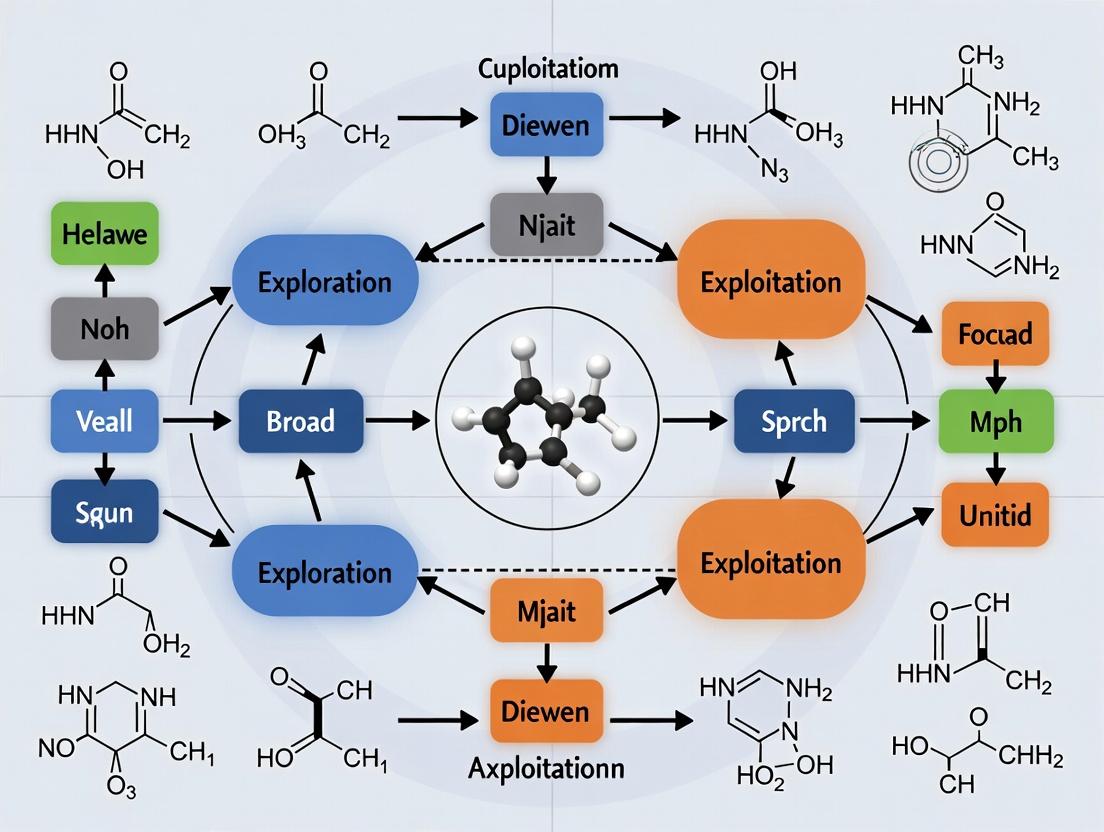
This article provides a comprehensive guide for researchers and drug development professionals on the critical balance between exploring novel regions of chemical space and exploiting known, promising areas.
Strategic Search in Drug Discovery: Mastering the Exploration-Exploitation Trade-off in Chemical Space
Abstract
This article provides a comprehensive guide for researchers and drug development professionals on the critical balance between exploring novel regions of chemical space and exploiting known, promising areas. We cover the foundational theory from multi-armed bandits to active learning, detail cutting-edge methodological implementations like Bayesian optimization and reinforcement learning, address common pitfalls and optimization strategies for real-world projects, and finally compare and validate different algorithmic approaches. The goal is to equip scientists with the strategic framework and practical tools to efficiently navigate the vast molecular landscape and accelerate the identification of viable drug candidates.
The Core Dilemma: Defining Exploration vs. Exploitation in Molecular Discovery
Technical Support Center
This support center is framed within the thesis on Balancing exploration and exploitation in chemical space search research. It addresses common practical issues encountered when navigating this vast theoretical landscape.
Troubleshooting Guides & FAQs
Q1: My virtual screening of a large library (1M+ compounds) is computationally intractable. How can I prioritize compounds for initial testing? A: This is a classic exploration-exploitation trade-off. Implement a multi-fidelity screening workflow.
- First Pass (Exploration): Use fast, low-cost filters (e.g., Rule of 5, PAINS filters, molecular weight) to remove undesirable compounds.
- Second Pass (Balanced): Apply medium-cost methods like 2D similarity searching or pharmacophore mapping to cluster compounds and select diverse representatives.
- Third Pass (Exploitation): Perform high-cost molecular docking or preliminary MD simulations on a focused subset (<10,000 compounds).
Q2: My synthesized lead compound shows poor solubility, halting further testing. How could this have been predicted and mitigated earlier? A: Solubility is a key dimension of chemical space often under-prioritized in exploration.
- Prevention: Integrate calculated physicochemical properties (e.g., LogP, LogS, polar surface area) as mandatory constraints in your virtual screening protocol.
- Mitigation: Employ a "property-focused" exploitation strategy. Create a focused library around your lead's core scaffold, systematically modifying substituents known to improve solubility (e.g., adding ionizable groups, reducing lipophilicity).
Q3: My high-throughput experimentation (HTE) results are noisy and irreproducible when exploring a new reaction space. What are the key checkpoints? A: Reproducibility is a critical practical constraint.
- Reagent Quality: Ensure solvents and reagents are dry and fresh, especially for air/moisture-sensitive chemistries. Use the "Research Reagent Solutions" table below.
- Liquid Handling Calibration: Regularly calibrate pipettes and liquid handlers. For nanoscale HTE, even minor deviations cause significant error.
- Control Density: Include positive and negative controls in every reaction plate to contextualize results and identify systematic failures.
Q4: How do I decide between exploring a new, uncharted chemical scaffold versus deeply optimizing a known hit series? A: This decision is the core of the research thesis. Implement a quantitative decision framework.
- Score the exploitation potential of your known hit (e.g., potency, synthetic accessibility, SAR understanding).
- Estimate the exploration potential of the new scaffold (e.g., novelty, structural diversity, predicted property space).
- Use a threshold or scoring matrix based on your project's risk tolerance and stage. Early discovery favors exploration; lead optimization demands exploitation.
Quantitative Data on Chemical Space
Table 1: Estimated Size of Chemical Space Segments
| Chemical Space Segment | Estimated Number of Compounds | Description/Constraint |
|---|---|---|
| Potentially Drug-Like (GDB-17) | ~166 Billion | Molecules with up to 17 atoms of C, N, O, S, Halogens following simple chemical stability & drug-likeness rules. |
| Organic & Small Molecules | >10⁶⁰ | Theoretically possible following rules of valence. Vastly exceeds observable universe atoms. |
| Commercially Available | ~100 Million | Compounds readily purchasable from chemical suppliers (e.g., ZINC, Mcule databases). |
| Actually Synthesized | ~250 Million | Unique compounds reported in chemical literature (CAS Registry). |
Table 2: Key Dimensions & Practical Constraints in Navigation
| Dimension | Description | Typical Experimental Constraint |
|---|---|---|
| Structural Complexity | Molecular weight, stereocenters, ring systems. | Synthetic feasibility, cost, and time limit exploration of highly complex regions. |
| Physicochemical Property | LogP, solubility (LogS), pKa, polar surface area. | Must adhere to "drug-like" or "lead-like" boundaries for desired application. |
| Pharmacological Activity | Binding affinity, selectivity, functional efficacy. | Requires expensive, low-throughput in vitro or in vivo testing. |
| Synthetic Accessibility | Estimated ease and yield of synthesis. | The primary gatekeeper for moving from virtual to real compounds. |
Experimental Protocols
Protocol 1: Multi-Fidelity Virtual Screening for Balanced Exploration-Exploitation Objective: To efficiently identify viable hit compounds from an ultra-large virtual library. Methodology:
- Library Preparation: Curate library (e.g., from ZINC). Standardize structures, remove duplicates, calculate 1D/2D descriptors.
- Tier 1 - Fast Filtering (Exploration Widening): Apply hard filters: 150 ≤ MW ≤ 600, -2 ≤ LogP ≤ 5, Rotatable Bonds ≤ 10. Remove PAINS and toxicophores.
- Tier 2 - Similarity & Diversity Selection (Balanced): For the remaining pool, calculate ECFP4 fingerprints. Perform k-means clustering. Select a diverse subset (e.g., 50,000 compounds) by choosing top N compounds closest to each cluster centroid.
- Tier 3 - High-Fidelity Docking (Exploitation Deepening): Prepare protein structure (e.g., from PDB). Define binding site. Dock the 50,000-compound subset using Glide SP or AutoDock Vina. Select top 1,000 by docking score for visual inspection and further analysis.
Protocol 2: Focused Library Synthesis for SAR Exploitation Objective: To optimize a lead compound's potency through systematic analog synthesis. Methodology:
- SAR Analysis: Identify the core scaffold and variable R-groups (R1, R2, R3) of the lead.
- Library Design: For each R-group position, select 5-10 substituents representing a range of properties (e.g., electron-donating/withdrawing, small/large, polar/apolar).
- Parallel Synthesis: Employ a parallel synthesis technique (e.g., automated microwave synthesis, solid-phase synthesis) to combinatorially generate the analog library (e.g., 5 x 5 x 5 = 125 compounds).
- Purification & Characterization: Purify all compounds via automated flash chromatography. Characterize using LC-MS and NMR.
- Biological Testing: Test all analogs in a consistent in vitro assay (e.g., enzyme inhibition IC₅₀). Plot results in a matrix to visualize SAR.
Pathway & Workflow Visualizations
Title: Multi-Fidelity Virtual Screening Workflow
Title: Exploration-Exploitation Decision Logic in Chemical Research
The Scientist's Toolkit: Research Reagent Solutions
Table 3: Essential Materials for Reproducible High-Throughput Experimentation
| Reagent / Material | Function & Rationale |
|---|---|
| Anhydrous Solvents (DMSO, DMF, THF) | High-purity, dry solvents prevent unwanted side reactions and catalyst deactivation, crucial for reproducibility in screening. |
| Deuterated Solvents for Reaction Monitoring | Enables real-time, in-situ NMR tracking of reactions in HTE plates, providing mechanistic insight. |
| Solid-Supported Reagents & Scavengers | Simplify purification in parallel synthesis; allows for filtration-based workup, enabling automation. |
| Pre-weighed, Sealed Reagent Kits | Ensures consistent stoichiometry and eliminates weighing errors for air/moisture-sensitive compounds in HTE. |
| Internal Standard (for LC-MS/GC-MS) | A consistent compound added to all analysis samples to calibrate instrument response and quantify yields reliably. |
| Positive/Negative Control Compounds | Benchmarks for biological or catalytic activity in every assay plate, essential for data normalization and identifying false results. |
Technical Support Center
Troubleshooting Guides & FAQs
Q1: During a virtual screening campaign using a multi-armed bandit (MAB) algorithm, my agent gets stuck exploiting a single, sub-optimal compound series too early. How can I encourage more sustained exploration?
A: This is a classic issue of insufficient exploration. Implement or adjust the following:
- Epsilon-Greedy Adjustment: Systematically decay the exploration rate (ε) over time instead of using a fixed value. Start with a high ε (e.g., 0.3) and reduce it according to a schedule (e.g., εt = ε0 / log(t+1)).
- Switch to Upper Confidence Bound (UCB): Adopt UCB1 or its variants. UCB explicitly balances the estimated reward (exploitation) and the uncertainty (exploration) for each "arm" (compound series). The formula for arm i at round t is:
UCB(i, t) = μ_i + √(2 * ln(t) / n_i), whereμ_iis the average observed reward andn_iis the number of times arm i has been pulled. - Contextual Bandits: If you have molecular descriptors (context), use a Linear UCB or Thompson Sampling with a linear model. This allows for generalization across chemical space, making exploration more intelligent.
Q2: How do I define a meaningful and computationally efficient "reward" for a bandit algorithm in a drug discovery setting?
A: The reward function is critical. It must be a proxy for the ultimate goal (e.g., binding affinity, solubility) and cheap to evaluate. Common strategies include:
- Proxy Models: Use predictions from a fast, pre-trained machine learning model (e.g., a Random Forest or a shallow Neural Network predicting pIC50) as the reward.
- Multi-Fidelity Rewards: Implement a tiered reward system. Initial rewards come from cheap calculations (e.g., docking score, QSAR prediction). Only compounds that pass a reward threshold are evaluated with more expensive methods (e.g., MM/GBSA, experimental assay), updating the reward for that arm with the higher-fidelity data.
- Shaped Rewards: Incorporate penalties for undesirable properties (e.g., high molecular weight, poor solubility) directly into the reward calculation:
Reward = Docking_Score - λ * (MW_penalty + SA_penalty).
Table 1: Comparison of Reward Strategies
| Strategy | Computational Cost | Data Efficiency | Suitability |
|---|---|---|---|
| Direct Experimental | Very High | Low | Late-stage, small libraries |
| Proxy ML Model | Low | High | Large virtual libraries |
| Multi-Fidelity | Medium | Medium | Iterative screening campaigns |
| Shaped Reward | Low-Medium | High | Early-stage property optimization |
Q3: My Thompson Sampling agent for molecule optimization seems to converge to a local optimum. What diagnostics can I run?
A: Perform the following diagnostic checks:
- Posterior Visualization: Plot the posterior distributions (e.g., Gaussian for each arm) over time. If they separate and collapse too quickly, exploration is insufficient.
- Arm Selection Statistics: Track the percentage of rounds each compound series (arm) is selected. A healthy run should show a gradual focus, not an abrupt shift to one arm.
- Regret Analysis: Calculate the cumulative regret: the difference between the reward of the optimal arm (in hindsight) and the reward obtained. Plot cumulative regret over rounds. Linear regret indicates poor performance; sublinear (logarithmic) regret is ideal.
Experimental Protocol: Diagnosing Regret
- Pre-run: Identify the best possible compound series (arm) using a full enumeration of your library (if possible) or a prior benchmark.
- Define Optimal Reward: Set the expected reward of this optimal arm as
μ*. - Log Data: During the MAB run, log the reward
r_treceived at each roundt. - Calculate Instantaneous Regret:
δ_t = μ* - r_t. - Calculate Cumulative Regret:
R_T = Σ_{t=1 to T} δ_t. - Plot: Generate a line plot of
R_Tvs.T. Compare the curve's growth rate to theoretical bounds (log(T)).
Q4: How do I map a chemical space search problem onto a multi-armed bandit formalism?
A: Follow this structured mapping protocol:
Experimental Protocol: Problem Formulation for Chemical Bandits
- Define Arms: Cluster your compound library into discrete series or "buckets" based on scaffold or key functional groups. Each cluster is an arm. Alternatively, define each arm as a specific reaction or transformation in a synthesis plan.
- Define Context (If Contextual): Compute a feature vector (e.g., ECFP6 fingerprint, RDKit descriptors) for each individual compound. This is the context
x. - Initialize Reward Model: Choose a prior for each arm. For Bernoulli bandits (success/failure), use a Beta(α=1, β=1) prior. For Gaussian rewards, use a Normal-Gamma prior.
- Select Arm: At each iteration
t, use your chosen policy (ε-Greedy, UCB, Thompson Sampling) to select an arma_t. - Sample & Evaluate: If using contextual bandits, sample a specific compound from the chosen arm's cluster, perhaps based on its context. Obtain its reward
r_t(e.g., assay result, prediction score). - Update Model: Update the posterior distribution or the average reward estimate for the selected arm
a_twith the new observation(x_t, r_t). - Loop: Repeat steps 4-6 until the budget (e.g., number of experiments) is exhausted.
Chemical Space MAB Workflow
The Scientist's Toolkit: Research Reagent Solutions
Table 2: Essential Components for a Multi-Armed Bandit Experiment in Chemical Search
| Item | Function & Rationale |
|---|---|
| Discretized Chemical Library | Pre-clustered compound sets (by scaffold, Bemis-Murcko framework) serving as the foundational "arms" for classical bandits. |
| Molecular Featurization Software (e.g., RDKit, Mordred) | Generates numerical context vectors (descriptors, fingerprints) for contextual bandit approaches. |
| Proxy/Predictive Model | A fast, pre-trained QSAR/activity model to provide cheap, initial reward estimates for guiding exploration. |
| Bandit Algorithm Library (e.g., Vowpal Wabbit, MABWiser, custom Python) | Core engine implementing selection policies (UCB, Thompson Sampling) and maintaining reward estimates. |
| Multi-Fidelity Data Pipeline | A system to integrate low-cost (docking, prediction), medium-cost (MD simulation), and high-cost (experimental) reward data, updating arm estimates accordingly. |
| Regret & Convergence Monitor | Diagnostic dashboard tracking cumulative regret, arm selection counts, and posterior distributions to ensure balanced search. |
MAB Agent-Environment Interaction
Technical Support Center: Troubleshooting Search Strategy in Chemical Space
Frequently Asked Questions (FAQs)
Q1: What does 'regret' quantify in a chemical space search, and how is it calculated? A1: In this context, regret quantifies the opportunity cost of not selecting the optimal compound (e.g., highest binding affinity, desired property) at each iteration of a search campaign. Cumulative regret is the sum of these differences over time. Low cumulative regret indicates an effective strategy balancing exploration and exploitation.
Formula: Instantaneous Regret = (Performance of Best Possible Compound) - (Performance of Compound Selected at time t). Cumulative Regret = Σ (Instantaneous Regret over T rounds).
Q2: My search is getting stuck in a local optimum. How can I adjust my algorithm parameters to encourage more exploration? A2: This is a classic sign of over-exploitation. Adjust the following parameters in your acquisition function (e.g., Upper Confidence Bound, Thompson Sampling):
- Increase the exploration weight (β) in UCB: A higher β value prioritizes uncertainty, directing the search to less sampled regions of chemical space.
- For ε-Greedy strategies, increase ε: This raises the probability of choosing a random compound for evaluation.
- Review your kernel's length scales: In Gaussian Process-based Bayesian Optimization, shorter length scales can lead to more localized exploitation. Consider lengthening them to allow the model to generalize across broader regions.
Q3: How do I decide when to stop a sequential search experiment? A3: Stopping is recommended when the marginal cost of a new experiment outweighs the expected reduction in regret. Monitor these metrics:
- Plateau in Performance: No significant improvement in primary objective (e.g., pIC50) over the last N iterations (e.g., 20-30).
- Diminishing Regret Reduction: The rate of decrease in cumulative regret approaches zero.
- Budget Exhaustion: Pre-defined budget (number of compounds, computational time, lab resources) is consumed.
Q4: My surrogate model predictions are poor, leading to high regret. How can I improve model accuracy? A4: Poor model fidelity undermines the entire search. Troubleshoot using this checklist:
- Feature Representation: Ensure your molecular featurization (e.g., fingerprints, descriptors, graphs) captures relevant chemical information for the property of interest.
- Initial Dataset Size: The surrogate model requires a sufficiently diverse initial dataset (e.g., 50-100 compounds) for meaningful learning. Consider augmenting with publicly available data.
- Model Choice: Evaluate if your model (Random Forest, Gaussian Process, Graph Neural Network) is appropriate for the data structure and size. Cross-validate rigorously.
Troubleshooting Guides
Issue: High Initial Cumulative Regret in Early Search Rounds Diagnosis: This is often due to an uninformed or poorly diversified initial set of compounds (the "seed set"). Resolution Protocol:
- Step 1: Characterize the diversity of your seed set using Tanimoto similarity or principal component analysis (PCA) of molecular descriptors.
- Step 2: If diversity is low (<0.7 average pairwise dissimilarity), employ a space-filling design (e.g., Kennard-Stone, Latin Hypercube Sampling) on chemical descriptors to select a new, more representative seed set.
- Step 3: Re-initiate the search with the new seed set and monitor regret trajectory.
Issue: Volatile Regret with High Variance Between Iterations Diagnosis: The acquisition function may be overly sensitive to model noise or the experimental noise (assay variability) is high. Resolution Protocol:
- Step 1 (Assay Check): Re-test previous high-performing compounds to estimate experimental noise. Calculate the coefficient of variation (CV). If CV > 15%, prioritize assay optimization.
- Step 2 (Algorithm Tuning): For acquisition functions like Expected Improvement, add a jitter parameter or increase the xi parameter to dampen over-sensitive reactions to small prediction differences.
- Step 3: Implement batch selection (e.g., q-UCB, batch Thompson Sampling) to evaluate several compounds in parallel, which can smooth the regret curve.
Data Presentation
Table 1: Comparison of Search Algorithm Performance on a Simulated Drug Likeness (QED) Optimization Scenario: Searching a 10,000 molecule library for max QED over 100 sequential queries.
| Algorithm | Cumulative Regret (↓) | Best QED Found (↑) | Exploitation Score* | Exploration Score* |
|---|---|---|---|---|
| Random Search | 12.45 | 0.948 | 0.10 | 0.95 |
| ε-Greedy (ε=0.1) | 8.91 | 0.949 | 0.75 | 0.25 |
| Bayesian Opt. (UCB, β=0.3) | 5.23 | 0.951 | 0.82 | 0.18 |
| Pure Exploitation (Greedy) | 15.67 | 0.923 | 0.98 | 0.02 |
(Scores normalized from 0-1 based on selection analysis.)*
Table 2: Key Parameters for Common Regret-Minimization Algorithms
| Algorithm | Key Tunable Parameter | Effect of Increasing Parameter | Typical Starting Value |
|---|---|---|---|
| ε-Greedy | ε (epsilon) | Increases random exploration. | 0.05 - 0.1 |
| Upper Confidence Bound (UCB) | β (beta) | Increases optimism/exploration of uncertain regions. | 0.1 - 0.5 |
| Thompson Sampling | Prior Distribution Variance | Increases initial exploration spread. | Informed by data. |
| Gaussian Process BO | Kernel Length Scale | Longer scales smooth predictions, encouraging global search. | Automated Relevance Determination (ARD). |
Experimental Protocols
Protocol 1: Benchmarking a Search Strategy Using Cumulative Regret Objective: Quantitatively compare the performance of two search algorithms (e.g., Random Forest UCB vs. Thompson Sampling) for a molecular property prediction task. Materials: Pre-computed molecular descriptor database, property values for full dataset (ground truth), computing cluster. Methodology:
- Initialization: Randomly select a seed set of 50 molecules from the full database. Hide the remaining property values.
- Iterative Search Loop (for each algorithm, independently): a. Train a surrogate model (Random Forest) on all currently evaluated molecules (descriptors -> property). b. Use the algorithm's acquisition function to select the next 1 molecule from the unevaluated pool. c. "Query" the ground truth for that molecule's property. d. Calculate instantaneous regret: (Max global property) - (Property of selected molecule). e. Add molecule and its property to the training set.
- Repeat Step 2 for 200 iterations.
- Analysis: Plot cumulative regret vs. iteration for both algorithms. The algorithm with the lower area under the cumulative regret curve is superior for this task.
Protocol 2: Calibrating Exploration Weight (β) in UCB for a New Chemical Series Objective: Empirically determine an optimal β value for a real-world high-throughput screening (HTS) follow-up campaign. Materials: Primary HTS hit list (≥ 1000 compounds), secondary assay ready for sequential testing. Methodology:
- Setup: Featurize all compounds. Use the top 20 hits by primary assay potency as the initial seed set.
- Parallel Tracks: Run three identical Bayesian Optimization workflows in parallel, differing only in the UCB β parameter: Low (0.1), Medium (0.3), High (0.7).
- Weekly Cycle: Each week, each workflow proposes a batch of 5 compounds for testing based on its model and β.
- Evaluation: After 10 weeks (50 compounds tested per track), analyze:
- Cumulative potency gain.
- Diversity of selected compounds (average pairwise similarity).
- Number of distinct molecular scaffolds discovered.
- Selection: Choose the β value whose track best balances finding the most potent compound (exploitation) and discovering new productive scaffolds (exploration).
Visualizations
Diagram 1: The Regret Minimization Search Cycle
Diagram 2: Exploration vs. Exploitation in Chemical Space
The Scientist's Toolkit: Research Reagent Solutions
| Item Name | Function & Role in Regret Minimization |
|---|---|
| Molecular Descriptor Software (e.g., RDKit, Dragon) | Generates quantitative numerical features from chemical structures, forming the fundamental representation of "chemical space" for the surrogate model. |
| Surrogate Model Library (e.g., scikit-learn, GPyTorch) | Provides algorithms (Random Forest, Gaussian Process, Neural Networks) to learn the structure-property relationship from available data and predict uncertainty. |
| Acquisition Function Code | Implements the decision rule (UCB, EI, Thompson Sampling) that quantifies the "value" of testing each unexplored compound, balancing predicted performance vs. uncertainty. |
| Assay-Ready Compound Library | The physical or virtual set of molecules to be searched. Quality (diversity, purity) directly impacts the achievable minimum regret. |
| High-Throughput Screening (HTS) Assay | The "oracle" that provides expensive, noisy ground-truth data for selected compounds. Its precision and accuracy are critical for valid regret calculation. |
| Laboratory Automation (Liquid handlers, plate readers) | Enforces the sequential experimental protocol with high reproducibility, minimizing technical noise that could distort the regret signal. |
Troubleshooting Guides & FAQs
FAQ: General Concepts
Q1: What are the key metrics used to quantify exploration and exploitation in a chemical space search? A1: The balance is measured using specific, complementary metrics. Table 1: Key Metrics for Balancing Exploration and Exploitation
| Metric Category | Specific Metric | Measures | Typical Target/Interpretation |
|---|---|---|---|
| Exploitation (Performance) | Predicted Activity (e.g., pIC50, Ki) | Binding affinity or potency of designed molecules. | Higher is better. |
| Drug-likeness (e.g., QED) | Overall quality of a molecule as a potential oral drug. | Closer to 1.0 is better. | |
| Synthetic Accessibility Score (SA) | Ease of synthesizing the molecule. | Lower is better (e.g., 1-10 scale, 1=easy). | |
| Exploration (Novelty) | Molecular Similarity (e.g., Tanimoto to training set) | Structural novelty compared to a known set. | Lower similarity indicates higher novelty. |
| Scaffold Novelty | Percentage of molecules with new Bemis-Murcko scaffolds. | Higher percentage indicates broader exploration. | |
| Chemical Space Coverage | Diversity of molecules in a defined descriptor space (e.g., PCA). | Broader distribution is better. |
Q2: My model is stuck generating very similar, high-scoring molecules. How can I force more exploration? A2: This is a classic over-exploitation issue. Adjust the following algorithmic parameters:
- Increase the "Temperature" (τ) parameter: In probabilistic models (e.g., RL, generative models), a higher temperature increases randomness, making low-probability (novel) selections more likely.
- Adjust the Acquisition Function: If using Bayesian Optimization, switch from pure expected improvement (EI) to upper confidence bound (UCB) or add an explicit distance penalization term to favor points far from previously sampled ones.
- Diversify the Starting Population: In genetic algorithms, ensure the initial population is highly diverse. Introduce random mutations at a higher rate.
Q3: My search is generating highly novel but poor-performing molecules. How can I refocus on quality? A3: This indicates excessive exploration. Apply these corrective measures:
- Increase Exploitation Weighting: Recalibrate your objective function. Increase the weight or penalty associated with critical performance metrics (e.g., predicted activity, SA score).
- Implement a Performance Filter: Introduce a hard threshold in your workflow (e.g., "only explore molecules with predicted pIC50 > 7.0").
- Lower the "Temperature" (τ) parameter: This makes the model more deterministic, favoring high-probability, known-good solutions.
- Utilize a Memory/Experience Replay Buffer: Retain and periodically resample high-performing molecules from earlier stages to reinforce their characteristics.
FAQ: Technical Implementation
Q4: How do I technically implement a reward function for Reinforcement Learning (RL) that balances novelty and performance?
A4: A common approach is a multi-component reward function:
R(molecule) = w1 * Activity_Score + w2 * SA_Penalty + w3 * Novelty_Bonus
- Activity_Score: Normalized predicted bioactivity.
- SA_Penalty: Negative reward for high synthetic accessibility scores.
- Novelty_Bonus: Reward based on inverse Tanimoto similarity to a reference set.
- w1, w2, w3: Tunable weights that control the balance. Start with w1=1.0, w2=-0.5, w3=0.2 and adjust based on output.
Q5: In a Bayesian Optimization (BO) loop, the model suggests molecules that are invalid or cannot be synthesized. How do I fix this? A5: Constrain your search space.
- Pre-processing Constraint: Use a rules-based filter (e.g., medicinal chemistry filters, PAINS filters) before the proposal is evaluated by the surrogate model.
- Latent Space Constraint: If using a variational autoencoder (VAE), ensure the decoder only produces valid molecules by training on a corpus of synthetically accessible compounds.
- Post-processing Correction: Implement a validity checker and "corrector" step. If the BO proposes an invalid SMILES, it can be passed through a repair algorithm before being added to the training set.
Experimental Protocols
Protocol 1: Setting Up a Multi-Objective Optimization Experiment
Objective: To generate a Pareto front of molecules balancing predicted activity (pIC50) and scaffold novelty.
- Define Objectives: Set Objective A: Maximize predicted pIC50 (from a QSAR model). Set Objective B: Maximize minimum Tanimoto distance (1 - similarity) to the training set molecules.
- Choose Algorithm: Select a multi-objective algorithm (e.g., NSGA-II, MOEA/D) integrated with a molecular generator (e.g., graph-based GA, SMILES-based RL).
- Initialization: Create a random, diverse population of 100 molecules from your seed set.
- Evaluation: For each molecule in the population, compute Objective A and Objective B.
- Iteration: Run the algorithm for 50 generations. The algorithm will select, crossover, and mutate molecules to evolve the population.
- Analysis: Extract the non-dominated front (Pareto front) from the final generation. These molecules represent the optimal trade-offs between activity and novelty.
Protocol 2: Evaluating Exploration vs. Exploitation Trade-off in a Campaign
Objective: Quantify the progression of novelty and performance over an active learning cycle.
- Setup: Run a standard Bayesian Optimization loop for 50 iterations, aiming to maximize pIC50.
- Log Data: At every 5th iteration, record:
- Average pIC50 of the proposed batch (Exploitation)
- Average Tanimoto similarity of the batch to the initial training set (Exploration: lower similarity = higher novelty)
- Visualization: Plot iteration number vs. (a) Average pIC50 and (b) Average Similarity on a dual-axis chart.
- Interpretation: An effective balanced search should show a general upward trend in pIC50 while maintaining or only gradually increasing the average similarity, indicating sustained novelty.
Diagrams
Active Learning Loop for Multi-Objective Search
RL Reward Function Balancing Act
The Scientist's Toolkit: Research Reagent Solutions
Table 2: Essential Tools for Exploration-Exploitation Experiments
| Tool/Reagent | Category | Function in Experiment | Example/Provider |
|---|---|---|---|
| QSAR/Predictive Model | Software/Model | Provides the primary exploitation metric (e.g., predicted activity, solubility). Crucial for virtual screening. | Random Forest, GNN, commercial platforms (Schrodinger, MOE). |
| Molecular Generator | Software/Algorithm | Core engine for proposing new chemical structures. Design determines exploration capacity. | SMILES-based RNN/Transformer, Graph-Based GA, JT-VAE. |
| Diversity Selection Algorithm | Software/Algorithm | Actively promotes exploration by selecting dissimilar molecules from a set. | MaxMin algorithm, sphere exclusion, k-means clustering. |
| Bayesian Optimization Suite | Software Framework | Manages the iterative propose-evaluate-update loop, balancing exploration/exploitation via acquisition functions. | Google Vizier, BoTorch, Scikit-Optimize. |
| Chemical Space Visualization Tool | Software | Maps generated molecules to assess coverage and identify unexplored regions (exploration audit). | t-SNE, UMAP plots based on molecular descriptors/fingerprints. |
| Synthetic Accessibility Scorer | Software/Model | Penalizes unrealistic molecules, grounding exploitation in practical chemistry. | SA Score (RDKit), SYBA, RAscore. |
| High-Throughput Screening (HTS) Data | Dataset | Serves as the initial training set and reality check for exploitation metrics. | PubChem BioAssay, ChEMBL. |
Troubleshooting Guides & FAQs
Q1: Our Bayesian optimization algorithm for reaction yield prediction is exploiting known high-yield conditions too aggressively and failing to explore new, promising regions of chemical space. How can we adjust our priors to better balance this? A: This indicates your prior on catalyst performance may be too "sharp" or overconfident. Implement a tempered or "flattened" prior distribution. For example, if using a log-normal prior for yield based on historical data, increase the variance parameter. A practical protocol:
- Re-analyze your historical yield dataset (e.g., past 100 similar reactions).
- Calculate the mean (μ) and standard deviation (σ) of log(yield).
- For the new search, set your prior mean to μ but inflate the standard deviation to kσ, where k is a tuning parameter (start with k=1.5).
- This wider, less confident prior encourages the acquisition function (e.g., Expected Improvement) to value unexplored conditions more highly.
Q2: When using a Gaussian Process (GP) to model solubility, how do I encode the prior knowledge that adding certain hydrophobic groups beyond a threshold always decreases aqueous solubility? A: You can incorporate this as a monotonicity constraint in the GP prior. Instead of a standard squared-exponential kernel, use a kernel that enforces partial monotonicity. Experimental Protocol for Constrained GP:
- Kernel Selection: Use a Gibbs kernel or a kernel from the
GPyTorchlibrary that supports monotonicity constraints. - Define Constraint Regions: In your feature space (e.g., molecular descriptor for hydrophobicity), specify the dimension(s) and direction (decreasing) for the constraint.
- Virtual Observations: Add synthetic data points that explicitly satisfy the monotonic rule to your training set, but with a very small noise parameter to ensure they act as "soft" constraints rather than hard data.
- Model Validation: Test the model's predictions on a held-out set of known compounds to ensure the monotonic trend holds without degrading overall predictive accuracy.
Q3: We are screening a new library of fragments. Our historical hit rates for similar libraries are ~5%. How should we use this 5% as a prior in our multi-armed bandit active learning protocol? A: Use a Beta prior in a Bayesian Bernoulli model for each fragment's probability of being a hit. Methodology:
- Interpret the historical 5% hit rate (e.g., 50 hits out of 1000 compounds) as a Beta(α=50, β=950) prior distribution.
- For each new fragment i in the current screen, start with this prior: Hit Probability ~ Beta(α⁰ᵢ=50, β⁰ᵢ=950).
- As you test fragments and get binary outcomes (hit=1, miss=0), update the posterior: Beta(α⁰ᵢ + successes, β⁰ᵢ + failures).
- Your acquisition function (e.g., Thompson Sampling) should draw samples from these posteriors to decide which fragment to test next. This naturally balances exploring fragments with high uncertainty and exploiting those with high expected hit probability.
Table 1: Impact of Prior Strength on Search Performance in a Simulated Drug Discovery Benchmark
| Prior Type | Historical Data Points Used | Average Final Yield/Activity (%) | Average Steps to Find Optimum | Exploration Metric (Avg. Distance Traveled in Descriptor Space) |
|---|---|---|---|---|
| Uninformed (Uniform Prior) | 0 | 78.2 | 42 | 15.7 |
| "Weak" Informed Prior (Broad Dist.) | 50 | 88.5 | 28 | 9.4 |
| "Strong" Informed Prior (Sharp Dist.) | 200 | 92.1 | 18 | 4.2 |
| Overconfident Misppecified Prior | 50 (from different dataset) | 75.8 | 35 | 6.1 |
Table 2: Comparison of Bayesian Optimization Methods with Different Priors for Catalyst Selection
| Method | Prior Component | Avg. Improvement Over Random Search (%) | Computational Overhead (Relative Time) | Robustness to Prior Mismatch (Score 1-10) |
|---|---|---|---|---|
| Standard GP (EI) | None / Uninformative | 220 | 1.0x (Baseline) | 10 |
| GP with Historical Mean Prior | Linear Mean Function | 285 | 1.1x | 7 |
| GP with Domain-Knowledge Kernel | Custom Composite Kernel | 310 | 1.3x | 5 |
| Hierarchical Bayesian Model | Empirical Bayes Hyperpriors | 295 | 1.8x | 8 |
Experimental Protocols
Protocol: Calibrating Priors for a New Chemical Space Objective: Systematically set prior parameters when moving from one project domain (e.g., kinase inhibitors) to another (e.g., GPCR ligands).
- Data Collation: Gather all historical dose-response data (pIC50) from the source domain (Kinases). Calculate mean (μsrc) and variance (σ²src) of the log-transformed values.
- Expert Elicitation: With domain scientists, define a "similarity score" (S, 0-1) between the source and target (GPCR) domains based on molecular properties and assay conditions.
- Prior Transfer: Set the prior for the target domain as a Normal distribution: μtgt = μsrc, σ²tgt = σ²src / S. A low similarity (S→0) inflates variance, creating a less informative prior.
- Validation Loop: Run a short pilot screen of 50 compounds in the new domain. Update the prior to a posterior using Bayesian updating. Compare the posterior mean to the pilot's empirical mean to assess prior calibration.
Protocol: Building a Knowledge-Based Kernel for Reaction Outcome Prediction Objective: Integrate domain knowledge about functional group compatibility into a GP kernel.
- Feature Engineering: Represent each reaction by (a) computed molecular descriptors of reactants, and (b) a binary vector indicating the presence/absence of key functional groups (e.g., -OH, -NH2, -Br).
- Kernel Design: Construct a composite kernel:
K_total = w1 * K_RBF(descriptors) + w2 * K_Jaccard(binary_vector). The RBF kernel captures smooth similarity, the Jaccard kernel captures exact functional group matches. - Prior on Weights (w1, w2): Set a Dirichlet prior favoring the knowledge-based kernel (w2) if the historical database shows strong functional group determinism. For example, Dirichlet(α=[1, 3]).
- Model Fitting: Infer the kernel weights along with other GP hyperparameters using type-II maximum likelihood or MCMC, allowing the data to refine the strength of the domain-knowledge prior.
Visualizations
Title: Bayesian Optimization Loop with Priors
Title: Composite Kernel Structure for Priors
The Scientist's Toolkit: Research Reagent Solutions
| Item/Category | Function & Role in Leveraging Priors |
|---|---|
| Bayesian Optimization Software (e.g., BoTorch, GPyOpt) | Provides the framework to implement custom priors, kernels, and acquisition functions for chemical space search. |
| Cheminformatics Library (e.g., RDKit) | Generates molecular descriptors and fingerprints that form the feature basis for knowledge-informed prior kernels. |
| Historical HTS/HCS Databases (e.g., ChEMBL, corporate DB) | The primary source of quantitative data for constructing empirical prior distributions on compound activity. |
| Probabilistic Programming Language (e.g., Pyro, Stan) | Allows for flexible specification of complex hierarchical priors that combine multiple data sources and expert beliefs. |
| Domain-Specific Ontologies (e.g., RXNO, Gene Ontology) | Provides a structured vocabulary to codify expert knowledge into computable constraints for priors. |
| Automated Liquid Handling & Reaction Rigs | Enables the high-throughput experimental testing required to rapidly validate and update priors in an active learning loop. |
From Theory to Lab: Modern Algorithms for Navigating Chemical Space
Troubleshooting Guide & FAQs
FAQ 1: Why is my Bayesian Optimization (BO) algorithm converging to a suboptimal region of chemical space?
- Answer: This is often a sign of an imbalanced acquisition function. The standard Expected Improvement (EI) can become too exploitative. In the context of chemical space search, where the landscape is vast and rugged, this leads to premature convergence. To remedy this, increase the exploration parameter (kappa for Upper Confidence Bound) or use a decay schedule for kappa. Alternatively, switch to a more exploratory acquisition function like Probability of Improvement (PI) with a small, non-zero trade-off parameter or investigate information-theoretic acquisitions like Entropy Search.
FAQ 2: My surrogate model (Gaussian Process) is taking too long to train as my dataset of evaluated molecules grows. How can I scale BO for high-throughput virtual screening?
- Answer: Gaussian Process (GP) regression scales cubically (O(n³)) with the number of data points. For scaling in chemical search:
- Use Sparse Gaussian Process Models: Implement approximations using inducing points to reduce computational complexity.
- Switch to Tree-Structured Parzen Estimators (TPE): TPE is often more efficient for very high-dimensional, categorical-like molecular representations (e.g., SMILES strings) in early search phases.
- Batch Bayesian Optimization: Use q-EI or local penalization methods to select a batch of molecules for parallel experimental evaluation (e.g., in parallel assay plates).
- Feature Dimensionality Reduction: Apply techniques like PCA or autoencoders to your molecular fingerprint/descriptor space before training the GP.
FAQ 3: How do I effectively encode categorical variables (like functional group presence) and continuous variables (like concentration) simultaneously in a BO run for chemical reaction optimization?
- Answer: Use a hybrid kernel in your Gaussian Process. A common and effective approach is to use a combination of a continuous kernel (like Matérn) for continuous variables and a discrete kernel (like Hamming) for categorical variables. For example, in a reaction optimizing temperature, catalyst amount, and solvent type, define a kernel as:
K_total = K_Matérn(temperature) * K_Matérn(catalyst) + K_Hamming(solvent).
FAQ 4: The performance of my BO-driven search plateaus after an initial period of rapid improvement. Is the algorithm stuck?
- Answer: A plateau may indicate that the algorithm has exhausted local improvements and needs a strategic nudge for exploration. Implement a "restart" protocol:
- Trigger: Monitor improvement over the last N iterations (e.g., 20). If the best observed value hasn't changed beyond a threshold ε, trigger a restart.
- Action: Re-initialize the surrogate model by adding random exploration points to the dataset, or temporarily switch the acquisition function to pure random search for 2-5 iterations to diversify the data.
Experimental Protocols & Data
Protocol 1: Benchmarking Acquisition Functions in Molecular Property Optimization
Objective: Compare EI, UCB, and PI for optimizing the penalized logP score of a molecule using a SELFIES representation.
- Representation: Encode the initial molecular set (e.g., from ZINC database) as SELFIES strings.
- Surrogate Model: Use a GP with a composite kernel (string kernel for SELFIES + Tanimoto kernel for Morgan fingerprints).
- Acquisition Functions: Run three parallel BO loops (50 iterations each, 5 initial random points), each using EI, UCB (κ=2.576), or PI (ξ=0.01).
- Evaluation: Use the RDKit-based scoring function to compute the penalized logP for each proposed molecule.
- Analysis: Record the best-found score per iteration. Repeat 10 times with different random seeds.
Table 1: Performance of Acquisition Functions after 50 Iterations (Mean ± Std)
| Acquisition Function | Best Penalized logP Score | Convergence Iteration | Avg. Runtime per Iteration (s) |
|---|---|---|---|
| Expected Improvement (EI) | 4.21 ± 0.85 | 32 ± 7 | 45.2 ± 5.1 |
| Upper Confidence Bound (UCB, κ=2.576) | 5.87 ± 1.12 | 41 ± 9 | 46.8 ± 4.7 |
| Probability of Improvement (PI, ξ=0.01) | 3.45 ± 0.92 | 28 ± 5 | 44.9 ± 5.3 |
Protocol 2: Implementing a Batch BO Loop for Parallel Screening
Objective: Select a batch of 6 candidate molecules for parallel synthesis and assay using the q-Expected Improvement method.
- Initial Data: Start with a dataset of 50 molecules with known IC50 values from a preliminary screen.
- Model Training: Fit a GP model using 1024-bit Morgan fingerprints (radius=2) as input and -log(IC50) as the target.
- Batch Selection: Using the fitted GP, optimize the q-EI acquisition function (with q=6) via gradient-based methods to propose the 6 molecules expected to collectively yield the highest improvement.
- Parallel Evaluation: Send the 6 molecular structures for parallel synthesis and biological testing.
- Update & Iterate: Incorporate the new 6 data points into the training set and repeat from Step 2.
Visualization: BO Workflow in Chemical Search
Title: Bayesian Optimization Loop for Drug Discovery
Title: Exploration-Exploitation Balance in BO
The Scientist's Toolkit: Key Research Reagent Solutions
Table 2: Essential Materials & Tools for BO-Driven Chemical Research
| Item | Function in Experiment | Example/Supplier |
|---|---|---|
| Gaussian Process Software Library | Core engine for building the surrogate model that predicts chemical properties and their uncertainty. | GPyTorch, scikit-learn, GPflow |
| Molecular Representation Library | Converts chemical structures into machine-readable formats (vectors/graphs). | RDKit (for fingerprints, descriptors), DeepChem |
| Acquisition Function Optimizer | Solves the inner optimization problem to propose the next experiment. | BoTorch (for Monte Carlo-based optimization), scipy.optimize |
| High-Throughput Assay Kits | Enables parallel experimental evaluation of batch BO candidates. | Enzymatic activity assay kits (e.g., from Cayman Chemical), cell viability kits. |
| Chemical Space Database | Provides initial seed compounds and a broad view of synthesizable space. | ZINC, ChEMBL, Enamine REAL. |
| Automation & Lab Informatics | Tracks experiments, links computational proposals to lab results, and manages data flow. | Electronic Lab Notebook (ELN), Laboratory Information Management System (LIMS). |
Reinforcement Learning (RL) and Policy-Gradient Methods for de novo Design
Technical Support Center
Frequently Asked Questions (FAQs)
Q1: During RL training for molecular generation, my agent's reward plateaus early, and it gets stuck generating a small set of similar, suboptimal structures. How can I improve exploration? A1: This is a classic exploitation-over-exploration problem. Implement or adjust the following:
- Entropy Regularization: Increase the
entropy_coefficient(e.g., from 0.01 to 0.05) in your PPO or REINFORCE loss function to encourage action diversity. - Intrinsic Reward: Add a novelty bonus. Use a running fingerprint (e.g., ECFP4) dictionary; reward the agent for generating structures with Tanimoto similarity below a threshold (e.g., <0.4) to existing ones.
- Epsilon-Greedy Sampling: During training, with probability ε (start at 0.3, decay to 0.05), select a random valid action from the vocabulary instead of the top policy action.
Q2: My policy gradient variance is high, leading to unstable and non-convergent training. What are the key stabilization steps? A2: Policy-gradient methods are inherently high-variance. Implement these stabilization protocols:
- Use Advantage Estimation: Replace Monte Carlo returns with advantage estimates (A=Q-V). Implement Generalized Advantage Estimation (GAE) with λ typically between 0.92 and 0.98.
- Implement a Critic Network (Actor-Critic): Train a separate value network (critic) to estimate state values, providing a stable baseline for the policy update.
- Gradient Clipping: Clip policy gradients by norm (max norm ~0.5) or value (clamp between -0.5, 0.5) to prevent explosive updates.
Q3: How do I handle invalid molecular actions (e.g., adding a bond to a non-existent atom) and the resulting sparse reward problem? A3:
- Invalid Action Masking: At each step, programmatically compute all chemically invalid actions (valency violations, disconnected structures) and set their logits from the policy network to
-infbefore the softmax, ensuring they are never sampled. - Reward Shaping: Do not rely solely on a final property score (e.g., logP). Design intermediate rewards for:
- Penalizing invalid step attempts (small negative reward).
- Rewarding progress towards desired functional groups or scaffolds.
Q4: What are the best practices for representing the molecular state (St) and defining the action space (At) for an RL agent? A4: The choice is critical for efficient search.
Table 1: Common State and Action Space Representations
| Component | Option 1: String-Based (SMILES/SELFIES) | Option 2: Graph-Based |
|---|---|---|
| State (S_t) | A partial SMILES/SELFIES string. | A graph representation (atom/feature matrix, adjacency matrix). |
| Action (A_t) | Append a character from a vocabulary (e.g., 'C', '=', '1', '('). | Add an atom/bond, remove an atom/bond, or modify a node/edge feature. |
| Pros | Simple, fast, large existing literature. | More natural for molecules, guarantees valence correctness. |
| Cons | High rate of invalid SMILES; SELFIES mitigates this. | More complex model architecture required (Graph Neural Network). |
Experimental Protocols
Protocol 1: Standard REINFORCE with Baseline for Molecular Optimization Objective: Maximize a target property (e.g., QED) using a SMILES-based generator.
- Agent Setup: Use an RNN (GRU/LSTM) as the policy network πθ. Initialize a separate but similar RNN as the value network (baseline) Vφ.
- Episode Generation: For N episodes, generate a molecule by sampling tokens from πθ until the terminal token is produced. Record states (St), actions (At), and rewards (Rt=0 until terminal step).
- Reward Assignment: Compute the target property (e.g., QED, SAScore) for the finalized valid molecule. Assign this reward to all steps (Rt = RT for all t) of the episode. Invalid molecules receive reward R = 0.
- Baseline Computation: For each state St, compute the estimated value Vφ(S_t).
- Gradient Calculation: Update policy parameters θ: Δθ = α Σt (Rt - Vφ(St)) ∇θ log πθ(At\|St). Update value parameters φ to minimize (Rt - Vφ(S_t))².
- Iteration: Repeat steps 2-5 for M iterations.
Protocol 2: Proximal Policy Optimization (PPO) for Scaffold-Constrained Generation Objective: Explore novel analogues within a defined molecular scaffold.
- Environment: Define the action space as adding atoms/fragments only to specified attachment points on a fixed core scaffold. Invalid actions are masked.
- Collection: Let the current policy π_θ interact with the environment to collect a batch of T trajectories (states, actions, rewards, dones).
- Advantage Estimation: Compute rewards-to-go Rt and advantages Ât using GAE across the batch.
- PPO-Clip Loss: Optimize the surrogate objective: L(θ) = Et[min( rt(θ) * Ât , clip(rt(θ), 1-ε, 1+ε) * Ât )], where rt(θ) = πθ(At\|St) / πθold(At\|S_t). Typical ε=0.2.
- Update: Perform K (e.g., 4) epochs of gradient descent on L(θ) using the collected batch before gathering new data.
Diagrams
Diagram Title: RL Agent Interaction with Chemical Space
Diagram Title: Policy Gradient Molecular Design Workflow
The Scientist's Toolkit: Research Reagent Solutions
Table 2: Essential Tools for RL-based Molecular Design Experiments
| Tool / Reagent | Function / Purpose | Example / Note |
|---|---|---|
| RL Framework | Provides algorithms (PPO, DQN), environments, and training utilities. | Stable-Baselines3, Ray RLlib. Facilitates rapid prototyping. |
| Cheminformatics Library | Handles molecular I/O, fingerprinting, validity checks, and property calculation. | RDKit, Open Babel. Essential for reward function and state representation. |
| Deep Learning Framework | Library for building and training policy & critic neural networks. | PyTorch, TensorFlow. PyTorch is often preferred for research flexibility. |
| Molecular Representation | Defines the fundamental building blocks and grammar for generation. | SELFIES (recommended over SMILES for validity), DeepSMILES. |
| Property Prediction Model | Provides fast, differentiable reward signals (e.g., binding affinity, solubility). | A pre-trained Graph Neural Network (GNN) or Random Forest model. |
| Orchestration & Logging | Manages experiment queues, hyperparameter sweeps, and tracks results. | Weights & Biases (W&B), MLflow, TensorBoard. Critical for reproducibility. |
Active Learning and Uncertainty Sampling in High-Throughput Virtual Screening
Troubleshooting Guides and FAQs
Q1: The active learning loop appears to be "stuck," repeatedly selecting compounds with similar, high-uncertainty scores but not improving the model's overall predictive accuracy for the desired property. What could be the cause and solution?
A: This is a classic sign of over-exploration within a narrow, uncertain region of chemical space, neglecting exploitation of potentially promising areas. The issue often stems from the uncertainty sampling function.
- Cause: The algorithm may be sampling exclusively from the "decision boundary," where model predictions are close to 0.5 (for classification) or have high variance (for regression), but these regions may be sparse or noisy.
- Troubleshooting Steps:
- Verify Data Quality: Check the experimental data for the initially labeled set. High noise in the training data prevents the model from establishing a reliable decision boundary.
- Implement Hybrid Query Strategies: Move from pure uncertainty sampling to a balanced strategy. Combine uncertainty with a measure of exploitation, such as:
- Expected Model Change: Query points that would cause the largest change to the current model.
- Thompson Sampling: Balance uncertainty with the predicted probability of success.
- Cluster-Based Diversity: After ranking by uncertainty, select the top k candidates from different structural clusters to ensure chemical diversity.
- Adjust Acquisition Function: Introduce a trade-off parameter (β) to balance exploration (uncertainty) and exploitation (predicted activity). Formally, score compounds using:
Score = (Predicted Activity) + β * (Uncertainty).
Q2: During batch-mode uncertainty sampling, the selected batch of compounds for experimental testing lacks chemical diversity, leading to redundant information. How can this be addressed?
A: This occurs when sequential queries are correlated. The solution is to incorporate a diversity penalty directly into the batch selection algorithm.
- Solution: Use Batch-Balanced Sampling (e.g., using K-Means or MaxMin distance).
- Rank all unlabeled compounds in the pool by their uncertainty score.
- Select the top N x M candidates (where N is your final batch size, and M is an oversampling factor, e.g., 10).
- Cluster these pre-selected candidates using a rapid fingerprint-based method (ECFP4) and a diversity metric like Tanimoto distance.
- From each cluster, select the candidate with the highest uncertainty score until the desired batch size N is filled.
Q3: The performance of the active learning model degrades significantly when applied to a new, structurally distinct scaffold not represented in the initial training set. How can we improve model transferability?
A: This indicates the model has overfit to the explored region and fails to generalize—a critical failure in balancing exploration across broader chemical space.
- Cause: The initial training set and subsequent queries lacked sufficient scaffold diversity to learn generally applicable structure-activity relationships.
- Mitigation Protocol:
- Initial Seed Design: Begin the active learning loop with a structurally diverse set of compounds, validated by a metric like Scaffold Tree analysis. Do not start with a single chemical series.
- Incorporate Domain Awareness: Use a multi-armed bandit framework at the scaffold level. Allocate a portion of each batch (e.g., 20%) to explicitly sample from under-explored molecular scaffolds, regardless of their immediate uncertainty within their own region.
- Model Choice: Employ models with better generalization properties, such as Graph Neural Networks (GNNs), which can learn more fundamental features than fingerprint-based models, or use ensembles of models trained on different descriptor sets.
Table 1: Performance Comparison of Query Strategies in a Virtual Screening Campaign for Kinase Inhibitors
| Query Strategy | Compounds Tested | Hit Rate (%) | Novel Active Scaffolds Found | Avg. Turnaround Time (Cycles to Hit) | Key Limitation |
|---|---|---|---|---|---|
| Random Sampling | 5000 | 1.2 | 3 | N/A | Inefficient, high cost |
| Pure Uncertainty | 500 | 5.8 | 2 | Fast (2-3) | Gets stuck in local uncertainty maxima |
| Expected Improvement | 500 | 7.1 | 4 | Moderate (3-4) | Computationally more expensive |
| Hybrid (Uncertainty + Diversity) | 500 | 6.5 | 8 | Moderate (3-4) | Requires tuning of balance parameter |
| Thompson Sampling | 500 | 8.3 | 5 | Fast (2-3) | Can be sensitive to prior assumptions |
Table 2: Impact of Initial Training Set Diversity on Active Learning Outcomes
| Initial Set Composition | Size | Scaffold Diversity (Entropy) | Final Model Accuracy (AUC) | Exploration Efficiency (% of Space Surveyed) |
|---|---|---|---|---|
| Single Scaffold | 100 | 0.1 | 0.91 (high) / 0.62 (low)* | 12% |
| Cluster-Based | 100 | 1.5 | 0.87 | 45% |
| Maximum Dissimilarity | 100 | 2.3 | 0.89 | 68% |
*Model accuracy was high within the explored scaffold but low when tested on a broad external validation set.
Experimental Protocols
Protocol 1: Implementing a Hybrid (Exploration-Exploitation) Query Strategy
Objective: To select a batch of compounds for experimental testing that balances the exploration of uncertain regions with the exploitation of predicted high-activity regions.
Methodology:
- Model Training: Train an ensemble of machine learning models (e.g., Random Forest, GNN) on the current labeled set
L. - Prediction & Uncertainty: For all compounds in the unlabeled pool
U, generate predictions (meanμ(x)) and uncertainty estimates (standard deviationσ(x)across the ensemble). - Calculate Composite Score: For each compound
xinU, compute a score using the Upper Confidence Bound (UCB) acquisition function:UCB(x) = μ(x) + β * σ(x)whereβis a tunable parameter controlling the exploration-exploitation trade-off (β=0 for pure exploitation, high β for pure exploration). - Batch Selection with Diversity: Rank all compounds by their UCB score. From the top 20% of this ranked list, perform a maximum dissimilarity selection using the MaxMin algorithm with Tanimoto distance on ECFP4 fingerprints to select the final batch
B. - Experimental Testing & Iteration: Send batch
Bfor experimental validation. Add the new(compound, activity)pairs toLand retrain the models. Repeat from step 1.
Protocol 2: Evaluating Scaffold-Level Exploration in an Active Learning Run
Objective: Quantify how well an active learning strategy explores diverse molecular scaffolds, ensuring it does not prematurely converge.
Methodology:
- Scaffold Assignment: Using the RDKit toolkit, decompose all compounds in the database and each selected batch into their Bemis-Murcko scaffolds.
- Tracking: Maintain a cumulative set
Sof all unique scaffolds selected for testing up to the current cycle. - Calculate Metrics per Cycle:
- Novel Scaffold Rate: Number of newly encountered scaffolds in the current batch divided by the batch size.
- Cumulative Scaffold Coverage:
|S| / |S_total|, where|S_total|is the total number of unique scaffolds in the entire screening library. - Scaffold Entropy: Compute the Shannon entropy of the scaffold distribution in the selected set to measure diversity.
- Visualization: Plot Cumulative Scaffold Coverage vs. Cycle Number. A strategy that effectively balances exploration will show a steady, linear increase, while an over-exploitative strategy will plateau quickly.
Visualizations
Title: Active Learning Cycle for Virtual Screening
Title: Exploration vs. Exploitation in Query Strategies
The Scientist's Toolkit: Research Reagent Solutions
Table 3: Essential Components for an Active Learning-Driven Virtual Screening Pipeline
| Item | Function in the Experiment | Example/Tool |
|---|---|---|
| Molecular Database | The vast, unlabeled chemical space pool for screening. Provides compounds for prediction and selection. | ZINC20, Enamine REAL, ChEMBL, in-house corporate library. |
| Molecular Descriptors/Features | Numeric representations of chemical structures for machine learning models. | ECFP4 fingerprints, RDKit 2D descriptors, 3D pharmacophores, Graph features (for GNNs). |
| Predictive Model Ensemble | The core machine learning model that predicts activity and estimates its own uncertainty. | Random Forest, Gaussian Process, Deep Neural Networks, Graph Neural Networks (GNNs). |
| Acquisition Function Library | Algorithms that calculate the "value" of testing an unlabeled compound, defining the exploration-exploitation balance. | Upper Confidence Bound (UCB), Expected Improvement (EI), Thompson Sampling, entropy-based methods. |
| Diversity Selection Algorithm | Ensures structural breadth in batch selection to prevent over-concentration in one chemical region. | MaxMin Algorithm, K-Means Clustering on fingerprints, scaffold-based binning. |
| Automation & Orchestration Software | Manages the iterative loop: model training, prediction, batch selection, and data integration. | Python scripts (scikit-learn, PyTorch), KNIME, Pipeline Pilot, specialized platforms (e.g., ATOM). |
| High-Throughput Experimentation (HTE) Platform | The physical system that provides experimental validation data for the selected compounds, closing the loop. | Automated assay systems (e.g., for enzyme inhibition, binding, cellular activity). |
Troubleshooting Guides & FAQs
Q1: My EA converges to a sub-optimal region of chemical space too quickly. How can I enhance exploration? A: Premature convergence often indicates an imbalance favoring exploitation (crossover) over exploration (mutation).
- Solution: Implement adaptive operator rates. Increase the mutation rate progressively as population diversity decreases. Use metrics like average Hamming distance between genotypes to trigger this change.
- Protocol: For a population of molecule fingerprints (e.g., ECFP4), calculate pairwise Tanimoto distance. If the mean distance falls below threshold T (e.g., 0.3), scale the mutation rate from a baseline (e.g., 0.05) by a factor of (T/mean_distance).
Q2: After high mutation, my algorithm fails to refine promising leads. How can I improve exploitation? A: Excessive exploration via mutation disrupts beneficial building blocks (substructures).
- Solution: Introduce a local search operator alongside standard mutation. Use a two-stage protocol: 1) High-probability crossover with low-probability mutation for exploitation. 2) For the best 10% of solutions, apply a deterministic local search (e.g., a small set of predefined, "smart" R-group substitutions).
- Protocol: After each generation, clone the top-performing individuals. Apply a limited molecular modification set (e.g., from a targeted library of bioisosteres) to each clone and evaluate. Re-insert improved clones.
Q3: How do I quantitatively decide the crossover vs. mutation rate for my molecular design problem? A: The optimal ratio depends on the landscape roughness and size of your chemical space.
- Solution: Perform an initial parameter grid search using a small subset of your objective function (e.g., a fast docking score proxy).
- Protocol: Run 10-generation trials across the following grid. Use the best-performing pair for your full experiment.
| Crossover Rate | Mutation Rate | Trial Performance (Avg. Fitness) | Notes |
|---|---|---|---|
| 0.9 | 0.05 | +125.4 | Fast early gain, then plateau. |
| 0.7 | 0.2 | +118.1 | Slower gain, broader search. |
| 0.5 | 0.5 | +101.7 | High diversity, slow convergence. |
| 0.8 | 0.15 | +129.8 | Best balance for this test case. |
Q4: The algorithm's performance is highly variable between runs. How can I stabilize it? A: High stochasticity from operator imbalance reduces reproducibility.
- Solution: Incorporate elitism and use a higher crossover rate on elite individuals. Implement a duplicate removal step after mutation to maintain diversity without sacrificing good solutions.
- Protocol: 1) Preserve the top 5% of solutions unchanged to the next generation (elitism). 2) Apply crossover with a rate of 0.85 to the elite and next 40% of solutions. 3) Apply a higher mutation rate (0.2) to the remaining 55%. 4) Use hashing of molecular fingerprints to detect and replace duplicates with random novel individuals.
Q5: How can I design a crossover operator that respects chemical synthesis feasibility? A: Standard one-point crossover on SMILES strings often generates invalid or nonsensical molecules.
- Solution: Use a fragment-based or reaction-aware crossover.
- Protocol: 1) Fragment parent molecules at retrosynthetically interesting bonds (e.g., using the RECAP method). 2) Create a child by combining a large fragment from one parent with a compatible small fragment from another, ensuring the joining bond type is chemically valid. 3) Validate the child via a set of synthetic accessibility (SA) score filters.
Research Reagent Solutions
| Item/Reagent | Function in EA for Chemical Search |
|---|---|
| RDKit | Open-source cheminformatics toolkit used for molecule manipulation, fingerprint generation, and validity checks. |
| ECFP/FCFP Fingerprints | Fixed-length vector representations of molecular structure for calculating genetic distances and similarity. |
| Synthetic Accessibility (SA) Score Filter | Computational metric (often rule-based) used as a penalty in the fitness function to bias search towards synthesizable compounds. |
| Target-specific Scoring Function (e.g., docking score, QSAR model) | The primary fitness function that drives selection, quantifying the predicted biological activity of a candidate molecule. |
| High-Performance Computing (HPC) Cluster | Enables the parallel evaluation of thousands of candidate molecules per generation, essential for practical search times. |
| Standardized Molecular Fragmentation Library (e.g., BRICS) | Provides chemically sensible building blocks for creating intelligent crossover and mutation operators. |
EA Workflow with Operator Balance
Adaptive Operator Control Logic
Thompson Sampling and Upper Confidence Bound (UCB) Strategies
Troubleshooting Guides & FAQs
FAQ 1: Why does my UCB1 algorithm converge prematurely to a sub-optimal compound, ignoring other promising regions of the chemical space?
- Answer: Premature convergence in UCB is often caused by an incorrectly set exploration parameter (
c) or insufficient initial sampling. UCB1 uses the formulaUCB(i) = μ_i + c * sqrt(ln(N) / n_i). Ifcis set too low, the algorithm will over-exploit seemingly good candidates before sufficiently exploring others. - Troubleshooting Guide:
- Increase Parameter
c: Systematically increase the exploration parameter (e.g., from 1 to 2, √2, or higher) in a controlled test run on a known benchmark library. - Implement Forced Initial Exploration: Run a round-robin phase where each compound in the initial library is tested at least 2-3 times before applying the UCB policy to ensure stable initial mean (
μ_i) estimates. - Check Reward Scaling: Ensure your biological assay output (e.g., IC50, binding affinity) is normalized appropriately. Very large reward values can dominate the
sqrt(ln(N) / n_i)term.
- Increase Parameter
FAQ 2: In Thompson Sampling for high-throughput virtual screening, my posterior distributions are not updating meaningfully. What could be wrong?
- Answer: This typically indicates a mismatch between your likelihood function (observation model) and the actual experimental noise, or an incorrectly defined prior.
- Troubleshooting Guide:
- Validate Likelihood Model: If you assume Gaussian noise, verify that your experimental replicates are roughly normally distributed. For binary outcomes (e.g., active/inactive), switch to a Beta-Bernoulli model.
- Inspect Prior Hyperparameters: For a Beta prior
Beta(α, β), overly strong priors (very largeα+β) will slow posterior updating. Start with weak, uninformative priors likeBeta(1,1). - Check for Data Logging Errors: Ensure that new experimental results are correctly associated with the sampled compound and are updating the correct posterior distribution parameters.
FAQ 3: How do I choose between UCB and Thompson Sampling for my automated chemical synthesis and testing platform?
- Answer: The choice hinges on the need for computational simplicity vs. incorporating probabilistic models.
- Use UCB if you require a deterministic, easy-to-implement policy with clear interpretability on the exploration-exploitation trade-off via the
cparameter. It is less computationally intensive. - Use Thompson Sampling if you have a reliable probabilistic model of the chemical space and assay noise, and you want to naturally balance exploration and exploitation by sampling from posteriors. It is often more performative but requires maintaining and sampling from distributions.
- Use UCB if you require a deterministic, easy-to-implement policy with clear interpretability on the exploration-exploitation trade-off via the
FAQ 4: My experimental batch results show high variance, causing both algorithms to perform poorly. How can I mitigate this?
- Answer: High experimental noise destabilizes both the reward estimates for UCB and the posterior updates for Thompson Sampling.
- Troubleshooting Guide:
- Implement Replication Protocols: Do not rely on single-point measurements. For top candidates, institute a rule of performing
k(e.g., k=3) technical or biological replicates. Use the average reward for algorithm updates. - Adaptive Batching for Thompson Sampling: Instead of sampling one compound at a time, sample a small batch. Use a technique like Batch Thompson Sampling, which enforces diversity within the batch by approximating the probability that each candidate is optimal.
- Apply Variance-Stabilizing Transforms: Transform your assay data (e.g., log transform for IC50 values) before feeding it to the bandit algorithm to reduce heteroscedasticity.
- Implement Replication Protocols: Do not rely on single-point measurements. For top candidates, institute a rule of performing
Experimental Protocols for Algorithm Validation in Chemical Search
Protocol 1: Benchmarking UCB vs. Thompson Sampling on a Public Molecular Dataset
- Objective: Compare cumulative regret of UCB and Thompson Sampling strategies.
- Materials: Public dataset with pre-calculated molecular properties and target activities (e.g., ChEMBL, MOSES with simulated docking scores).
- Methodology:
- Step 1 - Simulation Setup: Define a discrete chemical library of N compounds. Use a known property (e.g., docking score, solubility) as the ground-truth reward.
- Step 2 - Noise Introduction: Add Gaussian noise (ε ~ N(0, σ²)) to the ground-truth reward to simulate experimental error.
- Step 3 - Algorithm Initialization:
- UCB1: Set exploration parameter
c(start with √2). - Thompson Sampling (Gaussian): Assume a Gaussian likelihood with known noise σ². Use a conjugate Normal prior for the mean reward of each compound.
- UCB1: Set exploration parameter
- Step 4 - Iterative Simulation: For T rounds (T << N), each algorithm selects a compound, observes a noisy reward, and updates its internal parameters (mean count for UCB, posterior for TS).
- Step 5 - Metrics: Calculate cumulative regret:
Regret(T) = Σ_t (μ* - μ_{I_t}), where μ* is the optimal reward and μ{It} is the reward of the chosen compound at round t.
Protocol 2: Integrating Thompson Sampling with a Bayesian Neural Network (BNN) for Continuous Chemical Space Exploration
- Objective: Guide the synthesis of new compounds by sampling from a model that captures uncertainty in structure-activity relationships.
- Materials: Initial dataset of compound structures (SMILES) and assay results; BNN framework (e.g., using TensorFlow Probability or Pyro).
- Methodology:
- Step 1 - Model Training: Train a BNN to predict biological activity (
μ) and its epistemic uncertainty (σ) from molecular fingerprints or descriptors. - Step 2 - Acquisition: For each candidate in a virtual library, the BNN outputs a distribution of predicted activities. Sample once from this distribution for each candidate (Thompson Sampling principle).
- Step 3 - Selection: Select the candidate with the highest sampled value for synthesis and testing.
- Step 4 - Iterative Update: Add the new experimental result to the training set and update the BNN weights (or perform approximate online updates). Repeat from Step 2.
- Step 1 - Model Training: Train a BNN to predict biological activity (
Table 1: Comparison of UCB and Thompson Sampling Core Characteristics
| Feature | Upper Confidence Bound (UCB1) | Thompson Sampling (Beta-Bernoulli) |
|---|---|---|
| Principle | Deterministic optimism in the face of uncertainty | Probabilistic matching via posterior sampling |
| Key Parameter | Exploration constant c |
Prior hyperparameters α, β |
| Update Rule | Update empirical mean μ_i and count n_i |
Update posterior Beta(α + successes, β + failures) |
| Exploitation | Selects argmax of μ_i + c * sqrt(ln(N)/n_i) |
Samples from posteriors, selects argmax of sample |
| Advantage | Simple, deterministic, strong theoretical guarantees | Often better empirical performance, natural balance |
Table 2: Example Simulation Results on a 10,000 Compound Library (T=2000 rounds)
| Algorithm & Parameters | Cumulative Regret (Mean ± SD) | % Optimal Compound Found |
|---|---|---|
| UCB1 (c=1.0) | 342.5 ± 45.2 | 65% |
| UCB1 (c=√2) | 298.1 ± 32.7 | 82% |
| UCB1 (c=2.0) | 315.4 ± 41.5 | 78% |
| Thompson Sampling | 275.3 ± 28.9 | 88% |
| Random Selection | 1250.8 ± 120.4 | 12% |
Note: Simulated data for illustrative purposes. SD = Standard Deviation over 50 simulation runs.
Visualization: Algorithm Workflows
Title: UCB vs Thompson Sampling Bandit Workflows
Title: Closed-Loop Chemical Search with Thompson Sampling
The Scientist's Toolkit: Research Reagent Solutions
| Item | Function in Bandit-Driven Chemical Research |
|---|---|
| Beta Distribution Priors (Beta(α,β)) | Conjugate prior for binary activity data (e.g., active/inactive in a primary screen). Enables efficient posterior updates in Thompson Sampling. |
| Gaussian Process (GP) Surrogate Model | Models continuous chemical space and predicts both expected activity and uncertainty for unexplored compounds, ideal for integration with UCB or TS. |
| Molecular Fingerprints (ECFP4) | Fixed-length vector representations of molecular structure. Serve as the input feature x for predictive models linking structure to activity. |
| Normalized Assay Output | A scaled reward signal (e.g., 0-100% inhibition, -log10(IC50)). Essential for stable algorithm performance and fair comparison between different assay types. |
| Automated Synthesis Platform | Enables the physical realization of the algorithm's selected compound for testing, closing the loop in an autonomous discovery system. |
| High-Throughput Screening (HTS) Data | Provides the initial, sparse dataset of compound-activity pairs necessary to bootstrap the probabilistic model for the search. |
Technical Support Center
Troubleshooting Guides & FAQs
Q1: During a Bayesian Optimization run, my molecular property predictor (DNN) returns NaN values, causing the search to crash. What are the likely causes and solutions?
A: This is typically a data or model instability issue.
- Cause 1: The search algorithm (e.g., SMILES GA) generated invalid or unstable molecular structures that the featurizer (e.g., RDKit descriptors) cannot process.
- Solution: Implement a robust chemical validity check and sanitization step before featurization. Use
rdkit.Chem.SanitizeMol()and catch exceptions.
- Solution: Implement a robust chemical validity check and sanitization step before featurization. Use
- Cause 2: The training data for the DNN was not properly normalized, and the search is exploring regions of chemical space with extreme descriptor values leading to explosive gradients.
- Solution: Apply standard scaling (Zero mean, unit variance) to training data. During search, use the same scaler to transform generated molecule features. Clip extreme values.
- Protocol: Implement a pre-prediction pipeline:
Generated SMILES -> Validity/Sanitization Check -> Featurization -> Check for NaN/Inf in features -> Scale using training scaler -> Predict.
Q2: My genetic algorithm (GA) for molecular optimization seems to be stuck in a local optimum, repeatedly generating similar high-scoring molecules without exploring new scaffolds. How can I improve the exploration?
A: This is a classic exploration-exploitation imbalance in the search algorithm.
- Cause: The GA's selection pressure is too high, and crossover/mutation operators are not diverse enough.
- Solutions:
- Adjust GA Parameters: Reduce the elite fraction, increase mutation rate, and use tournament selection with a moderate size.
- Diversity Penalty: Incorporate a fitness function that penalizes molecules highly similar to previously explored ones (e.g., using Tanimoto similarity on fingerprints).
- Hybrid Approach: Use a multi-objective GA (e.g., NSGA-II) to optimize both property prediction and molecular diversity simultaneously.
- Algorithm Switching: Implement an adaptive strategy that switches to a more exploratory algorithm (e.g., random search or a diversity-oriented algorithm) when population diversity drops below a threshold.
- Protocol: Monitor population diversity (e.g., average pairwise Tanimoto distance) each generation. If diversity < threshold X for N generations, increase mutation rate by factor Y or inject random molecules.
Q3: The predictions from my QSAR model are accurate on the test set but the molecular search algorithm fails to find compounds with improved properties. Where is the disconnect?
A: This often indicates a failure in the "closing the loop" step between the predictor and the search.
- Cause 1: Domain Shift. The search algorithm is exploring regions of chemical space far from the training data distribution, where the QSAR/DNN model is an unreliable extrapolator (the "out-of-distribution" problem).
- Solution: Implement an uncertainty estimation or domain applicability measure. Reject molecules whose features are beyond a Mahalanobis distance threshold from the training set.
- Cause 2: Search Mismatch. The search algorithm's objective function does not fully align with the desired, complex real-world property.
- Solution: Review the search objective. A single predicted pIC50 may not account for synthetic accessibility (SA) or other pharmacokinetic properties. Use a composite score:
Fitness = Predicted Activity - λ * SAscore + δ * DiversityBonus.
Q4: How can I practically balance exploration and exploitation when integrating a Monte Carlo Tree Search (MCTS) with a DNN predictor?
A: Balance is controlled by the UCB1 exploration constant and the simulation policy.
- Cause: A high UCB1 constant (
C) over-explores, whileC=0greedily exploits the DNN's current knowledge. - Solution: Use a decaying or adaptive
C. Start with a highCto encourage broad scaffold exploration, and reduce it over iterations to focus on optimizing promising leads. - Protocol: Implement a scheduler for
C:C(iteration) = C_initial * exp(-decay_rate * iteration). Use the DNN as the rollout policy during simulation to estimate leaf node values, speeding up the search. - Critical Check: Ensure the DNN used in the MCTS rollout is retrained periodically with new data from the search to avoid bias.
Data Presentation
Table 1: Comparison of Search Algorithm Performance on Benchmark Tasks
| Algorithm | Avg. Top-3 Score (↑) | Success Rate (↑) | Novelty (↑) | Avg. Molecules Evaluated (↓) | Key Parameter for Exploration |
|---|---|---|---|---|---|
| Random Search | 0.45 | 15% | 0.95 | 10,000 | N/A (Pure Exploration) |
| Genetic Algorithm | 0.82 | 65% | 0.65 | 2,000 | Mutation Rate, Diversity Penalty |
| Bayesian Opt. | 0.88 | 72% | 0.55 | 500 | Acquisition Function (e.g., UCB κ) |
| MCTS | 0.85 | 70% | 0.75 | 1,500 | UCB1 Constant (C), Rollout Policy |
Note: Scores normalized between 0-1. Success Rate = finding molecule with property > target. Novelty = Avg. Tanimoto distance to training set. Data synthesized from recent literature benchmarks (2023-2024).
Table 2: Common DNN Predictor Failures and Mitigations
| Failure Mode | Symptom | Diagnostic Check | Mitigation Strategy |
|---|---|---|---|
| Extrapolation | High error on search-generated molecules | Calculate Mahalanobis distance to training set | Implement an applicability domain filter |
| Overfitting | High train accuracy, low search performance | Monitor validation loss during training | Use dropout, regularization, early stopping |
| Feature Instability | NaN predictions | Check descriptor range for new molecules | Use robust featurization (e.g., Morgan FP), input sanitization |
Experimental Protocols
Protocol 1: Integrated GA-DNN Pipeline for Lead Optimization
Objective: To optimize a target property (e.g., predicted binding affinity) using a GA directed by a pre-trained DNN.
Initialization:
- Population: Generate an initial population of 200 valid, unique molecules (e.g., from ZINC database).
- DNN Predictor: Load pre-trained model (
model.h5) and associated feature scaler (scaler.pkl).
Fitness Evaluation:
- For each molecule in the population: Convert SMILES to RDKit molecule, sanitize.
- Compute features (e.g., 2048-bit Morgan fingerprints, radius=2).
- Apply the saved scaler to the features.
- Use the DNN to predict the property. Use the prediction as the fitness score.
GA Cycle (for 100 generations):
- Selection: Select parents using tournament selection (size=3).
- Crossover: Perform graph-based crossover on parent molecules with probability 0.7.
- Mutation: Apply random mutation (atom/bond change, scaffold morph) with probability 0.2.
- Elitism: Preserve the top 10% of molecules unchanged to the next generation.
- Diversity Enforcement: If the average pairwise Tanimoto similarity of the population > 0.8, apply a penalty to fitness scores of similar molecules.
Termination & Analysis:
- Terminate after generations or if no improvement in max fitness for 20 generations.
- Analyze the Pareto front of top-scoring molecules for diversity and synthetic accessibility.
Protocol 2: Assessing Model Robustness for Search
Objective: To evaluate if a QSAR/DNN model is reliable for guiding a molecular search.
- Generate Probe Set: Use a script (e.g., using
mols2grid) to generate 1000 molecules that are structurally distinct from the training set but within a reasonable property space. - Predict and Cluster: Use the model to predict properties for the probe set. Cluster the molecules based on their feature vectors (e.g., UMAP).
- Visualize Discontinuities: Plot the predicted property over the clustered 2D map. Sharp, unpredictable changes in prediction across small spatial distances indicate a non-robust, "bumpy" model that will confuse gradient-based search algorithms.
- Decision: If the prediction landscape is highly non-smooth, consider using an ensemble of models (bagging) or switching to a more robust algorithm like Random Forest for the initial search phases.
Mandatory Visualization
Diagram Title: Integrated Molecular Optimization Workflow
Diagram Title: Active Learning Loop for Exploration-Exploitation Balance
The Scientist's Toolkit: Research Reagent Solutions
| Item | Function & Relevance to Integration |
|---|---|
| RDKit | Open-source cheminformatics toolkit. Function: Core for molecule manipulation, SMILES parsing, descriptor calculation, fingerprint generation, and chemical reaction handling. Essential for the "search" side. |
| DeepChem | Open-source library for deep learning in chemistry. Function: Provides high-level APIs for building and training graph neural networks (GNNs) and other DNNs on molecular datasets. Essential for the "predictor" side. |
| GPflow / BoTorch | Libraries for Gaussian Process (GP) modeling and Bayesian Optimization. Function: Enables the implementation of sophisticated search algorithms like BO that can model prediction uncertainty, directly aiding exploration-exploitation balance. |
| Jupyter Notebook / Lab | Interactive computing environment. Function: Critical for prototyping the integration pipeline, visualizing molecules and search progress, and creating reproducible experimental workflows. |
| scikit-learn | Machine learning library. Function: Used for auxiliary tasks: data preprocessing (scaling, normalization), building baseline QSAR models (Random Forest), and clustering analysis of chemical space. |
| Docker | Containerization platform. Function: Ensures the entire computational environment (library versions, dependencies) is consistent and reproducible, which is crucial for long-running search experiments. |
Overcoming Pitfalls: Optimizing Your Search Strategy for Real-World Challenges
Technical Support Center
Troubleshooting Guides and FAQs
Q1: How do I choose an initial compound library for screening when I have no prior bioactivity data for my novel target? A: This is the classic cold-start problem. Without data, you cannot train a predictive model. The recommended strategy is Knowledge-Based Initialization. Leverage public datasets of known protein-ligand interactions for targets with similar structural domains or functional roles (e.g., from the Protein Data Bank (PDB) or ChEMBL). Perform a sequence or structural alignment. Select a diverse subset of compounds known to bind these related targets. This provides a starting point that is more informed than purely random selection and initiates the exploration-exploitation cycle.
Q2: My first-round high-throughput screening (HTS) yielded a very low hit rate (<0.1%). Is the experiment a failure, and how should I proceed? A: A low hit rate is a common outcome but is not a failure; it is valuable exploration data. This result strongly suggests your initial chemical space is not optimal. Proceed as follows:
- Analyze the chemical space: Perform clustering (e.g., using Morgan fingerprints) on your screened library. Confirm it is chemically diverse.
- Shift strategy: For the next iteration, pivot to a more focused exploration. Use the negative data from this HTS to train a simple machine learning model (e.g., a Random Forest classifier) to identify regions of chemical space to avoid.
- Select a new library: Choose a new, diverse library that is maximally different from the predicted inactive compounds, while potentially incorporating some chemical features from any weak hits you observed. This strategically guides your exploration.
Q3: How many compounds should I select for the first round of experimentation to balance cost and information gain? A: There is no universal number, but a range can be defined based on common practice and computational studies. The goal is to sample chemical space broadly enough to infer structure-activity relationships (SAR). See Table 1 for quantitative guidance.
Table 1: Initial Dataset Sizing Guidelines
| Target/Scenario Type | Recommended Initial Set Size | Rationale |
|---|---|---|
| Novel Target, No Analogues | 5,000 - 20,000 compounds | Provides a baseline for chemical space exploration; size allows for meaningful diversity and some SAR. |
| Target with Known Structural Homologues | 1,000 - 5,000 compounds | Can use homology models for virtual screening to pre-filter, requiring a smaller initial experimental set. |
| Focused Library (e.g., Kinase-targeted) | 500 - 2,000 compounds | Chemical space is more constrained; libraries are designed around known pharmacophores. |
Q4: What are the key metrics to track to know if my exploration strategy is working? A: Track both discovery metrics and learning metrics to evaluate the balance. See Table 2.
Table 2: Key Performance Metrics for Cold-Start Campaigns
| Metric Category | Specific Metric | Target/Goal |
|---|---|---|
| Exploration | Chemical Diversity (Avg. Tanimoto Distance) | Maintain >0.85 across selection batches to ensure broad exploration. |
| Exploitation | Hit Rate Progression | Show increasing trend over iterative cycles, indicating learning. |
| Learning | Model Prediction Accuracy (AUC) on held-out test sets | Improve over time, confirming the model is learning meaningful SAR. |
| Efficiency | Cost per Confirmed Hit | Decrease over iterative cycles, demonstrating improved targeting. |
Experimental Protocol: Knowledge-Based Initial Dataset Selection for a Novel GPCR
Objective: To select a diverse initial screening set of 10,000 compounds for a novel G Protein-Coupled Receptor (GPCR) with no direct ligand data. Methodology:
- Homology Identification: Use BLASTp to find the top 3 human GPCRs with highest sequence homology (>40% identity) to the novel target. Retrieve their known active ligands from the IUPHAR/BPS Guide to PHARMACOLOGY database.
- Ligand Pool Assembly: Compile all unique, commercially available small molecule ligands for the identified homologous targets. This forms a "seed set" (approx. 500-2000 compounds).
- Similarity Search: For each ligand in the seed set, perform a similarity search (Tanimoto coefficient on ECFP4 fingerprints ≥ 0.6) against a large virtual library (e.g., Enamine REAL Space). This yields a larger candidate set.
- Diversity Filtering: Apply a maximum common substructure (MCS) or clustering-based algorithm to the candidate set. Select 10,000 compounds that maximize diversity while ensuring every selected compound has at least one structural analogue (Tc ≥ 0.5) in the seed set. This ensures a link to known bioactive chemotypes.
- Property Filtering: Apply standard drug-like filters (e.g., Lipinski's Rule of Five, molecular weight < 500 Da).
The Scientist's Toolkit: Research Reagent Solutions
Table 3: Essential Materials for Cold-Start Screening Campaigns
| Item | Function/Benefit |
|---|---|
| Diverse Compound Libraries | Pre-plated sets (e.g., ChemDiv, LifeChemicals) covering broad chemical space for unbiased initial exploration. |
| Focused Target-Class Libraries | Libraries enriched for chemotypes active against target families (e.g., kinases, GPCRs, ion channels) to bias exploration toward productive regions. |
| qHTS-Compatible Assay Kits | Robust, validated biochemical or cell-based assay kits (e.g., from Promega, Cisbio) enabling quantitative high-throughput screening with low volume. |
| Chemical Descriptor Software | Tools like RDKit or ChemAxon for generating molecular fingerprints, calculating properties, and assessing diversity. |
| Active Learning Platforms | Integrated software (e.g., REINVENT, DeepChem) that combines molecular modeling with selection algorithms to propose next-round compounds. |
Visualizations
Diagram 1: Iterative Exploration-Exploitation Cycle in Drug Discovery
Diagram 2: Protocol for Knowledge-Based Initial Dataset Selection
Dealing with Sparse and Noisy Biological Assay Data
Troubleshooting Guides & FAQs
Q1: Our high-throughput screening (HTS) campaign yielded a hit rate below 0.1%, resulting in extremely sparse active compounds. How can we reliably prioritize these for follow-up within a limited budget? A: This is a classic exploration-exploitation challenge in chemical space. With such low hit rates, confirming true activity is critical.
- Troubleshooting Steps:
- Employ Dose-Response Confirmation: Immediately retest all primary hits in a dose-response format (e.g., 10-point, 1:3 serial dilution). This filters out false positives from single-concentration noise.
- Apply Robust Statistical Metrics: Use the Z'-factor (>0.5 is acceptable) for each assay plate to validate screen quality. For actives, calculate the strictly standardized mean difference (SSMD) over replicate measurements; an SSMD > 3 indicates a high-probability true hit.
- Triangulate with Orthogonal Assays: Subject dose-response confirmed hits to a secondary, mechanistically distinct assay. This exploits the initial data but explores for robustness.
- Leverage Chemocentric Analysis: Perform chemical clustering on confirmed actives. If actives form tight structural clusters, it supports genuine structure-activity relationships (SAR). Isolated singletons are higher-risk.
- Experimental Protocol (Dose-Response Confirmation):
- Prepare compound dilutions in DMSO from a 10 mM stock using serial dilution.
- Transfer using acoustic or pintool dispensing to maintain DMSO concentration below 1%.
- Add assay reagents (cells, enzyme/substrate) according to your primary HTS protocol.
- Incubate under identical conditions to the primary screen.
- Read signals on a plate reader.
- Analyze: Fit the dose-response curve using a 4-parameter logistic (4PL) model in software like GraphPad Prism. Report IC50/EC50 and efficacy (max response).
Q2: Our cell-based assay has a high coefficient of variation (CV > 20%), creating noisy data that obscures subtle potency trends. How can we improve data quality for better SAR analysis? A: High noise forces excessive exploration (re-testing) and hampers exploitation (SAR modeling).
- Troubleshooting Steps:
- Audit Cell Health & Passage Number: Use cells at a consistent, low passage number. Check viability (>95%) via trypan blue exclusion before assay setup.
- Optimize Signal Window: Systematically titrate key reagents (cell number, substrate concentration, detection antibody) to maximize the signal-to-background (S/B) ratio and dynamic range. Aim for Z' > 0.5.
- Implement Advanced Normalization: Move from simple column-based normalization to control pattern correction or B-score normalization to remove systematic row/column biases within plates.
- Increase Replication Strategically: For compounds in key exploitation phases (lead series), run biological replicates (n=3) on different days. Use the mean result for analysis.
Q3: When applying machine learning to sparse, noisy data for activity prediction, the model overfits and fails on new compounds. How should we structure our training data and model? A: This directly impacts the balance: a poor model misguides both exploration and exploitation.
- Troubleshooting Steps:
- Curate a "Clean" Training Set: Only use compounds with confirmed dose-response data (reliable pIC50). Exclude single-point and unconfirmed hits.
- Use Appropriate Descriptors & Models: Utilize robust molecular descriptors (e.g., ECFP4 fingerprints). Start with simpler, more interpretable models like Random Forest before moving to deep learning. Implement rigorous k-fold cross-validation.
- Apply Regularization: Use L1 (Lasso) or L2 (Ridge) regularization to penalize model complexity and reduce overfitting to noise.
- Define a Clear Applicability Domain: Characterize the chemical space of your training set. Flag predictions for new compounds that fall outside this domain as less reliable, prompting careful experimental exploration.
Table 1: Assay Quality Metrics for Data Confidence
| Metric | Formula / Description | Target Value | Interpretation for Sparse/Noisy Data |
|---|---|---|---|
| Z'-Factor | 1 - [ (3σc+ + 3σc-) / |μc+ - μc-| ] | > 0.5 | Measures assay robustness. Essential for trusting single-point HTS data. |
| Signal-to-Background (S/B) | μc+ / μc- | > 10 (Cell-based) | Higher ratio reduces impact of additive noise on activity calls. |
| Signal-to-Noise (S/N) | (μc+ - μc-) / √(σc+² + σc-²) | > 10 | Accounts for variance in both control populations. |
| Coefficient of Variation (CV) | (σ / μ) * 100 | < 15% | Lower CV increases precision for potency (IC50) determination. |
| Strictly Standardized Mean Difference (SSMD) | (μsample - μc-) / √(σsample² + σc-²) | > 3 for "Strong Hit" | Critical for judging confidence in hits from noisy replicate data. |
Table 2: Strategies for Model Training on Sparse Noisy Data
| Challenge | Strategy | Rationale | Implementation Tip |
|---|---|---|---|
| Limited Active Compounds | Use of pre-trained models (Transfer Learning) | Exploits knowledge from larger, public bioactivity datasets. | Fine-tune a model pre-trained on ChEMBL with your proprietary data. |
| High False Positive Rate | Label smoothing / Negative set curation | Down-weights confidence in noisy labels, regularizing the model. | Assign a probability (e.g., 0.9 for active, 0.1 for inactive) instead of binary labels (1,0). |
| Activity Cliffs & Noisy Potency | Ordinal classification over regression | Predicts potency bins (e.g., inactive, weak, potent) instead of exact pIC50. | Reduces model's attempt to fit noise in continuous values. |
| Model Overfitting | Ensemble methods & Consensus | Combines predictions from multiple models to average out noise-specific errors. | Train Random Forest, SVM, and GBM separately; average their predictions. |
Experimental Protocols
Protocol 1: B-Score Normalization for Plate-Based Noise Reduction
Objective: Remove spatial (row/column) biases within assay plates to improve data quality for SAR analysis. Materials: Raw plate reader data, statistical software (R/Python). Methodology:
- Calculate Plate Median: For each plate, compute the median activity value of all sample wells (excluding controls).
- Fit a Two-Way Median Polish: Model the data as: Well_Value = Overall_Median + Row_Effect + Column_Effect + Residual.
- Calculate B-score: For each well, the B-score is the residual (the observed value minus the fitted value) divided by the median absolute deviation (MAD) of all residuals on the plate. B = Residual / MAD(Residuals).
- Apply Normalization: Use the B-scores as the normalized activity measure for downstream analysis. This removes positional artifacts without distorting the underlying distribution of activity.
Protocol 2: Orthogonal Assay Confirmation for Hit Triage
Objective: Validate primary HTS hits using a mechanistically distinct assay to filter out assay-specific artifacts. Materials: Confirmed dose-response hits, reagents for orthogonal assay (e.g., SPR for binding, enzymatic assay for cell-based primary screen). Methodology:
- Select Top 50-100 Compounds: Prioritize based on confirmed potency, efficacy, and chemical attractiveness from primary data.
- Design Orthogonal Assay: Choose a method with a different readout (e.g., switch from luminescence to fluorescence polarization) that probes the same biological target.
- Run Dose-Response: Test selected compounds in the orthogonal assay using the same dose-response protocol as the confirmation stage.
- Analyze Correlation: Plot potency (pIC50/pEC50) from the primary vs. orthogonal assay. True hits will show a positive correlation (potency within 10-fold). Compounds active only in the primary screen are likely false positives or assay interferers and should be deprioritized (reducing wasteful exploration).
Visualizations
Title: Balancing Exploration & Exploitation in Hit Triage
Title: B-Score Normalization Workflow
The Scientist's Toolkit: Key Reagent Solutions
| Item | Function in Sparse/Noisy Data Context | Key Consideration |
|---|---|---|
| Cell Viability Assay Kits (e.g., CellTiter-Glo) | Confirms actives are not cytotoxic, a major source of false positives in phenotypic screens. | Use in counter-screen mode to triage sparse hits. |
| TR-FRET or AlphaLISA Detection Kits | Provides high S/B ratios for biochemical assays due to time-resolved fluorescence, reducing noise. | Ideal for low-concentration, sensitive target engagement assays. |
| qPCR Reagents & Assays | Offers orthogonal, gene-expression level validation of cellular activity with high precision. | Use on confirmed hits to explore mechanism, moving from phenotype to target. |
| Surface Plasmon Resonance (SPR) Chips & Buffers | Provides label-free, direct binding confirmation (K_D) to filter out fluorescence/luminescence interferers. | Critical exploitation tool for validating binding of prioritized hits. |
| Compound Management Solutions (e.g., Echo Qualified Plates, DMSO) | Ensures accurate, precise compound transfer for dose-response, minimizing a key source of technical variability. | Enables reliable generation of high-quality potency data from sparse actives. |
| Validated Chemical Probes (e.g., from SGC) | Serves as essential, high-quality controls for assay validation, defining the expected signal window. | Benchmarks for Z' and SSMD calculations to assess data trustworthiness. |
Troubleshooting Guides & FAQs
Q1: My active learning loop seems to have converged, but I'm unsure if further exploration will yield better candidates. How can I diagnose this?
A: This is a classic sign of exploration exhaustion. Implement the following diagnostic protocol:
- Plateau Analysis: Track the improvement of the best candidate found over the last N iterations (e.g., last 20 batches). Calculate the slope. A slope near zero indicates a plateau.
- Prediction Stability Check: Monitor the standard deviation of your model's predictions for the top candidates in the pool across the last few model retrainings. Low and decreasing variance suggests the model is no longer learning new patterns from the data.
- Diversity Audit: Calculate the average pairwise distance (e.g., Tanimoto similarity for molecules) of the last K explored samples. A sharp increase in similarity suggests the search is clustering in a narrow region.
Table 1: Diagnostic Thresholds for Stopping Exploration
| Metric | Calculation | Warning Threshold | Suggested Action |
|---|---|---|---|
| Improvement Plateau | Slope of best candidate score over last 20 batches | Slope < 0.5% of score range | Strong candidate to switch to exploitation. |
| Prediction Stability | Std. dev. of top-100 predictions over last 5 retrains | Std. dev. < 1% of prediction range | Model confidence is high; exploration less beneficial. |
| Exploration Diversity | Avg. Tanimoto similarity of last 50 explored samples | Similarity > 0.7 | Search is overly localized. Consider a reset or exploit. |
Q2: I have a fixed computational budget (e.g., 1000 DFT calculations). What's the optimal split between exploration and exploitation phases?
A: There is no universal split, as it depends on the roughness of your chemical space. A robust method is the Adaptive Horizon protocol:
- Initial Exploration (30%): Spend the first 300 evaluations on broad exploration using a space-filling design or high-exploration acquisition function (e.g., high-variance sampling, Probability of Improvement).
- Monitoring Phase: After each subsequent batch of 50 evaluations, perform the diagnostics from Q1.
- Adaptive Switch: The moment two of the three warning thresholds are triggered, switch your acquisition function to pure exploitation (e.g., Expected Improvement, lower confidence bound).
- Final Exploitation: Use the remaining budget for exploitation around the most promising regions identified.
Q3: How do I handle a scenario where my model's predictions are inaccurate, leading to poor exploration decisions?
A: This indicates a model failure, likely due to extrapolation or poor training data quality.
Troubleshooting Steps:
- Verify Data Quality: Check for outliers or systematic errors in your training data labels (e.g., failed simulations).
- Assess Model Calibration: Plot predicted vs. actual values for a held-out test set. Use the Mean Absolute Error (MAE) or Calibration plots.
- Protocol for Recovery:
- Pause Exploration: Halt the active learning loop.
- Enrich Training Data: Manually or randomly select a small batch (e.g., 20 points) from the most uncertain regions of your search space and evaluate them.
- Retrain and Validate: Retrain the model on the enriched dataset. Validate that MAE on a test set has improved.
- Resume with Caution: Resume exploration with a more conservative, exploration-heavy acquisition function for the next few batches.
Table 2: Model Accuracy Troubleshooting Guide
| Symptom | Potential Cause | Immediate Action | Long-term Fix |
|---|---|---|---|
| High MAE (>15% of range) | Sparse/biased training data | Enrich data via diverse random sampling | Implement a better initial design (e.g., Latin Hypercube). |
| Poor calibration (over/under-confident) | Incorrect model hyperparameters | Recalibrate model or use ensemble | Switch to a model with native uncertainty (e.g., Gaussian Process). |
| Good train MAE, poor test MAE | Overfitting | Simplify model complexity | Increase regularization, use more data, or apply dropout (for NN). |
Workflow & Logical Diagrams
Title: Decision Workflow for Adaptive Budget Allocation
Title: Three-Pronged Diagnostic for Stopping Exploration
The Scientist's Toolkit: Research Reagent Solutions
Table 3: Essential Materials for Chemical Space Search Experiments
| Item / Solution | Function & Explanation |
|---|---|
| High-Throughput Virtual Screening (HTVS) Pipeline | Automated workflow to screen millions of compounds via fast docking or QSAR models. Enables the initial broad exploration of vast chemical libraries. |
| Density Functional Theory (DFT) Software | Provides accurate quantum mechanical calculations for final candidate validation and generating high-quality training data for machine learning models. |
| Active Learning Platform (e.g., ChemML, DeepChem) | Software framework to manage the iterative loop of prediction, selection, evaluation, and model updating. Core engine for balancing exploration/exploitation. |
| Molecular Fingerprint Library (e.g., ECFP, RDKit) | Encodes molecular structures into fixed-length bit vectors, enabling similarity calculations and serving as features for machine learning models. |
| Diverse Compound Library (e.g., ZINC, Enamine REAL) | Large, commercially accessible virtual libraries representing the "search space" for discovery. The quality and diversity directly impact exploration potential. |
| Uncertainty Quantification Tool | Method (e.g., ensemble models, Gaussian Process) to estimate the model's own prediction uncertainty, which is critical for exploration decisions. |
| Automated Laboratory (Robotics) | For physical synthesis and testing, this executes the "evaluation" step in the loop, translating computational predictions into real-world data. |
Avoiding Getting Stuck in Local Performance Maxima ("Molecular Ruts")
Technical Support Center
Troubleshooting Guides & FAQs
Q1: My virtual screening campaign has converged on a series of analogs with nearly identical scores, showing no improvement for the last 50 iterations. Have I hit a "molecular rut," and what are the diagnostic steps?
A1: This is a classic symptom of convergence on a local maximum. Follow this diagnostic protocol:
- Landscape Analysis: Calculate the Pairwise Tanimoto Similarity (PTS) matrix for the last 100 compounds explored. A mean PTS > 0.85 suggests a rut.
- Diversity Audit: Compute the radius of gyration (RoG) and polar surface area (PSA) for your top 50 hits. Low standard deviation (< 15% of mean) confirms structural stagnation.
- Path Dependency Check: Review the decision log of your search algorithm (e.g., which molecular transformations were repeatedly selected).
Diagnostic Data Table:
| Metric | Calculation | Rut Threshold | Your Value (Example) |
|---|---|---|---|
| Mean Pairwise Tanimoto Similarity (FP4) | $\frac{2}{n(n-1)} \sum{i |
> 0.85 | 0.91 |
| Std. Dev. of RoG (Å) | $\sqrt{\frac{1}{N-1} \sum{i=1}^N (xi - \bar{x})^2}$ | < 15% of mean | 0.8 (12% of mean) |
| Std. Dev. of PSA (Ų) | As above | < 15% of mean | 15 (10% of mean) |
| Score Improvement (Last 20 cycles) | $\Delta Score = Score{iter} - Score{iter-20}$ | ≤ 0.05 log units | +0.02 |
Q2: My reinforcement learning (RL)-based molecular optimizer is exploiting a single pharmacophore too aggressively. How can I force a strategic exploration phase without restarting the experiment?
A2: Implement a directed exploration burst using uncertainty quantification.
- Protocol - Epistemic Uncertainty Sampling:
a. Retrain your predictive QSAR model on all data using 5 different initializations (or a deep ensemble).
b. For each candidate in the current generation, predict activity using all 5 models.
c. Calculate the standard deviation of these 5 predictions as the epistemic uncertainty.
d. Create a new candidate selection score:
Adjusted Score = Predicted Activity - β * Uncertainty. Set β to a negative value (e.g., -0.5 to -1.0) to reward high-uncertainty regions. e. Execute 10-15 exploration cycles using this adjusted score before reverting to the exploitative policy.
Q3: In a high-throughput experimentation (HTE) campaign, my Bayesian optimizer suggests very similar reaction conditions repeatedly. How do I adjust the acquisition function to cover more of the "chemical space"?
A3: Switch from an exploitative to an explorative acquisition function and recalibrate.
- Protocol - Adjusting the Bayesian Optimization Loop: a. Pause the main optimization routine. b. Switch Acquisition Function: Change from Expected Improvement (EI) or Upper Confidence Bound (UCB) to Thompson Sampling or Maximum Entropy Search for the next batch of 20-30 experiments. c. Increase Kernel Length-Scale: Manually increase the length-scale parameter in your Gaussian Process (GP) kernel by 25-50%. This makes the model see correlations over broader distances, encouraging distant exploration. d. Inject Random Seeds: Manually add 5-10 completely random, well-spaced condition tuples (e.g., using Latin Hypercube Sampling) into the next batch to disrupt the cycle. e. After this exploration batch, resume optimization with a standard acquisition function, but with a lower exploitation weight.
The Scientist's Toolkit: Research Reagent Solutions
| Item | Function in Avoiding Ruts |
|---|---|
| Diversity-Oriented Synthesis (DOS) Libraries | Pre-synthesized or virtual libraries featuring high skeletal and stereochemical diversity. Used to inject novel scaffolds into a stalled campaign. |
| Generative Model with Diversity Penalty (e.g., JT-VAE, GENTRL) | AI model trained to generate novel structures. A explicit diversity penalty term in the loss function forces exploration of underrepresented regions of chemical space. |
| Gaussian Process (GP) with Matern Kernel | A Bayesian model for mapping structure-activity landscapes. The Matern kernel provides more flexible, less smooth correlations than standard RBF, better capturing complex, rugged landscapes prone to ruts. |
| Meta-Learning Optimizer (e.g., HyperOpt, Optuna) | Frameworks that can dynamically switch or combine optimization algorithms (e.g., alternating between random search, BO, and evolutionary algorithms) to break cyclic behavior. |
| Feprepiline / Benchmarking Sets (e.g., DEKOIS, DUD-E) | Public sets of decoy molecules used to validate and calibrate virtual screening protocols. Essential for testing if your workflow has inherent exploration biases. |
Visualizations
Diagram 1: Adaptive Chemical Space Search Workflow
Diagram 2: Multi-Armed Bandit Analogy for Molecular Design
Diagram 3: Decision Logic for Rut Detection & Response
Technical Support Center: Troubleshooting Guides and FAQs
This support center addresses common issues faced by researchers in chemical space search when tuning hyperparameters to balance exploration and exploitation. The context is a thesis on optimizing search strategies for novel molecular entities in drug discovery.
FAQ 1: Algorithm Configuration and Initial Setup
Q1: My Bayesian Optimization (BO) loop for virtual screening seems stuck in a local region of chemical space. How can I encourage more exploration? A: This is a classic sign of over-exploitation. Adjust the acquisition function's balance parameter.
- Troubleshooting Steps:
- Diagnose: Check the history of selected molecules over the last 20 iterations. High structural similarity (e.g., average Tanimoto similarity >0.7) confirms the issue.
- Adjust: If using Upper Confidence Bound (UCB), increase the
kappaparameter. Start by multiplying your current kappa by 5. For Expected Improvement (EI), try decreasing thexiparameter to encourage more exploration. - Validate: Run for 5 iterations and re-calculate the diversity metric.
- Detailed Protocol for Diagnosis:
- Export SMILES strings from the last N iterations of your BO run.
- Calculate molecular fingerprints (e.g., ECFP4) for all molecules.
- Compute the pairwise Tanimoto similarity matrix.
- Calculate the mean off-diagonal similarity. A value >0.7 suggests insufficient exploration.
Q2: After adjusting for exploration, my algorithm is sampling random, poorly-scoring molecules. How do I reintroduce exploitation? A: You have likely over-corrected. Systematically reduce the exploration incentive.
- Troubleshooting Steps:
- Diagnose: Plot the score (e.g., pIC50 prediction) per iteration. A flat or decreasing trend indicates too much exploration.
- Adjust: For UCB, reduce
kappaincrementally (e.g., halve it each adjustment). For EI, increasexi. - Implement a Schedule: Consider a decay schedule for
kappa(e.g.,kappa_decay=0.95) to automatically shift from exploration to exploitation over time.
FAQ 2: Performance and Convergence Issues
Q3: My hyperparameter tuning for a QSAR model is slow and computationally expensive. What are efficient sampling strategies for the initial phase? A: Use space-filling designs for the initial exploration before handing off to an exploitation-heavy optimizer.
- Detailed Experimental Protocol:
- Define your hyperparameter space (e.g., learning rate, dropout, number of layers) with valid ranges.
- Initial Exploration (Exploration Phase): Use a Latin Hypercube Sampling (LHS) design to generate 10 * N configurations, where N is the number of hyperparameters. This ensures broad coverage.
- Train & Evaluate: Train your QSAR model on each configuration and record the validation loss.
- Transition to Exploitation: Use the top 20% of these configurations to seed a Gaussian Process (GP) model for Bayesian Optimization, which will now exploit promising regions.
Q4: How do I know when to stop my chemical space search experiment? A: Define convergence criteria based on your thesis objectives. Monitor key metrics.
- Stopping Criteria Table:
| Metric | Calculation Method | Threshold Indicating Convergence | Rationale in Chemical Search |
|---|---|---|---|
| Performance Plateau | Moving average of best score over last K iterations | Change < 1% over 15 iterations | Diminishing returns on finding higher-activity compounds. |
| Search Space Coverage | Percentage of predefined scaffold clusters sampled | >80% of clusters sampled at least once | Sufficient exploration of diverse chemotypes. |
| Prediction Uncertainty | Mean standard deviation (from GP model) of proposals | Value drops below 0.1 (normalized scale) | Model has high confidence; search is exploitative. |
Experimental Protocols
Protocol 1: Benchmarking Exploration-Exploitation Settings
Objective: Systematically evaluate the effect of the UCB kappa parameter on a benchmark chemical space.
- Dataset: Use a public dataset like ChEMBL with measured activity (e.g., pIC50) for a target.
- Surrogate Model: Train a Random Forest model on 5% of the data as a proxy for a costly experiment.
- Search Algorithm: Implement Bayesian Optimization with UCB acquisition.
- Variable: Run 5 experiments with
kappavalues [0.1, 1, 5, 10, 25]. Each run consists of 100 sequential queries. - Metrics: Record for each run: a) Best Activity Found, b) Average Diversity of queried molecules, c) Cumulative Regret.
- Analysis: Plot metrics vs.
kappato identify the optimal balance for your objective.
Protocol 2: Implementing a Simulated Annealing Schedule for Kappa Objective: Automatically transition from exploration to exploitation.
- Start with a high
kappa(e.g., 25). - Define a decay rate
d(e.g., 0.97) and a decay intervalI(e.g., every 5 BO iterations). - After each interval
I, update:kappa = kappa * d. - This ensures aggressive exploration early on and focused exploitation near the end of the budget.
Visualizations
Title: Bayesian Optimization Workflow in Chemical Search
Title: Key Levers and Metrics for Search Balance
The Scientist's Toolkit: Research Reagent Solutions
| Item | Function in Hyperparameter Tuning / Chemical Search |
|---|---|
| Bayesian Optimization Library (e.g., BoTorch, Ax) | Provides robust implementations of GP models and acquisition functions (UCB, EI) to manage the exploration-exploitation trade-off. |
| Chemical Fingerprint Library (e.g., RDKit, Morgan FP) | Generates numerical representations (fingerprints) of molecules to calculate similarity and diversity, essential for quantifying exploration. |
| High-Performance Computing (HPC) Cluster | Enables parallel evaluation of multiple hyperparameter sets or molecular candidates, crucial for efficient search. |
| Benchmark Molecular Datasets (e.g., ChEMBL, PubChem) | Provide real bioactivity data for validating search algorithms and simulating costly experimental loops. |
| Hyperparameter Tuning Dashboard (e.g., Weights & Biases, MLflow) | Tracks experiments, visualizes the relationship between hyperparameters and model performance, and facilitates comparison of different "kappa" strategies. |
| Diversity Metrics Suite (e.g., Tanimoto, Scaffold Analysis) | Quantifies the explorative breadth of the search algorithm, ensuring coverage of chemical space beyond local optima. |
Balancing Synthetic Accessibility with Predicted Activity
Technical Support Center: Troubleshooting & FAQs
This support center assists researchers navigating the trade-off between molecular activity predictions and synthetic feasibility within exploration-exploitation search strategies.
Frequently Asked Questions (FAQs)
Q1: My high-activity virtual hit has a SA Score > 4.5. How can I simplify it without losing critical activity? A: This is a classic exploitation vs. exploration challenge. Follow this protocol:
- Deconstruction: Fragment the molecule using retrosynthetic analysis (e.g., RECAP rules).
- Analogue Search: In your enumerated library, search for fragments with high structural similarity but known, simpler synthons. Use the Alternative Simpler Core Table below.
- Re-scoring: Re-dock the simplified analogues. Accept a maximal ∆pIC₅₀ of -1.0 to maintain a viable exploitation path.
Q2: The synthesis route proposed by my retrosynthesis software has an implausibly low estimated yield for a key step. What are my options? A: This indicates a poor balance where synthetic accessibility (SA) was overestimated.
- Option A (Exploitation): Use a building block with a higher commercial availability score (>0.8) to circumvent the low-yield step. See Reagent Solutions Table.
- Option B (Exploration): If the core is novel, accept the low-yield step for the first synthesis (exploration) and initiate a parallel analog program to find a more accessible isostere for future cycles (exploitation).
Q3: How do I quantitatively balance SA Score and pIC₅₀ when prioritizing compounds for synthesis? A: Implement a Pareto Front multi-parameter optimization. Score compounds using a weighted objective function: Objective Score = (α * Norm(pIC₅₀)) + (β * (1 - Norm(SA_Score))) where α + β = 1. Adjust α/β based on your campaign phase (high α for exploitation, higher β for exploration). Use the Prioritization Metrics Table for guidance.
Q4: My exploration library is biased towards synthetically complex structures. How can I correct this? A: Your generative model or search algorithm likely lacks a sufficient SA penalty. Apply a filter during library generation:
- Calculate SA Score (e.g., using RDKit's SA_Score function) and SYBA score.
- Set a hard threshold (e.g., SA Score < 5.0).
- Re-weight the probability distribution in your generative model to favor known, high-quality reactions.
Data Tables
Table 1: Prioritization Metrics for a Virtual Hit List
| Compound ID | Predicted pIC₅₀ | SA Score (1-10) | SYBA Score | Synthetic Steps (Est.) | Objective Score (α=0.7, β=0.3) | Priority Rank |
|---|---|---|---|---|---|---|
| VH-102 | 8.2 | 3.1 | 5.8 | 5 | 0.85 | 1 |
| VH-255 | 9.1 | 6.8 | 2.1 | 11 | 0.72 | 3 |
| VH-188 | 7.8 | 2.5 | 7.5 | 4 | 0.83 | 2 |
Table 2: Alternative Simpler Core Guide
| Complex Core (Problem) | Simpler Isostere (Solution) | Typical ∆pIC₅₀ Impact | SA Score Improvement |
|---|---|---|---|
| Spiro[4.5]decane | Bicyclo[2.2.2]octane | -0.3 to -0.8 | +2.1 (Better) |
| Benzothiazole | Benzoxazole | -0.1 to -0.5 | +1.5 |
| 2,3-Dihydro-1H-indene | Tetralin | ±0.0 to -0.3 | +1.0 |
Experimental Protocols
Protocol 1: Evaluating the Synthesis-Activity Pareto Front Objective: To identify the optimal set of compounds balancing predicted potency and synthetic feasibility. Method:
- Library Generation: Use a SMILES-based RNN or transformer model to generate 10,000 virtual compounds.
- Activity Prediction: Pass all compounds through a pre-validated QSAR model (e.g., random forest, graph neural network) for pIC₅₀ prediction.
- SA Scoring: Concurrently, calculate Synthetic Accessibility (SA) Score (range 1=easy to 10=hard) and SYBA score for each compound.
- Pareto Analysis: Plot pIC₅₀ vs. (1/SA_Score) for all compounds. Identify the Pareto frontier—compounds where one metric cannot be improved without worsening the other.
- Synthesis Prioritization: Select 5-10 compounds closest to the Pareto frontier for further retrosynthetic analysis.
Protocol 2: Iterative Library Refinement Based on Synthetic Feedback Objective: To incorporate real synthetic outcomes into the next design cycle, balancing exploration and exploitation. Method:
- Cycle 1 (Exploration): Synthesize a diverse set of 20 compounds from the initial virtual screen, accepting SA Scores up to 6.
- Feedback Logging: For each compound, record the actual synthesis success (Y/N), number of steps, and overall yield.
- Model Retraining: Use this data to fine-tune the SA prediction model. Apply a penalty factor to reaction templates that failed.
- Cycle 2 (Exploitation): Generate a new focused library using the retrained model, biasing towards successful templates. Set a stricter SA Score threshold (<4.5) to exploit known successful chemistry.
Visualizations
Title: Closed-Loop Molecular Design Workflow
Title: Target Zone Balances SA and Novelty
The Scientist's Toolkit: Research Reagent Solutions
| Item/Category | Example Product/Code | Function in Balancing SA & Activity |
|---|---|---|
| Building Block Libraries | Enamine REAL Space, WuXi MADE | Provide readily accessible, high-quality intermediates to simplify synthesis (improve SA) of predicted active cores. |
| Retrosynthesis Software | ASKCOS, AiZynthFinder | Proposes synthetic routes and estimates feasibility, directly scoring SA to inform prioritization. |
| SA Prediction Tools | RDKit SA_Score, SYBA, SCScore | Quantitative metrics to computationally flag synthetically complex molecules before resource investment. |
| Parallel Synthesis Kits | AMAP LEGO Headpieces | Enable rapid analoging (exploitation) around a promising core to find the optimal activity-SA profile. |
| Flow Chemistry Systems | Vapourtec R-Series, Syrris Asia | Facilitate the synthesis of compounds with challenging or hazardous steps, effectively improving practical SA. |
Benchmarking Success: How to Evaluate and Choose the Right Search Strategy
Standard Benchmark Datasets and Tasks for Fair Comparison (e.g., Guacamol, MOSES)
Troubleshooting & FAQs
Q1: When running a Guacamol benchmark, my generative model scores poorly on the 'rediscovery' tasks (e.g., Celecoxib rediscovery). What are the most likely causes and fixes?
A: Poor performance on rediscovery tasks typically indicates an exploitation failure. Your model is not sufficiently leveraging known chemical space.
- Check Training Data: Ensure your training set includes diverse, drug-like molecules. The model may be exploring too randomly.
- Tune Sampling Temperature: Lower the sampling temperature to reduce randomness and favor higher-probability (more known) outputs.
- Review Objective Function: If using reinforcement learning, ensure the reward function adequately penalizes unrealistic structures and rewards similarity to the target.
- Protocol: Standard protocol for this benchmark involves training your model, then generating a large sample (e.g., 10,000 molecules). The success rate is the proportion of generated molecules achieving a Tanimoto similarity ≥ 0.9 to the target (using ECFP4 fingerprints) within the first
kmolecules (e.g., k=100, 1000).
Q2: My model performs well on MOSES benchmarking metrics like Validity and Uniqueness but poorly on the Fréchet ChemNet Distance (FCD). What does this signify?
A: This signals a failure in exploration. Your model generates valid, unique molecules, but their distribution does not match the desired, drug-like properties of the MOSES training set.
- Cause: The model is likely "mode collapsing" or generating molecules from a narrow, unrealistic region of chemical space.
- Fix: Introduce or strengthen adversarial or distribution-matching loss components (e.g., via a discriminator network) to penalize divergence from the reference distribution. Increase diversity-promoting techniques during training.
- Protocol: FCD is calculated by feeding both the test set and your generated set through the ChemNet neural network. The activations of the last layer are modeled as a multivariate Gaussian. The Fréchet Distance between these two Gaussians is computed. A lower FCD is better, indicating closer distributional match.
Q3: During a goal-directed benchmark (like Guacamol's 'Medicinal Chemistry' tasks), how do I balance exploiting known scaffolds with exploring novel regions?
A: This is the core challenge. Implement a multi-armed bandit or Bayesian optimization strategy at the sampling level.
- Methodology: Maintain a pool of promising scaffolds (exploitation). Allocate a portion of sampling budget (e.g., 20-30%) to random or diversity-driven generation (exploration). Use an acquisition function (e.g., Upper Confidence Bound) to decide when to switch between exploiting a known scaffold and testing a novel one.
- Toolkit: Use libraries like
scikit-optimizeorBoTorchto manage the exploration/exploitation trade-off algorithmically.
Q4: I encounter memory errors when calculating the Synthetic Accessibility (SA) score or SCScore for large batches of molecules in MOSES evaluation. How can I resolve this?
A: This is a computational resource issue.
- Immediate Fix: Process molecules in smaller batches (e.g., 1000 at a time) rather than the entire set at once.
- Efficient Protocol: Use a streaming evaluation script. Load the model for SA or SCScore once, then iterate over the generated SMILES list, scoring incrementally and discarding molecules from memory after scoring.
- Code Check: Ensure you are not accidentally storing intermediate fingerprint arrays for the entire dataset multiple times.
| Benchmark | Primary Focus | Key Tasks | Key Metrics | Dataset Size (Train/Test) |
|---|---|---|---|---|
| Guacamol | Goal-directed Generation | Rediscovery, Similarity, Isomer Generation, Median Molecules | Success Rate, Score (0-1) | Varies by task; training typically uses ~1.6M ChEMBL molecules. |
| MOSES | Unconditional Generation & Distribution Learning | Generating a realistic distribution of drug-like molecules. | Validity, Uniqueness, Novelty, FCD, SNN, Frag, Scaf, IntDiv | ~1.9M train, ~200k test (from ZINC Clean Leads). |
| Therapeutic Data Commons (TDC) | Multi-objective Optimization & ADMET | Oracle, ADMET, Multi-Property, Docking Score | Performance scores specific to each oracle (e.g., AUC, binding score). | Varies by specific ADMET/Oracle dataset. |
Table 2: Target Scores for Baseline Models
| Model (on MOSES) | Validity ↑ | Uniqueness ↑ | Novelty ↑ | FCD ↓ | Notes |
|---|---|---|---|---|---|
| JT-VAE | 1.000 | 1.000 | 0.998 | 1.076 | Baseline VAE model. |
| Organ | 0.977 | 0.999 | 0.999 | 2.109 | Character-based RNN. |
| Graph MCTS | 1.000 | 1.000 | 0.999 | 3.194 | Exploration-focused. |
Experimental Protocols
Protocol 1: Running a Standard MOSES Evaluation Pipeline
- Data Preparation: Use the
mosesPython library to load the canonical training and test sets (moses.get_dataset('train')). - Model Training: Train your generative model on the training set SMILES strings.
- Generation: Use the trained model to generate a large sample (e.g., 30,000 unique, valid molecules). Deduplicate.
- Metrics Calculation: Use
moses.metricsmodule to compute all standard metrics against the test set. For FCD, ensurefcdpackage is installed. - Comparison: Compare your metrics against the published baselines in Table 2.
Protocol 2: Evaluating on a Guacamol Goal-Directed Task
- Task Selection: Choose a task from the
guacamollibrary (e.g.,perindopril_rings). - Model Setup: Your model must implement a
generate_optimized_moleculesfunction that takes the goal (scoring_function) and number of molecules to generate. - Execution: The benchmark will call your function. It will first assess the oracle calls (how many times your model queries the scoring function).
- Scoring: The benchmark evaluates the top
kmolecules (default k=100) from your model's output based on the task-specific objective. The final score is normalized between 0 and 1.
Visualizations
Diagram 1: Exploration vs. Exploitation in Benchmarking
Diagram 2: Standard Benchmark Evaluation Workflow
The Scientist's Toolkit
Table 3: Essential Research Reagents & Software for Benchmarking
| Item | Category | Function/Benefit |
|---|---|---|
| MOSES Python Package | Software | Provides standardized datasets, evaluation metrics, and baseline model implementations for fair comparison. |
| Guacamol Python Package | Software | Suite of goal-directed benchmarks with well-defined objectives and scoring functions to test optimization. |
| RDKit | Software | Open-source cheminformatics toolkit essential for molecule manipulation, descriptor calculation, and fingerprinting. |
| FCD (Frèchet ChemNet Distance) Library | Software | Specifically calculates the FCD metric, crucial for assessing distribution learning in MOSES. |
| PyTorch / TensorFlow | Software | Deep learning frameworks for building and training custom generative models. |
| ZINC Database | Data | A curated public database of commercially-available compounds, forms the basis for MOSES data. |
| ChEMBL Database | Data | A large-scale bioactivity database, often used for training and goal-directed tasks (Guacamol). |
| SA Score Model | Model | Pre-trained model to estimate synthetic accessibility, a key metric for realism. |
| SCScore Model | Model | Pre-trained model to estimate synthetic complexity relative to the training set. |
Troubleshooting Guides & FAQs
Q1: My virtual screening campaign resulted in a high hit rate, but all confirmed actives share the same core scaffold. What metric failed, and how can I adjust my search strategy? A: This indicates a potential over-reliance on Hit Rate at the expense of Scaffold Diversity. You are successfully exploiting a local region of chemical space but failing to explore broadly.
- Solution: Incorporate diversity-picking algorithms (e.g., MaxMin, sphere exclusion) before or during the selection of compounds for experimental testing. Weight your objective function to include a diversity penalty or novelty score.
Q2: How do I distinguish between true novel chemotypes and trivial analogues when calculating the Novelty score? A: A common error is using an inappropriate reference database or an overly simplistic fingerprint/Tanimoto threshold.
- Solution:
- Use a large, relevant reference database (e.g., ChEMBL, PubChem).
- Employ scaffold-based analysis (e.g., Bemis-Murcko scaffolds) in addition to molecular fingerprints.
- Define novelty hierarchically: a compound is novel if its Bemis-Murcko scaffold is not present in the reference set. Use the following protocol.
Q3: My diversity metrics look good, but my assay confirms zero hits. What might be wrong? A: High Diversity coupled with a Hit Rate of zero suggests your search is exploring irrelevant regions of chemical space.
- Solution: Re-evaluate your initial screening model or pharmacophore hypothesis. The exploration is not anchored to a valid structure-activity relationship (SAR). Increase the exploitation component by focusing exploration around known weakly active compounds, if any exist.
Q4: How can I quantitatively measure Scaffold Hopping Efficiency in a prospective screening? A: You must pre-define what constitutes a "hop" and have a ground-truth set of scaffolds from known actives.
- Solution Protocol:
- Define Scaffolds: Generate Bemis-Murcko scaffolds for all known actives (Reference Scaffolds).
- Define a "Hop": Set a similarity threshold (e.g., ECFP4 Tanimoto < 0.3) between the new hit and all known actives and confirm the new hit's scaffold is not in the Reference Scaffolds set.
- Calculate Efficiency: After experimental confirmation, use:
SHE = (Number of Hits with Novel Scaffolds) / (Total Number of Hits) * 100%.
Q5: Are these metrics interdependent, and how do I balance them? A: Yes, they are often in tension. Optimizing for one can reduce another. The core thesis of balancing exploration and exploitation is managing these trade-offs.
- Guidance: Implement a multi-objective optimization strategy (e.g., Pareto front) that simultaneously considers predicted activity (Hit Rate proxy), diversity, and novelty scores during compound selection.
| Metric | Definition | Typical Calculation | Ideal Value (Context-Dependent) | Primary Goal |
|---|---|---|---|---|
| Hit Rate | Proportion of tested compounds that show desired activity. | (Number of Confirmed Hits) / (Total Compounds Tested) * 100% |
Higher is better, but must be considered with other metrics. | Measure Exploitation - Effectiveness of finding actives. |
| Novelty | Measure of how different a discovered hit is from known actives. | 1 - max(Tanimoto(NewHit, KnownActive_i)) or Scaffold absence check. |
Higher score indicates greater novelty. | Measure Exploration - Finding new chemotypes. |
| Diversity | Spread or variety of structures within a selected compound set. | Intra-set average pairwise dissimilarity: 1 - Tanimoto(A, B) averaged over all pairs. |
Higher score indicates more diverse set. | Guide Exploration - Ensure broad coverage of chemical space. |
| Scaffold Hopping Efficiency (SHE) | Ability to find active compounds with novel core scaffolds. | (Number of Hits with Novel Bemis-Murcko Scaffolds) / (Total Hits) * 100% |
Higher is better for innovative discovery. | Balance Exploration/Exploitation - Find actives that are structurally distinct. |
Experimental Protocol: Calculating Integrated Metrics for a Screening Campaign
Objective: To retrospectively evaluate a completed virtual screening campaign using integrated metrics. Materials: List of tested compounds, their experimental activity outcomes, a reference database of known actives (e.g., ChEMBL).
Data Preparation:
- Generate standardized molecular representations (SMILES) for all tested compounds (
Tested_Set) and known actives (Known_Actives). - Calculate molecular fingerprints (e.g., ECFP4) for all structures.
- Generate Bemis-Murcko scaffolds for all structures.
- Generate standardized molecular representations (SMILES) for all tested compounds (
Hit Rate Calculation:
- From assay data, classify each compound in
Tested_Setas Hit or Inactive. - Apply formula:
Hit Rate = (Count(Hits) / Count(Tested_Set)) * 100.
- From assay data, classify each compound in
Novelty Score per Hit:
- For each confirmed Hit, compute its maximum Tanimoto similarity to every compound in
Known_Actives. Novelty(Hit) = 1 - max(Tanimoto(Hit, Known_Actives)).- Report the average novelty of all Hits.
- For each confirmed Hit, compute its maximum Tanimoto similarity to every compound in
Diversity of Selected Set:
- Compute the full pairwise Tanimoto similarity matrix for the initial
Tested_Set. - Calculate the average pairwise dissimilarity:
Diversity = 1 - average(Tanimoto(A,B) for all unique pairs A,B in Tested_Set).
- Compute the full pairwise Tanimoto similarity matrix for the initial
Scaffold Hopping Efficiency:
- Identify the set of unique scaffolds from
Known_Actives(Reference_Scaffolds). - For each Hit, determine its Bemis-Murcko scaffold.
- A Hit is a "scaffold hop" if its scaffold is NOT in
Reference_Scaffolds. - Calculate:
SHE = (Count(Scaffold Hop Hits) / Count(All Hits)) * 100.
- Identify the set of unique scaffolds from
Diagram: Exploration-Exploitation Search Strategy Workflow
Title: Iterative Screening Strategy Balancing Exploration and Exploitation
The Scientist's Toolkit: Research Reagent Solutions
| Item | Function in Metric-Driven Discovery |
|---|---|
| Cheminformatics Toolkit (RDKit, OpenBabel) | Generates molecular structures, fingerprints, calculates similarities, and performs scaffold decomposition. Essential for computing all quantitative metrics. |
| Reference Compound Databases (ChEMBL, PubChem) | Provide the ground-truth set of known actives and their scaffolds. Critical for calculating Novelty and Scaffold Hopping Efficiency. |
| Diversity Selection Algorithms (e.g., MaxMin) | Software or scripts to select a subset of compounds that maximize molecular diversity. Directly used to optimize the Diversity metric before testing. |
| Multi-Objective Optimization Library (e.g., pymoo) | Enables the simultaneous optimization of competing objectives (e.g., predicted activity vs. novelty) to balance exploration and exploitation. |
| Assay Plates & Reagents | Physical materials for high-throughput experimental validation. The source of ground-truth data to calculate the definitive Hit Rate. |
| Visualization Software (e.g., ChemSuite, DOT/Graphviz) | Creates chemical space maps (e.g., t-SNE, PCA) and workflow diagrams to visually communicate the relationship between explored areas and discovered hits. |
Technical Support Center
FAQs & Troubleshooting Guides
Q1: My Bayesian Optimization (BO) campaign seems stuck, repeatedly sampling similar compounds. How do I encourage more exploration? A: This indicates excessive exploitation. Adjust your acquisition function. Switch from Expected Improvement (EI) to Upper Confidence Bound (UCB) with a higher kappa parameter (e.g., 0.5 to 1.5). Explicitly increase the noise parameter in your Gaussian Process (GP) kernel to model uncertainty more conservatively. Periodically inject random candidates (e.g., 5% of each batch) to disrupt local cycles.
Q2: When using Reinforcement Learning (RL), the agent's performance collapses after showing initial promise. What is happening and how do I fix it? A: This is likely a case of catastrophic forgetting where the agent overfits to recent trajectories. Implement an Experience Replay buffer with prioritized sampling. Regularly save and evaluate against a held-out set of historical molecules. Consider stabilizing training with Proximal Policy Optimization (PPO) or Soft Actor-Critic (SAC) algorithms which have better sample efficiency and stability.
Q3: How do I handle mixed data types (e.g., continuous descriptors, categorical fingerprints, text-based assays) in my BO surrogate model? A: Use a composite kernel in your GP. For example, combine a Matérn kernel for continuous variables with a Hamming kernel for binary fingerprints. Pre-process text-based assay notes using a transformer model (e.g., ChemBERTa) to generate dense numerical embeddings, then use a standard kernel. Ensure all inputs are appropriately scaled.
Q4: My RL agent converges on molecules that score highly on the primary objective (e.g., potency) but violate key chemical rules (e.g., synthetic accessibility, toxicity). How can I constrain the search? A: Incorporate constraints directly into the reward function. Use a penalized reward: Rfinal = Rprimary - λ * Σ(violations). Alternatively, use a Constrained Policy Optimization framework. A simpler approach is to implement a post-generation filter in your agent's action space to reject invalid actions before they are executed.
Q5: Computational budget for the GP in BO is becoming prohibitive with over 5000 data points. What are my options? A: Move from exact GP inference to scalable approximations. Use Sparse Variational Gaussian Processes (SVGP). Alternatively, switch to a Random Forest or Gradient Boosting Machine as a faster, though less calibrated, surrogate model. Implement batch selection (e.g., via q-EI) to parallelize expensive experimental validation steps.
Table 1: Performance Comparison in Simulated Lead Optimization Campaigns
| Metric | Bayesian Optimization (GP-UCB) | Reinforcement Learning (PPO) | Random Search |
|---|---|---|---|
| Avg. Iterations to Hit Target (pIC50 > 8) | 42 ± 7 | 58 ± 15 | 105 ± 22 |
| Best Compound pIC50 Achieved | 8.7 ± 0.3 | 9.1 ± 0.4 | 7.9 ± 0.6 |
| Computational Cost (GPU-hr) | 15 ± 5 | 220 ± 45 | 2 |
| Synthetic Accessibility Score (SA) of Top Hit | 3.2 ± 0.4 | 4.8 ± 0.7 | 2.9 ± 0.5 |
| Sample Efficiency (First 50 Iters.) | High | Low | N/A |
Table 2: Typical Hyperparameter Ranges for Optimization
| Component | Bayesian Optimization | Reinforcement Learning |
|---|---|---|
| Learning Rate | N/A | 0.0001 - 0.001 |
| Exploration Parameter | Kappa (UCB): 0.1-2.0 | Epsilon (decay): 1.0→0.01 |
| Surrogate/Network | Matérn Kernel (ν=2.5) | 3-5 Dense Layers (256-512 units) |
| Batch Size | 5-10 (for q-acquisition) | 64-256 (for experience replay) |
| Key Regularization | Noise Likelihood, Kernel Lengthscale | Entropy Bonus, Gradient Clipping |
Detailed Experimental Protocols
Protocol 1: Standard Bayesian Optimization Cycle for Potency Optimization
- Initialization: Create a diverse seed set of 50-100 molecules with measured pIC50. Use MaxMin diversity selection on ECFP4 fingerprints.
- Surrogate Model Training: Train a Gaussian Process (GP) model. Standardize the target values. Use a Matérn 5/2 kernel. Optimize hyperparameters via marginal likelihood maximization.
- Acquisition Function Calculation: Apply the Upper Confidence Bound (UCB) function:
α(x) = μ(x) + κ * σ(x). Set κ=0.5 for a balanced search. - Candidate Selection: Identify the top 5-10 molecules that maximize
α(x)from a pool of 10,000 virtually generated successors (using a genetic algorithm or simple molecular transformations). - Evaluation & Iteration: In silico: Predict properties (ADMET). In vitro: Synthesize and assay the top 2-3 candidates. Add the new data to the training set. Return to Step 2 for 20-50 cycles.
Protocol 2: Deep RL Policy Training for Multi-Objective Optimization
- Environment Setup: Define the state
s_tas the current molecule (Morgan fingerprint). Define actionsa_tas valid chemical transformations (e.g., from a predefined reaction library). The rewardr_tis defined as:r_t = Δ(pIC50) - 0.5 * Δ(LogP) + 10 * I(hit novel scaffold). - Agent Architecture: Implement an Actor-Critic network. The Actor (policy network) maps states to a probability distribution over actions. The Critic (value network) estimates the expected cumulative reward.
- Training Loop: a. Collect trajectories by letting the agent interact with the environment (molecular generator) for N steps. b. Compute advantages using Generalized Advantage Estimation (GAE). c. Update the policy using the PPO clipping objective to avoid large updates. d. Update the value function by minimizing the mean-squared error. e. Decay exploration noise (ε-greedy or action noise) over 100 epochs.
- Evaluation: Every 10 epochs, freeze the policy and run 100 evaluation episodes, selecting the top-performing molecules for in silico validation.
Diagrams
Diagram 1: BO vs RL Search Strategy Flow
Diagram 2: Key Reward Function for RL in Lead Optimization
The Scientist's Toolkit: Key Research Reagent Solutions
| Item / Solution | Function in BO/RL Campaigns |
|---|---|
| Gaussian Process Library (GPyTorch, GPflow) | Provides the core surrogate modeling framework for BO, enabling flexible kernel design and scalable inference. |
| RL Framework (RLlib, Stable-Baselines3) | Offers robust, tested implementations of PPO, SAC, and other algorithms, accelerating RL agent development. |
| Chemical Representation Library (RDKit) | Essential for generating molecular fingerprints (ECFP), calculating descriptors, performing transformations, and validating structures. |
| High-Throughput Virtual Screening Software (Schrödinger, OpenEye) | Used to generate the large candidate pools (10k+) from which BO selects batches or RL draws initial states. |
| Automated Synthesis & Assay Platforms | Enables the physical evaluation of computationally proposed molecules, closing the loop in the campaign. |
| Molecular Dynamics Simulation Suite (GROMACS, Desmond) | Used for advanced, physics-based scoring of top candidates identified by BO or RL, adding a confirmatory layer. |
Technical Support Center
Troubleshooting Guides & FAQs
Q1: My evolutionary algorithm (EA) for virtual screening is converging too quickly on a few similar compounds, reducing chemical diversity. How can I improve exploration? A: This indicates an imbalance favoring exploitation. Implement the following:
- Adjust Fitness Pressure: Temporarily reduce the selection pressure or incorporate a fitness sharing function that penalizes individuals based on similarity to others in the population.
- Diversity-Enhancing Operators: Increase the probability of mutation operators over crossover. Introduce novel mutation schemes that enable larger jumps in chemical space (e.g., scaffold hopping mutations).
- Inject Randomness: Implement an "immigration" operator that periodically introduces completely new, random individuals into the population.
- Multi-Objective Optimization: Reframe the problem to explicitly optimize for both predicted activity and a diversity metric (e.g., Tanimoto dissimilarity to existing hits).
Q2: The predictive model in my active learning (AL) cycle is giving high-confidence but inaccurate predictions, leading to poor compound selection. What could be wrong? A: This is a classic model overconfidence or bias issue.
- Check Initial Training Set: Ensure your initial labeled set (seed data) is representative and not biased toward a single chemical series. If not, augment it with diverse representatives.
- Calibrate Model Uncertainty: Switch to a model that provides better uncertainty quantification (e.g., Gaussian Process models, ensemble methods like Random Forest or Deep Neural Networks with dropout) instead of relying solely on prediction score.
- Modify Acquisition Function: Change from an exploitation-heavy function (e.g., expected improvement) to one balancing exploration (e.g., upper confidence bound, Thompson sampling, or query-by-committee with high disagreement).
Q3: How do I decide the batch size for querying in a batch-mode active learning experiment? A: The batch size is a critical parameter balancing throughput and learning efficiency.
- Small Batches (1-10): Use for high iteration cycles where the model is updated frequently. Better for fine-grained exploration but computationally more intensive per compound tested. Ideal for expensive assays.
- Large Batches (50+): Use for operational efficiency where assay plating or synthesis is batch-oriented. To mitigate redundancy, ensure your acquisition function includes a diversity component (e.g., using clustering or a determinantal point process) to select a diverse subset from the top candidates.
Q4: My experiment is computationally expensive. Which method, EA or AL, typically requires fewer expensive fitness evaluations (e.g., docking scores) to find a good hit? A: Based on recent benchmarks, Active Learning often shows superior sample efficiency in the early stages (< 20% of the space sampled). EAs may require more generations (and thus evaluations) to refine a hit. See the quantitative comparison table below.
Quantitative Performance Comparison
Table 1: Benchmark Results on Public Datasets (e.g., DUD-E, LIT-PCBA)
| Metric | Evolutionary Algorithm (GA) | Active Learning (GP-UCB) | Notes / Source |
|---|---|---|---|
| Avg. Hits Found @ 1% | 12.5 | 18.7 | After screening 1% of a ~1M compound library. |
| Avg. Enrichment Factor (EF1%) | 22.1 | 35.4 | EF measures concentration of hits in top-ranked fraction. |
| Diversity of Hits (Avg. Tanimoto <0.4) | High | Medium | EAs maintain higher scaffold diversity in final hit set. |
| Computational Cost per Cycle | Low | High | AL cost dominated by model retraining; EA by evaluation. |
| Sample Efficiency to First Hit | 1500 eval. | 850 eval. | Median evaluations required. |
Detailed Experimental Protocols
Protocol 1: Standard Genetic Algorithm for Virtual Screening
- Initialization: Generate an initial population of 1000 molecules using random SMILES strings or a diverse subset from a library (e.g., ZINC20).
- Evaluation (Fitness): Score each molecule using the objective function (e.g., docking score from AutoDock Vina, predicted pIC50 from a QSAR model).
- Selection: Perform tournament selection (size=3) to choose parent molecules, biasing towards higher fitness.
- Crossover & Mutation: Apply:
- Crossover (Prob. 0.7): Use a graph-based crossover to merge scaffolds from two parents.
- Mutation (Prob. 0.3): Apply random mutations: atom/bond change, scaffold hop, or SMILES grammar mutation.
- Replacement: Form a new generation using an elitist strategy (top 5% carried over).
- Termination: Repeat steps 2-5 for 50 generations or until convergence (no improvement in max fitness for 10 gens).
Protocol 2: Batch-Mode Active Learning with Uncertainty Sampling
- Seed Model: Train an initial Random Forest regressor on a seed set of 50 known actives and 150 inactives.
- Pool Screening: Predict the activity and its standard deviation (from ensemble variance) for all molecules in the unlabeled pool (e.g., 1M compounds).
- Acquisition Function: Calculate the acquisition score for each pool molecule:
Score = Predicted_Activity + β * Uncertainty. β balances exploration/exploitation. - Batch Selection: Select the top 50 scoring compounds. Apply a maximum dissimilarity filter (using k-means clustering on fingerprints) to choose the final 20 for assay.
- Assay & Update: Obtain experimental activity data for the 20 queried compounds. Add them to the training set and retrain the model.
- Termination: Repeat steps 2-5 for 10-15 cycles or until a predetermined number of hits is discovered.
Visualizations
The Scientist's Toolkit: Research Reagent Solutions
Table 2: Essential Materials & Software for Comparative Studies
| Item Name | Category | Function / Explanation |
|---|---|---|
| ZINC20 Library | Compound Library | Publicly accessible database of commercially available compounds for virtual screening. |
| RDKit | Cheminformatics | Open-source toolkit for molecule manipulation, fingerprint generation, and descriptor calculation. |
| AutoDock Vina | Molecular Docking | Software for predicting ligand-protein binding affinity and pose. Used as a fitness function. |
| scikit-learn | Machine Learning | Python library for building regression/classification models (Random Forest, GP) for AL. |
| DeepChem | Deep Learning | Provides specialized layers and models for chemical data, useful for advanced AL models. |
| SMILES VS | String-Based EA | A tool for running evolutionary algorithms directly on SMILES string representation of molecules. |
| Lit-PCBA | Benchmark Dataset | Public dataset with confirmed activity data for validating and benchmarking search algorithms. |
| Assay Kit (e.g., Kinase Glo) | Biochemical Assay | A typical homogeneous assay for measuring enzymatic activity in high-throughput screening. |
The Impact of Molecular Representation (SMILES, Graphs, Descriptors) on Search Dynamics
Troubleshooting Guide & FAQs
Q1: During a directed library search using SMILES strings, my optimization algorithm gets trapped in a local plateau, generating highly similar structures. How can I force more exploration?
A: This is a classic "over-exploitation" issue with SMILES-based search. The algorithm is likely optimizing around minor string mutations. Implement the following:
- Increase the Exploration Rate: Temporarily raise the temperature parameter (if using a Boltzmann-based policy) or the epsilon value (if using epsilon-greedy) in your RL or evolutionary algorithm.
- Inject Randomness: Introduce a probability to apply a "SMILES augmentation" step (e.g., random stereo inversion, ring opening/closing) that is not guided by the reward function.
- Switch Representation Temporarily: Decode the top SMILES to a graph, apply a random, valid graph mutation (e.g., using the BRICS framework), then re-encode. This leverages graph-space for exploration before returning to SMILES-space for exploitation.
- Protocol: For an RL agent: Every N optimization steps, set
epsilon = 0.5for the next M steps. For each action, with probabilityP_augment=0.3, apply a random SMILES augmentation before scoring.
Q2: My graph neural network (GNN)-based molecular generator produces invalid or chemically implausible structures. What are the key checks?
A: Graph-based models must enforce chemical rules during the generation process.
- Issue: The model may predict bonds that violate atom valences (e.g., a pentavalent carbon).
- Solution: Implement a valence check function after each node or edge addition step in the autoregressive generation. Reject invalid actions by masking the model's output logits.
- Issue: The generation process may create disconnected fragments.
- Solution: Implement a connectivity check. Ensure that after k steps, all nodes in the graph belong to a single largest connected component. Penalize or mask actions that lead to fragmentation.
- Protocol: During inference, after the model proposes an action (add atom/bond), run it through a validation function
is_valid(action, current_graph). IfFalse, set the logit for that action to-infand re-normalize probabilities.
Q3: When using molecular descriptors (e.g., QSAR descriptors) for a Bayesian optimization search, the suggested candidates are chemically diverse but have poor synthetic accessibility. How can I constrain this?
A: Descriptor-only searches often lack implicit chemical knowledge.
- Solution 1: Add a Synthetic Accessibility (SA) Score Penalty. Use a calculated SA score (e.g., from RDKit) as a penalty term in your acquisition function. For example, modify the Expected Improvement (EI) to
EI_mod = EI * (1 - lambda * SA_penalty), wherelambdais a weighting parameter. - Solution 2: Hybrid Representation. Use a latent representation from a pre-trained autoencoder (e.g., on SMILES or graphs) instead of traditional descriptors. The latent space often better preserves chemical realism. Perform Bayesian optimization in this latent space.
- Protocol: Calculate SCScore or RAscore for each proposed molecule. Set a threshold (e.g., SAscore < 4.5). If the top candidate from the Bayesian optimizer exceeds the threshold, reject it and re-optimize the acquisition function with an added constraint
SA_score < threshold.
Q4: How do I balance the search dynamics when using a hybrid SMILES+Descriptor representation in a genetic algorithm?
A: The balance is controlled by how you define crossover and mutation operators for each part.
- Problem: SMILES crossover can break syntax; descriptor crossover may lead to unrealistic combinations.
- Protocol:
- Representation: Store each individual as a tuple
(smiles_string, descriptor_vector). - Crossover (80% probability): With a 50/50 chance, perform either SMILES crossover (single-point crossover on aligned SELFIES representations) or Descriptor crossover (blend the vectors:
child_desc = alpha * parent1_desc + (1-alpha)* parent2_desc). - Mutation (20% probability): With a 50/50 chance, perform either SMILES mutation (random character change) or Descriptor mutation (add Gaussian noise to a random descriptor).
- Validation: Decode the child's SMILES to a molecule, recalculate its true descriptors, and replace the noisy/blended vector. Discard invalid molecules.
- Representation: Store each individual as a tuple
- Balance Tuning: Adjust the 50/50 probabilities within crossover/mutation to favor one representation. Favoring SMILES increases exploitation of syntactic patterns; favoring descriptors increases exploration in property space.
Table 1: Search Algorithm Performance Across Representations on Benchmark Tasks
| Representation | Algorithm | Success Rate (↑) | Avg. Step to Goal (↓) | Chemical Validity (↑) | Synthetic Accessibility (SAscore) (↓) | Exploration Metric (Avg. Tanimoto Diversity) |
|---|---|---|---|---|---|---|
| SMILES | REINVENT RL | 92% | 850 | 99.8% | 3.2 | 0.35 |
| Graph | GCPN RL | 88% | 1100 | 100.0% | 2.8 | 0.65 |
| Descriptors | Bayesian Opt. | 75% | N/A | 100.0% | 4.5 | 0.85 |
| Hybrid (SMILES+Graph) | Genetic Algorithm | 85% | N/A | 99.5% | 3.5 | 0.55 |
Table 2: Computational Cost & Resource Requirements
| Representation | Model Training Time (hrs) | Inference Time per 1k Molecules (sec) | Memory Overhead | Suitable for Library Size |
|---|---|---|---|---|
| SMILES (RNN) | 24 | 5 | Low | 10^5 - 10^6 |
| Graph (GNN) | 72 | 120 | High | 10^3 - 10^5 |
| Descriptors (Kernel) | 2 | 1 | Very Low | 10^4 - 10^7 |
| Latent (VAE) | 48 | 10 | Medium | 10^5 - 10^6 |
Experimental Protocols
Protocol 1: Benchmarking Search Dynamics with a Goal-Directed Task
- Objective: Optimize a molecule for a target property (e.g., QED + clogP).
- Method:
- Initialization: Create a population of 1,000 random molecules (ZINC250k subset).
- Search Loop: For 500 steps:
- Selection: Score all molecules with objective function.
- Exploration/Exploitation: Select top 100 (exploitation). Generate 100 new molecules via mutation/crossover (representation-specific).
- Evaluation: Score new molecules.
- Update: Merge with population, keep top 1,000.
- Tracking: Record best score, population diversity (average pairwise Tanimoto fingerprint distance), and validity rate at each step.
Protocol 2: Measuring Exploration-Exploitation Balance in a Generative Model
- Objective: Quantify how a representation influences the chemical space coverage.
- Method:
- Training: Train a generative model (e.g., RNN on SMILES, GNN on graphs) on a focused dataset (e.g., kinase inhibitors).
- Sampling: Generate 10,000 molecules from the model.
- Analysis:
- Exploitation Metric: Calculate the average similarity (Tanimoto) of generated molecules to the nearest neighbor in the training set.
- Exploration Metric: Calculate the pairwise diversity within the generated set.
- Novelty: Calculate the percentage of generated molecules with Tanimoto < 0.4 to all training set molecules.
- Visualization: Plot the 2D t-SNE of training set vs. generated molecules (colored by source).
Diagrams
Title: Search Dynamics Workflow & Representation Impact
Title: Representation Bias on the Exploration-Exploitation Spectrum
The Scientist's Toolkit: Research Reagent Solutions
| Item Name | Function & Role in Search Experiments |
|---|---|
| RDKit | Open-source cheminformatics toolkit. Core functions: SMILES parsing, fingerprint/descriptor calculation, molecular validation, and basic graph operations. Essential for preprocessing and analysis. |
| DeepChem | Library for deep learning in chemistry. Provides standardized datasets, graph neural network layers (MPNN, GAT), and interfaces to integrate models with search algorithms. |
| SELFIES | A robust, 100% valid string representation for molecules. Used as a drop-in replacement for SMILES to prevent syntax errors during string-based generation, improving search stability. |
| BRICS Decomposition | A method to fragment molecules into synthetically accessible building blocks. Used to define chemically meaningful mutation/crossover operations in graph or fragment-based searches. |
| Guacamol Benchmark Suite | A set of standardized goal-directed and distribution-learning benchmarks. Used to objectively evaluate and compare the performance of different representation/algorithm combinations. |
| PyTor Geometric (PyG) | A library for deep learning on graphs. Essential for building and training custom Graph Neural Network (GNN) generators and property predictors. |
| BoTorch / Ax | Frameworks for Bayesian optimization and adaptive experimentation. Used to implement efficient search strategies in continuous descriptor or latent spaces. |
| Tanimoto Similarity (FP) | A metric using Morgan fingerprints to quantify molecular similarity. The primary metric for tracking exploration (low similarity) vs. exploitation (high similarity) during a search. |
Technical Support Center: Troubleshooting & FAQs
Q1: During a retrospective analysis of high-throughput screening (HTS) data, we observe high hit rates but poor subsequent confirmation rates in lead optimization. What could be the cause and how can we address it?
A1: This is a classic symptom of assay interference or "promiscuous" aggregators in the primary screen.
- Troubleshooting Guide:
- Check for Pan-Assay Interference Compounds (PAINS): Filter your historical hit lists using current PAINS substructure filters. Cross-reference with known aggregator databases.
- Analyze Assay Conditions: Review the detergent concentration (e.g., Triton X-100) in your original HTS buffer. Low or absent detergent (<0.01%) can fail to inhibit colloidal aggregation.
- Implement Orthogonal Assays: For future work, design a counter-screen using a non-enzymatic or displacement assay (e.g., fluorescence polarization) immediately after the primary HTS to triage artifacts.
Q2: When applying machine learning models trained on historical project data to new chemical series, the predictive power drops significantly. How do we improve model generalizability?
A2: This indicates overfitting to the narrow chemical space of past projects, a failure to balance exploitation of known data with exploration of broader chemistry.
- Troubleshooting Guide:
- Analyze Chemical Space Coverage: Calculate the Tanimoto similarity between your training set (historical projects) and your new chemical series. Low average similarity confirms a domain shift.
- Employ Transfer Learning: Don't retrain from scratch. Use the pre-trained model as a feature extractor and retrain only the final layers on a small, high-quality dataset from the new series.
- Integrate Diverse Data: Augment your training data with publicly available bioactivity data (e.g., ChEMBL) to fill chemical space gaps, even if the targets are different, to teach the model more general molecular representations.
Q3: In revisiting old natural product isolation projects, we cannot reproduce the reported biological activity with newly sourced or synthesized compound. What are the key factors to investigate?
A3: Reproducibility issues often stem from compound instability or initial mischaracterization.
- Troubleshooting Guide:
- Verify Compound Purity and Structure: Re-analyze any archived samples via contemporary methods (e.g., LC-HRMS, advanced NMR). Historical stereochemical assignments may be incorrect.
- Review Storage Conditions: Check logs for light, temperature, and humidity exposure. Many natural products are prone to decomposition.
- Audit Biological Assay Protocols: Minor changes in cell passage number, serum batch, or assay buffer ionic strength can dramatically affect outcomes for sensitive natural products.
Q4: How do we quantitatively decide when to terminate ("kill") a lead series based on historical attrition reasons, versus investing in further exploration?
A4: This is the core challenge of balancing exploration and exploitation. Implement a quantitative decision framework.
| Historical Attrition Reason | Key Metric to Calculate | Threshold for Termination (Example) | Strategy for Further Exploration |
|---|---|---|---|
| Poor ADMET Profile | Ligand Efficiency (LE) & Lipophilic Ligand Efficiency (LLE) | LLE < 3; LE < 0.3 | Invest in 5-10 focused analogs to test SAR for efficiency gains. If no improvement, kill. |
| Lack of In Vivo Efficacy | Rat PK/PD disconnect: Free Plasma Conc. vs. Target Engagement | Free Cmax < 10x cellular IC50 for >12h | Explore up to 3 prodrug approaches or alternative formulations. |
| Selectivity Issues | Selectivity Index (SI) vs. nearest ortholog | SI < 30-fold in biochemical assays | Invest in 3-5 key mutagenesis experiments to validate binding site hypothesis. |
| Chemical Synthesis Hurdles | Step Count & Overall Yield for scale-up | >15 linear steps; Overall Yield <1% | Allocate 1 FTE for 3 months to develop a novel, convergent route. |
Experimental Protocols from Cited Historical Analyses
Protocol 1: Retrospective Analysis of HTS Assay Interference
Objective: To identify false-positive hits in a historical HTS campaign post-hoc. Methodology:
- Data Retrieval: Extract all primary hit structures (e.g., >70% inhibition) and corresponding inactives from project archives.
- Computational Filtering: Process the hit list through the RDKit cheminformatics package. Apply a substructure filter based on the Brenk PAINS patterns.
- Experimental Validation: Re-test a representative subset of PAINS-flagged hits in the original assay buffer and in buffer supplemented with 0.01% Triton X-100. A significant reduction (>50%) in activity in the presence of detergent is indicative of aggregation.
- Data Integration: Correlate the confirmed interference rate with the original lead confirmation rate to establish a project-specific quality score.
Protocol 2: Quantitative Decision Framework for Lead Series Continuation
Objective: To apply a data-driven "kill/continue" decision point. Methodology:
- Define Metrics: For the current lead series, calculate the key metrics from the table above (LLE, LE, SI, Synthetic Score).
- Historical Benchmarking: Compare each metric to the project's internal historical benchmarks (derived from past successful and failed series). If no internal data exists, use literature benchmarks (e.g., LLE >5 is optimal).
- Scorecard Creation: Create a visual scorecard (e.g., radar chart) plotting the current series against the historical "success threshold."
- Decision Rule: If 3 or more metrics fall below the historical threshold, initiate a defined, time-boxed (e.g., 6-month) exploration program with clear go/no-go milestones. Otherwise, proceed with exploitation (optimization).
Visualizations
Diagram Title: Balancing Exploration & Exploitation in Drug Discovery
Diagram Title: Retrospective Validation Workflow
The Scientist's Toolkit: Research Reagent Solutions
| Reagent/Tool | Function in Retrospective Analysis | Example/Catalog Consideration |
|---|---|---|
| PAINS/Structural Alert Filters | Computational identification of compounds likely to cause assay interference. | RDKit or KNIME cheminformatics nodes implementing Brenk or FDA guidelines. |
| Triton X-100 or CHAPS | Non-ionic detergents used in assay buffers to inhibit false positives from colloidal aggregation. | Thermo Fisher Scientific, 1% (v/v) stock solution in assay buffer. |
| Benchmark Datasets (e.g., ChEMBL, PubChem BioAssay) | External public data for model training augmentation and chemical space expansion. | Download latest release; use for transfer learning to combat overfitting. |
| Ligand Efficiency Calculators | Scripts/tools to calculate LE, LLE, LELP etc., for historical lead quality assessment. | Custom Python script using RDKit for descriptors and measured potency/pKa data. |
| Historical Compound Libraries | Archived physical samples from past projects for structural re-confirmation. | Internal inventory; crucial for stability testing and NMR re-analysis. |
| Standardized PK/PD Data Template | Unified format for extracting in vivo pharmacokinetic and pharmacodynamic parameters for comparison. | Internal database with fields for Species, Dose, Free Cmax, AUC, ED50. |
Conclusion
Successfully balancing exploration and exploitation is not a one-size-fits-all formula but a dynamic, context-dependent strategy central to modern computational drug discovery. A robust approach combines a deep understanding of the foundational trade-offs with the judicious application of advanced algorithms like Bayesian Optimization and Reinforcement Learning, carefully tuned to overcome project-specific data and resource constraints. Validation against standardized benchmarks is crucial for selecting the optimal strategy. Looking forward, the integration of generative AI models, automated synthesis planning, and high-throughput experimentation promises to create tighter, more adaptive feedback loops. This will transform the search from a sequential process into a more integrated, efficient, and intelligent molecular design cycle, significantly shortening the path from concept to clinical candidate and fundamentally reshaping biomedical research pipelines.