Robust Glycomics Analysis: A Plackett-Burman Design Guide for Method Development and Validation
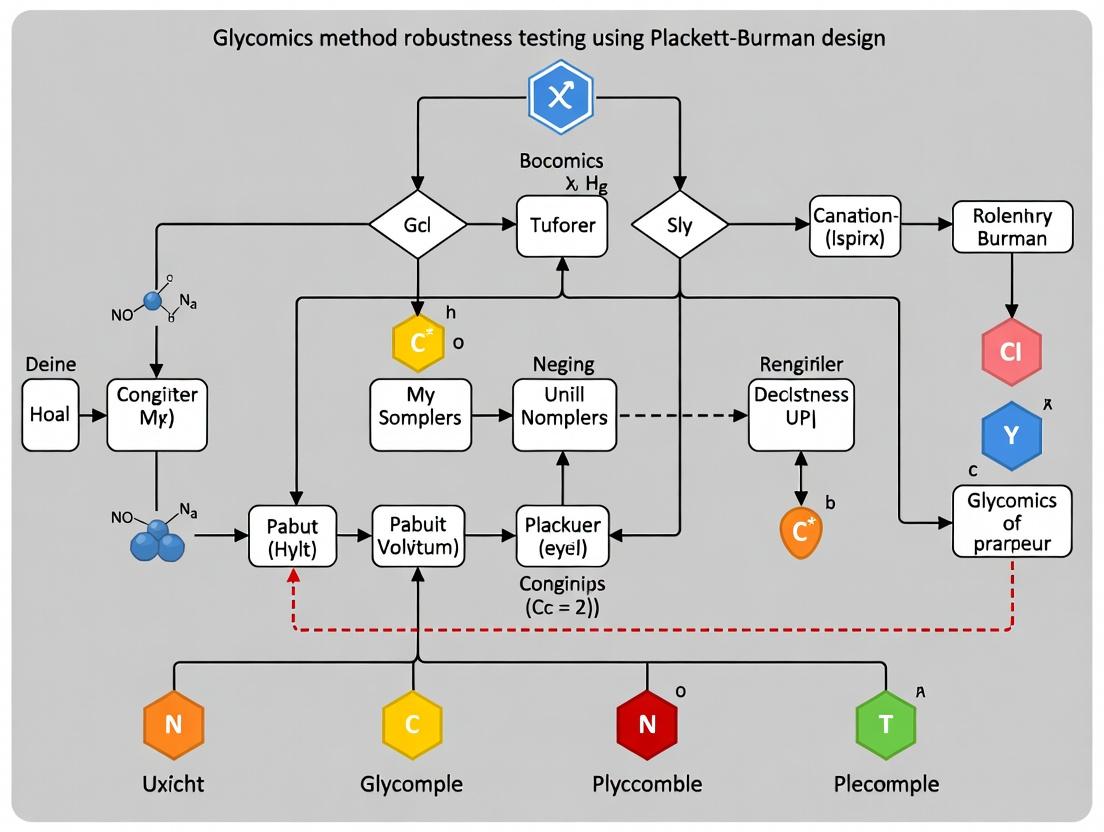
This article provides a comprehensive guide for researchers and drug development professionals on implementing Plackett-Burman (PBD) experimental design to test and enhance the robustness of glycomics methods.
Robust Glycomics Analysis: A Plackett-Burman Design Guide for Method Development and Validation
Abstract
This article provides a comprehensive guide for researchers and drug development professionals on implementing Plackett-Burman (PBD) experimental design to test and enhance the robustness of glycomics methods. We cover the foundational principles of PBD and its unique suitability for screening multiple analytical variables in glycan analysis. A detailed methodological walkthrough demonstrates its application to liquid chromatography-mass spectrometry (LC-MS) and capillary electrophoresis workflows for N-glycan, O-glycan, and glycosaminoglycan profiling. We address common troubleshooting scenarios and optimization strategies for factors like derivatization, enzymatic digestion, and instrument parameters. Finally, we present a validation framework comparing PBD to other screening designs (e.g., Full Factorial, Fractional Factorial) and show how its results feed into definitive robustness and method qualification protocols, ensuring reliable, reproducible data for biomarker discovery and biotherapeutic characterization.
Plackett-Burman Design Essentials: A Primer for Glycomics Robustness Screening
Why Robustness Testing is Non-Negotiable in Modern Glycomics
Modern glycomics, with its complex sample matrices and multi-step workflows, is highly susceptible to subtle variations. Robustness testing, specifically using designs like Plackett-Burman (P-B), systematically evaluates the impact of critical operational factors, ensuring methods produce reliable, reproducible data essential for research credibility and drug development.
Troubleshooting Guides & FAQs
FAQ 1: Why do my Glycan Release (Hydrazinolysis) Yields Vary Dramatically Between Batches?
- Issue: Inconsistent recovery of N-linked glycans from monoclonal antibody (mAb) substrates.
- Likely Culprits (P-B Factors): Hydrazine reaction temperature, hydrazine purity/water content, and sample drying time post-reaction.
- Solution: Implement a P-B design to test these factors. Use a 12-run P-B matrix to assess 6 factors at 2 levels (e.g., Temp: 60°C vs 80°C; Drying: 1 hr vs 3 hrs). A subsequent confirmation run at the optimized "robust" levels will stabilize yields.
FAQ 2: How Can I Minimize Sialic Acid Loss During Sample Preparation for LC-MS?
- Issue: Degradation or loss of labile sialic acid residues during labeling or purification steps.
- Likely Culprits: Labeling reaction pH, desalting column type (membrane vs. resin), and elution solvent acidity.
- Solution: A robustness test evaluating these factors will identify the most sensitive parameter. For example, a P-B design might reveal pH during 2-AB labeling is critical, while desalting method has negligible effect. Stabilize pH with a non-interfering buffer at the level identified as optimal.
FAQ 3: My HILIC-UPLC Glycan Profile Shows High Retention Time Drift. How Do I Fix It?
- Issue: Poor chromatographic reproducibility, complicating peak annotation and quantification.
- Likely Culprits: Column temperature stability, buffer ammonium concentration, and organic solvent gradient starting percentage.
- Solution: Conduct a robustness study on your HILIC method. Test small, realistic variations (e.g., Column Temp: 40°C ± 2°C; Ammonium formate: 50mM ± 5mM). The P-B analysis will rank which factor most affects retention time stability, allowing you to tighten its control specifications.
FAQ 4: My MALDI-TOF-MS Glycan Spectra Have Poor Signal-to-Noise and Spot-to-Spot Variance.
- Issue: Inconsistent co-crystallization of glycan sample with matrix, leading to "hot spots."
- Likely Culprits: Matrix-to-analyte ratio, spotting technique (dried droplet vs. thin layer), and cation concentration (e.g., [Na+]).
- Solution: Use a targeted P-B experiment. Systematically vary these preparation factors to find the combination that maximizes signal reproducibility. The quantitative analysis will show if a higher matrix ratio reduces variance more than changing the spotting method.
Experimental Protocol: Plackett-Burman Design for Glycan Labeling Robustness Test
Objective: To identify critical factors affecting the yield and reproducibility of 2-aminobenzoic acid (2-AA) labeling of released N-glycans.
1. Factor and Level Selection:
- Select 5 key factors from the labeling protocol. Define a high (+) and low (-) level representing an acceptable operating range.
- A: Labeling Reaction Temperature (65°C / 75°C)
- B: Reaction Time (2 hr / 3 hr)
- C: 2-AA Concentration (30 mg/mL / 50 mg/mL)
- D: Reducing Agent (NaBH₃CN) Concentration (30 mg/mL / 50 mg/mL)
- E: Drying Time Post-Reaction (30 min / 60 min)
2. Experimental Design Matrix (8 Trials): A Plackett-Burman design for 5 factors in 8 experimental runs is constructed. Each run is a unique combination of factor levels.
Table 1: Plackett-Burman Design Matrix for 2-AA Labeling Robustness
| Experimental Run | A: Temp | B: Time | C: [2-AA] | D: [Reductant] | E: Dry Time | Measured Yield (n=3, Mean %) |
|---|---|---|---|---|---|---|
| 1 | - | - | - | + | + | 78.2 |
| 2 | + | - | - | - | + | 82.5 |
| 3 | - | + | - | - | - | 75.8 |
| 4 | + | + | - | + | - | 85.1 |
| 5 | - | - | + | + | - | 80.3 |
| 6 | + | - | + | - | - | 83.6 |
| 7 | - | + | + | - | + | 77.4 |
| 8 | + | + | + | + | + | 87.9 |
3. Execution & Analysis:
- Perform all 8 experiments in randomized order to avoid bias.
- Use the same batch of released glycans from a standard mAb (e.g., NISTmAb).
- Purify labeled glycans identically and quantify yield via HPLC with fluorescence detection.
- Perform each run in triplicate.
- Calculate the main effect of each factor:
Effect = (Mean Yield at + level) - (Mean Yield at - level). - Rank factors by the absolute magnitude of their effect. Factors with the largest effects are critical for method robustness.
Table 2: Main Effect Calculation from P-B Design Data
| Factor | Description | Mean Yield at High (+) | Mean Yield at Low (-) | Main Effect |
|---|---|---|---|---|
| A | Temperature | 84.8% | 77.9% | +6.9% |
| B | Time | 81.6% | 81.1% | +0.5% |
| C | [2-AA] | 82.3% | 80.3% | +2.0% |
| D | [Reductant] | 82.9% | 79.8% | +3.1% |
| E | Dry Time | 81.4% | 81.3% | +0.1% |
Conclusion: Reaction Temperature (A) and Reductant Concentration (D) are the critical factors requiring strict control for robust labeling.
Visualization: Glycomics Workflow & Robustness Testing
Title: Glycomics Workflow with Integrated Robustness Testing
Title: Plackett-Burman Design Analysis Workflow
The Scientist's Toolkit: Key Research Reagent Solutions
Table 3: Essential Materials for Glycomics Robustness Testing
| Item | Function in Robustness Testing | Example / Specification |
|---|---|---|
| NISTmAb Reference Material | Provides a standardized, well-characterized glycoprotein substrate for inter-experiment comparison and system suitability testing. | NIST Monoclonal Antibody Reference Material 8671 |
| High-Purity Glycan Release Enzyme | Ensures consistent, complete liberation of N-glycans. Variability in enzyme activity is a major noise factor. | Recombinant PNGase F, glycerol-free, >95% purity |
| Isotopically Labeled Glycan Internal Standard | Allows for correction of sample preparation losses and instrumental variance during MS quantification. | [¹³C₆]-GlcNAc-labeled core glycan |
| Chromatography-Quality Water & Solvents | Minimizes background noise and adduct formation in LC-MS. Variability in solvent purity can drastically affect retention times. | LC-MS grade water, acetonitrile, ammonium salts |
| Calibrated pH Meter & Buffers | Critical for reproducible labeling and chromatographic separation. A key factor often tested in P-B designs. | Certified buffer solutions, regular electrode calibration |
| Automated Liquid Handler | Reduces operational variability in pipetting during high-throughput sample preparation for multi-run P-B designs. | Systems from Hamilton, Tecan, or Beckman |
Troubleshooting Guides & FAQs
Q1: My Plackett-Burman (PB) screening results show no significant factors. What could have gone wrong? A: This is common. Potential issues include: 1) The experimental noise (error) is larger than the main effects, drowning out signals. Check your measurement system's precision. 2) The factor ranges you chose were too narrow. In glycomics, a 10% change in derivatization time may be insignificant; consider a 50-200% range. 3) Confounding of main effects with two-factor interactions. Use a follow-up foldover design to de-alias suspected factors.
Q2: How do I handle missing data points in a PB run for my glycan purification yield analysis? A: Do not simply repeat the run. For a single missing value, estimate it using the formula: Missing Y = (k * Average of all other runs with factor at high level) - ((k-2) * Grand Average of all other runs), where k is the number of factors. For multiple missing points, use expectation-maximization (EM) algorithm-based software. Always document this imputation.
Q3: My OFAT experiment gave an optimal condition, but when I combined all "optima," the system failed. Why? A: OFAT ignores factor interactions. In glycomics, the optimal pH for lectin binding may shift depending on buffer ionic strength. PB designs, while not fully resolving interactions, can signal their presence through aberrant or large effects, warning you that interactions exist and OFAT results are unreliable.
Q4: How many center points should I add to my 12-run PB design for glycoprofiling? A: Add 3-5 center points. Replicate center points provide a pure estimate of experimental error and allow a check for curvature (non-linearity). If curvature is significant, your optimal may lie inside the experimental region, and a response surface methodology (RSM) design should follow.
Q5: Can I use a PB design to screen categorical factors like "enzyme type" or "column brand"? A: Yes. Assign the categories to the high (+) and low (-) levels. For example, for enzyme, use Enzyme A (-) and Enzyme B (+). Interpret results carefully: a significant effect means performance differs between the two options. Do not extrapolate beyond these two categories.
Data Comparison Tables
Table 1: Design Efficiency Comparison
| Feature | Plackett-Burman Design (12 Run) | Traditional OFAT (for 7 factors) |
|---|---|---|
| Number of Runs | 12 | 16 (1 baseline + 7 factors * 2 levels + 1 final combo) |
| Factors Screened | Up to 11 | 7 |
| Main Effects Resolution | Resolution III (confounded with 2FI) | Full (but invalid if interactions exist) |
| Interaction Information | Limited, only signals presence | None |
| Error Estimation | From built-in duplicates or center points | From replicates at baseline |
| Robustness to Interactions | More robust; gives unbiased main effects if interactions are mild | Highly fragile; interactions bias main effect estimates |
Table 2: Example Glycomics Factors for Screening
| Factor | Low Level (-1) | High Level (+1) | Unit |
|---|---|---|---|
| A: Derivatization Time | 30 | 180 | minutes |
| B: LC Gradient Slope | 0.5 | 2.0 | %B/min |
| C: MS Spray Voltage | 2.8 | 3.4 | kV |
| D: Digest Temperature | 37 | 50 | °C |
| E: Quenching pH | 2.5 | 4.5 | pH |
| F: Lectin Concentration | 10 | 50 | µg/mL |
| G: Salting Buffer | Ammonium Acetate | Sodium Chloride | Type |
Experimental Protocol: Implementing a Plackett-Burman Screen for Glycan Release Efficiency
Objective: To identify critical factors affecting N-glycan release yield using PNGase F.
Materials: See "The Scientist's Toolkit" below.
Procedure:
- Design: Select a 12-run PB design matrix for up to 11 factors. Assign 7 glycomics-relevant factors (e.g., from Table 2) to columns 1-7. Leave the remaining columns as "dummy" factors to estimate error.
- Randomization: Randomize the run order of the 12 experiments using a random number generator to avoid confounding with lurking variables (e.g., instrument drift, reagent age).
- Experimental Execution:
- Prepare protein substrate aliquots.
- For each run, set up the reaction according to the design matrix's +/- levels for that run.
- Execute release, purification, and labeling steps per run conditions.
- Analyze all samples via UHPLC-FLR in a single, contiguous sequence to minimize instrumental variance.
- Response Measurement: Record the integrated peak area of total glycans for each run as the primary response (Yield).
- Analysis: Calculate the main effect for each factor: Effect = (Average Yield at High) - (Average Yield at Low). Use a half-normal probability plot or a Pareto chart to identify statistically significant effects relative to the dummy factor effects.
Visualizations
Title: Screening Design Logic Flow
Title: Glycomics Workflow with PB Factor Screening
The Scientist's Toolkit: Key Research Reagent Solutions
| Item | Function in Glycomics Robustness Testing |
|---|---|
| Recombinant PNGase F | Enzyme for releasing N-glycans from glycoproteins. Different lots/vendors are a key categorical screening factor. |
| Procainamide Labeling Kit | Derivatization reagent for fluorescent detection of glycans. Reaction time and dye concentration are key factors. |
| Hydrophilic Interaction (HILIC) SPE Plates | For solid-phase extraction cleanup of released glycans. Sorbent type and elution solvent are critical factors. |
| Lectin Microarray | Tool for glycan binding profiling. Lectin type and concentration can be screened for binding robustness. |
| Stable Isotope-Labeled Glycan Standard | Internal standard to correct for MS ionization variability during screening of instrument parameters. |
| UHPLC-FLR/MS System | Analytical platform. Gradient slope, column temperature, and spray voltage are prime screening factors. |
| Design of Experiments (DOE) Software | For generating PB design matrices, randomizing runs, and performing statistical analysis of effects. |
Within a thesis investigating glycomics method robustness, the Plackett-Burman (PB) design is a critical statistical tool for screening a large number of factors (e.g., buffer pH, incubation time, enzyme concentration, temperature) to identify those most influential on glycosylation analysis outcomes. Its core principles of Resolution, Runs, and Factor Sparsity enable efficient experimentation when resources are limited.
Troubleshooting Guides & FAQs
Q1: My Plackett-Burman design for a glycan purification step identified no significant factors. Does this mean my process is already optimal? A: Not necessarily. This result often indicates issues with experimental execution or design setup.
- Troubleshooting Steps:
- Check Effect Sparsity Assumption: PB designs assume only a few factors (typically <20%) have large effects. If many factors are active, effects can cancel out or be obscured. Re-examine your factor selection.
- Review Noise Level: High experimental noise (e.g., variability in mass spec sensitivity) can mask real effects. Ensure your protocol is standardized and include replicate center points to estimate pure error.
- Verify Factor Levels: The range between your high (+) and low (-) levels for each factor (e.g., 25°C vs. 37°C) may be too narrow. Widen the levels to elicit a stronger signal over background noise, ensuring they remain practically feasible.
- Analyze Interaction Aliasing: Be aware that main effects are aliased (confounded) with two-factor interactions in Resolution III designs. A significant effect could be a main effect or an interaction. Follow-up experiments are needed to de-alias.
Q2: I have 7 potential factors affecting my LC-MS glycomics profile, but a standard PB design table shows 8, 12, or 20 runs. How do I choose? A: The choice balances resource constraints with design efficiency.
- Guidance: Use the smallest design where the number of runs (N) exceeds the number of factors (k). For 7 factors, an N=8 run design is the minimum. However, adding 4 dummy factors (or using an N=12 design with 5 dummy factors) is strongly advised.
- Why: Dummy factors (factors you don't actually manipulate) provide an internal estimate of experimental error and allow you to check for significance more reliably. An N=12 design offers more degrees of freedom for error estimation, increasing the robustness of your conclusions.
Q3: What does "Resolution III" mean in the context of my glycomics screening study, and what is its key limitation? A: Resolution III is a property of all Plackett-Burman designs. It means that main effects (the effect of a single factor like "digestion time") are aliased (completely confounded) with two-factor interactions (e.g., "digestion time * enzyme concentration").
- Practical Implication: If you find a significant effect, you cannot definitively say whether it is due to the main factor itself or a interaction between two factors. PB designs are for screening only. Significant factors must be investigated further using full factorial or Response Surface Methodology designs to de-alias and model interactions.
Table 1: Common Plackett-Burman Design Sizes and Properties
| Number of Runs (N) | Maximum Factors (k) Can Screen | Resolution | Degrees of Freedom for Error (with max k) | Recommended for Glycomics When... |
|---|---|---|---|---|
| 8 | 7 | III | 0 | Resources are extremely limited; accept no internal error estimate. |
| 12 | 11 | III | 0 | Screening 8-10 real factors; better to use 7-8 real + dummy factors. |
| 16 | 15 | III | 0 | Screening 12-14 real factors; better to use 10-12 real + dummy factors. |
| 20 | 19 | III | 0 | Screening 15-18 real factors; provides more runs for error detection. |
Table 2: Example PB Design Factor Setup for Glycan Labeling Robustness Test
| Factor Code | Factor Name | Low Level (-1) | High Level (+1) | Justification for Range |
|---|---|---|---|---|
| A | Labeling Reaction Time | 60 min | 180 min | Manufacturer's protocol suggests 1-3 hours. |
| B | Labeling Temperature | 25°C | 50°C | Literature shows yield variation in this range. |
| C | Dye-to-Glycan Ratio | 5:1 | 20:1 | Covers stoichiometric excess to ensure completion. |
| D | Quenching pH | 4.5 | 7.5 | Spans optimal vs. suboptimal quenching conditions. |
| E | Dummy 1 | - | - | Internal control for error estimation. |
| F | Dummy 2 | - | - | Internal control for error estimation. |
| Response | Labeling Efficiency | Measured via HPLC fluorescence peak area |
Experimental Protocols
Protocol: Executing a Plackett-Burman Screening Study for N-Glycan Release Efficiency Objective: Identify critical factors affecting the efficiency of enzymatic N-glycan release from a monoclonal antibody.
I. Pre-Experimental Planning
- Define Response: Primary response is "% Glycan Release" measured by HILIC-UPLC fluorescence.
- Select Factors (k=7): Enzyme concentration (A), incubation time (B), incubation temperature (C), detergent % (D), denaturation temperature (E), denaturation time (F), pH (G).
- Choose Design: Select an N=12 run PB design. Assign the 7 real factors randomly to 7 columns; treat the remaining columns as dummy factors.
- Randomize Runs: Randomize the run order of the 12 experiments to avoid bias from systematic trends.
II. Experimental Execution
- Prepare 12 separate aliquots of the monoclonal antibody standard.
- For each run, set up conditions per the design matrix (e.g., Run 1: A(+), B(+), C(-), D(-), E(-), F(-), G(+)).
- Perform the denaturation, enzymatic release, and cleanup steps precisely according to each run's specified factor levels.
- Label purified glycans with 2-AB fluorophore using a standardized protocol.
- Analyze all 12 samples in a single, randomized HILIC-UPLC sequence to minimize instrument drift effects.
III. Data Analysis
- Calculate the main effect for each factor: Effect = (Average response at high level) - (Average response at low level).
- Generate a half-normal or Pareto plot of the absolute effects.
- Use the effects from the dummy factors to establish a baseline error threshold. Any real factor effect substantially larger than the dummy factor effects is considered potentially significant.
- Plan a subsequent optimization experiment focusing on the 2-3 most significant factors identified.
Visualizations
Title: Plackett-Burman Design Workflow for Robustness Testing
Title: Main Effects are Aliased with Two-Factor Interactions
The Scientist's Toolkit: Key Research Reagent Solutions
Table 3: Essential Materials for a Glycomics Robustness PB Study
| Item | Function in the Experiment | Example/Note |
|---|---|---|
| Monoclonal Antibody Standard | Consistent, well-characterized glycoprotein substrate for the robustness tests. | Use an in-house or commercially available mAb with known glycoforms. |
| PNGase F Enzyme | Enzyme for releasing N-glycans; a critical factor to test (concentration, buffer). | Source from a reliable vendor; aliquot to avoid freeze-thaw cycles. |
| 2-AB Fluorophore Labeling Kit | For derivatizing released glycans for sensitive fluorescence detection. | Ensure fresh reducing agent (NaCNBH3) is used for efficient labeling. |
| HILIC-UPLC Columns | For separation of labeled glycans based on hydrophilicity. | Maintain dedicated column for glycan analysis with appropriate conditioning. |
| Glycan Reference Standards | For constructing calibration curves and assigning peaks. | A released glycan ladder or characterized mAb glycan profile. |
| Standardized Buffer Systems | To ensure pH and salt composition are controlled factors, not noise sources. | Prepare large, single-batch stocks for the entire design study. |
| LC-MS Grade Solvents | For sample preparation and UPLC mobile phases to minimize background noise. | Use water, ACN, and ammonium formate of the highest available purity. |
Identifying Critical Method Parameters (CMPs) in Glycan Analysis Workflows
Technical Support & Troubleshooting Center
FAQs & Troubleshooting Guides
Q1: During HILIC-UPLC analysis of 2-AB labeled N-glycans, I observe poor peak resolution and broad peaks. What are the likely CMPs to investigate? A: This is often linked to mobile phase preparation and column temperature, two key CMPs in chromatographic separation.
- Action: Verify the precise pH and ionic strength of the ammonium formate buffer (e.g., 50 mM, pH 4.4). A deviation of ±0.1 pH units can significantly impact resolution. Ensure the buffer is freshly prepared. Secondly, stabilize the column compartment temperature. Fluctuations >±0.5°C can cause peak broadening. The recommended temperature is typically 40-60°C, and consistency is critical.
- Protocol for Buffer Validation: Prepare ammonium formate buffer (50 mM, pH 4.4) using a calibrated pH meter with automatic temperature compensation. Filter through a 0.22 µm nylon membrane. Analyze a standard 2-AB-labeled dextran ladder or known glycan pool in triplicate. System suitability criteria: Resolution (Rs) between key ladder peaks (e.g., DP6/DP7) should be ≥1.5, and %RSD of retention times should be <0.5%.
Q2: My released and labeled O-glycans show low signal intensity in MS. Which sample preparation CMPs are most critical for ionization efficiency? A: The completeness of cleanup to remove salts and detergents (CMP: Purification Stringency) and the labeling reagent purity (CMP: Labeling Efficiency) are paramount.
- Action: Implement a stringent solid-phase cleanup step (e.g., using graphitized carbon cartridges or hydrophilic interaction media) with explicit wash volumes. For 1-2 µg of glycans, wash with 3 x 1 mL of 0.1% TFA in water before elution. For labeling, use fresh, high-purity reagents and confirm the dye-to-glycan ratio is optimal.
- Protocol for Glycan Cleanup: Load released glycans in 85% ACN/1% TFA onto a microcrystalline graphite plate. Wash with 3 column volumes of 1% TFA. Elute with 40% ACN/0.1% TFA. Dry completely before reconstitution in MS-compatible solvent (e.g., 50% MeOH).
Q3: When using exoglycosidase sequencing, I get inconsistent digestion results. What parameters in the enzymatic reaction are critical? A: The enzyme-to-substrate ratio and incubation time are primary CMPs for enzymatic steps.
- Action: Standardize the amount of enzyme (mU) per nmol of glycan. For example, use 5 mU of Sialidase S (from Streptococcus pneumoniae) per 1 nmol of sialylated glycan. Precisely control incubation time (±10 minutes) and temperature (±0.5°C) using a thermal cycler or calibrated block heater.
- Protocol for Exoglycosidase Digestion: In a 10 µL reaction, combine 1 µL of purified glycan (equivalent to ~1 nmol), 2 µL of appropriate reaction buffer (e.g., 50 mM sodium acetate, pH 5.5), 1 µL of enzyme (5 mU), and 6 µL of HPLC-grade water. Incubate at 37°C in a sealed PCR tube for 18 hours. Inactivate at 80°C for 20 minutes.
Q4: How do I use a Plackett-Burman (P-B) design to screen for CMPs in my glycan release protocol? A: A P-B design efficiently screens multiple parameters with minimal runs. Select 7-11 factors you suspect are critical.
- Action: Define each parameter at a high (+) and low (-) level (see Table 1). Follow the randomized run order prescribed by the design. The primary response (output) could be Total Glycan Yield (measured by fluorescence or MS total ion count).
- Protocol for P-B Screening of N-Glycan Release: Using a 12-run P-B design to screen 7 factors: 1. Denaturation Temperature (65°C+, 50°C-), 2. Denaturation Time (5 min+, 2 min-), 3. PNGase F Amount (5 U+, 2 U-), 4. Incubation Time (18 hr+, 2 hr-), 5. Incubation Temperature (37°C+, 25°C-), 6. % Non-Ionic Detergent (0.1%+, 0.01%-), 7. Protein Amount (50 µg+, 10 µg-). Process samples, label with 2-AB, and quantify yield via fluorescence HPLC. Analyze data to calculate the main effect of each parameter.
Experimental Data Summary
Table 1: Plackett-Burman Design for Screening N-Glycan Release Parameters
| Run Order | Denaturation Temp. | Denaturation Time | PNGase F Amount | Incubation Time | Incubation Temp. | Detergent % | Protein Amount | Total Yield (RFU) |
|---|---|---|---|---|---|---|---|---|
| 1 | + (65°C) | + (5 min) | - (2 U) | + (18 hr) | + (37°C) | - (0.01%) | + (50 µg) | 12,450 |
| 2 | - (50°C) | + | + (5 U) | + | + | + (0.1%) | - (10 µg) | 14,890 |
| 3 | - | - (2 min) | + | + | - (25°C) | + | + | 8,520 |
| 4 | + | - | - | + | - | - | - | 4,150 |
| 5 | + | + | + | - (2 hr) | - | - | + | 9,780 |
| 6 | + | + | - | - | + | + | - | 11,230 |
| 7 | - | + | + | - | + | - | + | 13,400 |
| 8 | - | - | - | - | - | + | + | 5,640 |
| 9 | + | - | + | + | + | - | - | 15,100 |
| 10 | - | + | - | + | - | + | - | 7,850 |
| 11 | + | - | - | - | + | - | + | 10,500 |
| 12 | - | - | + | - | - | - | - | 3,990 |
Table 2: Main Effects Calculated from P-B Design Analysis
| Parameter | Low Level (-) | High Level (+) | Main Effect (on Yield) | Identified as Critical? (p<0.05) |
|---|---|---|---|---|
| PNGase F Amount | 2 U | 5 U | +4,120 RFU | Yes |
| Incubation Time | 2 hr | 18 hr | +3,850 RFU | Yes |
| Denaturation Temperature | 50°C | 65°C | +1,950 RFU | No |
| Protein Amount | 10 µg | 50 µg | +1,800 RFU | No |
| Denaturation Time | 2 min | 5 min | +450 RFU | No |
| Incubation Temperature | 25°C | 37°C | +3,200 RFU | Yes |
| Detergent % | 0.01% | 0.1% | +150 RFU | No |
Visualizations
Title: N-Glycan Analysis Workflow with Potential CMPs
Title: Plackett-Burman Design Workflow for CMP Screening
The Scientist's Toolkit: Key Research Reagent Solutions
| Item | Function in Glycan Analysis |
|---|---|
| PNGase F (Recombinant) | The gold-standard enzyme for releasing intact N-linked glycans from glycoproteins. Critical for analysis fidelity. |
| 2-Aminobenzamide (2-AB) | A fluorescent label for released glycans, enabling sensitive detection by HILIC-UPLC with fluorescence detection. |
| Ammonium Formate (LC-MS Grade) | Essential volatile salt for preparing mobile phases in HILIC separations and direct infusion MS analysis. |
| Graphitized Carbon Solid-Phase Extraction Plates | For high-efficiency purification and desalting of released glycans prior to labeling and MS analysis. |
| Exoglycosidase Array (e.g., Sialidase, β1-4 Galactosidase) | Enzymes of defined specificity for sequential digestion to determine glycan linkage and monosaccharide sequence. |
| Deuterium-Labeled Reductive Amination Agent (e.g., d4-2-AB) | Internal standard for absolute quantitation of glycans via LC-MS, correcting for process variability. |
| HILIC-UPLC Column (e.g., BEH Amide, 1.7 µm) | Provides high-resolution separation of labeled glycans based on hydrophilicity. Column temperature stability is a key CMP. |
| Glycan Primary Standard (e.g., 2-AB Labeled Dextran Ladder) | Critical for system suitability testing, assigning glucose units (GU), and monitoring chromatographic performance. |
FAQs & Troubleshooting Guide
Q1: During my CE-LIF glycan profiling, I observe a gradual decrease in the peak area of sialylated glycans over successive runs. What could be causing this, and how can I address it?
A: This is indicative of sialic acid loss (desialylation), a common issue in glycomics. Primary causes and solutions:
- Cause: Low-pH Buffer Conditions. Sialic acids are labile in acidic environments.
- Fix: Ensure your labeling, dilution, and separation buffers are neutral or slightly alkaline (pH ≥ 7.0). Use fresh, properly prepared buffers.
- Cause: Enzymatic Contamination.
- Fix: Include sialidase inhibitors (e.g., 2,3-dehydro-2-deoxy-N-acetylneuraminic acid) in your sample storage and preparation buffers. Use ultrapure, nuclease-free water.
- Cause: Inefficient Instantaneous Derivatization. Slow labeling can allow desialylation during the reaction.
- Fix: Use a fluorophore with rapid kinetics (e.g., procainamide) and ensure the labeling reaction medium is optimal (e.g., DMSO + citric acid for APTS).
Q2: My Plackett-Burman design for robustness testing identifies "voltage" and "buffer concentration" as significant factors affecting migration time. How should I adjust my method to improve reproducibility?
A: Migration time is highly sensitive to electrophoretic conditions. To enhance robustness:
- Implement Internal Standards: Use a well-characterized isoform ladder or a labeled dextran standard in every sample. Normalize migration times to these standards.
- Tighten Voltage Control: The P-B result shows this is critical. Use a high-quality power supply with minimal fluctuation. Consider implementing a controlled temperature ramp at the start of the run.
- Buffer Standardization: Precisely prepare and filter (0.2 µm) the separation buffer. Use an automated buffer replenishment system if available. Document the batch and preparation date.
Q3: I have poor resolution (Rs < 1.5) between two critical isobaric glycan peaks. Which experimental factors from a robustness study should I prioritize optimizing to improve separation?
A: Resolution is a key response for method suitability. Based on typical P-B findings:
- Primary Factor to Optimize: Separation Buffer Additive Concentration. Even small changes in the concentration of additives like 1,4-diaminobutane (DAB) or ε-aminocaproic acid can dramatically alter selectivity. Perform a focused follow-up DoE (e.g., Central Composite Design) around the nominal value.
- Secondary Factor: Capillary Temperature. Temperature affects buffer viscosity and analyte mobility. Fine-tuning within a narrow range (e.g., ±2°C) can improve resolution without impacting stability.
- Action: Re-inspect your P-B data for interaction effects between buffer pH and additive concentration, as these often co-determine resolution.
Experimental Protocols
Protocol 1: Mitigating Sialic Acid Loss during 2-AB Labeling of N-Glycans
- Release: Release glycans from protein (100 µg) using PNGase F in a 50 µL ammonium bicarbonate buffer (50 mM, pH 7.8) for 18 hours at 37°C.
- Clean-up: Purify released glycans using porous graphitized carbon (PGC) solid-phase extraction (SPE). Elute with 40% acetonitrile (ACN) in 0.1% trifluoroacetic acid (TFA), followed by 60% ACN in 0.1% TFA. Dry completely.
- Labeling: Reconstitute glycans in 5 µL of a labeling mixture containing 2-AB (19.2 mg/mL) and sodium cyanoborohydride (32 mg/mL) in a 70:30 DMSO:Glacial Acetic Acid mixture. Note: The acetic acid is critical but can promote desialylation. Do not exceed 30% and limit reaction time.
- Incubation: Incubate at 65°C for exactly 2 hours.
- Quenching & Clean-up: Dilute the reaction with 1 mL of acetonitrile. Purify using microcrystalline cellulose SPE (pre-equilibrated with water). Wash with 1 mL of 90% acetonitrile. Elute labeled glycans with 500 µL of water. Dry and store at -20°C.
Protocol 2: Plackett-Burman Design Execution for CE Method Robustness
- Define Factors & Ranges: Select 7 critical method parameters (e.g., Voltage, Temperature, Buffer pH, Additive Concentration, Injection Pressure/Time, Capillary Length, Rinse Time). Set a high (+) and low (-) level for each, representing a realistic operating range (e.g., pH 9.5 ± 0.3).
- Select Design: Use a 12-run Plackett-Burman design matrix. This allows screening of the 7 main effects with 4 degrees of freedom for error estimation.
- Randomized Experiment: Execute the 12 CE runs in a fully randomized order to minimize bias from instrument drift.
- Measure Responses: For each run, record key responses: Peak Area (for major glycan), Resolution (between two critical peaks), and Migration Time (of a central standard).
- Statistical Analysis: Perform ANOVA or calculate the main effect for each factor on each response. Identify factors with statistically significant (p < 0.05) effects.
Table 1: Main Effects from a Plackett-Burman Design (12 Runs) on Key CE Responses
| Factor | Level (+/-) | Effect on Peak Area | Effect on Resolution | Effect on Migration Time |
|---|---|---|---|---|
| Separation Voltage | +25 kV / -20 kV | +3.2% (p=0.12) | -0.15 (p=0.32) | -2.1 min (p=0.003) |
| Buffer pH | +9.8 / -9.2 | -12.5% (p=0.002) | +0.41 (p=0.01) | +0.4 min (p=0.21) |
| DAB Concentration | +6 mM / -4 mM | +1.8% (p=0.45) | +0.52 (p=0.005) | +0.9 min (p=0.08) |
| Capillary Temperature | +25°C / -20°C | +4.1% (p=0.09) | -0.10 (p=0.52) | -1.8 min (p=0.007) |
| Injection Time | +10 s / -5 s | +28.7% (p<0.001) | -0.08 (p=0.61) | +0.2 min (p=0.55) |
Table 2: Common Causes & Corrections for Sialic Acid Loss
| Observed Issue | Potential Root Cause | Recommended Corrective Action |
|---|---|---|
| Progressive loss over runs | Carry-over of acidic buffer | Implement extended capillary rinse with neutral buffer (pH 7.5) between runs. |
| Loss during sample storage | Microbial/enzymatic activity | Aliquot samples, store at -80°C, add universal protease inhibitor. |
| Loss specific to labeling | Suboptimal labeling chemistry | Switch to a "mild acid" labeling kit or optimize reaction time/temperature. |
| Inconsistent loss between replicates | Variable evaporation causing pH shift | Standardize sample drying (speed vacuum) and reconstitution steps precisely. |
The Scientist's Toolkit: Key Research Reagent Solutions
| Item & Purpose | Function in Glycomics CE Analysis |
|---|---|
| PNGase F (Peptide-N-Glycosidase F) | Enzyme for cleaving intact N-linked glycans from glycoproteins for downstream analysis. |
| Procainamide or 2-AB (2-Aminobenzamide) Fluorophore | Tags released glycans with a fluorescent label for LIF detection; kinetics and stability vary. |
| 1,4-Diaminobutane (DAB) or ε-Aminocaproic Acid | Buffer additives that modulate EOF and improve resolution of sialylated and neutral glycans. |
| Sialidase Inhibitor (e.g., DANA analog) | Added to sample buffers to prevent enzymatic desialylation by contaminating neuraminidases. |
| Dextran Ladder Internal Standard (APTS-labeled) | Provides a calibrated mobility scale for normalized migration time (GU values) across runs. |
| Plackett-Burman Design Software (e.g., JMP, Minitab, or online generators) | Used to create the experimental design matrix and perform statistical analysis of factor effects. |
Visualizations
Step-by-Step Application: Implementing PBD in LC-MS and CE Glycomics Workflows
Troubleshooting Guides & FAQs
Q1: During N-glycan release with PNGase F, my yields are low and inconsistent. What are the most critical parameters to check? A: Low yields often stem from enzyme accessibility or suboptimal reaction conditions. Critical parameters to test for robustness include:
- Denaturant Concentration (e.g., SDS): Essential for protein unfolding but can inhibit PNGase F if not neutralized sufficiently with non-ionic detergents like Triton X-100 or NP-40.
- pH of Reaction Buffer: PNGase F activity is optimal between pH 7.5 and 8.5. Small deviations can significantly impact efficiency.
- Incubation Time/Temperature: Standard is 37°C overnight, but shorter times at higher temperatures (e.g., 50°C) are used. Variability here affects completeness of release.
- Protein/Enzyme Ratio: Insufficient enzyme for the substrate amount leads to incomplete release.
Q2: After fluorescent labeling (e.g., with 2-AB or procainamide), I observe high background noise in my HPLC/UPLC profiles. What steps in the cleanup are most likely responsible? A: High background is typically due to incomplete removal of excess fluorescent dye. The robustness of the following cleanup steps should be rigorously tested:
- Stationary Phase of Cleanup Cartridges: The consistency of binding capacity for labeled glycans vs. free dye in hydrophilic interaction (HILIC) or porous graphitized carbon (PGC) cartridges.
- Composition and Volume of Wash Buffers: The % acetonitrile and water in wash steps must be precise to elute contaminants while retaining glycans.
- Elution Volume and Solvent: Inconsistent elution volume or water content can lead to variable recovery of labeled glycans.
- Drying Time and Temperature Post-Cleanup: Incomplete drying leaves volatile contaminants, while over-drying makes glycans difficult to reconstitute.
Q3: My Plackett-Burman design for robustness testing shows a significant effect for "Lyophilization Time" after cleanup. How can this variable be controlled? A: Lyophilization time affects the final dryness of the sample, influencing reconstitution volume accuracy and potential sample loss. To control it:
- Standardize the lyophilizer performance by ensuring consistent condenser temperature and chamber pressure.
- Use a fixed time based on a predetermined "constant weight" test for a typical sample volume.
- Implement a secondary drying step with a defined time as part of the protocol.
- Consider alternative, more reproducible drying methods (e.g., vacuum centrifugation with temperature control) if variable lyophilization is identified as a critical noise factor.
Q4: When performing a Plackett-Burman experimental design for this workflow, which 7-8 factors should I prioritize for screening? A: Based on common failure points, prioritize these factors for a robustness screen:
| Factor Name | Low Level (-1) | High Level (+1) | Rationale |
|---|---|---|---|
| PNGase F Incubation Time | 16 hours | 18 hours | Tests completeness of release. |
| Labeling Reaction Temperature | 55°C | 65°C | Impacts labeling efficiency & dye degradation. |
| % Acetonitrile in Cartridge Wash | 96% | 98% | Critical for removing free dye without eluting glycans. |
| Wash Volume | 2 mL | 3 mL | Insufficient wash leaves dye; excess can cause glycan loss. |
| Elution Volume (Water) | 500 µL | 700 µL | Impacts glycan recovery & final concentration. |
| Lyophilization Time | 3 hours | 5 hours | Affects sample dryness and reconstitution consistency. |
| Sample Storage pH before Analysis | pH 4.5 | pH 7.0 | Low pH can cause desialylation. |
| Vortexing Time for Reconstitution | 30 seconds | 2 minutes | Affects homogeneity and accuracy of sample loading. |
Experimental Protocol: Plackett-Burman Robustness Screening for N-Glycan Processing
1. Objective: To identify critical factors affecting the yield, purity, and reproducibility of released, labeled N-glycans.
2. Experimental Design:
- Select 8 factors as outlined in the table above.
- Utilize a 12-run Plackett-Burman design matrix (generated by statistical software like JMP, Minitab, or R). This design allows for the efficient screening of main effects while assuming interactions are negligible.
- The response variables (outputs) to be measured are:
- Total Glycan Yield (RFU): Measured by fluorescence detector total area.
- Purity Index: Ratio of glycan peak areas to total chromatogram area.
- Relative Proportion of Key Glycan Peaks: e.g., % of major biantennary or sialylated structure.
3. Methodology:
- Standard Substrate: Use a purified glycoprotein standard (e.g., bovine fetuin, human IgG) at a fixed concentration for all experimental runs.
- Execution: Follow the design matrix exactly, varying the factor levels as prescribed for each run.
- Analysis: Analyze all samples under identical, optimized UPLC-HILIC-FLR conditions.
- Statistical Analysis: Fit the response data to the design model. Identify factors with statistically significant (p < 0.05) effects on the responses. Plot main effect plots to visualize the direction of each factor's influence.
Diagrams
Experimental Workflow for Robustness Testing
Plackett-Burman Factor Screening Logic
The Scientist's Toolkit: Key Research Reagent Solutions
| Item | Function in Robustness Testing |
|---|---|
| PNGase F (Recombinant) | Enzyme for releasing N-glycans from glycoprotein backbone. Lot-to-lot activity is a key variable. |
| Rapid PNGase F Buffer | Denaturation buffer containing SDS and neutralizing detergent. Consistency is vital for reproducible enzyme access. |
| 2-Aminobenzamide (2-AB) | Common fluorescent label for glycan derivatization. Fresh, dry stock is essential for consistent labeling efficiency. |
| Sodium Cyanoborohydride | Reducing agent for reductive amination during labeling. Must be protected from moisture. |
| HILIC µElution Plates (e.g., ZIP) | 96-well format solid-phase extraction for cleanup. Plate uniformity is critical for high-throughput robustness. |
| Acetonitrile (HPLC Grade) | Primary solvent for HILIC cleanup washes. Purity and water content affect glycan retention. |
| Glycoprotein Standard (e.g., Fetuin) | Well-characterized substrate with known glycan profile. Serves as a consistent control across all experimental runs. |
| UPLC HILIC Column (e.g., BEH Amide) | Stationary phase for separating labeled glycans. Column batch and age must be controlled during the study. |
Technical Support Center
FAQ & Troubleshooting Guide
Q1: During my Plackett-Burman screening for a glycan release method, my enzyme efficiency is highly inconsistent. What is the most likely factor, and how can I stabilize it? A: Enzyme concentration and pH are the primary suspects. Enzymes like PNGase F have a narrow optimal pH range (typically 7.5-8.5 for N-glycan release). Small deviations in buffer preparation can drastically alter activity. Troubleshooting Protocol: 1) Precisely calibrate your pH meter with fresh buffers. 2) Prepare a single, large-volume master buffer for the entire screening experiment to ensure uniformity. 3) Aliquot enzyme stocks to avoid freeze-thaw cycles. Use the "Research Reagent Solutions" table below for specifics.
Q2: My glycan recovery yields are low. I suspect the solvent composition during clean-up is affecting recovery. How should I adjust it? A: Solvent composition (e.g., Acetonitrile/Water/Trifluoroacetic acid ratios) in solid-phase extraction (SPE) is critical. Low yields often stem from overly hydrophilic or hydrophobic conditions washing away target glycans. Troubleshooting Protocol: Perform a micro-optimization: Pack a small amount of your SPE resin (e.g., graphitized carbon) in a pipette tip. Load your sample and sequentially elute with 5-10% increments of acetonitrile in 0.1% TFA (from 0% to 50%). Analyze each fraction by MS to create a recovery profile for your specific glycan library.
Q3: The reaction time factor in my design shows no significant effect. Should I eliminate it from future Optimization? A: Not necessarily. A non-significant result in Plackett-Burman is valuable information. It may indicate that over the tested range (e.g., 1-4 hours), the reaction reaches completion quickly. Verification Protocol: Set all other factors at their mid-point and run a time-course experiment (15min, 30min, 1h, 2h, 4h). If yield plateaus before the shortest time in your screening range, you can confidently reduce time in later designs. If yield increases linearly, expand the upper level in your next design.
Q4: How do I reconcile significant interaction effects (e.g., Temperature x pH) when my Plackett-Burman design assumes they are negligible? A: Plackett-Burman screens main effects but aliases them with interactions. A suspected Temperature x pH interaction can be deconvoluted. Follow-up Protocol: Run a simple two-factor factorial experiment. Hold other factors constant. Test: Low Temp/Low pH, Low Temp/High pH, High Temp/Low pH, High Temp/High pH. Plot the response. If lines are non-parallel, an interaction is confirmed, necessitating a Response Surface Methodology (RSM) design like Box-Behnken for full optimization.
Experimental Data Summary Table: Typical Factor Ranges for Glycomics Sample Preparation
| Factor | Low Level (-1) | High Level (+1) | Common Optimal Point (from literature) | Critical Note |
|---|---|---|---|---|
| pH | 7.0 | 9.0 | 8.0 - 8.5 (PNGase F) | Highly enzyme-specific. Affects protein folding & enzyme kinetics. |
| Temperature (°C) | 25 | 37 | 50 (for rapid chemoenzymatic release) | Higher temps speed kinetics but risk enzyme denaturation. |
| Time (Hours) | 1 | 18 | 2-3 (with optimized enzyme conc.) | Often interacts with temperature and enzyme concentration. |
| Solvent Composition (%ACN) | 0 | 50 | 5-20% (for SPE loading) | Level definition depends on the specific step (loading, washing, eluting). |
| Enzyme Concentration (mU/µL) | 0.5 | 5.0 | 2.0 (for complex samples) | Unit definition varies (mU vs. µg/µL). Standardize by activity. |
Detailed Protocol: Plackett-Burman Screening for Glycan Release Robustness
Objective: To identify critical factors affecting the yield and reproducibility of N-glycan release for downstream glycomics analysis.
Materials: See "Research Reagent Solutions" table.
Methodology:
- Design Setup: Select the 5 factors in the table above. Use a 12-run Plackett-Burman design matrix (generated by software like JMP, Minitab, or a pre-defined template).
- Sample Preparation: Aliquot a homogeneous, complex protein standard (e.g., pooled human IgG) into 12 identical samples.
- Factor Implementation: For each run, prepare the reaction buffer according to the design matrix's specified pH. Add the organic solvent (%ACN) as per the design. Add the specified amount of enzyme (PNGase F).
- Incubation: Place samples in thermoblockers set to the designated temperature for the exact time specified.
- Termination & Clean-up: Quench reactions by heating at 100°C for 5 mins. Purify glycans using a standardized SPE protocol (e.g., using graphitized carbon cartridges).
- Analysis: Analyze all 12 glycan pools by MALDI-TOF-MS or LC-MS. Use total ion count or summed peak intensities of major glycan species as the response variable (Yield).
- Statistical Analysis: Input the response data into the design matrix. Perform linear regression analysis. Factors with the largest absolute standardized effects and p-values < 0.1 (or a chosen alpha) are deemed significant and carried forward for optimization.
The Scientist's Toolkit: Research Reagent Solutions
| Item | Function in Glycomics Robustness Testing |
|---|---|
| Recombinant PNGase F (glycerol-free) | Gold-standard enzyme for cleaving N-glycans from proteins. Glycerol-free versions allow precise concentration control. |
| Ammonium Bicarbonate Buffer (LC-MS Grade) | Volatile buffer ideal for enzymatic digestion and subsequent MS analysis, leaving no interfering residues. |
| Graphitized Carbon Solid-Phase Extraction Plates | Standardized format for high-throughput glycan purification and desalting post-release. |
| 2,5-Dihydroxybenzoic Acid (DHB) Matrix | Common MALDI matrix for glycan profiling, promoting stable and sensitive ionization. |
| Fluorescent Tags (e.g., 2-AA, Procainamide) | For HPLC-based profiling with fluorescence detection, enhancing sensitivity and enabling linkage to separation. |
| Internal Standard (e.g., [13C6] Isotype-labeled glycan) | Spiked into samples pre-processing to correct for variability in recovery and ionization efficiency during MS. |
Visualizations
Diagram 1: Plackett-Burman Workflow for Glycomics
Diagram 2: Factor Interaction Impact on Glycan Yield
Troubleshooting Guides & FAQs
Q1: When generating a Plackett-Burman Design (PBD) matrix in JMP for a glycomics method, I get an error about "No runs for the specified number of factors." What does this mean and how do I fix it? A: PBDs require specific run numbers (N) for a given number of factors (k), such as N=12 for k=5-11, or N=20 for k=13-19. If your k doesn't fit a standard N, JMP will error. Solution: Adjust your factor count to fit a valid PBD run size or use a different screening design (e.g., Definitive Screening Design).
Q2: In Minitab, my PBD analysis shows "Aliasing" warnings. How should I interpret this for robustness testing of a glycomics sample preparation step? A: PBDs assume interactions are negligible. Aliasing means main effects are confounded with two-factor interactions. In glycomics robustness testing, this is often acceptable for initial screening. Solution: Document the alias structure. If a factor appears significant, plan follow-up experiments to de-alias it from potential interactions with critical steps like derivatization or hydrolysis.
Q3: I used the FrF2 package in R to create a PBD, but the design matrix has "-1" and "1" levels. How do I convert these to my actual experimental low/high values (e.g., pH 3.5 and 4.5)?
A: The coded levels (-1,1) are for analysis. You must map them to actual values. Solution: Use a data frame to store the actual values. Example R code:
Q4: During execution of my PBD experiment for HPLC-FLD glycomics analysis, one run (e.g., N-glycan release time at high level) failed. Can I still analyze the data?
A: Yes, but with caution. PBDs are not orthogonal and missing data can complicate analysis. Solution: Use software-specific approaches. In JMP: Use the "Missing Data" pattern in the Fit Model dialog. In R (FrF2/lmer), treat the missing run as NA and use linear models that handle unbalanced data. The effect estimates for factors not involving the failed run condition remain valid.
Q5: My PBD analysis in any software shows no significant factors, yet my glycan yield variability is high. What might be wrong? A: The chosen factor ranges (low/high levels) might be too narrow compared to the inherent noise of the glycomics assay (e.g., sample cleanup variability). Solution: Review your level settings against known method variability. Widen the practical ranges for factors like solvent volume or centrifugation speed in your next iteration, ensuring they remain within plausible operating limits.
Data Presentation
Table 1: Example PBD Run Matrix (12-run) for a Glycomics Derivatization Robustness Test
| Run | Factor A: pH | Factor B: Temp (°C) | Factor C: Time (min) | Factor D: [Reagent] (mM) | Response: Peak Area (Normalized) |
|---|---|---|---|---|---|
| 1 | 3.5 (-1) | 20 (-1) | 30 (+1) | 10 (-1) | 1.05 |
| 2 | 4.5 (+1) | 20 (-1) | 10 (-1) | 50 (+1) | 0.98 |
| 3 | 3.5 (-1) | 60 (+1) | 10 (-1) | 10 (-1) | 1.21 |
| 4 | 4.5 (+1) | 60 (+1) | 30 (+1) | 10 (-1) | 0.89 |
| 5 | 3.5 (-1) | 20 (-1) | 30 (+1) | 50 (+1) | 1.32 |
| 6 | 4.5 (+1) | 20 (-1) | 10 (-1) | 10 (-1) | 0.94 |
| 7 | 3.5 (-1) | 60 (+1) | 10 (-1) | 50 (+1) | 1.18 |
| 8 | 4.5 (+1) | 60 (+1) | 30 (+1) | 50 (+1) | 0.85 |
| 9 | 4.5 (+1) | 20 (-1) | 30 (+1) | 50 (+1) | 1.28 |
| 10 | 3.5 (-1) | 60 (+1) | 30 (+1) | 10 (-1) | 1.09 |
| 11 | 4.5 (+1) | 60 (+1) | 10 (-1) | 50 (+1) | 0.91 |
| 12 | 3.5 (-1) | 20 (-1) | 10 (-1) | 10 (-1) | 1.00 |
Table 2: Comparison of PBD Software Features for Glycomics Research
| Feature | JMP Pro (v17) | Minitab (v21) | R (FrF2/DoE.base packages) |
|---|---|---|---|
| Design Generation | GUI & DOE Wizard, visual factor setup | Assistant & Stat > DOE > Factorial | Script-based, high flexibility |
| Custom Run Size Handling | Limited to classic N | Limited to classic N | Allows non-classic N via pb |
| Analysis Output | Full ANOVA, Pareto, Prediction Profiler | ANOVA, Normal/Half-Normal Plots, Terms | lm() object, custom summary & plots |
| Alias Structure Display | Explicit in Model Dialog | Shown in Session Output | Calculated via alias() function |
| Data Visualization | Integrated rich graphics | Standard statistical graphs | Requires ggplot2 or base R coding |
| Ease of Automation | Moderate (JSL scripting) | Low to Moderate | High (fully scriptable) |
Experimental Protocols
Protocol: Plackett-Burman Design for Robustness Testing of N-Glycan Release and Labeling
- Factor Selection: Identify 5-7 critical method parameters from the glycomics workflow (e.g., hydrolysis pH, incubation temperature/time, labeling reagent concentration, quenching time).
- Level Assignment: Set realistic "low" (-1) and "high" (+1) levels for each factor reflecting minor, intentional variations around the nominal optimized condition.
- Design Construction: Using software (see Table 2), generate a 12-run PBD matrix. Randomize the run order to mitigate time-based biases.
- Experimental Execution: Prepare a single, large pool of standardized glycoprotein sample (e.g., IgG). Aliquot and process each according to the randomized PBD matrix.
- Response Measurement: Analyze all samples in a single, randomized HPLC-FLD or LC-MS batch. Record primary responses (e.g., total peak area for major glycans, sialic acid peak ratio).
- Statistical Analysis: Fit a linear model relating factors to response. Identify significant factors (p < 0.05 or using half-normal plots) that disproportionately influence method outcomes.
- Conclusion: Define the method's robust zone. Factors not significant are deemed robust within tested ranges. Document significant factors for controlled standardization.
Mandatory Visualization
PBD Experimental Workflow for Glycomics
Decision Logic for PBD Factor Significance
The Scientist's Toolkit
Table 3: Key Research Reagent Solutions for Glycomics Robustness Testing
| Item | Function in PBD Experiment |
|---|---|
| Standardized Glycoprotein (e.g., Human IgG, Fetuin) | Provides a consistent, complex N- and O-glycan source to test method variability across PBD runs. |
| PNGase F Enzyme (in solution or immobilized) | Catalyzes the release of N-glycans from the glycoprotein backbone; a critical step for robustness testing. |
| Fluorescent Labeling Reagent (e.g., 2-AB, Procainamide) | Derivatizes released glycans for sensitive detection by HPLC-FLD; concentration and reaction time are common PBD factors. |
| Hydrophilic Interaction Liquid Chromatography (HILIC) Column | Key analytical component for glycan separation; PBD may test factors influencing its performance (e.g., buffer pH, gradient time). |
| Glycan Release Quenching Solution (e.g., 100% Acetic Acid) | Stops the enzymatic reaction; volume and addition time can be factors in a robustness PBD. |
| Solid-Phase Extraction (SPE) Microplates (Graphitized Carbon) | For post-labeling cleanup of glycan samples; washing solvent composition and volume are potential PBD factors. |
Troubleshooting Guides & FAQs
Q1: We observe high variability in LC-MS/MS peak areas for identical glycan standards between runs. What are the primary culprits? A1: The most common causes are inconsistent sample loading due to autosampler carryover or drift, fluctuating electrospray ionization stability, and changes in chromatographic conditions. Ensure thorough needle washes and seal maintenance. Monitor system suitability samples at the start and end of each batch.
Q2: During our Plackett-Burman robustness testing, buffer pH was identified as a significant factor. How can we better control it across runs? A2: Always use freshly prepared buffers from standardized stock solutions. Employ a calibrated pH meter with daily verification. For critical mobile phases, consider using buffer cartridges or online degassers to minimize atmospheric CO2 absorption, which alters pH.
Q3: Our internal standard recovery varies significantly, skewing quantification. How do we troubleshoot this? A3: This indicates issues with sample preparation consistency or instrument response. Verify the stability of your labeled internal standard stock solution. Ensure the sample cleanup step (e.g., SPE, protein precipitation) is highly reproducible in terms of solvent volumes, incubation times, and vacuum/pressure consistency.
Q4: Column performance seems to degrade inconsistently, affecting retention times. What maintenance protocol is recommended? A4: Implement a rigorous guard column replacement schedule. Flush the column with recommended storage solvents at the end of each run series. Use a standardized gradient program for column cleaning and re-equilibration. Log column pressure and peak shape metrics for early detection of failure.
Q5: How can we minimize variability introduced by manual sample preparation steps in glycan release and labeling? A5: Automate where possible using liquid handlers. For manual steps, use calibrated positive displacement pipettes for viscous reagents. Perform all derivatization reactions in a thermomixer with precise temperature control and consistent mixing. Include a pooled QC sample in every batch to assess preparation variability.
Table 1: Common Sources of Inter-Run Variability and Mitigation Strategies
| Source of Variability | Impact Metric | Recommended Mitigation | Typical Acceptable Range (RSD%) |
|---|---|---|---|
| Autosampler Injection | Peak Area | Regular seal/piston maintenance, needle wash optimization | <2% |
| Chromatography (RT Shift) | Retention Time | Thermostat column oven, use premixed mobile phases | <0.5% |
| ESI Source Condition | Signal Intensity | Standardized daily source cleaning, stable desolvation temp | <15% (for complex samples) |
| Sample Preparation (SPE) | Internal Standard Recovery | Automated elution, humidity control for SPE cartridges | <10% |
| Enzyme Activity (PNGase F) | Deglycosylation Yield | Use of standardized enzyme units, controlled incubation time | >95% yield |
Experimental Protocols
Protocol: System Suitability Test for Inter-Run Consistency
- Preparation: Create a pooled quality control (QC) sample from a representative mixture of glycans.
- Injection Sequence: At the start of each run, inject three consecutive QC samples to condition the system. Inject a QC sample after every 6-8 experimental samples.
- Analysis: Monitor retention time (RT) stability (<2% RSD), peak area (<15% RSD for major peaks), and peak shape (asymmetry factor 0.8-1.5).
- Acceptance Criteria: The run is valid if QC samples interspersed throughout the run have mean values within ±20% of the initial conditioning QC average.
Protocol: Standardized Glycan Sample Cleanup Using SPE
- Conditioning: Load 1 mL of acetonitrile (ACN) to a 96-well SPE plate (graphitized carbon), followed by 1 mL of HPLC-grade water. Do not let the sorbent dry.
- Loading: Acidify the glycan sample (in water) to pH ~3 with 1% acetic acid. Load slowly (~1 drop/sec).
- Washing: Wash with 10 bed volumes of HPLC water to remove salts and buffers.
- Elution: Elute glycans with 1 mL of 40% ACN containing 0.1% trifluoroacetic acid into a deep-well plate.
- Drying: Dry eluents in a centrifugal vacuum concentrator at ≤40°C. Store dried glycans at -20°C until reconstitution.
Mandatory Visualizations
Workflow for Minimizing Inter-Run Variability
Root Causes of Inter-Run Variability in Glycomics
The Scientist's Toolkit: Research Reagent Solutions
Table 2: Essential Materials for Robust Glycomics Experiments
| Item | Function | Critical for Minimizing Variability |
|---|---|---|
| Calibrated Positive Displacement Pipettes | Accurate dispensing of viscous labeling reagents and enzymes. | Eliminates volume errors in manual sample prep steps. |
| Graphitized Carbon SPE Plates (96-well) | Cleanup and fractionation of released glycans. | Consistent binding/elution kinetics crucial for recovery. |
| NISTmAb Reference Material | Complex glycoprotein standard for system suitability. | Provides a benchmark for inter-lab and inter-run performance. |
| Stable Isotope-Labeled Glycan Internal Standards | For normalization of MS signal drift and preparation losses. | Corrects for run-to-run ionization fluctuations. |
| PNGase F, Rapid (GMP-grade) | High-purity, consistent enzyme for N-glycan release. | Ensures complete and reproducible deglycosylation. |
| Thermomixer with Heated Lid | For controlled-temperature incubations during derivatization. | Prevents evaporation and ensures uniform reaction times. |
| Pre-mixed Mobile Phase Buffers | LC-MS grade solvents and salts for chromatography. | Reduces batch-to-buffer preparation differences in pH/ionic strength. |
Data Collection and Initial Analysis of Main Effects and Interactions
Troubleshooting Guide & FAQs
Q1: After running my Plackett-Burman (P-B) design experiment for glycan sample preparation, the high-performance liquid chromatography (HPLC) peak areas show excessive variance. What could be the cause and how can I address it? A1: Excessive variance often stems from inconsistent derivatization or injection volumes. First, ensure your fluorophore-labeling reagent (e.g., 2-AB) is fresh and the reaction time/temperature is rigorously controlled across all runs. Second, implement an internal standard (e.g., a known, non-biological glycan) added at the very beginning of the sample prep to correct for injection inconsistencies. Centrifuge all samples before loading to the autosampler. Re-calibrate your HPLC syringe and check for air bubbles in the lines.
Q2: My initial analysis shows a "Prob > F" value for a main effect of 0.07, which is just above my threshold of 0.05. Should I disregard this factor? A2: In robustness screening, a value of 0.07 should not be immediately disregarded. It indicates a potentially influential factor. Document it as a "borderline significant" effect. Consider the practical significance: is the effect size (coefficient) large enough to impact the glycomics method's outcome clinically or analytically? You may decide to fix this factor at a robust level in future experiments or investigate it further in an optimization design.
Q3: I suspect a strong two-way interaction between digestion time and enzyme concentration in my N-Glycan release step, but the P-B design analysis isn't showing it. Why? A3: Plackett-Burman designs are resolution III designs, meaning they confound main effects with two-factor interactions. You cannot reliably separate them. The suspected interaction is likely aliased with one of the main effects in your model. To investigate interactions, you must progress to a higher-resolution design (e.g., a full or fractional factorial design) for those specific factors identified as significant in the P-B screen.
Q4: How do I handle a missing data point from one run in my P-B design matrix? A4: A single missing value can be estimated. Use the formula: Estimated Value = (Number of runs * Overall Mean + Number of Positive Signs in Column * Effect Coefficient) / (Number of runs - 1). Calculate the overall mean of all other responses. Find the effect coefficient for the factor column where the missing run has a '+' sign. Plug into the formula. Re-run the analysis with the estimated value, but clearly note this in your thesis methodology. If possible, repeating the run is ideal.
Q5: The normal probability plot of my effects shows most points on a line, but two effects are clear outliers. How do I proceed with the analysis? A5: The outliers are your likely significant effects. Proceed by building a preliminary model with only these significant factors. Re-plot the residuals from this reduced model. Ensure they are randomly distributed. Then, recalculate the effects and p-values for the remaining factors from this new model perspective. This iterative process helps clarify which factors truly influence your glycomics method robustness.
Key Data Tables
Table 1: Example Plackett-Burman Design Matrix (12-Run) for Glycan Derivatization Robustness Testing
| Run | Temp (°C) | Time (hr) | pH | [2-AB] (mM) | Quenching Agent | Peak Area (Response) |
|---|---|---|---|---|---|---|
| 1 | +1 (25) | -1 (2) | -1 (6.5) | +1 (50) | -1 (Acid) | 12540 |
| 2 | -1 (20) | +1 (4) | -1 | -1 (25) | +1 (Buffer) | 9875 |
| 3 | -1 | -1 | +1 (7.5) | +1 | +1 | 14200 |
| 4 | +1 | -1 | +1 | -1 | -1 | 11050 |
| 5 | -1 | +1 | +1 | +1 | -1 | 13875 |
| 6 | +1 | +1 | +1 | -1 | +1 | 11890 |
| 7 | +1 | +1 | -1 | +1 | +1 | 15230 |
| 8 | +1 | -1 | -1 | -1 | +1 | 8320 |
| 9 | -1 | +1 | -1 | -1 | -1 | 7650 |
| 10 | -1 | -1 | -1 | +1 | +1 | 13100 |
| 11 | -1 | -1 | +1 | -1 | +1 | 10560 |
| 12 | +1 | +1 | -1 | -1 | -1 | 7200 |
Table 2: Initial Analysis of Main Effects (Coded Units)
| Factor | Low Level (-1) | High Level (+1) | Effect Estimate | Sum of Squares | p-value (Prob > F) |
|---|---|---|---|---|---|
| Temperature | 20°C | 25°C | 1250.5 | 9376875 | 0.032 |
| Time | 2 hr | 4 hr | 1895.8 | 21561210 | 0.008 |
| pH | 6.5 | 7.5 | 452.3 | 1227402 | 0.245 |
| [2-AB] | 25 mM | 50 mM | 2105.7 | 26591523 | 0.003 |
| Quenching Agent | Acid | Buffer | -1850.2 | 20539167 | 0.009 |
Experimental Protocols
Protocol 1: Plackett-Burman Design Execution for N-Glycan Release and Labeling
- Design Setup: Select 5 critical factors (e.g., PNGase F concentration, incubation time, temperature, denaturant volume, labeling reagent volume). Use a 12-run P-B design matrix generated by statistical software (e.g., JMP, Minitab).
- Sample Preparation: Aliquot a standardized glycoprotein (e.g., IgG, fetuin) into 12 identical samples.
- Factor Manipulation: For each run, prepare the reaction mixture according to the high (+1) or low (-1) level specified in the design matrix for each factor.
- Controlled Steps: Keep all other steps (e.g., purification via solid-phase extraction, drying in a speed-vac) identical and rigorously timed.
- Response Measurement: Analyze each final, labeled glycan sample via HPLC with fluorescence detection. Use the total integrated peak area for all glycan peaks as the primary response variable.
- Randomization: Execute all 12 runs in a fully randomized order to avoid bias from instrument drift or reagent aging.
Protocol 2: Initial Data Analysis for Main Effects
- Data Compilation: Enter the response value (HPLC total peak area) for each run into the corresponding row of your design matrix.
- Effect Calculation: For each factor, calculate the main effect using the formula: Effect = (Ȳ+ - Ȳ-), where Ȳ+ is the average response for all runs where the factor is at its high level (+1), and Ȳ- is the average for runs at the low level (-1).
- Statistical Significance: Perform an analysis of variance (ANOVA) on the linear model. Use the p-value (typically < 0.05 or < 0.1 for screening) associated with each factor's effect to identify potentially significant factors.
- Visualization: Create a Pareto Chart of the absolute effect sizes and a Normal Probability Plot of the effects. Significant effects will deviate from the straight line in the normal plot.
Visualizations
P-B Screening Workflow for Glycomics Robustness
Data Analysis Logic for Main Effects
The Scientist's Toolkit: Research Reagent Solutions
| Item | Function in Glycomics Robustness Testing |
|---|---|
| PNGase F (Recombinant) | Enzyme for releasing N-linked glycans from glycoproteins. A key variable in robustness testing of the release step. |
| 2-Aminobenzamide (2-AB) | Fluorescent label for glycans enabling sensitive HPLC/LC-MS detection. Its concentration and purity are critical factors. |
| Solid-Phase Extraction (SPE) Plates (Porous Graphitized Carbon/Hydrophilic) | For purification and desalting of released/labeled glycans. Consistency in washing/elution is vital for reproducibility. |
| Internal Standard (e.g., Deutero-labeled or Non-Mammalian Glycan) | Added at process start to normalize for sample loss and injection variability during quantitative analysis. |
| Glycoprotein Standard (e.g., Fetuin, IgG) | A well-characterized glycoprotein with known glycan profile used as a consistent substrate across all experimental runs. |
| LC-MS Grade Solvents (Water, Acetonitrile, Ammonium Formate) | Essential for consistent chromatography and mass spectrometry detection. Variability here can be a major noise source. |
Troubleshooting PBD Results and Optimizing Glycomics Method Parameters
Interpreting Pareto Charts and Half-Normal Plots for Significant Effects
Troubleshooting Guides & FAQs
Q1: In my Plackett-Burman design for glycomics method robustness testing, my Pareto chart shows no effects crossing the reference line. Does this mean my method is perfectly robust? A: Not necessarily. A lack of significant effects crossing the reference line (often at t-value = 2.0) suggests that, within the tested ranges, none of the factors (e.g., pH, incubation time, temperature) have a statistically significant impact on your response (e.g., glycan peak area). This is a positive indicator of robustness. However, you must verify that: 1) The experimental error was correctly estimated, 2) The factor ranges were wide enough to challenge the method, and 3) The response measured is sufficiently sensitive. Confirm by checking the half-normal plot for any subtle, potentially important effects that cluster away from the line.
Q2: On my half-normal plot, I see a clear break in the slope, but the last few points are not far from the straight line. How do I definitively identify which effects are significant? A: In a half-normal plot, insignificant effects tend to fall on a straight line originating from the origin. Significant effects deviate from this line. Identify the point where the plot shows a clear change in slope or where points start to consistently deviate. The effects corresponding to points after this "break" or "elbow" are likely significant. For objective confirmation, combine this visual inspection with the Pareto chart analysis and use a statistical test like Lenth's PSE (Pseudostandard Error) to calculate a critical margin of error.
Q3: The Pareto chart and half-normal plot from my glycomics stability experiment seem to contradict each other. One suggests a factor is significant, the other does not. Which should I trust? A: This discrepancy often arises from the way effects are standardized or plotted. The Pareto chart typically uses absolute t-values or effects, while the half-normal plot orders the absolute effects against their theoretical quantiles. First, ensure both plots are generated from the same model (e.g., same alpha level). The half-normal plot is generally more reliable for visual identification of the significance threshold, especially with few effects. Cross-reference with numerical analysis (e.g., p-values from Lenth's method). Re-check your data entry and software settings for consistency.
Q4: What does it mean if the "time" factor in my sample preparation Plackett-Burman experiment appears as a significant negative effect on glycan yield? A: A significant negative effect (with a negative coefficient in the model) indicates that as you increase the time factor from its low to high level in your design, the measured response (glycan yield) decreases. This is critical for robustness: your method is sensitive to over-incubation. For a robust protocol, you should define a strict upper limit for sample preparation time and build in a safety margin from the high level you tested.
Data Presentation: Typical Scenarios in Glycomics Robustness Testing
Table 1: Interpretation of Common Visualization Scenarios
| Pareto Chart Pattern | Half-Normal Plot Pattern | Likely Interpretation | Recommended Action for Glycomics Method |
|---|---|---|---|
| One clear effect (e.g., Temp) crosses reference line. | A single point clearly deviates from the straight line. | One factor (Temperature) is statistically significant. | Optimize and tightly control this factor (e.g., heating block calibration). Define a narrow operating range. |
| No effects cross the line. | Points form a straight line with no clear break. | No significant effects found within tested ranges. Method appears robust. | Document the proven acceptable ranges (PARs) for all factors. Proceed to validation. |
| Multiple (2-3) effects cross. | A cluster of 2-3 points deviate from the line. | Several factors influence the method. | Investigate interaction possibilities. For critical factors (e.g., Enzyme Concentration), establish precise control protocols. |
| All effects appear large. | Points form a curve, not a straight line. | Experimental error may be underestimated, or many factors are active. | Re-examine data for outliers. Verify replication and error calculation. Consider a more focused design to re-test. |
Experimental Protocol: Plackett-Burman Design Execution for Glycomics Robustness
Title: Protocol for Screening Robustness Factors in N-Glycan Release and Labeling.
Objective: To identify critical factors affecting the consistency of peak area for a major N-glycan species using a 12-run Plackett-Burman design.
Materials: See "The Scientist's Toolkit" below. Methodology:
- Factor Selection: Define 7 factors to be screened at two levels (+1, -1). Example: A. Denaturation Temperature (70°C / 60°C), B. Denaturation Time (5 min / 2 min), C. PNGase F Concentration (5 mU / 2 mU), D. Incubation Time (18 hr / 14 hr), E. Labeling Time (1 hr / 3 hr), F. Quenching Ratio (1:1 / 1:2), G. Drying Speed (Fast / Slow). Assign 5 dummy factors or interactions to fill the 11-factor Plackett-Burman matrix.
- Experimental Matrix: Execute the 12 experimental runs as per the randomized Plackett-Burman matrix.
- Sample Processing: Follow your standard glycan release, labeling, and cleanup protocol, adjusting the factors as per the design matrix for each run.
- Response Measurement: Using HILIC-UPLC/FLR, integrate the peak area of a selected stable major glycan (e.g., FA2G2). Normalize areas if required.
- Data Analysis: Input the response data into statistical software (e.g., JMP, Minitab, R).
- Fit a linear model with the main effects.
- Generate a Pareto chart of the absolute standardized effects (t-values). Draw a reference line at t = ~2.0 (for 12-run design, approximate α=0.05).
- Generate a half-normal plot. Plot the absolute value of the ordered effects against their cumulative probabilities.
- Interpretation: Identify significant effects that cross the reference line in the Pareto chart and deviate from the straight line in the half-normal plot. Use Lenth's method to obtain confirmatory p-values.
Mandatory Visualization
Title: Workflow for Identifying Significant Effects in Robustness Testing
Title: Stepwise Guide to Reading a Half-Normal Plot
The Scientist's Toolkit: Research Reagent Solutions for Glycomics Robustness Testing
Table 2: Essential Materials for N-Glycan Sample Preparation Screening
| Item | Function in Robustness Experiment | Typical Vendor/Example |
|---|---|---|
| Recombinant PNGase F | Enzyme for cleaving N-glycans from glycoproteins. Factor 'C' in the design (concentration variability). | ProZyme, Sigma-Aldrich |
| RapiFluor-MS Labeling Kit | Chemical tags for sensitive fluorescence (FLR) detection of glycans. Factor 'E' (labeling time). | Waters Corporation |
| HILIC-UPLC Column (e.g., BEH Glycan) | Stationary phase for separating released glycans based on hydrophilicity. Critical for response (peak area) measurement. | Waters ACQUITY UPLC |
| Glycoprotein Standard (e.g., IgG, Fetuin) | Consistent, well-characterized substrate for the glycan release reaction across all experimental runs. | NISTmAb, Sigma-Aldrich |
| LC-MS Grade Solvents (ACN, Water, TFA) | High-purity mobile phases to reduce baseline noise and variability in UPLC-FLR response. | Fisher Chemical, Honeywell |
| 96-Well Protein Binding Plates | For standardized, high-throughput sample processing (denaturation, digestion, cleanup). | Agilent, GE Healthcare |
| Statistical Software with DoE Module | For generating Plackett-Burman design, randomizing runs, and creating Pareto/half-normal plots. | JMP, Minitab, Design-Expert |
Diagnosing and Addressing Factor Aliasing and Confounding in Saturated Designs
Troubleshooting Guides & FAQs
Q1: In my Plackett-Burman screening experiment for glycomics method development, I suspect two critical factors (e.g., incubation temperature and enzyme concentration) are aliased. How can I diagnose this? A1: Use the alias structure table generated by your statistical software (e.g., JMP, Minitab, R). In saturated Plackett-Burman designs, main effects are aliased with two-factor interactions. To diagnose, review the alias matrix. If Factor A (temperature) and Factor B (enzyme) are suspected, check which interaction (e.g., A*B) is aliased with another main effect. A practical diagnostic is to run two additional center points and a few axial points; a significant shift from the center point average suggests presence of aliased curvature from confounded interactions.
Q2: I have identified confounding in my design affecting the assessment of lectin binding buffer pH and ionic strength. How can I de-alias these factors without starting over? A2: Perform a fold-over of your original design. Create a new experimental block where the signs of all factors in the original design matrix are reversed. Combine the original and folded-over designs. This new composite design will resolve the aliasing between all main effects and two-factor interactions, allowing you to separate the effects of pH and ionic strength.
Q3: After analysis, my Pareto plot shows several significant factors, but I am concerned the results may be unreliable due to the saturated design's confounding. What is the next step for confirmation? A3: Conduct a confirmation experiment. Using the analysis, set all factors at their hypothesized optimal levels (high or low) and perform 3-5 replicate runs at that condition. Compare the predicted response from your model with the actual observed mean. A close match (within confidence intervals) validates the findings despite initial confounding. Additionally, run a point at the "opposite" settings to confirm the effect direction.
Q4: How do I handle a situation where a factor vital for glycan release efficiency (e.g., microwave power level) is confounded with an uncontrollable environmental factor (e.g., daily humidity fluctuation)? A4: This is a case of confounding with a nuisance variable. Re-analyze your data using the uncontrollable factor as a blocking variable. If humidity data was recorded, include it as a covariate in your regression model. For future robustness testing, use randomization more rigorously. If the factor is sequentially controlled (like instrument drift), use a split-plot or time-as-block approach in designing your experiment execution order.
Experimental Protocols
Protocol 1: Fold-Over Design to Resolve Aliasing
- Prerequisite: Original Plackett-Burman (PB) design matrix for k factors in N runs.
- Generate Fold-Over Matrix: Create a new N-run matrix by multiplying the original design matrix by -1 (i.e., swap all +1 levels to -1 and vice-versa).
- Re-randomize: Randomize the run order for the new fold-over set to minimize time-based confounding.
- Execute Experiments: Perform the new fold-over runs, maintaining identical experimental procedures and measurement techniques (e.g., UPLC-HILIC analysis of glycans).
- Combine & Re-analyze: Append the new data to the original dataset. Analyze the combined 2N run design. Main effects will now be free of two-factor interaction aliasing.
Protocol 2: Center Point Augmentation for Curvature Detection
- After Initial PB Runs: Select the midpoint (center) level for all continuous factors (e.g., temperature=37°C, pH=7.0, time=60min).
- Replicate Center Points: Incorporate 4-6 replicate experimental runs at this center point condition, interspersed randomly within the original design execution sequence.
- Analysis: Calculate the average response (e.g., glycan yield) at the center point. Perform a t-test comparing this average to the predicted response from the linear (main effects only) model at the center point.
- Interpretation: A statistically significant difference (p < 0.05) indicates the presence of curvature, likely due to active interactions aliased in the original design, signaling potential misinterpretation of main effects.
Data Presentation
Table 1: Alias Structure for a 12-Run Plackett-Burman Design (Factors A-G)
| Estimated Main Effect | Aliased Two-Factor Interaction(s) |
|---|---|
| A | BC + DE + F*G |
| B | AC + DF + E*G |
| C | AB + DG + E*F |
| D | AE + BF + C*G |
| E | AD + BG + C*F |
| F | AG + BD + C*E |
| G | AF + BE + C*D |
Table 2: Comparison of Design Resolution Strategies
| Strategy | Added Runs | Aliasing Resolution | Key Benefit | Best For Glycomics Use-Case |
|---|---|---|---|---|
| Full Fold-Over | +N | Resolves all ME from 2FI | Complete de-aliasing | Final stage of critical method optimization |
| Partial Fold-Over | +N/2 | Resolves specific ME | Targeted, resource-efficient | Suspecting 1-2 specific confounded pairs |
| Augment w/ Axial Points | +2k | Detects curvature | Quantifies interaction strength | When response surface mapping is eventual goal |
| Augment w/ Center Points | +4 to 6 | Detects presence of curvature | Low-cost diagnostic | Initial screening to check model adequacy |
Mandatory Visualization
Diagram 1: Workflow for diagnosing and resolving factor aliasing.
Diagram 2: Fold-over technique to resolve aliasing.
The Scientist's Toolkit: Research Reagent Solutions
| Item / Reagent | Function in Glycomics Robustness Testing |
|---|---|
| Plackett-Burman Design Template (Software) | Defines the experimental run matrix, randomizes order, and calculates alias structure to plan efficient screening. |
| Internal Standard (e.g., [13C6]-GlcNAc) | Spiked into every sample to normalize for variability in sample processing, derivatization, and instrument response. |
| Standardized Glycan Library (e.g., GPS) | A mixture of known glycan structures used as a system suitability control to confirm analytical platform performance across experimental runs. |
| Immobilized Enzyme Cartridge (e.g., PNGase F) | For consistent, automated N-glycan release. A key "factor" in robustness studies where enzyme lot, activity, and binding capacity are variables. |
| Fluorophore Tagging Kit (e.g., 2-AB/2-AA) | Provides reagents for consistent, high-sensitivity labeling of released glycans for UPLC-FLR analysis. Lot-to-lot consistency is a critical noise factor. |
| HILIC UPLC Column (e.g., BEH Amide) | The core separation component. Column age, lot, and storage conditions can be factors in a robustness study on glycan profiling. |
| Buffered Solutions at Precise pH (±0.02) | Critical for reproducible lectin affinity or chromatographic separations. pH is a common and often confounded factor in screening designs. |
Troubleshooting Guides & FAQs
Q1: After running a Plackett-Burman Design (PBD) for glycan purification, my identified significant factors seem to have no effect when tested individually. What went wrong? A: This often indicates factor interaction effects masked by the PBD's main-effects-only assumption. First, verify your screening results with a confirmatory experiment at the identified high and low levels. If the effect is not reproducible, conduct a follow-up fractional factorial design that includes suspected interaction terms (e.g., between buffer pH and incubation temperature). Ensure all non-significant factors from the PBD were held constant at their optimal center points, not random levels, during verification.
Q2: During the steepest ascent phase, my response (e.g., glycan yield or purity) plateaus and then decreases well before the predicted optimum. How should I proceed? A: This suggests the model's linear assumption is breaking down as you approach the curved region of the true response surface. Immediately halt the ascent path. Use the last three points (including the point where decrease began) to design a small, focused 2^2 factorial experiment with center points. This will map the local curvature and redirect the optimization towards the true maximum, transitioning you into a response surface methodology (RSM) phase.
Q3: My PBD screening results show high pure error, making it difficult to distinguish significant factors from noise. How can I improve signal detection in glycomics workflows? A: High pure error in glycomics often stems from inconsistent sample handling or enzymatic digestion steps. Implement these protocols:
- Reagent Pre-Aliquoting: Aliquot all labile reagents (e.g., PNGase F, labeling dyes) to minimize freeze-thaw cycles.
- Internal Standard Spike-In: Introduce a known quantity of a stable isotopically labeled glycan standard prior to cleanup. Use its recovery rate as a covariate in your analysis to normalize for process variability.
- Robust Center Points: Increase the number of center point replicates in your PBD from the typical 2-3 to 5-6. This provides a more reliable estimate of pure error for significance testing.
Q4: How do I set the step size for the steepest ascent path after a glycomics PBD? A: The step size is determined by scaling the regression coefficients. Use the following protocol:
- Choose a "base" factor with a reliable unit change (e.g., incubation time).
- Calculate the step size for other factors relative to the base factor using the ratio of their coefficients.
- ΔXᵢ / ΔXbase = βᵢ / βbase
- Start with a conservative step (e.g., 50% of the calculated step). Proceed along the path, running experiments at each point until the response fails to improve by more than 2%.
Table 1: Example Step Size Calculation for Steepest Ascent (Glycan Labeling Efficiency)
| Factor | Coefficient (β) from PBD | Relative Step (Δ) | Actual Experiment Step |
|---|---|---|---|
| Incubation Time (min) [Base] | +8.5 | 1.0 | +10 min |
| Labeling Dye Molar Excess | +3.2 | 3.2/8.5 ≈ 0.38 | +3.8% excess |
| Reaction pH | -1.7 | -1.7/8.5 ≈ -0.20 | -0.20 pH units |
| Temperature (°C) | +0.9 | 0.9/8.5 ≈ 0.11 | +1.1 °C |
Q5: One of the significant factors from screening is a categorical variable (e.g., solid-phase extraction cartridge brand). How do I incorporate this into a steepest ascent path? A: Categorical factors cannot be included in the numerical path. You must fix them at the level that gave the better response during PBD. Conduct two separate ascent sequences if you have multiple important categorical factors, one for each best combination. Alternatively, treat the categorical factor as a blocking variable and analyze the ascent within each block.
The Scientist's Toolkit: Research Reagent Solutions
Table 2: Essential Reagents for Glycomics Robustness Optimization
| Reagent / Material | Function in PBD & Steepest Ascent Experiments |
|---|---|
| PNGase F (Rapid vs. Standard) | Enzyme for N-glycan release. Testing enzyme source/kinetics is a common PBD factor for optimizing completeness of release vs. desialylation. |
| 2-AB or Procainamide Labeling Dye | Fluorescent tags for glycan detection. Dye excess and purity are critical factors for labeling efficiency and signal-to-noise. |
| Graphitized Carbon Cartridges (SPE) | Solid-phase extraction for glycan cleanup. Brand/lot variability (categorical) and wash solvent composition are key screening factors. |
| Hydrophilic Interaction Liquid Chromatography (HILIC) Columns | For glycan separation. Column temperature and initial gradient conditions are often optimized via RSM after initial screening. |
| Stable Isotope-Labeled Glycan Internal Standard | Added prior to processing to normalize recovery yields across all experimental runs, reducing pure error. |
| Buffers (Ammonium Formate, Ammonium Bicarbonate) | Buffer type, pH, and ionic strength are frequent continuous factors in PBD for optimizing enzymatic and chromatographic steps. |
Experimental Protocols
Protocol 1: Executing a Steepest Ascent Path from Glycomics PBD Results
Objective: To systematically increase glycan recovery yield based on significant factors identified in a screening PBD.
Methodology:
- Define Base Step: From your PBD model, select the factor with the largest absolute coefficient that is easy to adjust precisely (e.g., salt concentration). Define a practical, conservative step change for it (ΔX_base).
- Calculate Path: Compute the step size for all other significant continuous factors using the formula: ΔXᵢ = (βᵢ / βbase) * ΔXbase.
- Set Origin: The origin for the path is the center point (0) of your PBD design in coded units.
- Run Experiments: Conduct experiments along the calculated path:
- Point n:
(ΔX_base * n, ΔX₂ * n, ΔX₃ * n...)in coded units, converted back to natural units.
- Point n:
- Monitor Response: Measure the primary response (e.g., yield) at each point. Include duplicate runs to assess noise.
- Terminate Path: Stop when the response fails to increase in two consecutive steps. The point preceding the drop is your new center point for subsequent RSM.
Protocol 2: Confirmatory Experiment for PBD Significant Factors
Objective: To validate the main effects identified in the glycomics PBD before committing to steepest ascent.
Methodology:
- Design: For each significant factor, prepare samples at the "high" and "low" levels used in the PBD.
- Hold Constant: Set all non-significant factors at the optimal levels identified from the PBD (often the center point).
- Replication: Perform a minimum of n=4 independent replicates for each high/low condition to achieve reliable power.
- Analysis: Perform a t-test between the high and low groups for each factor. The effect is confirmed if the difference is statistically significant (p < 0.05) and in the direction predicted by the PBD model.
Visualizations
Title: Optimization Workflow from PBD Screening to Steepest Ascent
Title: From PBD Coefficients to Steepest Ascent Path Calculation
Technical Support Center: Troubleshooting Guides & FAQs
This support center is designed for researchers engaged in glycomics method development, particularly those utilizing Plackett-Burman designs for robustness testing. The focus is on mitigating two critical, high-risk factors in sialylated glycan analysis: sialic acid loss (via desialylation) and sample dehydration.
Troubleshooting Guide: Common Experimental Failures
Issue: Increased signal for neutral glycans but decreased signal for sialylated glycans in subsequent LC-MS/MS runs. Likely Cause: Non-optimized sample storage or handling leading to desialylation. Solution: Implement immediate derivatization (e.g., with DMT-MM or esterification) following release. For short-term storage, use buffers at pH 5.5-6.0 at -80°C. Never store in plain water or volatile buffers.
Issue: Poor chromatographic peak shape and low MS signal intensity for all glycan classes. Likely Cause: Sample dehydration during vacuum centrifugation or lyophilization, leading to incomplete redisolution and adsorption losses. Solution: Avoid over-drying. Use controlled drying systems with a trap cooler. Always redisolve samples in a known volume of aqueous buffer (e.g., 10-50mM ammonium bicarbonate) with 0.001% azide, vortex thoroughly, and bath sonicate for 5 minutes.
Issue: High variability in sialylated glycan quantitation across Plackett-Burman design runs. Likely Cause: Inconsistent stabilization of sialic acids across the factorial design points (e.g., variable pH, temperature, or time factors). Solution: Introduce a mandatory stabilization step (e.g., methyl esterification) prior to the variable steps being tested in the robustness study. This decouples the analytical stability from the factor effects.
Frequently Asked Questions (FAQs)
Q1: What is the most critical point in the workflow to stabilize sialic acids? A1: Immediately after release from the glycoprotein or glycolipid. Sialic acids are highly labile once in free glycan form. Stabilization via derivatization (e.g., methyl esterification for negative charge retention, or amidation) should occur within hours of release, prior to any purification or labeling steps that involve acidic conditions or elevated temperatures.
Q2: How can I minimize dehydration during sample preparation for mass spectrometry? A2: 1) Replace speed-vac drying with lyophilization for gentle removal of aqueous solvents. 2) When using a speed-vac is necessary, include a "stopping point" where a small volume of water remains. 3) For MALDI targets, use a matrix that promotes co-crystallization in an aqueous environment (e.g., DHB with 1% phosphoric acid). 4) Always include internal standards that are similarly susceptible to dehydration losses.
Q3: In a Plackett-Burman design for method robustness, how should I incorporate sialic acid stability as a factor? A3: Do not test "stable vs. unstable" as a factor. Instead, fix the stabilization protocol to be optimal. Use the Plackett-Burman design to test the impact of other, more manageable factors (e.g., incubation temperature, solvent composition, enzyme lot, time in auto-sampler) on the already-stabilized glycans. This gives a true measure of method robustness.
Q4: What are the best storage conditions for sialylated N-glycans after release? A4: See the quantitative data summary in Table 1. Short-term (<1 week): -80°C in 10-50mM ammonium acetate, pH 5.5. Long-term (>1 week): Derivatize (e.g., permethylate or label with a profluorophore), then store dried at -80°C under inert gas (Argon).
Q5: Which releasing enzyme is least detrimental to sialic acid integrity? A5: Recombinant PNGase F in a neutral buffer (pH 7.0-7.5) is standard. For O-glycans or when using chemical release (e.g., hydrazinolysis), post-release stabilization is even more critical, as these conditions are harsher.
Table 1: Stability of Sialylated Glycans Under Different Conditions
| Condition Factor | Level Tested | % Sialic Acid Retention (72 hrs) | Recommended Action |
|---|---|---|---|
| Storage pH | 4.0 | 15-25% | AVOID |
| 5.5 | 85-95% | Optimal for short-term aqueous storage | |
| 7.0 | 70-80% | Acceptable for immediate processing | |
| 8.5 | 40-60% | Requires stabilization | |
| Storage Temp | 25°C (Room Temp) | <10% | AVOID |
| 4°C | 50-70% | For <24 hours only | |
| -20°C | 75-85% | Acceptable for 1 week | |
| -80°C | >95% | RECOMMENDED | |
| Drying Method | Speed-Vac (Complete Dryness) | 60-75%* | High adsorption loss risk |
| Lyophilization | 90-98%* | RECOMMENDED | |
| Nitrogen Blowdown | 70-85%* | Use with inert matrix |
*Percentage assumes proper redisolution protocol. Dehydration losses are primarily from incomplete recovery.
Table 2: Efficacy of Common Sialic Acid Stabilization Techniques
| Stabilization Method | Protocol Summary | Key Advantage | % Stability Gain (vs. Untreated Control) |
|---|---|---|---|
| Methyl Esterification | Incubate with 0.1M HCl in anhydrous methanol, 1h, RT. | Converts to stable methyl ester; retains negative charge. | 85-90% |
| Amidation (DMT-MM) | React with 50mM DMT-MM & alkylamine, pH 6.0, 1h. | Converts to neutral amide; improves MS sensitivity in +ve mode. | 90-95% |
| Reductive Amination | Label with fluorophore (e.g., 2-AB) via NaBH3CN. | Simultaneously stabilizes and introduces label for detection. | >95% |
| Permethylation | Treat with NaOH slurry & methyl iodide in DMSO. | Stabilizes all labile residues; confers uniform MS fragmentation. | >98% |
Experimental Protocols
Protocol 1: Rapid Methyl Esterification of Sialic Acids (Adapted for Micro-recovery)
- Following glycan release and purification, dry samples completely in a 0.5 mL tube.
- Prepare fresh reagent: Anhydrous methanol containing 0.1M hydrochloric acid (prepared from acetyl chloride added to dry MeOH on ice).
- Reaction: Add 20-50 µL of reagent to the dried glycan pellet. Vortex vigorously. Incubate at room temperature for 1 hour.
- Quenching & Drying: Neutralize by adding 2 µL of concentrated ammonium hydroxide. Dry the sample under a gentle stream of nitrogen or by vacuum centrifugation.
- Reconstitution: Redissolve in desired aqueous buffer (e.g., 10mM ammonium bicarbonate) for downstream analysis (HPLC, MS).
Protocol 2: Controlled Lyophilization to Minimize Dehydration Artifacts
- Post-purification, transfer glycan sample to a low-binding microcentrifuge tube in a volatile buffer (e.g., 50mM ammonium bicarbonate).
- Flash Freeze: Place the open tube in a bath of dry ice/isopropanol or liquid nitrogen for 2-3 minutes until completely frozen.
- Setup: Immediately attach the frozen tube to a manifold lyophilizer pre-cooled to -50°C or below. Ensure the vacuum trap is charged.
- Primary Drying: Apply vacuum. Lyophilize for 12-16 hours.
- Secondary Drying: Gradually raise the shelf temperature to 25°C over 2-3 hours under continued vacuum.
- Storage: Back-fill the tube with dry argon gas before sealing. Store at -80°C.
- Reconstitution: Add precise volume of LC-MS grade water or buffer, vortex for 1 min, and bath sonicate for 5 min at 25°C.
The Scientist's Toolkit: Research Reagent Solutions
| Item | Function in Mitigating High-Risk Factors |
|---|---|
| DMT-MM (4-(4,6-Dimethoxy-1,3,5-triazin-2-yl)-4-methylmorpholinium chloride) | A water-soluble condensing agent for amidation of sialic acids, stabilizing them under mild, aqueous conditions (pH 4-6). |
| Anhydrous Methanol with 0.1M HCl (from Acetyl Chloride) | Reagent for rapid methyl esterification of sialic acids, converting them to stable esters for LC-MS analysis. |
| PNGase F (Recombinant, Glycerol-free) | For efficient N-glycan release under neutral pH conditions, minimizing acid-catalyzed desialylation during the release step itself. |
| Ammonium Acetate Buffer (50mM, pH 5.5) | Optimal short-term storage buffer that mildly acidifies the environment, slowing both desialylation (base-catalyzed) and dehydration reactions. |
| Porous Graphitized Carbon (PGC) Solid-Phase Extraction Tips | For micro-purification of glycans away from salts and proteins after release, using gentle volatile buffers compatible with stabilization chemistry. |
| Low-Binding Microcentrifuge Tubes (e.g., PCR tubes with polymer coating) | Minimizes adsorptive losses of dried glycan samples, a major consequence of dehydration. |
| Deuterated Sialylated Glycan Internal Standards (e.g., [D3]-Acetyl labeled) | Essential for quantitative correction of losses due to desialylation and dehydration during sample processing. |
Visualizations
Technical Support & Troubleshooting Center
FAQ 1: After my Plackett-Burman screening in glycomics sample prep, I have a large main effect but high p-value. What does this mean? Answer: A large main effect with a high p-value (e.g., >0.05) often indicates insufficient power or high variability in your responses (e.g., glycopeptide yield, sialic acid recovery). This combination suggests the factor (e.g., incubation temperature, enzyme concentration) is influential, but experimental noise is masking statistical significance. Troubleshooting: 1) Verify replicate consistency for each run. 2) Check for outliers in your LC-MS peak area data using the IQR method. 3) Re-calculate using a pooled estimate of error from all factors considered insignificant. 4) Consider if the response measurement itself (e.g., chromatographic integration) is a major variability source.
FAQ 2: How do I transition from significant screening factors to defining a "robust range"? Answer: The screening identifies direction. To define a robust range, you must perform a focused follow-up experiment. Protocol: For each critical factor identified (e.g., pH of digestion buffer), set a central point (the nominal optimal from screening) and test at least two levels above and below it while holding other key factors constant. Monitor multiple Critical Quality Attributes (CQAs) like N-glycan recovery, desialylation efficiency, and process-related impurity levels. The robust range is the interval where all CQAs remain within pre-defined acceptance criteria (see Table 1).
FAQ 3: My hydrolysis time for releasing O-glycans was significant, but interactions were not assessed. Is this valid for robustness? Answer: Plackett-Burman designs assume interactions are negligible. For robustness, this assumption must be tested. Troubleshooting Guide: If hydrolysis time and temperature were both significant, perform a small 2² factorial experiment with center points around your chosen operational point. Model the response (e.g., O-glycan yield via HILIC-FLD). A significant interaction term (p<0.1) means the optimal time depends on temperature. You must then define a robust operational region (not independent ranges), often visualized with a contour plot.
FAQ 4: How should I handle a quantitative factor (e.g., solvent ratio) vs. a qualitative factor (e.g., solid-phase extraction cartridge brand) in robustness testing? Answer: They are handled differently in the operational range definition.
- Quantitative Factor (Solvent Ratio): Your robust range will be a continuous interval (e.g., Acetonitrile percentage: 78% ± 3%). Confirm linearity of response across this range.
- Qualitative Factor (SPE Cartridge Brand): Robustness means the method works across acceptable options. Your protocol must explicitly list qualified alternatives (e.g., Brand A, Brand B). Include testing of each qualified option in your final method validation.
FAQ 5: During robustness testing, what system suitability criteria are specific to glycomics LC-MS? Answer: Beyond standard chromatographic criteria, incorporate glycomics-specific metrics:
- Isomer Separation: Resolution between two key isomers (e.g., Lacto-N-fucopentaose I and III) must be ≥1.2.
- Labeling Efficiency Check: For procainamide-labeled glycans, include a monitoring ion for free label and ensure its area is <5% of the total glycan peak area in a standard.
- Exoglycosidase Control: If used in the workflow, a control glycan structure must show ≥95% expected cleavage.
Data Presentation
Table 1: Example Acceptance Criteria for Glycomics CQAs in Robustness Testing
| Critical Quality Attribute (CQA) | Measurement Technique | Target | Robustness Acceptance Range |
|---|---|---|---|
| Total N-Glycan Yield | HILIC-FLD / MS Total Area Count | Maximize | ≥ 80% of yield at central point |
| Sialic Acid Loss | Ratio of Sialylated to Asialylated Peaks (LC-MS) | Minimize Loss | ≤ 15% increase in loss vs central point |
| Process Impurities (Peptide Residue) | A214 nm in clean-up flow-through | Minimize | Absorbance ≤ 0.05 AU |
| Reproducibility of Linkage Isomer Profile | LC-MS Peak Area Ratio (Isomer A/Isomer B) | Consistent | RSD ≤ 10% across robustness conditions |
Table 2: Example Transition from Screening to Robust Range for a Key Factor
| Factor (from Plackett-Burman) | Screening Result (Main Effect) | Post-Screening Study Levels Tested | Impact on Key CQA (Yield) | Robust Operational Range Determined |
|---|---|---|---|---|
| PNGase F Incubation Time | +22.3 (p=0.02) - Significant | 2h, 4h (central), 6h, 8h, 10h | Yield plateaus at 6h, degradation >8h | 4 - 7 hours |
Experimental Protocols
Protocol: Defining the Robust Range for a Critical Factor (e.g., Glycan Labeling Reaction Time)
- Design: One-factor, five-level experiment with 3 replicates at the central point.
- Levels: Set levels at 50%, 75%, 100%, 125%, and 150% of the nominal time derived from screening.
- Execution: Prepare identical aliquots of released glycans from a pooled sample. Perform the labeling reaction (e.g., with 2-AB) under identical conditions except for time. Quench reactions accordingly.
- Analysis: Purify all samples identically. Analyze via HILIC-FLD/UV. Measure response: (a) Total fluorescent peak area, (b) Yield of a key low-abundance glycan, (c) Presence of labeling by-products.
- Analysis: Plot responses vs. factor level. Apply acceptance criteria from Table 1. The robust range is the contiguous interval around the nominal point where all criteria are met.
Protocol: Testing for Critical Binary Interactions Post-Screening
- Design: A 2² full factorial design with 3 center points for the two most significant factors from screening (e.g., [A] Acid Concentration and [B] Heating Time).
- Levels: Low (-) and High (+) levels set at the proposed bounds of the initial robust range.
- Execution: Perform the hydrolysis step for all 4 combinations + 3 center replicates.
- Analysis: Model the response (e.g., sialic acid retention). Fit the model:
Yield = β₀ + β₁A + β₂B + β₁₂AB. A statistically significant β₁₂ coefficient (p < 0.1) indicates a meaningful interaction. - Output: If significant, use response surface or contour plots to define a combined operational region rather than independent ranges.
Mandatory Visualization
Title: Workflow from Screening to Robust Operational Range
Title: Glycomics Workflow with Critical Quality Attributes (CQAs)
The Scientist's Toolkit: Research Reagent Solutions
| Item | Function in Glycomics Robustness Testing |
|---|---|
| Recombinant PNGase F (Multiple Vendors) | Enzyme for releasing N-glycans. Testing lots/vendors is crucial for robustness. |
| 2-Aminobenzamide (2-AB) / Procainamide | Fluorescent tags for glycan labeling. Purity and fresh preparation are critical. |
| Hydrophilic Interaction Liquid Chromatography (HILIC) Column | Core separation tool. Column batch/brand can affect isomer separation; a robustness factor. |
| Solid-Phase Extraction (SPE) Plates (Graphitized Carbon, PGC) | For glycan clean-up. Consistent packing density between lots/manufacturers is key. |
| Exoglycosidase Kit (ABS, Sialidase, etc.) | For structural elucidation. Enzyme specificity and activity must be qualified. |
| Stable Isotope-Labeled Glycan Standard | Internal standard for MS-based assays to control for variability in sample prep and ionization. |
| Commercial Glycoprotein Standard (e.g., IgG, Fetuin) | Positive control material for inter-experiment and inter-operator reproducibility testing. |
From Screening to Validation: Integrating PBD into Glycomics Method Qualification
Troubleshooting Guides & FAQs
Q1: Why did my Plackett-Burman Design (PBD) screening experiment for glycan hydrolysis not identify the known critical factor of "reaction time"? A: PBD is a resolution III design. This means main effects are confounded with two-factor interactions. The main effect for "reaction time" is likely aliased (confounded) with an interaction between two other factors (e.g., "temperature" and "acid concentration"). You cannot distinguish between them. To resolve, (1) run a fold-over design to de-alias the main effect, or (2) use a higher-resolution design like a DSD or fractional factorial from the start.
Q2: My Full Factorial experiment for optimizing a Glycan Labeling reaction has too many runs to be practical. What are my options? A: A full factorial for k factors requires 2^k runs. For 6 factors, that's 64 runs. Consider: (1) A Resolution V fractional factorial design (e.g., 2^(6-1) with 32 runs) which estimates all main effects and two-factor interactions clearly. (2) A Definitive Screening Design (DSD), which for 6 factors requires only 13 runs and can estimate main effects and quadratic effects, and identify active two-factor interactions.
Q3: How do I handle a categorical factor (e.g., enzyme type: A, B, C) in a Definitive Screening Design for glycosylation analysis? A: Standard DSDs are for continuous factors. To include a categorical factor: (1) Create a separate design for each category (if resources allow). (2) Use a "multilevel" DSD variant or an algorithmic custom design generated by statistical software (JMP, Design-Expert), which can mix continuous and categorical factors efficiently.
Q4: My analysis of a DSD experiment shows a significant quadratic effect. What is the next experimental step? A: A significant quadratic effect indicates a curved (non-linear) response, often pointing to an optimum within the experimental region. The next step is to perform a Response Surface Methodology (RSM) experiment, such as a Central Composite Design (CCD), centered on the suspected optimum region to map the curvature precisely and find optimal factor settings.
Q5: During LC-MS glycomics profiling following a design, I'm getting high variability in replicates, obscuring effects. How to troubleshoot? A: High variability can mask significant effects. Follow this protocol: (1) Sample Preparation Check: Standardize quenching, glycan release (PNGase F time/temperature), purification (solid-phase step consistency), and labeling reagent freshness. (2) Instrument Check: Perform system suitability tests with a standard glycan mix; check LC column pressure stability and MS calibration. (3) Data Acquisition: Ensure automatic integration parameters are consistent; use internal standards (e.g., isotopic-labeled glycans). (4) Statistical Control: Include at least 3 center point replicates in your design to estimate pure experimental error.
Comparative Data Tables
Table 1: Key Design Characteristics Comparison
| Feature | Plackett-Burman Design (PBD) | Full Factorial (2-Level) | Definitive Screening Design (DSD) |
|---|---|---|---|
| Primary Goal | Screening: Identify a few vital factors from many | Characterization: Understand all effects & interactions | Screening with curvature detection |
| Run Efficiency | Very High (N = multiple of 4, ~ k+1 to k+4) | Very Low (N = 2^k) | High (N = 2k+1) |
| Resolution | III (Main effects confounded with 2fi) | Full (All effects clear) | III+ (Main effects clear of 2fi) |
| Models Estimated | Main Effects only | Main Effects & All Interactions | Main Effects, Quadratics, some 2fi |
| Ability to Detect Curvature | No | No | Yes |
| Practical Max Factors (for N<30) | ~20-25 | ~4-5 | ~10-12 |
Table 2: Example Experiment Scale for a 6-Factor Glycomics Workflow
| Design Type | Total Runs | Factors Tested | Can Estimate 2fi? | Can Estimate Quadratic? | Recommended Analysis Method |
|---|---|---|---|---|---|
| Full Factorial | 64 | 6 | Yes, all | No | Standard Least Squares |
| Fractional Factorial (Res V) | 32 | 6 | Yes, all | No | Standard Least Squares |
| Plackett-Burman | 12 | 6 | No | No | Main Effects Analysis, ANOVA |
| Definitive Screening | 13 | 6 | Partially | Yes | Forward Selection with Lasso |
Experimental Protocols
Protocol 1: Executing a Plackett-Burman Design for Screening Glycan Release Conditions
- Define Factors & Levels: Select 7-11 potential factors (e.g., PNGase F amount, incubation time, temperature, detergent concentration, denaturant type/volume, reaction buffer pH). Set a high (+) and low (-) level for each.
- Generate Design Matrix: Use statistical software to generate a 12-run PBD matrix. Randomize the run order.
- Experimental Execution: Prepare samples (e.g., purified glycoprotein). Follow the randomized matrix for each run. Use a master mix where possible for consistency.
- Response Measurement: Quantify released glycans via fluorescence (if labeled) or total sialic acid assay. Normalize responses.
- Statistical Analysis: Perform multiple linear regression or ANOVA on the main effects. Identify factors with p-values < 0.05 (or use half-normal plots).
Protocol 2: Implementing a Definitive Screening Design for Optimizing Glycan Derivatization
- Define Continuous Factors: Select 4-8 key continuous factors (e.g., labeling reagent concentration, reaction time, temperature, solvent percentage, quenching agent volume).
- Generate DSD Matrix: Use software (JMP, SAS) to create a DSD with 2k+1 runs. Include 3-5 replicated center points.
- Randomization & Execution: Randomize all runs. Perform derivatization (e.g., with 2-AB or procainamide) strictly according to the design matrix.
- Advanced Response Metrics: Use LC-MS/MS to measure multiple responses: derivatization yield (peak area), side-product formation (%), and sialic acid stability (%).
- Analysis: Fit a model using stepwise regression or DSD-specific analysis (e.g., combining main effects, interactions, and quadratic effects in a forward selection procedure).
Visualizations
Title: Sequential DOE Strategy for Glycomics
Title: Core Trait of Each Experimental Design
The Scientist's Toolkit: Key Research Reagent Solutions
| Item | Function in Glycomics DOE | Example Product/Catalog |
|---|---|---|
| Recombinant PNGase F | Enzyme for releasing N-glycans from glycoproteins; a key factor in release optimization studies. | ProZyme PK-PNGFS |
| 2-Aminobenzamide (2-AB) | Fluorescent label for glycan derivatization enabling HPLC/UV-FLR detection; factor in labeling optimization. | Sigma-Aldrich 294474 |
| Sialidase (Neuraminidase) | Enzyme to remove sialic acids; used to create response variables (e.g., % desialylation) or as a controlled factor. | NEB P0722S |
| Glycan Hydrophilic Interaction (HILIC) LC Column | Critical for separating labeled glycans; consistent column performance is vital for reproducible response data. | Waters ACQUITY UPLC BEH Amide |
| Deuterated or 13C-Labeled Glycan Standard | Internal standard to normalize MS or LC signal, correcting for preparation variability across design runs. | IsoSciences Glycan 13C6-Internal Standard Mix |
| Procainamide Tag | Alternative fluorescent label offering higher sensitivity than 2-AB for MS detection; a factor in labeling studies. | Agilent GKK-602 |
| Liquid Chromatography Mass Spectrometry (LC-MS) System | Platform for high-resolution glycan profiling; generates primary quantitative/qualitative response data. | Thermo Scientific Orbitrap, Agilent 6545XT |
Linking PBD Findings to Formal Robustness Testing (ICH Q2 Guideline Principles)
Technical Support Center: Troubleshooting Guides & FAQs
Frequently Asked Questions (FAQs)
Q1: During the analysis of my Plackett-Burman Design (PBD) for a glycan release method, the Pareto chart shows no significant factors. What does this mean, and how should I proceed with robustness testing under ICH Q2?
A: A PBD with no statistically significant factors (i.e., all p-values > 0.05) is a positive initial finding for robustness. It suggests that, over the chosen factor ranges, none of the tested variables (e.g., incubation temperature, enzyme concentration, pH) have a critical, unilateral impact on the method's Key Analytical Attributes (KAAs) like sialic acid recovery. Proceed as follows:
- Documentation: Record the PBD results, including effect estimates and p-values, as evidence of preliminary robustness.
- Formal ICH Q2 Testing: The formal robustness test (a "one-factor-at-a-time" or OFAT experiment) can use a narrower experimental range than the PBD. ICH Q2(R2) states robustness should evaluate the method's reliability during "normal use." Use the PBD's "insignificant" range as your justified "normal operating range."
- Protocol: For your formal test, select the midpoint of your PBD range for each factor. Then, vary one factor at a time to the high and low limits of the proven acceptable range (from PBD) while holding others constant. Measure KAAs (precision, accuracy of glycan profiling).
Q2: My PBD identified a critical factor (e.g., trifluoroacetic acid concentration in glycan labeling) affecting peak area precision. How do I link this finding to my formal robustness study design?
A: A significant factor requires a focused strategy in formal robustness testing.
- Refine the Range: The PBD indicates the factor is sensitive. You must tighten its operating range for the formal ICH study. For example, if you tested 0.1% to 1.0% TFA and found it significant, set the formal study range to 0.4%-0.6% for a more controlled condition.
- Increased Scrutiny: During the formal OFAT robustness test, you will analyze this factor's impact with higher replication (n≥3) on all relevant KAAs, especially system suitability criteria.
- Control Strategy: The finding must be documented in the method validation report with a clear control statement (e.g., "TFA concentration must be controlled at 0.5% ± 0.1% v/v to ensure system suitability precision.").
Q3: How do I translate PBD effect estimates into acceptance criteria for the formal ICH Q2 robustness test?
A: The PBD effect estimate quantifies the change in a response (e.g., %RSD of a major glycan peak) per unit change in the factor. Use this to set scientifically justified acceptance limits.
- Calculate Expected Variation: From your PBD model, predict the change in your KAA when moving a factor across its proposed formal range.
- Set Criteria: Ensure the predicted variation does not cause the KAA to exceed its pre-defined validation acceptance criterion (e.g., precision must be ≤15% RSD). The formal robustness test's acceptance criterion is that all KAAs remain within their pre-specified validation acceptance criteria despite the deliberate variations.
Troubleshooting Guide
| Issue | Possible Cause | Recommended Action |
|---|---|---|
| High unexplained error in PBD model | Inadequate factor range selection (too narrow), uncontrolled lurking variables (e.g., reagent lot, instrument drift), or poor measurement precision. | 1. Verify instrument calibration and system suitability. 2. Include a "dummy factor" or center points in PBD to estimate pure error. 3. Control reagent batches. 4. Consider widening factor ranges if practically relevant. |
| PBD results contradict prior knowledge (e.g., pH shows no effect) | Factor interactions may be masking main effects; PBD assumes additivity. The tested range may be within a buffered plateau region. | 1. Verify buffer capacity in your protocol. 2. Follow up with a factorial design on 2-3 suspected factors to check for interactions. 3. Review the experimental execution log for inconsistencies. |
| Formal robustness test fails (criteria exceeded) after a successful PBD | The formal OFAT test may have inadvertently combined extreme conditions, or a factor interaction present in the OFAT sequence was not detected by PBD. | 1. Re-execute the failing robustness runs with fresh reagents/standards. 2. Analyze the sequence of experiments for carry-over or drift. 3. Consider augmenting the formal test with a confirmatory fractional factorial run combining the worst-case factor settings. |
Experimental Data & Protocols
Table 1: Example PBD Results for a 2-AB Labeled N-Glycan Profiling Method (8-run design, 7 factors)
| Factor | Low Level (-) | High Level (+) | Effect on Main Peak %Area (Normalized) | p-value |
|---|---|---|---|---|
| A: Enzymatic Release Time | 2 hr | 18 hr | +1.2% | 0.32 |
| B: Incubation Temperature | 37°C | 65°C | +8.7% | 0.02 |
| C: Labelling Reaction Time | 1 hr | 3 hr | -0.5% | 0.78 |
| D: TFA % in Mobile Phase | 0.05% | 0.15% | -6.3% | 0.04 |
| E: Column Temperature | 25°C | 45°C | +1.8% | 0.25 |
| F: Drying Time (Post-labelling) | 30 min | 120 min | -1.1% | 0.41 |
| G: Dummy Factor | - | - | +0.4% | 0.88 |
Table 2: Derived Formal Robustness Test Ranges (OFAT) Based on PBD Findings
| Factor | Justified Normal Range (from PBD) | Formal OFAT Test Level -1 | Nominal (0) | Formal OFAT Test Level +1 |
|---|---|---|---|---|
| Critical: Incubation Temp. (B) | Narrowed to 50°C ± 2°C | 48°C | 50°C | 52°C |
| Critical: TFA % (D) | Narrowed to 0.10% ± 0.02% | 0.08% | 0.10% | 0.12% |
| Non-Critical: Release Time (A) | Full PBD range acceptable | 2 hr | 10 hr | 18 hr |
| Non-Critical: Column Temp. (E) | Full PBD range acceptable | 25°C | 35°C | 45°C |
Detailed Protocol: Formal Robustness Test (ICH Q2) for Glycan Labeling Efficiency Objective: To demonstrate the method's reliability when small, deliberate changes are made to critical and non-critical parameters. Method:
- Prepare a standard glycoprotein sample (e.g., Monoclonal Antibody, 1 mg/mL) and a glycan standard mix.
- Baseline Run: Execute the full glycomics workflow (release, labeling, cleanup, HPLC-FLD) using all nominal (0) conditions from Table 2. Perform in triplicate (n=3).
- OFAT Variations: For each factor in Table 2, run the method in singlicate (n=1) at its -1 and +1 level, while all other factors are held at nominal (0).
- Key Analytical Attributes (KAAs): For each run, calculate (i) Labeling Efficiency (% of total glycan signal relative to baseline), (ii) Precision (%RSD of major G0F peak retention time), (iii) System Suitability Resolution (between two critical isobaric glycans).
- Acceptance Criteria: The method is robust if all KAAs for all variant runs meet pre-defined validation criteria (e.g., Labeling Efficiency ≥ 70%, RT %RSD ≤ 2%, Resolution ≥ 1.5).
Visualization
Title: Workflow Linking PBD Screening to ICH Robustness Testing
Title: OFAT Experimental Design Table for Critical Parameters
The Scientist's Toolkit: Research Reagent Solutions
| Item | Function in Glycomics Robustness Testing |
|---|---|
| Recombinant PNGase F | Enzyme for cleaving N-glycans from glycoproteins. Critical factor for release efficiency; lot-to-lot consistency is vital for robustness. |
| 2-Aminobenzamide (2-AB) | Fluorescent label for glycan derivatization. Labeling efficiency and stability are key KAAs in robustness studies. |
| Glycan Standard Mixture | A defined mix of known glycans (e.g., Dextran ladder, human IgG glycans). Essential for system suitability, monitoring retention time precision, and resolution. |
| Hydrophilic Interaction LC (HILIC) Column | Stationary phase (e.g., BEH Amide) for glycan separation. Column temperature and mobile phase pH/TFA concentration are typically tested factors. |
| Trifluoroacetic Acid (TFA), LC-MS Grade | Ion-pairing reagent in mobile phase for HILIC separation. A common critical factor affecting peak shape, retention, and resolution. |
| Dimethyl Sulfoxide (DMSO), Anhydrous | Solvent for 2-AB labeling reaction. Reaction efficiency is sensitive to water content; consistent, dry DMSO is crucial. |
| Solid Phase Extraction (SPE) Plates (Hydrophilic) | For post-labeling cleanup of glycans (removal of excess dye). Elution volume and solvent composition can be PBD factors. |
| Buffered Solutions (e.g., PBS, Ammonium Formate) | For enzymatic digestion and mobile phase preparation. Buffer concentration and pH are common factors tested for robustness. |
FAQs & Troubleshooting Guides
Q1: During the precision study, my %RSD for peak area is consistently above 5%. What could be the cause and how can I troubleshoot this? A: High %RSD often indicates instability in the sample preparation, derivatization reaction, or liquid chromatography system. Follow this protocol:
- Check Derivatization: Ensure the 2-AB labeling reaction is complete and reproducible. Use a fresh aliquot of labeling reagent and strictly control time and temperature (65°C for 2 hours, followed by cleanup).
- Verify Injection Volume: Use an internal quantitative standard (e.g., 2-AB labeled dextran ladder) to distinguish between preparation variability and instrument variability. High RSD on the standard indicates an injector issue.
- System Suitability Test: Run a system suitability sample (a defined N-glycan pool from a standard glycoprotein like IgG) before your batch. If it fails, perform LC-MS system maintenance: purge lines, check for leaks, and clean or replace the guard column.
Q2: My recovery rates in the accuracy/spike-recovery experiment are low (<80% or >120%). How should I proceed? A: This suggests interference, incomplete extraction, or matrix effects. Follow this detailed protocol:
- Step 1: Repeat the sample clean-up step (e.g., using HILIC solid-phase extraction microplates). Ensure equilibration, washing, and elution buffers are freshly prepared and pH-adjusted.
- Step 2: Prepare calibration standards in the same biological matrix as your samples (e.g., plasma, cell lysate) to account for matrix effects. Do not use buffer alone.
- Step 3: Use a stable isotope-labeled internal standard (SIL-IS) for each glycan of interest, if available. This corrects for ionization suppression in the MS source.
- Step 4: If low recovery persists for specific glycans, optimize the enzymatic release step (PNGase F). Confirm enzyme activity, buffer pH (should be 7.5-8.5), and incubation time (typically 18 hours at 37°C).
Q3: The Plackett-Burman design identified "Drying Time after SPE" as a significant factor. How do I validate the optimized condition for this step? A: You must perform a targeted robustness test around the optimized value.
- Protocol: Prepare a single batch of 2-AB labeled N-glycans. Divide into 6 aliquots. For the SPE eluate drying step (using a centrifugal evaporator), test three time points: the optimized time (X minutes), X-5 minutes, and X+5 minutes (n=2 each). Reconstitute in identical volume of acetonitrile/water (70/30 v/v).
- Analysis: Measure the peak area of 3 key glycans (high-, medium-, low-abundance). Calculate the %RSD across the 6 samples. An RSD < 10% confirms the method is robust for small variations in drying time.
Q4: After method optimization, my system suitability test fails due to poor resolution (Rs < 1.5) between two isomeric glycans. How can I improve this? A: This is a critical failure. Troubleshoot the chromatographic conditions.
- Column Temperature: Increase column temperature in 5°C increments (from 40°C to 60°C). Isomers often separate better at higher temperatures on HILIC columns (e.g., Waters BEH Amide).
- Mobile Phase pH: Adjust the ammonium formate buffer pH. A change of ±0.2 pH units can significantly alter selectivity. Ensure the buffer is fresh.
- Gradient Slope: Flatten the acetonitrile/water gradient around the retention window of the co-eluting pair. For example, reduce the %B change from 1.0%/min to 0.3%/min over 10 minutes.
Data Summary Tables
Table 1: Precision Data for Key N-glycan Standards (n=6)
| N-glycan Composition | Mean Peak Area | Standard Deviation | %RSD | Acceptance Met (≤15%) |
|---|---|---|---|---|
| FA2 | 1,250,450 | 78,500 | 6.3 | Yes |
| A2G2S1 | 854,200 | 32,460 | 3.8 | Yes |
| M8 | 320,560 | 28,950 | 9.0 | Yes |
| A1F | 95,550 | 8,210 | 8.6 | Yes |
Table 2: Accuracy/Recovery Data for Spiked Serum Samples
| Spike Level (%) | Target Glycan (FA2) | Recovery (%) | Target Glycan (A2G2S2) | Recovery (%) |
|---|---|---|---|---|
| 50 | 102.5 | 98.7 | ||
| 100 | 97.8 | 101.2 | ||
| 150 | 103.4 | 96.5 | ||
| Mean Recovery | 101.2 | 98.8 |
Experimental Protocols
Protocol 1: System Suitability Test (SST) Execution
- SST Sample: Inject 5 replicates of a standardized 2-AB labeled N-glycan aliquot from pooled human IgG (100 fmol/µL).
- Chromatography: Use the optimized HILIC-UPLC conditions (e.g., ACQUITY UPLC BEH Amide, 1.7 µm, 2.1 x 150 mm column). Gradient: 70-53% Acetonitrile in 50mM ammonium formate, pH 4.5, over 45 min.
- Metrics Calculation:
- Retention Time (RT) %RSD: Must be ≤ 2% for 5 major peaks.
- Peak Area %RSD: Must be ≤ 10% for 5 major peaks.
- Resolution (Rs): Between isomeric pair FA2G2S1/FA2G2S2 must be ≥ 1.5.
- Action: The sample batch can proceed only if all SST criteria are met.
Protocol 2: Plackett-Burman Design for Robustness Testing
- Define Factors: Select 7 critical method parameters (e.g., PNGase F incubation time, labeling temperature, SPE wash volume, drying time, LC gradient slope, column temp, buffer pH).
- Design Experiment: Use a 12-run Plackett-Burman design matrix (generated by software like Minitab or JMP) to assign high (+) and low (-) levels to each factor.
- Execute: Perform the 12 randomized experimental runs. The response variable is the peak area of a key glycan (e.g., FA2).
- Analysis: Use statistical software to identify which factors have a significant (p < 0.05) effect on the response. These are the "critical parameters" for final validation.
Diagrams
The Scientist's Toolkit: Key Research Reagent Solutions
| Item | Function in Glycomics Validation |
|---|---|
| Recombinant PNGase F | Enzyme for releasing N-glycans from glycoproteins. Critical for accuracy; ensure it is glycerol-free for MS compatibility. |
| 2-Aminobenzamide (2-AB) | Fluorescent label for glycan derivatization. Enables sensitive detection by UPLC-FLR. Must be stored desiccated and in the dark. |
| HILIC Solid-Phase Extraction (SPE) Microplates | For purification of released glycans (pre-labeling) and cleanup of labeled glycans (post-labeling). Key for precision and recovery. |
| Stable Isotope-Labeled Internal Standards (SIL-IS) | 13C/15N-labeled glycans. Spiked into samples pre-processing to correct for losses and matrix effects in MS, crucial for accuracy. |
| Standardized Glycan Library | Characterized 2-AB labeled N-glycan mix (e.g., from IgG, serum). Used for system suitability testing, calibration, and peak assignment. |
| BEH Amide UPLC Column | Stationary phase for high-resolution separation of labeled glycans by hydrophilic interaction liquid chromatography (HILIC). |
| Ammonium Formate, LC-MS Grade | Buffer salt for mobile phase. Volatile and MS-compatible. pH must be precisely adjusted (e.g., to 4.5) for reproducible retention times. |
Technical Support Center
Troubleshooting Guides & FAQs
Q1: During N-glycan profiling of a therapeutic monoclonal antibody using HILIC-UPLC, we observe poor peak resolution and retention time drift. What are the primary causes and solutions?
- Causes: (1) Incomplete or variable labeling with 2-AB or RapiFluor-MS reagent due to moisture. (2) Insufficient or degraded column conditioning. (3) Mobile phase pH or buffer concentration inconsistency.
- Solutions: Ensure absolute anhydrous conditions for labeling. Implement a standardized column equilibration protocol (e.g., 10-15 column volumes of starting buffer). Prepare fresh ammonium formate buffer (e.g., 50 mM, pH 4.4) weekly. Use a quality control sample (e.g., released N-glycans from human IgG) at the start of each sequence.
Q2: In our Plackett-Burman design for robustness testing of a glycan release protocol, the factor "PNGase F Incubation Time" shows a statistically significant but unexpected negative effect on yield. How should this be interpreted?
- Answer: A significant negative effect suggests that, within the tested range (e.g., 1-3 hours), longer incubation is associated with lower measured yield. This may indicate secondary degradation processes (e.g., from trace proteases) or increased adsorption to vessel walls over time, not incomplete release. The recommendation is to fix incubation time at the lower level in your optimized protocol and investigate sample stability during incubation.
Q3: When performing LC-MS glycomics for biomarker discovery, we encounter high biological variability that masks potential disease associations. What experimental controls are critical?
- Answer: Implement stringent pre-analytical controls: uniform serum/plasma collection tubes, immediate processing, and standardized storage at -80°C. Include a sample pooling strategy (a "master mix" of all samples) as a technical replicate across runs to distinguish technical from biological variance. Normalize data using internal standards (e.g., isotopically labeled glycans) and total area sum.
Q4: Our MALDI-TOF-MS spectra for O-glycans show significant in-source decay and poor signal for sialylated species. What are the key method adjustments?
- Answer: (1) Optimize matrix selection: use DHB (2,5-dihydroxybenzoic acid) with a co-matrix like 1-hydroxyisoquinoline for sialic acid stabilization. (2) Apply neutral-loss tuning on your instrument if available. (3) Implement on-target permethylation or ethyl esterification to stabilize sialic acids. (4) Ensure laser power is at the threshold necessary for ionization without inducing excessive fragmentation.
Experimental Protocols
Protocol 1: Robust N-Glycan Release, Labeling, and HILIC-UPLC Analysis for Monoclonal Antibodies (Based on Plackett-Burman Optimization)
- Denaturation: Dilute 100 µg of mAb in 50 µL of PBS. Add 50 µL of 2% SDC/5 mM TCEP in PBS. Incubate at 60°C for 20 min.
- Release: Add 2.5 µL of 10% NP-40 and 2.5 µL of PNGase F (500 U/µL). Incubate at 50°C for 3 hours (optimized per P-B results).
- Clean-up: Precipitate proteins/degraded SDC by adding 500 µL of ice-cold ethanol. Vortex and centrifuge at 14,000g for 10 min. Transfer supernatant containing glycans to a new tube.
- Labeling: Dry supernatant completely. React with 25 µL of RapiFluor-MS labeling reagent in DMSO:Acetic Acid (85:15) at room temperature for 30 min.
- Purification: Dilute reaction with 475 µL of ACN. Load onto a HILIC µElution plate pre-conditioned with 200 µL water and 200 µL 95% ACN. Wash with 200 µL 95% ACN. Elute glycans with 100 µL water.
- HILIC-UPLC: Inject on a BEH Glycan column (2.1 x 150 mm, 1.7 µm) at 60°C. Use mobile phase A: 50 mM ammonium formate, pH 4.4; B: ACN. Gradient: 70-53% B over 28 min at 0.4 mL/min. Detect with fluorescence (Ex 265 nm, Em 425 nm).
Protocol 2: Serum Glycoprotein Capture and Glycan Profiling for Biomarker Studies
- Depletion & Capture: Process 20 µL of human serum using a multi-affinity column (e.g., MARS14) to remove high-abundance proteins. Desalt via 10 kDa MWCO filters.
- Tryptic Digestion: Reconstitute in 50 mM ammonium bicarbonate. Add trypsin (1:50 enzyme:protein ratio). Incubate overnight at 37°C.
- Glycopeptide Enrichment: Acidify digest and load onto a porous graphitized carbon (PGC) solid-phase extraction tip. Wash with 0.1% TFA. Elute glycopeptides with 40% ACN / 0.1% TFA, followed by 60% ACN / 0.1% TFA. Combine and dry.
- LC-MS/MS Analysis: Reconstitute in 0.1% formic acid. Analyze by nanoLC (C18, 75µm x 25cm) coupled to a high-resolution tandem mass spectrometer. Use a gradient of 3-35% ACN in 0.1% formic acid over 90 min. Perform data-dependent acquisition (DDA) with stepped HCD fragmentation (e.g., 20, 30, 40% normalized collision energy).
Table 1: Plackett-Burman Design Results for 7 Factors Affecting N-Glycan Yield from a mAb
| Factor | Low Level (-1) | High Level (+1) | Main Effect (Peak Area x10^6) | p-value | Significant? (p<0.05) |
|---|---|---|---|---|---|
| PNGase F Volume (µL) | 1.0 | 2.5 | +2.34 | 0.003 | Yes |
| Incubation Temp (°C) | 37 | 50 | +3.87 | <0.001 | Yes |
| Incubation Time (hr) | 1 | 3 | -1.15 | 0.041 | Yes |
| Denaturant Conc. (%) | 1 | 2 | +0.45 | 0.212 | No |
| Reducing Agent | None | 5mM TCEP | +0.89 | 0.078 | No |
| Ethanol Ppt. Temp | RT | 4°C | +1.56 | 0.023 | Yes |
| Labeling Time (min) | 15 | 30 | +0.32 | 0.405 | No |
Table 2: Glycan Biomarker Panel Performance in a Pilot Cohort Study (N=100)
| Glycan Feature (HILIC-Gu) | Disease Group Mean (AU) | Control Group Mean (AU) | Fold Change | AUC (95% CI) | Adjusted p-value |
|---|---|---|---|---|---|
| FA2G2S1 (A2G2S1) | 1.45e6 | 2.11e6 | 0.69 | 0.81 (0.72-0.89) | 0.003 |
| FA2BG1 (A2G1) | 3.22e6 | 2.54e6 | 1.27 | 0.75 (0.66-0.84) | 0.012 |
| M5 | 0.89e6 | 0.71e6 | 1.25 | 0.68 (0.58-0.77) | 0.045 |
| A3G3S3 | 0.51e6 | 0.98e6 | 0.52 | 0.88 (0.81-0.94) | <0.001 |
Visualizations
Title: N-Glycan Profiling Workflow for mAbs
Title: Glycan-Mediated Immune Signaling Pathway
The Scientist's Toolkit: Research Reagent Solutions
| Item | Function & Rationale |
|---|---|
| Recombinant PNGase F | Enzyme for efficient release of N-linked glycans from glycoproteins under native or denaturing conditions. Essential for comprehensive profiling. |
| RapiFluor-MS Labeling Kit | Fluorescent tag (contains 9H-(1,3-dichloro-9,9-dimethylacridin-2-one-7-yl) significantly enhances MS detection sensitivity and enables complementary FLD detection. |
| BEH Amide HILIC Column | Provides high-resolution separation of labeled glycans based on hydrophilicity. Robust and reproducible for generating glucose unit (GU) values. |
| Porous Graphitized Carbon (PGC) | Solid-phase material for selective enrichment of glycopeptides and separation of isomeric glycans prior to LC-MS analysis. |
| Deuterated or 13C-labeled Glycan Internal Standards | Allows for precise absolute or relative quantitation in MS-based workflows, correcting for ionization efficiency and sample loss. |
| Plackett-Burman Experimental Design Software | Statistical package (e.g., JMP, Minitab, R FrF2) to efficiently screen multiple method factors for robustness testing with minimal runs. |
Establishing a Control Strategy Based on PBD-Informed Method Understanding
Troubleshooting Guides & FAQs
Q1: Our glycan derivatization yield is inconsistent between runs, causing high variability in LC-MS peak areas. What PBD factors should we prioritize investigating?
A: Inconsistent derivatization is often linked to reagent stability and environmental factors. A Plackett-Burman Design can efficiently screen key variables. Prioritize these factors in your PBD:
- Factor A: Concentration of derivatizing agent (e.g., 2-AB).
- Factor B: Reaction temperature and time.
- Factor C: Reducing agent (NaBH3CN) purity and aliquot age.
- Factor D: Drying time and completeness of the glycan sample prior to derivatization.
- Factor E: Batch of organic solvent (e.g., DMSO).
- Factor F: Storage condition of the derivatization kit reagents.
Protocol: Set up a 12-run PBD with the above 6 factors at a High (+) and Low (-) level. Use a standardized N-glycan pool from a control glycoprotein (e.g., IgG). Measure the yield by the total ion count of major glycan peaks after LC-MS. Analyze the main effects plot to identify the 1-3 factors with the largest absolute effect on yield consistency.
Q2: After a PBD screen, how do we transition from identifying significant factors to establishing a robust control strategy for our glycomics workflow?
A: The control strategy is built on the PBD-informed understanding of critical method parameters (CMPs). The steps are:
- Verification: Perform a follow-up, more focused experiment (e.g., a full factorial design) on the top 2-3 significant factors from the PBD to confirm their effect and identify optimal set points.
- Control Plan: For each confirmed CMP:
- Define an operational range (based on experimental data) and a tighter control range.
- Assign a monitoring frequency (e.g., reagent purity: every new batch; instrument calibration: daily).
- System Suitability: Establish system suitability test (SST) criteria using a control glycan sample that is sensitive to the identified CMPs. The SST must be passed before each batch of experimental samples.
Q3: We observe increased sialic acid loss in our released N-glycans during sample preparation. Which part of the workflow should we stress-test using a PBD?
A: Sialic acid loss is pH- and enzyme-dependent. Design a PBD to stress-test the release and cleanup steps.
- Key Factors: Incubation pH of PNGase F, use of neutral vs. mild acid conditions during solid-phase extraction (SPE), type of SPE sorbent, sample drying temperature, and storage time of released glycans prior to analysis.
- Response: Measure the ratio of sialylated to asialylated peaks of a standard glycoprotein like fetuin.
Protocol: Use commercial fetuin. Set up the PBD with the listed factors. Perform release and cleanup. Analyze by HILIC-FLD or LC-MS. The main effects will show which step(s) most critically impact sialic acid integrity, guiding where to implement stricter controls (e.g., mandated pH monitoring, defined SPE elution buffers).
Q4: How can we use a PBD approach to design a risk-based monitoring plan for our LC-MS glycomics platform?
A: A PBD can screen platform variables that affect data quality. Run the PBD using a quality control (QC) glycan sample over several days.
- Factors: Include variables like ESI source cleaning cycle, column age (injections), mobile phase pH variation, MS calibration status, and analyst.
- Responses: Use robustness metrics: retention time shift, peak width change, signal-to-noise ratio for low-abundance glycans.
- Outcome: The analysis identifies which instrument and operational factors have statistically significant effects on performance. These become the basis for your preventive maintenance schedule and required SST parameters (e.g., "maximum RT shift" criterion).
Experimental Protocol: PBD for Glycan Release Robustness Testing
Objective: To identify critical factors affecting the completeness and reproducibility of N-glycan release using PNGase F.
1. Design:
- Model: 12-run Plackett-Burman Design screening 7 factors.
- Sample: 50 µg of RNase B (high-mannose standard) and 50 µg of human IgG (complex standard) per run.
2. Factors & Levels:
| Factor Code | Variable Name | Low Level (-) | High Level (+) |
|---|---|---|---|
| A | Denaturation Temp/Time | 70°C / 5 min | 95°C / 10 min |
| B | PNGase F Enzyme Lot | Lot X | Lot Y |
| C | Incubation Buffer pH | 7.5 | 8.5 |
| D | Incubation Time | 3 hours | 18 hours (overnight) |
| E | Detergent (NP-40) | 0.0% v/v | 0.2% v/v |
| F | Reduction/Alkylation Step | Omitted | Performed |
| G | Sample Shaking During Incubation | No | Yes (500 rpm) |
3. Procedure:
- Prepare samples in 96-well plates according to the PBD run matrix.
- Denature and reduce/alkylate (if required by design) glycoproteins.
- Add PNGase F enzyme under specified buffer, pH, and detergent conditions.
- Incubate at 37°C for the specified time with or without shaking.
- Stop the reaction by heating at 80°C for 10 min.
- Purify released glycans using a solid-phase extraction (SPE) microplate.
- Label glycans with 2-AB fluorescent tag.
- Analyze by HILIC-UPLC with fluorescence detection.
4. Data Analysis:
- Primary Response:
% Release Yield= (Peak area of main glycan / sum of all glycan peaks + residual glycopeptide) * 100. - Secondary Response:
Profile Robustnessmeasured by Pearson correlation coefficient of the glycan profile versus a reference profile generated under standard conditions. - Use statistical software to generate a Pareto chart and main effects plots to identify significant factors (p < 0.05).
Visualizations
PBD-Informed Control Strategy Development Workflow
Core Glycomics Workflow with PBD Risk Assessment Zones
The Scientist's Toolkit: Key Research Reagent Solutions
| Item | Function in Glycomics / PBD Robustness Testing |
|---|---|
| Standard Glycoprotein Mix (RNase B, IgG, Fetuin) | Provides a consistent, well-characterized source of N-glycans (high-mannose, complex, sialylated) for use as a system suitability test and inter-experiment control. |
| PNGase F (Multiple Recombinant Lots) | Enzyme for releasing N-glycans from glycoproteins. Testing multiple lots is a critical factor in PBD to assess vendor-to-vendor variability. |
| 2-Aminobenzamide (2-AB) Labeling Kit | Fluorescent derivatization reagent for glycan detection. Kit stability and reaction efficiency are key factors for quantitative robustness. |
| Hydrophilic Interaction (HILIC) UPLC Column | Stationary phase for separating released, labeled glycans based on hydrophilicity. Column age and batch are potential noise factors. |
| Solid-Phase Extraction (SPE) Microplates (Porous Graphitized Carbon) | For purifying released glycans from salts, detergents, and proteins. The elution solvent composition and conditioning are often screened in PBD. |
| LC-MS Suitable Mobile Phase Additives | High-purity ammonium formate/acetate and solvents for consistent electrospray ionization and chromatographic performance. |
| Plackett-Burman Design Software | Statistical software (e.g., JMP, Minitab, R) to generate design matrices and analyze main effects for robustness screening. |
Conclusion
Plackett-Burman design provides a powerful, efficient, and statistically sound framework for proactively testing the robustness of complex glycomics methods. By systematically screening multiple Critical Method Parameters with minimal experimental runs, researchers can identify key sources of variability, optimize conditions, and build a deep understanding of their analytical process. This proactive approach moves beyond traditional, reactive troubleshooting and is essential for developing methods that yield reproducible and reliable data—a cornerstone for advancing glycan-based biomarker discovery, ensuring the quality of biotherapeutics, and building confidence in translational glycoscience research. Future directions include the integration of PBD with advanced machine learning models for predictive optimization and its expanded use in high-throughput clinical glycomics pipelines to ensure data integrity across large sample cohorts.