Advancing CDG Diagnosis: A Comprehensive Guide to Serum N-Glycome Analysis Using HILIC-UPLC-ESI-MS
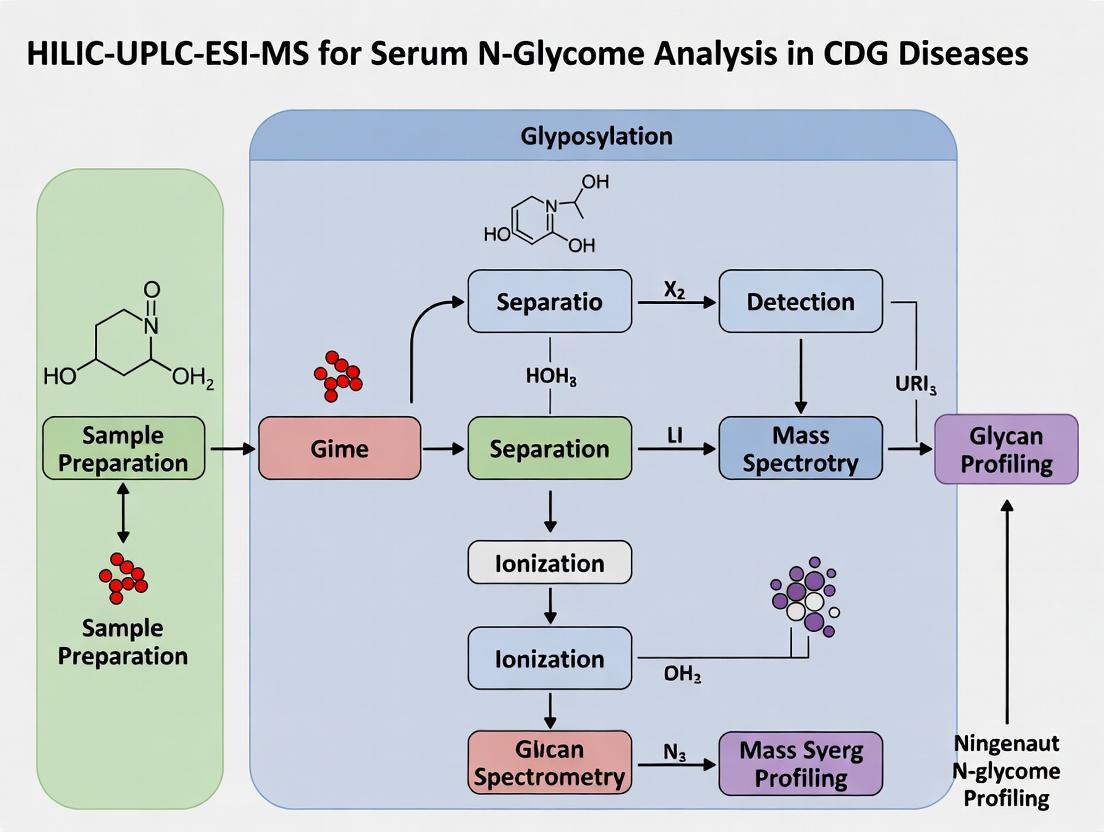
Congenital Disorders of Glycosylation (CDGs) represent a complex group of metabolic diseases with significant diagnostic challenges.
Advancing CDG Diagnosis: A Comprehensive Guide to Serum N-Glycome Analysis Using HILIC-UPLC-ESI-MS
Abstract
Congenital Disorders of Glycosylation (CDGs) represent a complex group of metabolic diseases with significant diagnostic challenges. This article provides a detailed technical guide for researchers and drug development professionals on the application of Hydrophilic Interaction Liquid Chromatography coupled with Ultra-Performance Liquid Chromatography and Electrospray Ionization Mass Spectrometry (HILIC-UPLC-ESI-MS) for the analysis of the serum N-glycome as a critical biomarker source for CDGs. We explore the fundamental principles linking glycosylation defects to CDG pathology, deliver a step-by-step methodological protocol from sample preparation to data acquisition, address common troubleshooting and optimization strategies to enhance sensitivity and reproducibility, and validate the approach through comparative analysis with other diagnostic techniques. This resource aims to establish HILIC-UPLC-ESI-MS as a robust, high-throughput platform for CDG screening, biomarker discovery, and monitoring therapeutic interventions.
The Glycosylation Blueprint: Understanding N-Glycans as Biomarkers for Congenital Disorders of Glycosylation (CDGs)
Abstract Congenital Disorders of Glycosylation (CDGs) are a rapidly expanding group of over 150 inherited metabolic diseases caused by defects in the synthesis and processing of glycans. This article details the application of hydrophilic interaction liquid chromatography coupled with ultra-performance liquid chromatography-electrospray ionization mass spectrometry (HILIC-UPLC-ESI-MS) for serum N-glycome profiling. This protocol serves as a core analytical method within a thesis focused on elucidating disease biomarkers, characterizing clinical heterogeneity, and monitoring therapeutic interventions in CDG research and drug development.
The CDG Landscape: Deficiencies and Heterogeneity
CDGs are categorized into two primary groups: disorders of protein N-glycosylation (CDG-I) and O-glycosylation (CDG-II), and disorders of lipid glycosylation and other pathways. The clinical presentation is profoundly heterogeneous, ranging from severe multi-systemic involvement (neurological deficits, coagulopathies, hepatopathy) to milder, tissue-specific phenotypes. This heterogeneity complicates diagnosis and necessitates precise biochemical stratification.
Table 1: Selected CDG Types, Deficient Enzymes, and Key Serum N-Glycan Biomarkers
| CDG Type | Defective Gene/Enzyme | Pathway | Characteristic Serum N-Glycan Signature (HILIC-UPLC-ESI-MS) | Primary Clinical Features |
|---|---|---|---|---|
| PMM2-CDG (Ia) | PMM2/Phosphomannomutase 2 | N-linked | ↓ Dihydrid, ↑ Monohydrid & Asialo, ↓ Trisialo, ↓ Tetrasialo | Severe: psychomotor disability, stroke-like episodes, coagulopathy. |
| ALG6-CDG (Ic) | ALG6/Glucosyltransferase 1 | N-linked | ↑ Glc1Man9GlcNAc2 isomer (Glc1) | Moderate: hypotonia, epilepsy, bleeding tendency. |
| ATP6AP1-CDG | ATP6AP1/V-ATPase assembly factor | N & O-linked | Complex pattern with ↑ of truncated structures | Immunodeficiency, hepatopathy, neurological symptoms. |
Core Protocol: HILIC-UPLC-ESI-MS for Serum N-Glycome Analysis
This protocol describes the reproducible preparation and analysis of native (underivatized) serum N-glycans.
Materials and Reagent Solutions
Research Reagent Solutions
| Item | Function/Explanation |
|---|---|
| PNGase F (Roche) | Enzyme cleaves N-glycans from glycoproteins at the asparagine site. |
| 96-Well Protein Precipitation Plate (Orochem) | For high-throughput serum protein precipitation and clean-up. |
| HILIC-UPLC Column (Waters, BEH Amide, 1.7µm, 2.1x150mm) | Stationary phase for separating glycans by hydrophilic interaction. |
| Mass Spectrometer (e.g., Xevo G3 QTOF, Waters) | ESI-MS detection for accurate mass and structural profiling. |
| Mobile Phase A: 50mM Ammonium Formate, pH 4.4 | Aqueous buffer for HILIC separation. |
| Mobile Phase B: Acetonitrile | Organic solvent for HILIC separation. |
| 2-AB Labeling Kit (Ludger) | Optional protocol: Fluorescent labeling for sensitive detection with fluorescence. |
| Glycan Release & Labeling System (AutoGlyco, Waters) | Optional: Automated platform for high-throughput glycan processing. |
Detailed Experimental Protocol
Part A: N-Glycan Release and Purification
- Serum Denaturation: Dilute 10 µL of human serum with 40 µL of HPLC-grade water and 50 µL of 2% (w/v) SDS in a 0.5 mL LoBind tube. Heat at 60°C for 10 min.
- Detergent Removal & Enzymatic Release: Add 25 µL of 4% (v/v) Igepal-CA630. Add 10 µL of 10x PBS (pH 7.5) and 2 µL (≥20 mU) of PNGase F. Incubate at 37°C for 18 hours.
- Glycan Clean-up: Load the digest onto a pre-conditioned (with 200 µL methanol, then 200 µL water) 96-well protein precipitation plate. Collect the flow-through containing released glycans. Dry the eluate in a vacuum concentrator.
Part B: HILIC-UPLC-ESI-MS Analysis
- Sample Reconstitution: Reconstitute dried glycans in 100 µL of 75% (v/v) acetonitrile.
- UPLC Conditions:
- Column: BEH Amide, 1.7 µm, 2.1 x 150 mm.
- Column Temp.: 60°C.
- Flow Rate: 0.4 mL/min.
- Gradient: 75-62% B over 25 min (linear), then 62-50% B over 10 min, followed by column re-equilibration.
- Injection Volume: 5-10 µL (partial loop).
- ESI-MS Detection:
- Mode: Negative ion sensitivity mode.
- Capillary Voltage: 2.0 kV.
- Source Temp.: 120°C.
- Desolvation Temp.: 350°C.
- Cone Voltage: 40 V.
- Mass Range: m/z 500-2000.
- Lock Mass: Leucine Enkephalin ([M-H]⁻ = m/z 554.2615) for real-time mass correction.
Part C: Data Processing
- Process raw data using proprietary (e.g., UNIFI, Waters) or open-source (Glycomics@ExPASy tools) software.
- Align chromatograms, integrate peaks, and assign compositions based on accurate mass (using [M-H]⁻ or [M+Cl]⁻ adducts) and known HILIC elution order.
- Express data as relative percentage abundances of individual glycan species within the total integrated profile.
Visualization of Workflow and Pathogenesis
CDG Analysis via Serum N-Glycomics Workflow
N-Glycan Biosynthesis Pathway with CDG Defect Sites
Serum N-glycans represent a dynamic, integrated readout of systemic protein glycosylation. Their analysis provides a non-invasive window into physiological and pathological states, making them invaluable biomarkers. Within Congenital Disorders of Glycosylation (CDG) research, profiling the serum N-glycome via hydrophilic interaction liquid chromatography coupled with electrospray ionization mass spectrometry (HILIC-UPLC-ESI-MS) is a cornerstone for diagnosis, biomarker discovery, and therapeutic monitoring.
Quantitative Data on Serum N-Glycan Alterations in CDG
Table 1: Characteristic Serum N-Glycan Profile Shifts in Major CDG Types
| CDG Type (Gene) | Key Glycan Feature | Quantitative Change (vs. Healthy Control) | Typical HILIC-UPLC Peak (GU) | Associated MS Ion ([M+Na]+) |
|---|---|---|---|---|
| PMM2-CDG (PMM2) | Loss of complete glycans | ↑ Dihydroxy- & Monohydroxy- glycans (A2G0, A2G1) | GU 4.5-5.5 | 1252.4, 1414.5 |
| Decreased sialylation | ↓ Tri- & Tetra-sialylated glycans (A3G3S3, A4G4S4) | GU 8.5-10.5 | 3192.1, 3545.3 | |
| ALG6-CDG (ALG6) | Increased oligomannose | ↑ Man5-9GlcNAc2 (M5-M9) | GU 5.8-7.2 | 1580.6, 1742.7, 1904.8 |
| Truncated hybrid glycans | Presence of hybrid-type glycans | GU ~6.5 | 1837.7 | |
| MPI-CDG (MPI) | Hypoglycosylation pattern | ↑ A2G0, FA2G0 (underoccupancy) | GU 4.2, 5.1 | 1252.4, 1485.5 |
| SLC35A2-CDG (SLC35A2) | Reduced sialylation & galactosylation | ↓ Sialylated glycans (e.g., FA2G2S2) | GU 8.2 | 2602.9 |
| ↑ Agalactosylated glycans (FA2G0) | GU 5.1 | 1485.5 |
Table 2: Diagnostic Performance of Key N-Glycan Ratios in CDG Screening
| Diagnostic Ratio (Glycan Structure) | CDG Type | Cut-off Value | Sensitivity | Specificity | AUC |
|---|---|---|---|---|---|
| (M5 + M6 + M7 + M8 + M9) / Total Glycans | ALG6-CDG | >0.15 | 98% | 99% | 0.99 |
| (A2G0 + A2G1) / FA2G2S2 | PMM2-CDG | >2.5 | 95% | 97% | 0.98 |
| FA2G0 / FA2G2S2 | Multiple (N-glycosylation defects) | >1.0 | 92% | 94% | 0.96 |
Detailed Experimental Protocols
Protocol 1: Serum N-Glycan Release, Purification, and Labeling for HILIC-UPLC-ESI-MS
Objective: To isolate, label, and purify N-linked glycans from human serum for downstream analysis.
Materials:
- 10 µL of human serum.
- Protein Deglycosylation Mix (e.g., PNGase F, recombinant, glycerol-free).
- 96-well Protein A/G plate for IgG depletion (optional for specific profiling).
- Non-porous graphitized carbon (SPE Carbon cartridges, 100 mg).
- 2-aminobenzamide (2-AB) labeling reagent.
- Sodium cyanoborohydride (in THF).
- Dimethyl sulfoxide (DMSO), glacial acetic acid.
- Acetonitrile (ACN), HPLC-grade water.
Procedure:
- Serum Denaturation & IgG Depletion (Optional):
- Dilute 10 µL serum with 40 µL 20 mM ammonium bicarbonate, pH 7.8.
- Heat at 95°C for 5 min, cool on ice.
- For IgG depletion, load denatured sample onto equilibrated Protein A/G plate, collect flow-through.
N-Glycan Release:
- Add 2 µL PNGase F (500 U/µL) to the sample (≈50 µL total volume).
- Incubate at 37°C for 18 hours in a thermomixer (300 rpm).
Glycan Purification via Solid-Phase Extraction (SPE):
- Activate a carbon SPE cartridge with 3 mL 80% ACN / 0.1% TFA.
- Equilibrate with 3 mL 0.1% TFA in water.
- Load the PNGase F digest (adjust to >95% aqueous).
- Wash with 5 mL 0.1% TFA.
- Elute glycans with 2 mL 40% ACN / 0.1% TFA, followed by 2 mL 60% ACN / 0.1% TFA. Collect eluates.
2-AB Fluorescent Labeling:
- Dry eluates completely in a vacuum concentrator.
- Prepare labeling solution: 25 µL DMSO/acetic acid (70:30 v/v) containing 0.35 M 2-AB and 1.0 M sodium cyanoborohydride.
- Resuspend dried glycans in 25 µL labeling solution.
- Incubate at 65°C for 2 hours.
Clean-up of Labeled Glycans:
- Use a fresh carbon SPE cartridge or hydrophilic interaction SPE.
- For HILIC-SPE: Equilibrate with water, condition with 95% ACN. Load labeled reaction in >85% ACN. Wash with 95% ACN. Elute with water.
- Dry and reconstitute in 100 µL 70% ACN for HILIC-UPLC injection.
Protocol 2: HILIC-UPLC-ESI-MS Analysis of 2-AB Labeled N-Glycans
Objective: To separate and detect serum N-glycans via HILIC-UPLC with fluorescence detection and online ESI-MS.
Materials:
- Acquity UPLC H-Class PLUS system with FLR detector.
- Acquity UPLC Glycan BEH Amide column, 130Å, 1.7 µm, 2.1 x 150 mm.
- Mass spectrometer (e.g., Xevo G3 QTOF or similar) with ESI source.
- Solvent A: 50 mM ammonium formate, pH 4.5.
- Solvent B: 100% Acetonitrile.
UPLC Conditions:
- Column Temperature: 40°C
- Sample Temperature: 10°C
- Injection Volume: 10 µL (partial loop mode)
- Flow Rate: 0.4 mL/min
- Gradient:
Time (min) %A %B Curve 0 30 70 6 38 47 53 6 39 70 30 6 41 70 30 6 42 30 70 6 50 30 70 6
Detection:
- Fluorescence (FLR): λex = 330 nm, λem = 420 nm. Used for relative quantification (peak area %).
- ESI-MS (Positive Ion Mode):
- Capillary Voltage: 2.8 kV
- Cone Voltage: 40 V
- Source Temp: 120°C
- Desolvation Temp: 350°C
- Desolvation Gas: 800 L/hr
- Scan Range: m/z 500-2500
- Data Acquisition: Continuum mode.
Data Processing:
- Assign glycan structures using a combination of Glucose Unit (GU) values from external dextran ladder and m/z from MS/MS fragmentation.
- Use automated processing software (e.g., UNIFI, GlycoWorkbench) for peak picking, integration, and GU calculation.
- Normalize FLR peak areas to total area to obtain % abundance.
Diagrams
Title: Serum N-Glycan Analysis Workflow for CDG Research
Title: CDG Pathogenesis to Serum N-Glycome Impact Pathway
The Scientist's Toolkit: Essential Research Reagent Solutions
Table 3: Key Reagents and Materials for Serum N-Glycome Analysis in CDG
| Item | Function & Rationale | Example Product/Catalog # |
|---|---|---|
| Recombinant PNGase F (glycerol-free) | Essential enzyme for releasing N-glycans from glycoproteins. Glycerol-free form is optimal for downstream MS. | Promega, Cat# V4831 |
| 2-Aminobenzamide (2-AB) | Fluorescent label for glycans, enabling sensitive UPLC-FLR detection and providing a charged moiety for improved ESI-MS ionization. | Sigma-Aldrich, Cat# 143879 |
| SPE Cartridges (Graphitized Carbon, 100 mg) | Purifies released glycans from salts, peptides, and detergents. High affinity for oligosaccharides. | Waters, Cat# 186004840 |
| HILIC UPLC Column (BEH Amide, 1.7 µm) | Provides high-resolution separation of glycans based on hydrophilicity. BEH technology ensures robustness. | Waters, Cat# 186004742 |
| Dextran Hydrolysate Ladder | Standard for assigning Glucose Unit (GU) values to unknown glycan peaks, enabling structural assignment. | Waters, Cat# 186006963 |
| Protein A/G Depletion Plate | Removes abundant IgG to reduce dynamic range and uncover lower-abundance glycoproteins in serum. | Thermo Fisher, Cat# 89949 |
| Ammonium Formate, MS Grade | Used to prepare mobile phase for HILIC; volatile salt compatible with ESI-MS. | Fluka, Cat# 78314 |
| GlycoWorkbench Software | Open-source tool for predicting structures from MS/MS data and drawing glycan cartoons. | EUROCarbDB |
Within the framework of advancing the diagnosis and understanding of Congenital Disorders of Glycosylation (CDG), the detailed analysis of the serum N-glycome is paramount. CDGs are a rapidly expanding group of over 150 rare genetic diseases caused by defects in the synthesis and processing of glycans. The serum N-glycome serves as a rich, accessible source of biomarkers reflecting systemic glycosylation status. A robust analytical platform capable of high-resolution separation, sensitive detection, and structural characterization of complex glycan mixtures is essential. The synergy of Hydrophilic Interaction Liquid Chromatography (HILIC), Ultra-Performance Liquid Chromatography (UPLC), and Electrospray Ionization Mass Spectrometry (ESI-MS) constitutes the gold-standard methodology for this task, enabling high-throughput profiling with detailed compositional and isomeric information critical for identifying CDG-specific glycan signatures.
Core Principles of the Combined Platform
HILIC: Separation by Hydrophilicity
HILIC operates on the principle of partitioning analytes between a water-rich layer immobilized on a polar stationary phase (e.g., amide, silica) and a hydrophobic organic mobile phase (e.g., acetonitrile). Glycans, being highly hydrophilic, are retained strongly. Elution is achieved by a decreasing organic gradient, separating glycans primarily by polarity/size, with smaller, more polar glycans (e.g., high-mannose) eluting later than larger, less polar structures (e.g., complex, sialylated) in a typical amide-HILIC setup. This mechanism is ideal for separating underivatized, native glycans.
UPLC: Enhanced Efficiency via Small Particles
UPLC utilizes columns packed with sub-2µm particles and instrumentation capable of withstanding very high pressures (>15,000 psi). The reduced particle size dramatically increases theoretical plates, enhancing chromatographic resolution, peak capacity, and sensitivity while reducing run times and solvent consumption compared to conventional HPLC. This is critical for resolving the vast structural diversity of glycan isomers present in biological samples like serum.
ESI-MS: Soft Ionization for Intact Analysis
ESI is a "soft" ionization technique that produces gas-phase ions directly from a liquid solution by applying a high voltage to create a fine aerosol. It is exceptionally suited for polar, thermally labile molecules like glycans, generating intact molecular ions (e.g., [M+H]⁺, [M+Na]⁺, [M-H]⁻). When coupled with HILIC-UPLC, ESI provides online mass detection, enabling accurate mass determination, compositional assignment based on m/z, and, with tandem MS (MS/MS), detailed structural elucidation through fragmentation patterns.
Synergistic Advantages for Glycan Profiling
The combination is ideal because:
- HILIC provides excellent separation of glycan isomers based on their hydrophilic interactions.
- UPLC delivers this separation with unprecedented speed, resolution, and sensitivity.
- ESI-MS gently and efficiently ionizes the separated glycans for precise mass measurement and sequencing.
- The online coupling allows for high-throughput, reproducible analysis of complex samples, generating both retention time (isomer-specific) and mass (composition-specific) data in a single run.
Application Notes for Serum N-Glycome Analysis in CDG Research
Objective: To comprehensively profile the native underivatized serum N-glycome to identify disease-specific alterations in CDG patients versus healthy controls.
Sample: Human serum (or plasma).
Key Findings from Recent Studies: Quantitative profiling reveals consistent alterations in CDG patients. The table below summarizes common trends observed across multiple CDG types (e.g., PMM2-CDG, ALG6-CDG).
Table 1: Characteristic Serum N-Glycan Alterations in CDG vs. Healthy Controls
| Glycan Feature | Trend in CDG (vs. Control) | Proposed Biochemical Basis | Potential Diagnostic Utility |
|---|---|---|---|
| M5 (Man₅GlcNAc₂) | ↑ Increased | Under-occupancy of glycosylation sites; truncation of biosynthesis. | Primary screening marker. |
| Hybrid Glycans | ↑ Increased | Incomplete processing in Golgi. | Indicator of processing defects. |
| Sialylation (Total) | ↓ Decreased | Reduced transporter activity (SLC35A1) or sialyltransferase function. | Marker for specific CDG subtypes. |
| Fucosylation (Core) | ↓ Decreased | Impaired fucosyltransferase activity or GDP-fucose transport. | Seen in SLC35C1-CDG (Leukocyte Adhesion Deficiency II). |
| Galactosylation | ↓ Decreased | Impaired galactosyltransferase activity. | Common in multiple CDG types. |
| Complex Glycans (A2, A3, A4) | ↓ Decreased | Global reduction in fully processed structures. | General indicator of severe glycosylation impairment. |
Data Interpretation: The ratio of under-processed (e.g., M5, hybrid) to fully processed complex glycans is a robust diagnostic index. Specific patterns (e.g., isolated hyposialylation) can guide genetic testing towards particular pathways.
Detailed Experimental Protocol: HILIC-UPLC-ESI-MS of Serum N-Glycans
Workflow Title: Serum N-Glycan Release, Purification, and HILIC-UPLC-ESI-MS Analysis.
Protocol Steps:
A. N-Glycan Release from Serum Proteins
- Denaturation: Dilute 10 µL of serum with 30 µL of 50 mM ammonium bicarbonate. Add 10 µL of 1% (w/v) SDS. Heat at 60°C for 10 min.
- Reduction & Alkylation (Optional but recommended): Add 5 µL of 0.5 M DTT, incubate 30 min at 60°C. Cool, then add 5 µL of 1 M iodoacetamide, incubate 30 min at RT in the dark.
- Enzymatic Release: Add 300-400 Units of PNGase F (recombinant, glycerol-free). Incubate at 37°C for 18-24 hours.
B. Glycan Purification (Solid-Phase Extraction - SPE)
- Peptide Precipitation: Add 4 volumes of cold absolute ethanol to the digestion mix. Vortex and incubate at -20°C for 2 hours. Centrifuge at 13,000 x g for 15 min.
- HILIC-SPE (Porous Graphitized Carbon or Hydrophilic):
- Conditioning: Load a packed microcolumn (or tip) with 1 bed volume of acetonitrile (ACN), then 3 bed volumes of water.
- Loading: Apply the ethanol supernatant (containing glycans) directly to the conditioned column.
- Washing: Wash with 10-15 bed volumes of water to remove salts and buffers.
- Elution: Elute glycans with 2-3 bed volumes of 40% ACN / 0.1% TFA (for graphitic carbon) or 20% ACN / 0.1% TFA (for hydrophilic resin). Collect eluate.
- Drying: Dry the eluate completely in a vacuum concentrator.
C. HILIC-UPLC Analysis
- Reconstitution: Reconstitute dried glycans in 50-100 µL of 75% ACN.
- Column: Acquity UPLC BEH Glycan Column (1.7 µm, 2.1 x 150 mm) or equivalent.
- Mobile Phases: A) 50 mM ammonium formate, pH 4.5 (adjust with formic acid); B) 100% ACN.
- Gradient (Example): 75-65% B over 30 min at 0.4 mL/min, 40°C. Equilibration: 5 min at starting conditions.
- Injection: 5-10 µL partial loop injection.
D. ESI-MS Detection
- Ionization: Negative ion mode ESI.
- Source Parameters: Capillary voltage: 2.8 kV; Source temp: 120°C; Desolvation temp: 350°C; Cone gas: 50 L/hr; Desolvation gas: 800 L/hr.
- Mass Analysis: Full scan MS (m/z 500-2000). Data-dependent MS/MS on top 3-5 ions per scan for structural confirmation.
E. Data Processing
- Use dedicated software (e.g., UNIFI, GlycoWorkbench, MassHunter) for peak picking, alignment, and annotation using retention time and accurate mass databases.
- Quantify by peak area or height. Normalize to total area under the chromatogram or an internal standard.
The Scientist's Toolkit: Key Research Reagent Solutions
Table 2: Essential Materials for Serum N-Glycome Analysis via HILIC-UPLC-ESI-MS
| Item | Function & Rationale | Example/Supplier (Informational) |
|---|---|---|
| PNGase F (Glycerol-free) | Recombinant enzyme for efficient, non-destructive release of N-glycans from glycoproteins. Essential for native analysis. | Roche, NEB, ProZyme |
| Ammonium Bicarbonate | Volatile buffer for digestion; easily removed during SPE and drying, preventing ion suppression in MS. | Sigma-Aldrich |
| SDS (Sodium Dodecyl Sulfate) | Denaturant to unfold serum proteins, making N-glycosylation sites accessible to PNGase F. | Various |
| Ethanol (HPLC Grade) | For precipitation of proteins and peptides post-digestion, leaving glycans in the supernatant. | Various |
| Porous Graphitized Carbon (PGC) SPE Cartridges/Tips | Highly effective for desalting and purifying native glycans; retains isomers. | Glygen, Thermo Scientific |
| Acetonitrile (LC-MS Grade) | Primary organic mobile phase for HILIC. High purity is critical for low background noise in MS. | Various |
| Ammonium Formate | Volatile salt for HILIC mobile phase; provides excellent separation and ESI-MS compatibility. | Fluka, Sigma-Aldrich |
| UPLC BEH Glycan Column | Standard column with bridged ethylene hybrid amide stationary phase, optimized for high-resolution glycan separations. | Waters Corporation |
| Internal Standard (e.g., [¹³C₆]-M5) | Isotopically labeled glycan added at digestion start to monitor and correct for sample preparation variability. | Custom synthesis |
| Glycan Mass Standards | Dextran ladder or defined glycan pools for system calibration and alignment. | Waters, Ludger |
Pathway Diagram: Impact of CDG Defects on N-Glycan Biosynthesis
Diagram Title: Simplified N-Glycan Biosynthesis Pathway and CDG Disruption Points.
Within the broader thesis on advancing HILIC-UPLC-ESI-MS for serum N-glycome analysis in CDG research, this document details the specific correlation between defined genetic defects and their resulting serum N-glycan fingerprints. Precise glycan profiling serves as a critical diagnostic and research tool, enabling the correlation of specific CDG types (e.g., PMM2-CDG, ALG6-CDG) with characteristic alterations in the serum N-glycome, thereby bridging genotype and biochemical phenotype.
Characteristic N-Glycome Alterations in Specific CDG Types
The following table summarizes key quantitative alterations in serum N-glycans associated with common CDG types, as identified via HILIC-UPLC-ESI-MS analysis.
Table 1: Serum N-Glycome Alterations in Selected CDG Types
| CDG Type (Gene) | Defective Step | Characteristic N-Glycome Alteration (vs. Healthy Control) | Proposed Diagnostic Ratio/Marker |
|---|---|---|---|
| PMM2-CDG (Ia) | Early Cytosolic (Mannose-6-P → Mannose-1-P) | Severe decrease in total complex-type glycans (>70%). Increase in truncated (Man5GlcNAc2, Man6GlcNAc2) and hybrid structures. | [Man5]/[A2G2S2] ratio >10 (Highly specific) |
| ALG6-CDG (Ic) | Early ER (Glc3Man9GlcNAc2 synthesis) | Increase in truncated oligomannose structures (Man7GlcNAc2 to Man9GlcNAc2). Mild reduction in complex glycans. | [(Man7+Man8+Man9)/[A2G2S1] > 2.5 |
| ALG12-CDG (Ig) | ER (Man7 to Man8 addition) | Prominent increase in specific truncated oligomannose (Man7GlcNAc2). Decrease in Man8/Man9 and complex glycans. | [Man7GlcNAc2] peak area > 15% of total glycome |
| MGAT2-CDG (IIa) | Golgi (Complex branching, GlcNAc-TII) | Profound loss of tri-, tetra-antennary complex glycans. Near-total dominance of di-antennary glycans (>90% of complex type). | [A2G2S2]/[A3G3S3] ratio > 50 |
| SLC35A1-CDG (IIf) | Golgi (CMP-Sialic Acid Transport) | Severe hyposialylation across all complex glycans. Increase in asialo- and monosialylated structures. | % Di-sialylation of A2G2 < 20% |
Core Experimental Protocols
Protocol 3.1: Serum N-Glycan Release, Purification, and Labeling for HILIC-UPLC-ESI-MS
Objective: To isolate, label, and prepare serum N-glycans for high-resolution profiling.
Materials: See "The Scientist's Toolkit" (Section 5). Procedure:
- Serum Denaturation & Deglycosylation: Dilute 10 µL of human serum with 40 µL of 20 mM ammonium bicarbonate buffer (pH 7.5). Denature at 95°C for 5 min. Cool, add 1.2 µL of 2.5% (w/v) SDS, and incubate at 65°C for 15 min.
- Detergent Inactivation: Add 4 µL of 15% (v/v) Igepal-CA630, mix thoroughly.
- PNGase F Digestion: Add 2 µL (≥10 mU) of recombinant PNGase F. Incubate at 37°C for 18 hours.
- Glycan Purification: Apply the digest to a pre-washed (with 1 mL of 5% acetic acid, then 1 mL H₂O) PGC-SPE cartridge. Wash with 10 column volumes of H₂O. Elute glycans with 1 mL of 25% acetonitrile/0.1% TFA, followed by 1 mL of 50% acetonitrile/0.1% TFA. Combine eluates and dry in a vacuum concentrator.
- Fluorescent Labeling: Reconstitute dried glycans in 10 µL of 2% (v/v) acetic acid in DMSO. Add 10 µL of 50 mM 2-AB labeling solution (in DMSO:Acetic Acid, 70:30 v/v) and 10 µL of 2.0 M NaBH₃CN in DMSO. Incubate at 65°C for 2 hours.
- Cleanup of Labeled Glycans: Purify using hydrophilic-lipophilic balance (HLB) SPE. Condition cartridge with 1 mL MeOH, then 1 mL H₂O. Load sample. Wash with 1 mL H₂O. Elute glycans with 1 mL of 20% acetonitrile. Dry eluate and reconstitute in 100 µL of 70% acetonitrile for UPLC-MS analysis.
Protocol 3.2: HILIC-UPLC-ESI-MS Analysis of 2-AB Labeled N-Glycans
Objective: To separate and analyze labeled serum N-glycans.
Instrumentation: Acquity UPLC H-Class System coupled to a Q-TOF mass spectrometer (e.g., Xevo G2-XS) with ESI source. Chromatography:
- Column: Waters BEH Glycan, 1.7 µm, 2.1 x 150 mm.
- Mobile Phase: A = 50 mM ammonium formate, pH 4.5. B = Acetonitrile.
- Gradient: 70% B to 53% B over 40 min, at 0.4 mL/min. Column temp: 60°C. Sample temp: 10°C.
- Injection: 10-15 µL of reconstituted sample. Mass Spectrometry:
- Ionization Mode: ESI-positive.
- Capillary Voltage: 2.8 kV.
- Source Temp: 120°C.
- Desolvation Temp: 350°C.
- Cone Gas: 50 L/hr, Desolvation Gas: 600 L/hr (N₂).
- Scan Range: m/z 500-2000. Data processed with UNIFI or equivalent software using a glycan database.
Visualization of Workflow & Pathway Correlations
Title: CDG Diagnosis via Serum N-Glycan Analysis Workflow
Title: ER Glycosylation Defects in PMM2-CDG vs. ALG6-CDG
The Scientist's Toolkit: Key Research Reagent Solutions
Table 2: Essential Materials for Serum N-Glycome Analysis in CDG Research
| Item / Reagent | Function / Application in Protocol | Key Considerations |
|---|---|---|
| Recombinant PNGase F (Glycerol-free) | Enzymatic release of intact N-glycans from serum glycoproteins. | High purity ensures complete release. Glycerol-free is optimal for downstream MS. |
| Porous Graphitic Carbon (PGC) SPE Cartridges | Purification of released native glycans from salts, peptides, and detergents. | Excellent retention of hydrophilic oligosaccharides. Requires specific elution solvents (ACN/TFA). |
| 2-Aminobenzamide (2-AB) Labeling Kit | Fluorescent tagging of glycans for UPLC detection with minimal mass addition for MS. | Provides sensitive detection and stabilizes sialic acids. Must include NaBH₃CN as reductant. |
| Acquity UPLC BEH Glycan Column | High-resolution HILIC separation of labeled glycans based on size, composition, and polarity. | 1.7 µm particle size, 150 mm length for optimal separation. Requires specific HILIC mobile phases. |
| Ammonium Formate (LC-MS Grade) | Mobile phase buffer for HILIC separation. Provides volatile salt compatible with ESI-MS. | pH must be carefully adjusted to 4.5 for optimal separation and ionization. |
| Sialidase (Neuraminidase) Enzyme | Controlled desialylation for glycan structural confirmation and simplification of profiles. | Used in parallel experiments to confirm sialylated glycan identities. |
| N-Glycan Primary Standard (e.g., A2G2) | Chromatographic retention time calibrant and quality control for the platform. | Essential for aligning runs and confirming system performance. |
Congenital Disorders of Glycosylation (CDG) are a rapidly expanding group of over 150 rare, multisystemic metabolic diseases caused by defects in the synthesis and attachment of glycans to proteins and lipids. The diagnostic landscape for CDG remains challenging, characterized by clinical heterogeneity and the complexity of glycan structures. Traditional diagnostic methods, including isoelectric focusing (IEF) of transferrin and gene panel sequencing, have significant limitations. IEF, while a first-line screen, lacks specificity, provides low resolution, and cannot identify specific glycan structures or many newer CDG types. There is a critical unmet need for high-throughput, detailed glycan analysis to enable precise diagnosis, biomarker discovery, and therapeutic monitoring.
The Role of HILIC-UPLC-ESI-MS in Serum N-Glycome Analysis
Hydrophilic Interaction Liquid Chromatography coupled with Ultra-Performance Liquid Chromatography and Electrospray Ionization Mass Spectrometry (HILIC-UPLC-ESI-MS) has emerged as a powerful platform to address this need. This technology enables the high-resolution separation, quantification, and structural characterization of the total serum N-glycome—the collection of all N-linked glycans released from serum glycoproteins. Its high sensitivity, reproducibility, and throughput make it ideal for detecting the subtle, disease-specific glycan alterations characteristic of various CDG subtypes.
Application Notes
High-Throughput Screening for CDG
HILIC-UPLC-ESI-MS allows for the batch processing of hundreds of serum samples. It generates a comprehensive quantitative glycan profile (glycan fingerprint) that can serve as a primary diagnostic screen. Abnormal profiles, such as the absence of entire glycan branches (e.g., loss of sialylation in MPI-CDG) or the presence of truncated structures (e.g., in PMM2-CDG), are rapidly identifiable.
Subtype Differentiation and Biomarker Discovery
Beyond initial screening, detailed structural data from MS/MS fragmentation can differentiate between CDG subtypes that may present with similar total glycan profiles. Specific ratios or the presence of unique low-abundance glycans can serve as potential biomarkers for specific genetic defects.
Monitoring Therapeutic Efficacy
For the few treatable CDGs (e.g., MPI-CDG treated with mannose), serial HILIC-UPLC-ESI-MS analysis of the serum N-glycome provides an objective, quantitative measure of biochemical response to treatment, tracking the normalization of glycan profiles over time.
Table 1: Key N-Glycan Features in Common CDG Types
| CDG Type (Gene) | Characteristic N-Glycan Alteration (vs. Healthy Control) | Approximate Fold-Change | Detected By (UPLC / MS / Both) |
|---|---|---|---|
| PMM2-CDG | Increase in truncated (under-sialylated, -galactosylated) structures (e.g., Man5GlcNAc2) | Increase: 3-5x | Both |
| MPI-CDG | Loss of sialylated tri-antennary glycans | Decrease: >10x | Both |
| ALG6-CDG | Increase in mono-glucosylated hybrid-type glycans (Glc1Man5GlcNAc2) | Increase: 8-12x | Primarily MS (isobaric separation) |
| Healthy Control | Dominance of fully sialylated, complex bi- and tri-antennary glycans (e.g., A2G2S2) | Reference Profile | Both |
Experimental Protocols
Protocol 1: Serum N-Glycan Release, Purification, and Labeling for HILIC-UPLC-ESI-MS Analysis
Principle: N-glycans are enzymatically released from serum glycoproteins, purified from peptides and proteins, and fluorescently labeled to enable sensitive UPLC detection with parallel MS characterization.
Materials: See "The Scientist's Toolkit" below.
Procedure:
- Serum Preparation: Dilute 10 µL of human serum with 40 µL of 100 mM ammonium bicarbonate, pH 8.0.
- Denaturation & Reduction: Add 50 µL of 1% (w/v) SDS. Heat at 60°C for 10 min. Cool, then add 10 µL of 1M DTT. Incubate at 60°C for 30 min.
- Alkylation: Cool, add 25 µL of 1M IAA (in dark). Incubate at room temperature for 30 min in the dark.
- Protein Precipitation: Add 1 mL of ice-cold ethanol/acetone (1:1 v/v). Vortex and incubate at -20°C for 2 hours. Centrifuge at 15,000 x g for 15 min at 4°C. Discard supernatant.
- Enzymatic Release: Resuspend protein pellet in 50 µL of 100 mM ammonium bicarbonate, pH 8.0. Add 1.5 µL (750 units) of PNGase F. Incubate at 37°C for 18 hours.
- Glycan Purification: Apply the digestion mixture to a solid-phase extraction (SPE) microcolumn packed with porous graphitized carbon (PGC). Wash with 10 column volumes of water. Elute glycans with 40% (v/v) acetonitrile in water with 0.1% TFA, followed by 60% acetonitrile with 0.1% TFA. Combine and dry eluents in a vacuum centrifuge.
- Fluorescent Labeling: Reconstitute dried glycans in 10 µL of a 2% (v/v) solution of 2-AB in DMSO/acetic acid (70:30 v/v). Incubate at 65°C for 2 hours.
- Clean-up: Purify labeled glycans using SPE with hydrophilic interaction (HILIC) media (e.g., cotton wool or commercial cartridges). Wash with acetonitrile. Elute glycans with water. Dry the eluent.
Protocol 2: HILIC-UPLC-ESI-MS Analysis of 2-AB Labeled N-Glycans
Principle: Labeled glycans are separated by hydrophilicity on a UPLC BEH Amide column and detected in-line via fluorescence (for quantification) and ESI-MS (for mass determination and structural identification).
Materials: See "The Scientist's Toolkit."
Instrument Setup:
- Column: ACQUITY UPLC BEH Glycan, 1.7 µm, 2.1 x 150 mm.
- Mobile Phase A: 50 mM ammonium formate, pH 4.5.
- Mobile Phase B: Acetonitrile.
- Gradient: 75-62% B over 40 min at 0.4 mL/min, 40°C.
- Fluorescence Detection: λex = 330 nm, λem = 420 nm.
- MS Conditions: ESI positive ion mode; capillary voltage 3.0 kV; source temperature 120°C; desolvation temperature 350°C; cone voltage 40 V; mass range 500-2500 m/z.
Procedure:
- Reconstitute purified 2-AB labeled glycans in 100 µL of 70% acetonitrile.
- Inject 5-10 µL onto the HILIC-UPLC system.
- Acquire fluorescence chromatogram (Glycan Profile) and full MS scan data simultaneously.
- For structural confirmation, select precursor ions from the MS scan for CID fragmentation in a subsequent run (MS/MS mode).
Visualizations
Title: Serum N-Glycan Analysis Workflow for CDG Research
Title: Evolving CDG Diagnostic Algorithm with Glycomics
The Scientist's Toolkit: Research Reagent Solutions
Table 2: Essential Materials for Serum N-Glycome Analysis via HILIC-UPLC-ESI-MS
| Item | Function / Role in Protocol | Example Product / Specification |
|---|---|---|
| PNGase F | Enzyme that cleaves N-linked glycans from glycoproteins at the asparagine residue. Critical for glycan release. | Recombinant, Glycerol-free, >5000 U/mL |
| 2-Aminobenzamide (2-AB) | Fluorescent label for glycans. Enables highly sensitive UPLC fluorescence detection and improves MS ionization. | ≥99% purity, supplied as solid. |
| Porous Graphitized Carbon (PGC) | Solid-phase extraction media for purifying released native glycans from salts, peptides, and detergents. | SPE cartridges or bulk powder. |
| UPLC BEH Amide Column | Stationary phase for HILIC separation. Separates glycans based on hydrophilicity/size with high resolution. | ACQUITY UPLC BEH Glycan Column, 1.7µm, 2.1x150mm. |
| Ammonium Formate, pH 4.5 | Volatile buffer for HILIC mobile phase. Compatible with ESI-MS, prevents adduct formation. | LC-MS grade, prepared fresh. |
| Deuterated Glycan Standard | Labeled internal standard for quantitative MS. Corrects for run-to-run ionization variability. | e.g., [¹²C₆]/[¹³C₆] 2-AB labeled dextran ladder oligomers. |
| Serum Protein Denaturation Kit | Standardized reagents for reproducible protein denaturation, reduction, and alkylation. | Includes SDS, DTT, IAA at optimized concentrations. |
A Step-by-Step Protocol: Implementing HILIC-UPLC-ESI-MS for Serum N-Glycome Profiling in CDG Research
This Application Note details standardized protocols for serum sample collection, handling, and storage, tailored for N-glycan profiling using HILIC-UPLC-ESI-MS. This workflow is critical for ensuring data reliability in Congenital Disorders of Glycosylation (CDG) research, where subtle glycan profile alterations are diagnostically significant. Pre-analytical variability is a major confounder in biomarker discovery, making rigorous standardization paramount.
Pre-Analytical Variables & Impact on Serum N-Glycome
Key Variables and Recommended Controls
Based on current literature, the following variables significantly impact serum N-glycome stability and must be controlled.
Table 1: Critical Pre-Analytical Variables and Recommendations
| Variable | Impact on Serum N-Glycome | Evidence-Based Recommendation |
|---|---|---|
| Clotting Time | Alters sialylation and fucosylation levels due to platelet enzyme activity. | Standardize at 30-60 minutes at room temperature (RT). Avoid >2 hours. |
| Centrifugation | Incomplete separation contaminates serum with platelet-derived glycoproteins. | Two-step: 1,500-2,000 × g for 15 min at RT, then transfer and re-centrifuge at 2,500 × g for 10 min. |
| Hemolysis | Releases intracellular glycosidases and proteases, degrades glycans. | Reject samples with hemoglobin >0.2 g/L (visual or spectroscopic check). |
| Temperature & Time Delay to Processing | Progressive loss of sialic acids (especially Neu5Gc in some species) and increased degradation. | Process within 2 hours at RT or within 24 hours if kept at 4°C. For longer delays, aliquot and freeze at -80°C. |
| Freeze-Thaw Cycles | Causes glycan detachment and sialic acid loss. | Maximum 2 cycles. Store in small, single-use aliquots (≥50 µL) at -80°C. |
| Long-Term Storage | Slow degradation even at -80°C; matrix effects from vial adsorption. | Use low-protein-binding tubes. For >1 year, store at -80°C without frost-free cycles. Document storage duration for covariate analysis. |
Quality Indicators for Serum Samples
Table 2: Quality Control Metrics for Serum Suitability in Glycomics
| QC Metric | Method | Acceptable Range for Glycomics |
|---|---|---|
| Total Protein Concentration | Bradford or BCA assay | 60-85 mg/mL (major deviation suggests improper collection) |
| Albumin-to-Globulin (A/G) Ratio | Capillary electrophoresis or LC | ~1.5 - 2.2 (major shifts suggest hemolysis or inflammation) |
| Hemoglobin Presence | Spectrophotometry (414 nm absorbance) | Absorbance <0.25 (path length 1 cm) |
| Visual Inspection | Documentation of lipemia, hemolysis, icterus | Clear, slight yellow. Note and flag any deviation. |
Detailed Experimental Protocols
Protocol: Standardized Serum Collection for Glycomics
Objective: To obtain high-quality serum for N-glycan analysis with minimal pre-analytical bias. Materials: Sterile serum separator tubes (SST), timer, centrifuge, low-protein-binding microtubes, permanent labels. Procedure:
- Phlebotomy: Perform venous draw using a 21G needle. Fill the SST to the indicated volume to ensure proper clotting factor-to-blood ratio.
- Clotting: Invert tube gently 5 times. Place tube vertically in a rack at room temperature (20-25°C) for exactly 30 minutes.
- Initial Centrifugation: Centrifuge at 2,000 × g for 15 minutes at 20°C with no brake.
- Serum Transfer: Using a clean pipette, carefully transfer the supernatant (serum) to a fresh 15 mL polypropylene tube. Avoid aspirating any cells or clot material.
- Secondary Centrifugation: Centrifuge the transferred serum at 2,500 × g for 10 minutes at 20°C to remove any residual platelets or particles.
- Aliquoting & Storage: Immediately aliquot cleared serum into pre-labeled, low-protein-binding cryovials (≥50 µL per vial). Snap-freeze aliquots in liquid nitrogen or a dry-ice/ethanol bath. Transfer to a -80°C freezer for long-term storage. Record freeze time.
Protocol: Serum N-Glycan Release, Purification, and Cleanup for HILIC-UPLC-ESI-MS
Objective: To reproducibly isolate serum N-glycans for downstream profiling. Materials: 96-well protein precipitation plate (e.g., Captiva), PNGase F (Roche), GlycoWorks HILIC μElution Plate (Waters), 2-AB labeling reagent, speed vacuum concentrator, UPLC-MS system. Procedure:
- Protein Denaturation & Digestion:
- Thaw serum aliquot on ice. Pipette 10 µL of serum into a well of a protein precipitation plate.
- Add 20 µL of 1% (w/v) SDS in PBS. Mix and incubate at 60°C for 10 min.
- Add 20 µL of 4% (v/v) Igepal-CA630 in PBS to neutralize SDS.
- Add 10 µL of PNGase F solution (prepared per manufacturer in PBS). Incubate at 37°C for 18 hours.
Glycan Cleanup and Labeling:
- Post-digestion, load the entire mixture onto a conditioned HILIC μElution Plate.
- Wash with 200 µL of 85% Acetonitrile (ACN)/1% Formic Acid (FA) five times.
- Elute glycans with 100 µL of ultra-pure water into a 1.5 mL LoBind tube.
- Dry the eluate completely in a speed vacuum concentrator (no heat).
- Redissolve in 5 µL of a 2-AB labeling master mix (19:1 DMSO:Acetic acid with 0.35 M 2-AB). Incubate at 65°C for 2 hours.
Excess Dye Removal:
- Dilute the labeling mixture with 100 µL of 96% ACN.
- Load onto a second conditioned HILIC μElution Plate.
- Wash with 200 µL of 96% ACN five times.
- Elute labeled glycans with 100 µL of ultra-pure water.
- Dry, reconstitute in 50 µL of 75% ACN for HILIC-UPLC-MS injection.
Protocol: Implementing a Pre-Analytical Quality Control Dashboard
Objective: To monitor and document sample integrity from collection to analysis. Procedure:
- Create a sample manifest spreadsheet with fields: Sample ID, Collection Date/Time, Clotting Time, Processing Time Delay, Centrifugation Parameters, Visual QC Score, Hemoglobin Flag, Aliquoting Notes, Freeze/Thaw Count, Storage Location.
- For each sample batch, include a pooled quality control (QC) sample created from a small portion of multiple donor sera, processed identically.
- Prior to glycan release, run the QC sample and 10% of random study samples on a standard clinical chemistry analyzer to obtain A/G ratio and total protein.
- Plot QC sample glycan profiles (e.g., total area, % of major glycan peaks) over time in a control chart (Levey-Jennings plot) to detect analytical drift.
The Scientist's Toolkit: Essential Research Reagent Solutions
Table 3: Key Reagents and Materials for Serum N-Glycomics
| Item | Function | Example/Catalog Consideration |
|---|---|---|
| Serum Separator Tubes (SST) | Promotes clot formation and provides a barrier for clean serum separation. | BD Vacutainer SST II Advance. |
| Low-Protein-Binding Tubes | Minimizes adsorption of low-abundance glycoproteins during storage. | Eppendorf Protein LoBind Tubes. |
| Recombinant PNGase F | Enzyme that specifically releases N-linked glycans from glycoproteins. | Roche, PNGase F, recombinant, MS-grade. |
| 2-Aminobenzamide (2-AB) | Fluorescent label for glycan derivatization, enabling HILIC and MS detection. | Sigma-Aldrich, ≥98% purity. |
| HILIC μElution Plate | Solid-phase extraction for efficient glycan cleanup and dye removal. | Waters, GlycoWorks HILIC μElution Plate. |
| SDS & Igepal-CA630 | Denaturant and non-ionic detergent for protein denaturation and SDS neutralization prior to enzymatic digestion. | Sigma-Aldrich, molecular biology grade. |
| Acetonitrile (MS Grade) | Organic solvent for HILIC cleanup, mobile phases, and sample reconstitution. | Fisher Chemical, Optima LC/MS Grade. |
| Formic Acid (MS Grade) | Mobile phase additive for improving ESI-MS sensitivity and separation. | Fluka, LC-MS LiChropur. |
| Pooled Human Serum (Control) | Provides a consistent background matrix for spike-in experiments and system suitability testing. | BioIVT, Charcoal Stripped or Normal Donor Pool. |
Visualization of Workflows
Title: Serum Collection to MS Analysis Workflow for Glycomics
Title: Pre-Analytical Variable Impact Pathway on N-Glycome
This document details optimized protocols for the enzymatic release of N-glycans from serum glycoproteins using Peptide-N-Glycosidase F (PNGase F), a critical upstream step in the analysis of the serum N-glycome via Hydrophilic Interaction Liquid Chromatography-Ultra Performance Liquid Chromatography-Electrospray Ionization-Mass Spectrometry (HILIC-UPLC-ESI-MS). The application is specifically framed within Congenital Disorders of Glycosylation (CDG) research, where precise glycome profiling is essential for biomarker discovery and understanding disease pathophysiology. Efficient and complete release of N-glycans is paramount for accurate quantitative profiling.
Key parameters influencing PNGase F efficiency were optimized. The following tables summarize the quantitative findings.
Table 1: Effect of Denaturation/Reduction-Alkylation on N-Glycan Yield from Human Serum
| Pre-Treatment Condition | Relative Glycan Yield (%) (vs. Max) | Key Observation |
|---|---|---|
| No Denaturation | 45 ± 8 | Incomplete release, high-mannose glycans underrepresented. |
| Heat Denaturation Only (80°C, 10 min) | 85 ± 5 | Good recovery, but minor bias against complex sialylated structures. |
| Reduction-Alkylation (R/A) + Denaturation | 100 ± 3 | Maximum, reproducible yield across all glycan classes. |
| R/A with Chaotropic Agent (e.g., Guanidine-HCl) | 102 ± 2 | Slight incremental gain; necessary for tightly folded glycoproteins. |
Table 2: Impact of Enzyme-to-Substrate Ratio and Incubation Time
| PNGase F (U per mg protein) | Incubation Time (hrs, 37°C) | Completeness of Release (%) | Risk of O-Glycan Contamination* |
|---|---|---|---|
| 2.5 | 4 | 75 ± 6 | Very Low |
| 5.0 | 4 | 95 ± 3 | Very Low |
| 5.0 | 18 (Overnight) | 99.8 ± 0.5 | Low |
| 10.0 | 18 | 100 | Moderate (if sample is O-glycosylated) |
*Note: PNGase F is specific for N-glycans, but prolonged high enzyme loads may increase non-specific protein digestion.
Table 3: Comparison of Quenching and Glycan Cleanup Methods Post-Release
| Cleanup Method | Recovery of Sialylated Glycans (%) | Recovery of Neutral Glycans (%) | Suitability for HILIC-UPLC-MS |
|---|---|---|---|
| C18 Solid-Phase Extraction (SPE) | 92 ± 4 | 95 ± 3 | Excellent (removes salts, peptides) |
| Porous Graphitized Carbon (PGC) SPE | 95 ± 2 | 90 ± 5 | Excellent (also separates isomers) |
| Ethanol Precipitation | 65 ± 10 | 88 ± 7 | Poor (co-precipitation, high salt) |
| Acetonitrile-induced Protein Crash | 80 ± 8 | 85 ± 6 | Fair (fast, but less clean) |
Detailed Experimental Protocols
Protocol 1: Optimized Denaturation and Reduction-Alkylation of Serum Proteins
Objective: To unfold glycoproteins and break disulfide bonds for maximal PNGase F accessibility. Materials: Human serum (depleted of albumin/IgG recommended), 1.5M Tris-HCl pH 8.0, 8M Guanidine-HCl, 0.5M Dithiothreitol (DTT), 1M Iodoacetamide (IAA), Ammonium bicarbonate (ABC) buffer (50mM, pH 8.0). Procedure:
- Transfer 50 µg of serum protein (in ≤ 20 µL) to a low-binding tube.
- Add 10 µL of 8M Guanidine-HCl and 5 µL of 1.5M Tris-HCl, pH 8.0.
- Add 2.5 µL of 0.5M DTT (final ~50mM). Vortex, spin down, incubate at 56°C for 30 min.
- Cool to room temperature. Add 5 µL of 1M IAA (final ~100mM). Vortex, incubate in the dark for 30 min.
- Quench excess IAA by adding 5 µL of 0.5M DTT.
- Dilute the mixture 10-fold with 50mM ABC buffer to reduce guanidine concentration.
Protocol 2: Enzymatic N-Glycan Release with PNGase F
Objective: To cleave intact N-glycans from the denatured/reduced glycoprotein backbone. Materials: PNGase F (recombinant, glycerol-free preferred), Ammonium bicarbonate buffer (50mM, pH 8.0), Denatured/R-Alkylated sample from Protocol 1. Procedure:
- Adjust the pH of the diluted sample from Protocol 1 to ~8.0 if necessary.
- Add PNGase F at a ratio of 5 Units per 100 µg of starting protein.
- Mix gently and incubate at 37°C for 18 hours (overnight).
- To stop the reaction and precipitate proteins, add 4 volumes of ice-cold absolute ethanol (e.g., 400 µL to 100 µL reaction). Vortex.
- Incubate at -20°C for 2 hours or overnight.
- Centrifuge at 14,000 x g for 15 min at 4°C. Carefully transfer the supernatant (containing released glycans) to a new tube.
- Dry the supernatant in a vacuum concentrator.
Protocol 3: Glycan Cleanup via C18 and Porous Graphitized Carbon (PGC) SPE
Objective: To desalt and purify released N-glycans for downstream HILIC-UPLC-ESI-MS analysis. Materials: C18 SPE cartridges (100 mg), PGC SPE cartridges (10 mg), Acetonitrile (ACN), Trifluoroacetic Acid (TFA) 0.1%, Formic Acid (FA) 0.1%. Procedure for Sequential C18/PGC Cleanup:
- C18 Step (Remove Peptides):
- Condition C18 cartridge with 1 mL 100% ACN, then equilibrate with 2 mL 0.1% TFA.
- Reconstitute dried glycan sample in 200 µL 0.1% TFA, load onto cartridge.
- Wash with 2 mL 0.1% TFA. Glycans (highly hydrophilic) flow through; peptides are retained.
- Collect the flow-through and dry.
- PGC Step (Desalt and Retain Glycans):
- Condition PGC cartridge with 1 mL 80% ACN / 0.1% FA, then equilibrate with 2 mL 0.1% FA.
- Reconstitute C18-cleaned sample in 200 µL 0.1% FA, load onto PGC.
- Wash with 2 mL 0.1% FA to remove salts.
- Elute glycans with 500 µL of 40% ACN / 0.1% FA, followed by 500 µL of 60% ACN / 0.1% FA. Combine eluates and dry for MS analysis.
The Scientist's Toolkit: Research Reagent Solutions
| Item | Function in N-Glycan Release |
|---|---|
| Recombinant PNGase F (Glycerol-free) | Core enzyme for specific hydrolysis of N-glycans from asparagine. Glycerol-free ensures compatibility with downstream MS. |
| Guanidine Hydrochloride (GuHCl) | Chaotropic agent for deep protein denaturation, unfolding sterically hindered glycosylation sites. |
| Dithiothreitol (DTT) / Iodoacetamide (IAA) | Reduces disulfide bonds (DTT) and alkylates free cysteines (IAA) to prevent reformation, maximizing enzyme access. |
| Ammonium Bicarbonate Buffer | Volatile buffer ideal for enzymatic reactions and downstream mass spectrometry; evaporates easily during drying steps. |
| C18 Solid-Phase Extraction Cartridge | Removes hydrophobic peptides and proteins via reverse-phase mechanism, allowing hydrophilic glycans to pass through. |
| Porous Graphitized Carbon (PGC) Cartridge | Robust stationary phase for glycan retention and desalting; excellent for isolating polar and charged (sialylated) glycans. |
Visualization of Workflows and Pathways
Title: Serum N-Glycan Release and Cleanup Workflow
Title: CDG Research Context for N-Glycan Analysis
Within the context of a thesis on HILIC-UPLC-ESI-MS for serum N-glycome analysis in Congenital Disorders of Glycosylation (CDG) research, efficient and reproducible glycan cleanup and derivatization are critical pre-analytical steps. The complexity and low abundance of serum glycans necessitate rigorous purification to remove contaminants (salts, detergents, proteins) that inhibit downstream analysis, followed by derivatization with fluorescent tags like 2-aminobenzamide (2-AB) to enable sensitive detection via fluorescence and improved chromatographic separation on HILIC phases. This document outlines current protocols and strategies optimized for clinical glycomics research.
Glycan Purification Strategies
Following enzymatic release (e.g., PNGase F) from serum glycoproteins, purification is essential. Quantitative recovery data for common methods are summarized below.
Table 1: Comparison of Glycan Cleanup Methods
| Method | Principle | Avg. Recovery (%) | Pros | Cons | Suitability for CDG Serum |
|---|---|---|---|---|---|
| Solid-Phase Extraction (SPE) - Porous Graphitized Carbon (PGC) | Hydrophobic & polar interactions | 85-95% | Excellent for neutral/acidic glycans; desalting | Can be harsh for sialylated glycans; requires optimization | High - Effective for complex serum N-glycome |
| SPE - Hydrophilic Interaction (HILIC) | Hydrophilic interactions | 80-90% | Good desalting; compatible with labeling | May lose very hydrophilic species | Good - Robust for high-throughput |
| Ethanol Precipitation | Protein/salt precipitation | 70-85% | Simple, low cost | Incomplete removal of contaminants | Moderate - Pre-filter for low-volume samples |
| Membrane Filtration (3kDa MWCO) | Size-exclusion | 75-88% | Rapid, good for large volumes | Membrane adsorption losses | Good for initial desalting |
Fluorescent Labeling with 2-Aminobenzamide (2-AB)
2-AB labeling introduces a fluorophore via reductive amination, enabling highly sensitive fluorescence detection in UPLC and improving HILIC separation by increasing hydrophilicity.
Table 2: 2-AB Labeling Efficiency Under Different Conditions
| Condition | Incubation Temp/Time | Labeling Efficiency (%) | Relative Fluorescence Yield |
|---|---|---|---|
| Standard (NaBH3CN) | 65°C / 2-3 hrs | >95% | 1.00 (Reference) |
| Rapid (NaBH3CN) | 37°C / 16-18 hrs | ~90% | 0.92 |
| With Alternative Reductant (2-picoline borane) | 65°C / 1 hr | >97% | 1.05 |
| Suboptimal (Low Acid) | 65°C / 2 hrs | <60% | 0.55 |
Detailed Experimental Protocols
Protocol 4.1: PGC-based Cleanup of Released N-Glycans
Materials: PGC cartridges (e.g., GlycanClean S), Acetonitrile (ACN), Trifluoroacetic Acid (TFA), Deionized Water.
- Conditioning: Load 1 mL of 80% ACN / 0.1% TFA onto cartridge. Equilibrate with 1 mL of 0.1% TFA.
- Sample Loading: Dissolve dried, released glycans in 100 µL 0.1% TFA. Load onto cartridge slowly.
- Washing: Wash with 1 mL 0.1% TFA to remove salts and contaminants.
- Elution: Elute glycans with 1 mL of 50% ACN / 0.1% TFA into a fresh tube.
- Drying: Dry eluate in a vacuum concentrator for downstream labeling.
Protocol 4.2: 2-AB Labeling of Purified N-Glycans
Materials: 2-AB labeling solution (2-AB in DMSO:AcOH, 7:3 v/v), Sodium cyanoborohydride (NaBH3CN) solution, Acetonitrile.
- Sample Prep: Ensure purified glycans are completely dry.
- Labeling Mix: Prepare 10 µL labeling mix per sample: 4.5 µL 2-AB solution (20 mg/mL), 4.5 µL NaBH3CN solution (30 mg/mL in DMSO), 1 µL AcOH.
- Incubation: Add mix to dried glycan pellet. Vortex, spin down. Incubate at 65°C for 3 hours in the dark.
- Cleanup: Post-labeling, purify labeled glycans using a HILIC-SPE microplate (e.g., with 80% ACN washes) to remove excess dye. Elute with water.
- Storage: Dry and reconstitute in 80% ACN for HILIC-UPLC analysis or store at -20°C.
Visualization: Experimental Workflow
Title: Serum N-Glycan Analysis Workflow for CDG Research
The Scientist's Toolkit
Table 3: Essential Research Reagent Solutions for Glycan Cleanup & 2-AB Labeling
| Item | Function & Role in Protocol |
|---|---|
| PNGase F (Peptide-N-Glycosidase F) | Enzymatically releases N-glycans from glycoproteins under native or denaturing conditions. |
| Porous Graphitized Carbon (PGC) Cartridges | SPE medium for glycan purification via strong retention and efficient desalting. |
| 2-Aminobenzamide (2-AB) | Fluorescent tag for derivatization via reductive amination; enables sensitive FLR detection. |
| Sodium Cyanoborohydride (NaBH3CN) | Reducing agent for reductive amination reaction; stabilizes the Schiff base intermediate. |
| Anhydrous Dimethyl Sulfoxide (DMSO) | Anhydrous solvent for preparing 2-AB and reductant solutions; prevents hydrolysis. |
| Acetonitrile (ACN, LC-MS Grade) | Key solvent for HILIC-based SPE cleanup and mobile phase for HILIC-UPLC. |
| Trifluoroacetic Acid (TFA, 0.1%) | Ion-pairing agent/acidifier for conditioning and washing PGC cartridges. |
| HILIC-SPE Microplate (e.g., µElution Plate) | For high-throughput cleanup of 2-AB labeled glycans to remove excess dye. |
Application Notes and Protocols for Serum N-Glycome Analysis in CDG Research
Within the broader thesis investigating Congenital Disorders of Glycosylation (CDG) through serum N-glycome profiling using HILIC-UPLC-ESI-MS, the development of a robust chromatographic method is paramount. This protocol details the systematic optimization required to achieve high-resolution separation of underivatized, charged N-glycans.
1. Column Selection for N-Glycan Isomer Separation
The selection of the stationary phase is critical for resolving the complex isomeric mixtures present in human serum N-glycans. Evaluation is based on peak capacity, selectivity for structural isomers (e.g., sialylated and fucosylated species), and batch-to-batch reproducibility.
Table 1: Performance Comparison of Commercial HILIC Columns for N-Glycans
| Column (Dimension) | Stationary Phase Chemistry | Key Performance Metric (Peak Capacity)* | Resolution of Sialylated Isomers (α2-3 vs α2-6) | Suitability for MS Compatibility |
|---|---|---|---|---|
| Waters ACQUITY UPLC Glycan BEH Amide (2.1 x 150 mm, 1.7 µm) | Bridged Ethylene Hybrid (BEH) particle with amide ligand | High (~180-220) | Good | Excellent (low bleed) |
| Thermo Scientific Accucore Amide (2.1 x 150 mm, 2.6 µm) | Solid-core particle with amide ligand | Very High (~220-260) | Very Good | Excellent |
| Merck SeQuant ZIC-cHILIC (2.1 x 150 mm, 3.5 µm) | Zwitterionic sulfobetaine | Moderate (~150-180) | Excellent | Good (requires volatile salts) |
| Phenomenex Luna Omega HILIC (2.1 x 100 mm, 1.6 µm) | Bonded diol | Moderate (~140-170) | Fair | Excellent |
*Peak capacity calculated for a 60-min gradient.
Protocol 1.1: Column Screening Experiment
- Sample Prep: Inject 1 µL of a standardized pooled human serum N-glycan library (released by PNGase F, purified).
- Mobile Phase: Use a constant initial gradient condition of 75% solvent B. Solvent A: 50 mM ammonium formate, pH 4.5, in water. Solvent B: Acetonitrile.
- Gradient: Apply a linear gradient from 75% to 50% B over 60 minutes at 0.4 mL/min. Column temperature: 40°C.
- Detection: Use ESI-MS in negative ion mode with a time-of-flight (TOF) analyzer for accurate mass.
- Analysis: Calculate peak capacity (Pc = 1 + (tg / 1.7 * wavg)), where tg is gradient time and wavg is the average peak width at base. Evaluate resolution (Rs > 1.5) between key isomeric pairs (e.g., FA2G2S1 isomers).
2. Mobile Phase Optimization for Peak Shape and MS Sensitivity
The mobile phase composition affects selectivity, peak shape, and ESI-MS ionization efficiency. Optimization focuses on buffer type, concentration, and pH.
Table 2: Mobile Phase Buffer Optimization for HILIC-MS of N-Glycans
| Buffer System (50 mM) | pH (adjusted with Formic Acid) | Peak Symmetry (As) for Neutral Glycans | Signal Intensity for Sialylated Glycans (Relative %) | Observed In-Source Fragmentation |
|---|---|---|---|---|
| Ammonium Formate | 3.0 | 0.95 | 100% (Reference) | Low |
| Ammonium Formate | 4.5 | 1.05 | 95% | Very Low |
| Ammonium Acetate | 4.5 | 1.15 | 85% | Moderate |
| Ammonium Bicarbonate | 6.8 | 1.40 | 30% | High |
Protocol 2.1: Buffer and pH Optimization
- Preparation: Prepare Solvent A with 50 mM ammonium formate at four pH levels: 3.0, 3.5, 4.0, and 4.5. Use LC-MS grade water and formic acid for pH adjustment.
- Chromatography: Use the selected column (e.g., Accucore Amide). Perform a short gradient from 80% to 60% B over 20 min with the test solvent A.
- Evaluation: Measure peak asymmetry (As) at 10% height for the early-eluting neutral glycan peak (e.g., FA2). Compare the total ion chromatogram (TIC) area for a trisialylated glycan (e.g., A3G3S3).
3. Gradient Elution Optimization for Maximum Peak Resolution
A shallow, well-optimized gradient is essential to fully exploit the selectivity of the HILIC phase and resolve isomers.
Table 3: Gradient Profile Comparison for Comprehensive N-Glycome Separation
| Gradient Profile (B%) | Total Run Time (min) | Peak Capacity Achieved | Critical Pair Resolution (FA2G2S1 / FA2G2S1 isomer) | Comments |
|---|---|---|---|---|
| Linear: 75% → 50% B in 60 min | 75 (incl. re-equilib.) | 240 | 1.8 | Standard method, good resolution. |
| Multistep: 80% (2 min) → 73% (30 min) → 50% (40 min) | 85 | 280 | 2.3 | Superior for early isomer separation; longer run. |
| Shallow Middle: 75% → 65% (50 min) → 50% (10 min) | 80 | 260 | 2.1 | Excellent for sialylated isomer cluster. |
Protocol 3.1: Fine-Tuning Gradient Steepness
- Initial Condition: Start at 80% B for 2 minutes to focus the analytes.
- Shallow Segment: Program a very shallow gradient segment through the region where the majority of mono- and disialylated isomers elute (e.g., from 73% to 63% B over 40 minutes).
- Steeper Segment: Increase gradient steepness for the late-eluting tri- and tetrasialylated glycans (e.g., from 63% to 50% B over 15 minutes).
- Equilibration: Re-equilibrate at initial conditions for at least 15 column volumes.
- Data Analysis: Use MZmine 3 or similar software for peak picking and alignment. Calculate resolution for all peak pairs within a 0.5 Da window (MS1 level).
The Scientist's Toolkit: Essential Reagents and Materials
| Item | Function in HILIC-UPLC-ESI-MS N-Glycomics |
|---|---|
| PNGase F (Roche) | Enzyme for release of N-glycans from serum glycoproteins. |
| Prototype Serum N-Glycan Library (IGP) | Qualitative standard for glycan identification and retention time alignment. |
| Ammonium Formate, LC-MS Grade | Volatile buffer salt for mobile phase, ensures MS compatibility and good peak shape. |
| Acetonitrile, LC-MS Grade | Primary organic solvent (Solvent B) for HILIC separation. |
| Formic Acid, LC-MS Grade | Used for pH adjustment of the aqueous buffer (Solvent A). |
| 96-well SPE Plate (PVDF or hydrophilic) | For glycan cleanup and desalting post-release (e.g., using HILIC micro-elution). |
| Mass Spectrometry Quality Control Standard (e.g., Leu-enkephalin) | For continuous instrument calibration and performance monitoring during runs. |
Visualization of the Method Development Workflow
HILIC Method Dev Workflow
Visualization of the Role in CDG Research Thesis
Method's Role in CDG Thesis
In the context of a thesis on HILIC-UPLC-ESI-MS for serum N-glycome analysis in Congenital Disorders of Glycosylation (CDG) research, precise mass spectrometry parameter tuning is paramount. CDG pathologies manifest as altered abundances and structures of N-glycans, requiring methods that differentiate subtle isobaric and isomeric species. Electrospray Ionization (ESI) source conditions, collision energies, and data-dependent acquisition (DDA) strategies must be optimized to maximize sensitivity for native glycans, enable informative fragmentation for structural elucidation, and provide robust quantitation for biomarker discovery.
Optimized ESI Source Conditions for Negative-Ion Mode N-Glycan Analysis
Serum N-glycans released by PNGase F are typically analyzed in negative-ion mode due to the enhanced stability of deprotonated ions and more informative fragmentation patterns. The following parameters, consolidated from current literature and standard protocols, are critical.
Table 1: Optimized ESI Source Conditions for HILIC-UPLC-ESI-MS of Native N-Glycans
| Parameter | Recommended Setting | Function & Rationale |
|---|---|---|
| Ionization Mode | Negative | Enhanced detection of deprotonated [M-H]⁻ or [M-2H]²⁻ ions from acidic glycans; yields cleaner spectra with less cation adduction. |
| Capillary Voltage | 2.0 - 2.5 kV | Optimal for stable electrospray in negative mode. Too high leads to increased in-source fragmentation. |
| Source Temperature | 100 - 150 °C | Aids desolvation. Lower temperatures (e.g., 100°C) are often preferred for labile native glycans to prevent thermal degradation. |
| Desolvation Gas Temp | 200 - 250 °C | Completes droplet desolvation. Must be balanced with source temperature. |
| Desolvation Gas Flow | 600 - 800 L/hr | Critical for efficient ion formation; optimized based on specific LC flow rate (e.g., 0.3-0.4 mL/min). |
| Cone Voltage | 40 - 80 V | Controls initial ion declustering and focusing. Lower voltages preserve labile groups (e.g., sialic acids); higher voltages can induce in-source fragmentation for diagnostic ions. |
| Nebulizer Gas Pressure | 0.5 - 1.0 bar | Governs initial droplet formation. Optimized for consistent spray stability. |
Collision Energy Optimization for MS/MS Structural Elucidation
Collision-induced dissociation (CID) or higher-energy collisional dissociation (HCD) is used for fragmentation. Optimal collision energy (CE) is proportional to the mass-to-charge ratio (m/z) and charge state (z).
Table 2: Collision Energy Ramp for N-Glycan MS/MS
| Ion Type | m/z Range (approx.) | Recommended CE (eV) | Primary Fragments Produced |
|---|---|---|---|
| Low CE Ramp | 500 - 1200 | 15 - 35 | Cross-ring (⁰,²A, ⁰,²X) and B/Y-type glycosidic cleavages from the reducing end; provides sequence and some branching info. |
| Medium CE Ramp | 500 - 1200 | 35 - 70 | More extensive glycosidic cleavages (B, C, Y, Z ions); reveals antennarity and composition. |
| High CE Ramp | 500 - 1200 | 70 - 120 | Extensive cross-ring cleavages (A-type ions); critical for determining linkage and branching patterns (e.g., 2,4A, 2,5A). |
Protocol: Stepped Collision Energy Method Development
- Select Precursor: Isolate a well-characterized N-glycan standard (e.g., [M-H]⁻ of A2G2S2) from a HILIC-UPLC run.
- Define Ramp: In the MS/MS method editor, set a stepped collision energy. A typical ramp for a quadrupole-time-of-flight (Q-TOF) instrument is: 25 eV (30%), 50 eV (40%), 80 eV (30%).
- Acquire Data: Perform MS/MS acquisition.
- Analyze Spectra: Compare fragment ion intensity and diversity across the energy steps. The optimal ramp provides a comprehensive set of diagnostic ions (B/Y, C/Z, and A-type cross-ring fragments).
- Apply Formula: For automated methods, use the instrument's built-in CE scaling, often expressed as
CE = (slope) * (m/z / z) + (offset). For negative-mode N-glycans, a starting point isCE (eV) = (0.03) * (m/z) + 10.
Data Acquisition Modes: MS1 and MS/MS
A. High-Resolution MS1 Profiling
- Purpose: Accurate mass measurement for glycan composition assignment.
- Settings: Resolution > 30,000 FWHM; m/z range 500-2000; scan time ~0.5-1.0 sec.
B. Data-Dependent Acquisition (DDA) for Untargeted MS/MS
- Purpose: Automatic selection of top-N most intense ions for fragmentation.
- Settings: Intensity threshold: 1000-5000 counts; exclude singly charged ions; dynamic exclusion: 15-30 sec to diversify acquisitions.
- Limitation: May bias against low-abundance but biologically relevant glycans altered in CDG.
C. Parallel Reaction Monitoring (PRM) / Targeted MS/MS
- Purpose: High-sensitivity, quantitative fragmentation of pre-defined glycan ions of interest (e.g., putative CDG biomarkers).
- Protocol:
- From a discovery DDA run, generate a list of precursor m/z values for targeted glycans.
- Set MS1 isolation window to 1.5-2.0 m/z.
- Define a fixed or stepped normalized CE (as in Table 2).
- Set a high resolution (>15,000) for fragment detection. This mode provides superior selectivity and signal-to-noise for verifying low-abundance structural isoforms.
Diagram 1: HILIC-UPLC-ESI-MS Workflow for Serum N-Glycome in CDG Research
Diagram 2: N-Glycan Fragmentation Logic Under Different Collision Energies
The Scientist's Toolkit: Key Research Reagent Solutions
Table 3: Essential Materials for Serum N-Glycan Analysis in CDG Research
| Item | Function in Protocol | Key Consideration for CDG Research |
|---|---|---|
| PNGase F (Rapid) | Enzymatically releases N-glycans from serum glycoproteins. | Must be of high purity to ensure complete release for accurate quantitative profiling of low-abundance species. |
| HILIC Column | Separates native glycans by hydrophilicity. | Porous graphitic carbon (PGC) or amide-based; PGC offers superior isomer separation critical for detecting CDG-specific structural alterations. |
| Glycan Standards | External calibration for LC retention time and MS m/z. | A labeled (¹³C) or isobaric standard mix is ideal for normalization in quantitative studies across patient cohorts. |
| SPE Plates (C18 & PGC) | For sample cleanup post-release. | Sequential C18 (remove proteins) and PGC (desalt & enrich glycans) solid-phase extraction ensures clean MS signals. |
| Sialidase (Neuraminidase) | Enzymatic modification to simplify profiles. | Used in structural studies to confirm sialic acid linkage (α2-3 vs. α2-6) which can be altered in specific CDG types. |
| 2-AB or Procainamide | Fluorescent labeling for HILIC-FLD. | Provides complementary, sensitive quantitative data orthogonal to MS. Labeled glycans can also be analyzed by LC-MS. |
This Application Note details a comprehensive bioinformatics pipeline for processing liquid chromatography-mass spectrometry (LC-MS) data within a broader thesis research framework. The thesis focuses on utilizing Hydrophilic Interaction Liquid Chromatography coupled with Ultra-Performance Liquid Chromatography and Electrospray Ionization Mass Spectrometry (HILIC-UPLC-ESI-MS) for the high-throughput profiling of serum N-glycomes. The primary biological context is the investigation of Congenital Disorders of Glycosylation (CDG), a group of rare genetic metabolic diseases. Accurate data processing is paramount for identifying specific glycan biomarkers associated with CDG subtypes, understanding disease mechanisms, and monitoring therapeutic interventions.
Key Research Reagent Solutions
| Item | Function in HILIC-UPLC-ESI-MS N-glycome Analysis |
|---|---|
| 2-AA Labeling Kit | Contains 2-aminobenzoic acid (anthranilic acid), a fluorophore for labeling released glycans, enabling sensitive UV/fluorescence detection and influencing ESI-MS ionization efficiency. |
| PNGase F Enzyme | Peptide-N-Glycosidase F enzymatically releases N-linked glycans from glycoproteins in serum samples, crucial for sample preparation. |
| HILIC UPLC Column | A dedicated column (e.g., BEH Glycan, Acquity) for separating labeled glycans based on hydrophilicity and size. |
| LC-MS Grade Solvents | High-purity acetonitrile, water, and volatile buffers (e.g., ammonium formate) to ensure optimal chromatography, ion source performance, and minimal background noise. |
| Glycan Standard Library | A mixture of known, structurally defined glycans used for system calibration, retention time alignment (GU calibration), and method validation. |
Experimental Protocol: Serum N-Glycome Release, Labeling, and Analysis
A. N-Glycan Release from Serum Proteins
- Serum Depletion & Denaturation: Dilute 10 µL of human serum 1:10 with PBS. Denature proteins by heating at 95°C for 5 minutes in the presence of 1% SDS.
- Enzymatic Release: Add 2 µL of PNGase F (≥5 U) to the cooled mixture. Incubate at 37°C for 18 hours in a thermomixer.
- Clean-up: Purify released glycans using solid-phase extraction (SPE) with porous graphitized carbon (PGC) cartridges. Elute glycans with 40% acetonitrile (ACN) in 0.1% trifluoroacetic acid (TFA). Dry eluates in a vacuum concentrator.
B. 2-AA Fluorescent Labeling
- Labeling Reaction: Resuspend dried glycans in 10 µL of 2-AA labeling solution (prepared from kit: 2-AA in DMSO with sodium cyanoborohydride). Incubate at 65°C for 2 hours.
- Purification: Remove excess label using HILIC-SPE (e.g., MicroSpin columns). Equilibrate with acetonitrile, load sample in high-ACN solvent, wash, and elute glycans with water. Dry down.
C. HILIC-UPLC-ESI-MS Analysis
- Sample Reconstitution: Reconstitute labeled glycans in 50 µL of 70% ACN.
- Chromatography: Inject 5-10 µL onto a HILIC UPLC column maintained at 40°C. Use a gradient from 70% to 53% ACN in 50 mM ammonium formate, pH 4.4, over 45 minutes at a flow rate of 0.4 mL/min.
- MS Detection: Connect UPLC outlet to an ESI-Q-TOF/MS. Operate in negative ion mode. Use capillary voltage of 2.5 kV, source temperature 120°C, desolvation temperature 250°C. Acquire data in centroid mode from m/z 400-2000.
Data Processing Pipeline: Workflow & Quantitative Tables
Diagram Title: Bioinformatics Pipeline for LC-MS Glycomics
Table 1: Key Software Tools in the Data Processing Pipeline
| Software/Tool | Primary Function | Key Parameters/Notes |
|---|---|---|
| ProteoWizard msConvert | Converts vendor-specific raw files to open formats (.mzML). | Peak picking (vendor vs. centroid), filters. |
| MZmine 3 | Chromatogram alignment, peak detection, deisotoping, deconvolution. | ADAP chromatogram builder, Local min. search peak detector, RANSAC aligner. |
| Glycan Composition Calculator | Assigns putative compositions from accurate mass. | Mass tolerance (5-10 ppm), Adducts: [M-H]⁻, [M+FA-H]⁻. |
| R / Python (ggplot2, seaborn) | Statistical analysis, visualization, batch normalization. | Packages: statmod, limma (R), scipy.stats (Python). |
Table 2: Example Quantified N-Glycan Traits in Control vs. CDG Sample
| Glycan Composition | Theoretical m/z [M-H]⁻ | Measured m/z | GU Value | Relative Area (%) Control | Relative Area (%) CDG Case | Fold Change (CDG/Control) |
|---|---|---|---|---|---|---|
| H5N4F1 (A2G2F) | 1255.435 | 1255.438 | 5.85 | 12.5 | 8.2 | 0.66 |
| H5N4 (A2G2) | 1093.389 | 1093.392 | 4.92 | 18.7 | 25.1 | 1.34 |
| H3N5F1 | 1122.374 | 1122.377 | 5.10 | 3.1 | 9.8 | 3.16 |
| H3N4 | 848.308 | 848.310 | 3.45 | 5.5 | 2.1 | 0.38 |
Detailed Protocol: Data Processing with MZmine 3
- Import Data: Launch MZmine 3. Import .mzML files via
File -> Import -> Mass spectrometry data. - Build Chromatograms: Run
ADAP Chromatogram Builder. SetMin group size in # of scans= 5,Group intensity threshold= 1E4,Min highest intensity= 5E3,m/z tolerance= 0.005 m/z or 10 ppm. - Smooth & Detect Peaks: Apply
Savitzky-Golay filter. RunLocal minimum searchpeak detector. SetNoise level(use "Estimate" function),Min retention time range= 0.05 min,m/z tolerance= as above. - Deisotope: Run
Isotopic peaks grouper. Setm/z tolerance= 0.005,RT tolerance= 0.2 min,Monotonic shape= true. - Align Samples: Run
Join aligner(for few files) orRANSAC aligner(for batches). Setm/z tolerance= 0.01,Weight for RT= 1.0,RT tolerance= 0.15 min. - Fill Gaps: Run
Gap fillingusingIntensity tolerance= 20%,m/z tolerance= 0.005. - Export: Export peak list via
Export -> CSV filecontaining peak m/z, RT, and area for all samples.
Glycan Annotation and Pathway Mapping
Diagram Title: N-Glycan Biosynthesis & CDG Disruption Points
Annotation Protocol:
- Calculate Glucose Units (GU): Align sample peaks to a 2-AA labeled dextran ladder standard run. Interpolate GU value for each peak using its RT.
- Mass Matching: Use the theoretical mass of common human serum N-glycan compositions ([M-H]⁻ and [M+FA-H]⁻ adducts). Match within 10 ppm tolerance.
- Database Cross-reference: Cross-check GU and m/z against public databases (UniCarb-DB, GlyConnect). Prioritize matches consistent with known biosynthetic pathways.
- Structural Inference: Use exoglycosidase digestions (separate experiment) to confirm antennae and linkage information (e.g., Sialidase, β1-4 Galactosidase).
Maximizing Resolution and Reproducibility: Troubleshooting HILIC-UPLC-ESI-MS for Robust CDG Glycan Analysis
This document provides detailed application notes and protocols for addressing common chromatographic challenges in HILIC-UPLC-ESI-MS, framed within a thesis focused on serum N-glycome analysis for Congenital Disorders of Glycosylation (CDG) research. Effective separation is critical for accurate glycan profiling and disease biomarker discovery.
Table 1: Common HILIC Challenges in N-glycan Analysis and Their Impact
| Challenge | Primary Cause | Impact on MS Signal | Typical Resolution (Rs) Loss |
|---|---|---|---|
| Peak Tailing | Strong secondary interactions with stationary phase | Ion suppression, reduced sensitivity | < 1.5 |
| Peak Broadening | Poor mass transfer, excessive column dead volume | Reduced peak height, integration errors | N/A |
| Co-elution | Insufficient selectivity for structural isomers | Incorrect glycan assignment, quantitation errors | < 1.0 |
Table 2: Optimized HILIC Conditions for Serum N-glycan Separation
| Parameter | Recommended Setting | Alternative for Troubleshooting |
|---|---|---|
| Column | BEH Amide, 1.7 µm, 2.1 x 150 mm | CSH Fluoro-Phenyl, 1.7 µm |
| Mobile Phase A | 50 mM ammonium formate, pH 4.5 | 20 mM ammonium acetate, pH 4.4 |
| Mobile Phase B | Acetonitrile | Acetonitrile with 0.1% Formic Acid |
| Gradient | 75% B to 50% B over 25 min | 80% B to 40% B over 30 min |
| Column Temp (°C) | 40 | 60 |
| Flow Rate (mL/min) | 0.4 | 0.25 |
Experimental Protocols
Protocol 1: HILIC-UPLC Method for Minimizing Peak Tailing
Objective: Achieve symmetric peaks (Asymmetry Factor 0.8-1.2) for high-mannose and sialylated N-glycans.
Materials:
- Column: ACQUITY UPLC BEH Amide Column, 1.7 µm, 2.1 mm x 150 mm.
- Solvents: LC-MS Grade Acetonitrile, Ammonium Formate, Formic Acid.
- Instrument: UPLC system with temperature-controlled column compartment.
Procedure:
- Column Equilibration: Flush column with 90% acetonitrile, 10% 50 mM ammonium formate (pH 4.5) at 0.4 mL/min for 10 column volumes.
- Sample Injection: Reconstitute released and labeled N-glycans in 80% acetonitrile. Inject 5 µL.
- Gradient Elution:
- 0-2 min: Hold at 75% B.
- 2-27 min: Linear gradient from 75% B to 50% B.
- 27-30 min: Hold at 50% B for washing.
- 30-35 min: Re-equilibrate at 75% B.
- Key Parameters: Maintain column temperature at 40°C. Use a 5 µL sample loop. Ensure all tubing post-column is minimized (0.12 mm ID).
Troubleshooting: If tailing persists for sialylated glycans (>1.3 asymmetry), increase formate concentration to 100 mM or decrease pH to 4.0 to suppress silanol interactions.
Protocol 2: Protocol for Resolving Co-eluting Isomeric Glycans
Objective: Separate isomeric N-glycans (e.g., α2,3 vs α2,6 sialylated species) with resolution (Rs) > 1.5.
Materials:
- Column: CSH Fluoro-Phenyl Column, 1.7 µm, 2.1 mm x 100 mm.
- Modifier: LC-MS Grade Trifluoroacetic Acid (TFA).
- Instrument: UPLC system coupled to ESI-MS.
Procedure:
- Mobile Phase Preparation: Prepare A: 1% TFA in water. B: 1% TFA in acetonitrile.
- Shallow Gradient Method:
- Equilibrate at 85% B for 5 min.
- Run a shallow gradient from 85% B to 82% B over 40 min.
- Column temperature: 45°C.
- Flow rate: 0.25 mL/min.
- MS Detection: Use negative ion ESI mode. Employ parallel IM-MS if available to add a separation dimension.
Note: TFA acts as an ion-pairing agent, enhancing selectivity for sialic acid linkage isomers but can cause ion suppression. A post-column TFA makeup flow may be required for optimal MS sensitivity.
Protocol 3: System Suitability Test for CDG N-glycome Analysis
Objective: Validate system performance daily using a defined glycan standard mix.
Procedure:
- Prepare a standard mix containing 5 glycans: Man5, Man6, Man7, Man8, Man9 (5 pmol/µL each in 80% ACN).
- Inject 2 µL and run under standard conditions (Protocol 1).
- Acceptance Criteria:
- Peak Width: Man5 peak width at half height < 0.15 min.
- Resolution: Rs between Man8 and Man9 > 2.0.
- Tailing Factor: For all peaks, 0.9 - 1.2.
- Retention Time Shift: < 2% relative to previous calibration.
The Scientist's Toolkit
Table 3: Essential Research Reagent Solutions for HILIC N-glycome Analysis
| Item | Function in Analysis | Example Product/Catalog Number |
|---|---|---|
| RapiGest SF Surfactant | Facilitates rapid and complete denaturation and release of N-glycans from serum proteins. | Waters, 186008126 |
| PNGase F (Rapid) | Enzyme for non-reductive release of intact N-glycans from glycoproteins. | NEB, P0710S |
| 2-AA Labeling Kit | Fluorescent label for glycan derivatization, enabling UV/FLD detection and enhancing MS ionization. | Waters, 186008418 |
| HILIC SPE Microplate | For post-release glycan purification and desalting prior to UPLC-MS. | Waters, 186008322 |
| Glycan Performance Test Standard | Standard mixture of high-mannose glycans for system suitability testing. | Waters, 186009196 |
| LC-MS Grade Solvents & Salts | Minimizes background noise, adduct formation, and column contamination. | Various manufacturers |
Visualized Workflows and Relationships
Diagram Title: HILIC-MS Serum N-Glycan Analysis Workflow & Challenge Mitigation
Diagram Title: Causes and Solutions for Peak Tailing in HILIC
This application note details advanced protocols for optimizing HILIC-UPLC-ESI-MS performance in the analysis of serum N-glycomes, with a specific focus on Congenital Disorders of Glycosylation (CDG) research. Sensitivity and specificity are critical for detecting low-abundance glycans and overcoming matrix-induced ion suppression, which are common challenges in clinical biomarker discovery.
Table 1: Common Sources of Ion Suppression in Serum N-Glycome Analysis
| Source | Impact on Signal (% Suppression)* | Mitigation Strategy |
|---|---|---|
| Co-eluting Salts (Na+, K+) | 40-70% | Offline SPE (Graphitic Carbon), In-line Desalting Cartridges |
| Phospholipids | 30-60% | Phospholipid Removal Plates (e.g., Ostro) |
| Abundant Proteins/Peptides | 20-50% | Efficient Protein Precipitation (Cold ACN), PNGase F Cleanup |
| Detergent Residues (SDS, Triton) | 60-90% | Strict Avoidance or C18 Wash Steps |
| *Typical range observed in serum/plasma workflows using ESI-MS. |
Table 2: Strategies for Low-Abundance Glycan Detection
| Strategy | Theoretical Sensitivity Gain | Practical Consideration |
|---|---|---|
| Chemical Derivatization (e.g., Girard's T) | 10-50x (for sialylated glycans) | Introduces extra steps; quantitative yield must be validated. |
| LC Pre-concentration (Trapping Columns) | 5-20x | Requires compatible loading solvent (high ACN for HILIC). |
| Source Parameter Optimization (Gas Temp, Voltages) | 2-5x | Glycan-specific; labile structures may fragment. |
| Data-Dependent Acquisition (DDA) with Exclusion Lists | 3-10x for targeted low-mass ions | Requires prior sample knowledge. |
| Parallel Reaction Monitoring (PRM) | 10-100x (vs. full MS) | Requires high-resolution, accurate-mass MS. |
Detailed Experimental Protocols
Protocol 3.1: Serum Sample Preparation for Minimizing Ion Suppression
Objective: Isolate N-glycans from human serum with maximal removal of interfering compounds. Materials: 10 µL human serum, 100% ethanol, 100% acetonitrile (ACN), 10x PBS, PNGase F (2.5 U/µL), graphitic carbon solid-phase extraction (SPE) plates (e.g., Glygen Carbograph), 2% acetic acid, 0.05% TFA, 50% ACN/0.05% TFA, 40% ACN/0.1% TFA, 60% ACN/0.1% TFA. Procedure:
- Deproteinization: Mix 10 µL serum with 40 µL cold 100% ethanol. Vortex, incubate at -20°C for 1 hour, centrifuge at 14,000g for 15 min. Transfer supernatant to a new tube.
- Protein Pellet Digestion: Resuspend the protein pellet in 50 µL of 1x PBS. Add 2.5 µL PNGase F. Incubate at 37°C for 18 hours.
- Glycan Release Cleanup: Combine the deproteinized supernatant with the PNGase F digest. Load the entire mixture onto a pre-conditioned (sequentially with 1 mL 100% ACN, 1 mL H₂O, 1 mL 2% acetic acid) graphitic carbon SPE plate.
- Wash: Wash sequentially with 1 mL H₂O (to remove salts) and 1 mL 0.05% TFA (to remove contaminants).
- Elution: Elute N-glycans with 2 x 0.5 mL of 60% ACN/0.1% TFA. Dry eluents in a vacuum concentrator.
Protocol 3.2: HILIC-UPLC-ESI-MS Analysis with Sensitivity Optimization
Objective: Separate and detect native and low-abundance serum N-glycans with high sensitivity. LC Conditions:
- Column: Acquity UPLC Glycan BEH Amide, 1.7 µm, 2.1 x 150 mm.
- Mobile Phase A: 50 mM ammonium formate, pH 4.5.
- Mobile Phase B: 100% ACN.
- Gradient: 75% B to 50% B over 45 min at 0.4 mL/min, 40°C.
- Injection: 5 µL re-suspended in 80% ACN. MS Conditions (e.g., Q-TOF or Orbitrap):
- Ionization: ESI Negative Ion Mode (for native glycans).
- Source Parameters: Capillary Voltage: 2.8 kV; Nozzle Voltage: 500 V; Gas Temp: 150°C; Drying Gas: 12 L/min; Nebulizer: 35 psi; Sheath Gas Temp: 300°C; Sheath Gas Flow: 11 L/min.
- Acquisition Mode: Data-Dependent Acquisition (DDA) with dynamic exclusion (30 sec). MS1 Scan: m/z 500-2000, 2 spectra/sec. MS2 Scan: m/z 100-2000, threshold 1000 counts, isolation width ~1.3 m/z.
Protocol 3.3: PRM for Targeted Low-Abundance Glycan Quantification
Objective: Quantify specific CDG-relevant low-abundance glycan biomarkers. Procedure:
- From a discovery run (Protocol 3.2), compile a list of precursor m/z values and retention times for target glycans.
- Create a scheduled PRM method. Set an inclusion window of ±5 min around the expected RT and a precursor isolation width of 1.0-1.5 m/z.
- Use high-resolution MS2 (e.g., 30,000-60,000 resolution) for fragment ion detection. Set a fixed collision energy optimized for glycans (e.g., 25-35 eV for [M-H]-).
- Inject study samples. Quantify using the extracted ion chromatogram (XIC) of 3-5 diagnostic fragment ions per glycan.
Visualization of Workflows & Pathways
Diagram Title: Serum N-Glycan Analysis Workflow for CDG Research
Diagram Title: Ion Suppression Mechanisms & Mitigation
The Scientist's Toolkit: Research Reagent Solutions
Table 3: Essential Materials for Sensitive Serum N-Glycomics
| Item | Function & Rationale | Example Product/Chemical |
|---|---|---|
| Graphitic Carbon SPE | Selective retention of polar glycans; excellent removal of salts and hydrophilic contaminants. | Glygen Carbograph Cartridge; Supelclean ENVI-Carb |
| PNGase F (Rapid) | High-efficiency, rapid release of N-glycans from serum glycoproteins; critical for throughput. | PNGase F (Rapid), New England Biolabs |
| Ammonium Formate | Volatile LC-MS buffer salt for HILIC; provides stable pH and minimizes source contamination. | 50 mM Ammonium Formate, pH 4.5 (LC-MS Grade) |
| Glycan Internal Standard | Allows for signal normalization and correction of ion suppression variability. | [¹³C₆]–Labeled Dextran Ladder or A2G2 Standard |
| Phospholipid Removal Plate | Specifically binds phospholipids, a major cause of ion suppression in serum/plasma. | Ostro 96-well Plate (Waters) |
| HILIC Column | High-resolution separation of native glycans by hydrophilicity and size. | Acquity UPLC Glycan BEH Amide Column (Waters) |
Application Notes for HILIC-UPLC-ESI-MS in CDG N-Glycome Profiling
Robust and reproducible analysis of the serum N-glycome is critical for identifying novel biomarkers and elucidating pathophysiology in Congenital Disorders of Glycosylation (CDG). High-throughput methods like hydrophilic interaction liquid chromatography coupled with ultra-performance liquid chromatography and electrospray ionization mass spectrometry (HILIC-ULC-ESI-MS) are central to this research. However, batch-to-batch variation from reagent lots, instrument drift, and sample preparation inconsistencies can introduce significant analytical noise, obscuring biologically relevant glycan profile changes. This protocol details a comprehensive strategy to mitigate such variation through standardized processes.
Table 1: Primary Sources of Batch-to-Batch Variation in Serum N-Glycome Analysis
| Source Category | Specific Examples | Typical Impact (% RSD) | Control Method |
|---|---|---|---|
| Reagents & Kits | PNGase F enzyme activity, 2-AB labeling efficiency, solid-phase extraction (SPE) cartridge lots. | 10-25% (peak area) | Use of internal standards, reagent QC, bulk aliquoting. |
| Instrument Performance | UPLC pump pressure fluctuations, ESI source contamination, MS detector sensitivity drift. | 5-15% (retention time, intensity) | Daily calibration, system suitability tests, external standards. |
| Sample Preparation | Protein denaturation efficiency, glycan release time/temp, evaporation steps, analyst technique. | 15-30% (overall profile) | Robotic automation, detailed SOPs, process controls. |
| Data Processing | Baseline correction, peak picking, alignment thresholds. | Varies significantly | Standardized software parameters, manual review criteria. |
Table 2: Performance Metrics for Standardization Protocols
| Standardization Protocol | Target Metric | Acceptance Criteria | Frequency |
|---|---|---|---|
| Instrument Calibration | MS mass accuracy (m/z) | ≤ 2 ppm deviation | At start of each batch |
| System Suitability Test (SST) | Retention time (RT) stability for external standard glycan (e.g., A2G2) | RT %RSD ≤ 1% | Each batch, start and end |
| Internal Standard (ISTD) Recovery | Peak area ratio (Target Glycan / ISTD) | %RSD ≤ 15% across batch | Every sample |
| External Standard Calibrant | Relative abundance of major glycan peaks | Profile match ≥ 90% to reference | Each batch |
Detailed Experimental Protocols
Protocol 1: Pre-Batch Instrument Calibration and System Suitability Test Objective: Ensure MS and UPLC systems are within specification prior to sample batch analysis.
- MS Calibration: Inject the manufacturer's recommended calibrant (e.g., sodium formate) directly via syringe pump into the ESI source. Perform a full mass range calibration (typically m/z 400-2000) in positive ion mode. Adjust calibration parameters until mass accuracy is ≤ 2 ppm for all reference ions.
- SST Sample Preparation: Reconstitute a frozen aliquot of the "External Standard Glycan Pool" (a characterized pool of released and 2-AB labeled N-glycans from pooled control serum) in 100 µL of injection solvent (ACN/H2O, 70/30 v/v, 10mM ammonium formate).
- SST Chromatography: Inject 5 µL of the SST sample in technical triplicate using the standard HILIC-UPLC method (e.g., BEH Glycan column, 1.7 µm, 2.1 x 150 mm; gradient 70-53% ACN over 25 min).
- Acceptance: The average retention time for the major A2G2 glycan peak must have a %RSD ≤ 1% across triplicates. The total ion chromatogram (TIC) profile must visually align with the historical reference chromatogram.
Protocol 2: Serum N-Glycan Release, Labeling, and Cleanup with Internal Standards Objective: Standardize sample preparation using process/internal standards to correct for technical variation.
- Protein Denaturation & ISTD Addition: To 10 µL of serum (test, control, or calibrator), add 1 µL of a Process Internal Standard (e.g., [¹³C₆]-2-AB labeled glycans from an unrelated source) and 20 µL of denaturation buffer (2% SDS, 1M 2-mercaptoethanol). Heat at 60°C for 10 min.
- N-Glycan Release: Add 10 µL of 10% Igepal CA-630 and 2.5 µL (10 U) of PNGase F (from a pre-QC'd, bulk-aliquoted lot). Incubate at 37°C for 18 hours in a thermomixer.
- Glycan Labeling: Add 25 µL of a freshly prepared 2-AB labeling mix (1.2 M 2-AB in 30% glacial acetic acid/DMSO, with 1.0 M sodium cyanoborohydride). Incubate at 65°C for 2 hours.
- Cleanup via SPE: Use a hydrophilic-modified nylon membrane 96-well plate (e.g., GlycoClean S). Condition with 1 mL water. Load sample diluted in 98% ACN. Wash with 1 mL of 96% ACN. Elute glycans with 2 x 200 µL of water. Dry eluents in a vacuum concentrator.
- Pre-Injection Reconstitution: Reconstitute dried glycans in 100 µL of injection solvent. Centrifuge at 13,000 x g for 5 min before transfer to MS vials.
Protocol 3: Implementation of External Standard Calibration Curve Objective: Normalize batch-to-batch absolute response variations.
- Calibrant Preparation: Prepare a 5-point serial dilution of the "External Standard Glycan Pool" (from Protocol 1) in injection solvent.
- Batch Analysis: Run the entire calibrant dilution series at the beginning and end of each analytical batch containing patient samples.
- Data Normalization: For each major target glycan (e.g., FA2G2, FA2BG2, A2G2S2), plot the log(peak area) against the log(concentration factor) from the calibrant. Use the response factor derived from this curve to normalize the corresponding glycan peak areas in the patient samples within the same batch.
Visualization of Workflows and Relationships
Diagram 1: Overall Batch Correction Workflow for CDG N-Glycomics
Diagram 2: Variation Sources and Impact on CDG Research
The Scientist's Toolkit: Essential Research Reagent Solutions
Table 3: Key Materials for Standardized Serum N-Glycome Analysis
| Item | Function & Rationale |
|---|---|
| Recombinant PNGase F (Bulk, Glycerol Stocks) | Enzyme for releasing N-glycans. Bulk purchase and single-use aliquots minimize activity lot-to-lot variation. |
| Stable Isotope-Labeled Internal Standard ([¹³C₆]-2-AB glycans) | Process control. Corrects for losses during sample cleanup and variations in ESI-MS response. |
| Characterized External Glycan Standard Pool | Batch calibrator. A pooled serum glycan sample used for SST and generating inter-batch normalization factors. |
| 2-Aminobenzoic Acid (2-AB) of High Purity | Fluorescent label for glycan detection. High-purity, single-lot stocks ensure consistent labeling efficiency. |
| 96-Well GlycoClean S (or equivalent) Plates | For high-throughput, reproducible solid-phase extraction cleanup of labeled glycans. |
| HILIC Column (e.g., Waters BEH Glycan) | Specialized UPLC column for glycan separation. Dedicated column for this application extends lifetime and consistency. |
| Ammonium Formate (LC-MS Grade) | Mobile phase additive for HILIC separations. High-grade salt minimizes source contamination and ion suppression. |
| Process Control Serum Pool | A quality control sample (pool from healthy donors) included in every batch to monitor overall process performance. |
Application Notes
Within the context of HILIC-UPLC-ESI-MS for serum N-glycome analysis in Congenital Disorders of Glycosylation (CDG) research, optimizing throughput is paramount for clinical-scale studies. Recent advancements focus on leveraging ultra-performance liquid chromatography (UPLC) hardware and method refinements to reduce single-sample run times from traditional 60+ minutes to under 20 minutes, while maintaining resolution critical for distinguishing isomeric glycan structures implicated in CDG biomarker panels.
Key findings indicate that using sub-2µm particle columns (e.g., 1.7µm BEH Amide) at elevated temperatures (60-65°C) and moderate flow rates (0.4-0.6 mL/min) can reduce analysis time by over 60% with a minimal decrease in peak capacity (<15%). For a 1000-sample cohort study, this translates to a total instrument time saving of approximately 700 hours. Crucially, the method preserves the resolution of key diagnostic pairs, such as the disialylated vs. trisialylated triantennary glycans (A3G3S3 vs. A3G3S2), which show significant relative abundance changes in PMM2-CDG.
The balance is achieved by optimizing the shallow organic solvent gradient. A steeper gradient from 75% to 68% acetonitrile in 10 minutes, as opposed to 25 minutes in classical methods, provides the best compromise. Post-acquisition, advanced data processing tools employing targeted m/z and retention time alignment enable reliable high-throughput quantification.
Table 1: Comparison of HILIC-UPLC Methods for Serum N-Glycan Profiling
| Parameter | High-Resolution Method | Optimized Throughput Method | Change |
|---|---|---|---|
| Column Length | 150 mm | 100 mm | -33% |
| Run Time | 25 min | 12 min | -52% |
| Peak Capacity | 250 | 215 | -14% |
| Flow Rate | 0.4 mL/min | 0.6 mL/min | +50% |
| Column Temp | 45°C | 65°C | +20°C |
| Key Pair Resolution (A3G3S3/A3G3S2) | 1.5 | 1.2 | -0.3 |
| Samples per Day (24h) | ~57 | ~120 | +110% |
Table 2: Impact on CDG-Relevant Glycan Abundance CV% (n=20 replicates)
| Glycan Species (m/z + Adduct) | High-Res Method CV% | Optimized Method CV% | Acceptability Threshold |
|---|---|---|---|
| A2G2S2 (m/z 1257.43 [M+2Na]2+) | 4.2% | 5.8% | <15% |
| FA2G2S2 (m/z 1300.44 [M+2Na]2+) | 3.7% | 5.1% | <15% |
| A3G3S3 (m/z 1404.99 [M+3Na]3+) | 5.1% | 6.9% | <15% |
| A3G3S2 (m/z 1360.34 [M+3Na]3+) | 5.5% | 7.3% | <15% |
Experimental Protocols
Protocol 1: High-Throughput Serum N-Glycan Release, Labeling, and Clean-up
Purpose: To prepare serum samples for HILIC-UPLC-ESI-MS analysis with minimal hands-on time, suitable for 96-well plate format.
Materials: See "Scientist's Toolkit" below. Procedure:
- Serum Protein Denaturation & Release: Piper 10 µL of human serum into a 96-well protein LoBind plate. Add 25 µL of 1.2% (w/v) SDS in water. Seal and incubate at 65°C for 10 min. Cool. Add 10 µL of 4% Igepal CA-630 to quench SDS. Add 10 µL of 5x Phosphate Lysis Buffer (0.5M NaH₂PO₄, pH 7.5). Add 1.2 µL (600 U) of PNGase F. Seal plate, mix thoroughly, and incubate at 37°C for 18 hours in a thermomixer (500 rpm).
- Glycan Labeling: Directly to the release mixture, add 10 µL of 50 mM 2-aminobenzamide (2-AB) in DMSO:Acetic acid (70:30 v/v). Immediately add 10 µL of 1.0 M Sodium Cyanoborohydride in DMSO. Seal, vortex, and incubate at 65°C for 2 hours.
- Clean-up via HILIC-SPE: Activate a 96-well μElution SPE plate packed with cotton wool (or commercial HILIC μElution plate) with 200 µL water. Equilibrate with 2 x 200 µL of 96% acetonitrile. Dilute the labeling reaction with 400 µL of 96% acetonitrile and load onto the plate. Wash 3 times with 200 µL of 96% acetonitrile. Elute glycans with 2 x 50 µL of water into a new collection plate. Dry eluate in a centrifugal vacuum concentrator for 2 hours.
- Reconstitution: Reconstitute dried glycans in 100 µL of 80% acetonitrile. Vortex for 10 min, sonicate for 5 min. The sample is ready for UPLC-MS injection.
Protocol 2: Optimized HILIC-UPLC-ESI-MS Method for Fast Profiling
Purpose: To separate and detect labeled serum N-glycans with high throughput and maintained resolution for CDG biomarkers.
UPLC Conditions:
- Column: ACQUITY UPLC BEH Amide, 1.7 µm, 2.1 mm x 100 mm.
- Column Temperature: 65°C.
- Sample Temperature: 10°C.
- Injection Volume: 5 µL (partial loop with needle overfill).
- Flow Rate: 0.600 mL/min.
- Mobile Phase A: 50 mM ammonium formate, pH 4.5 (in water).
- Mobile Phase B: 100% Acetonitrile.
- Gradient: 0-1.0 min: 75% B (hold), 1.0-11.0 min: 75% B → 68% B, 11.0-11.5 min: 68% B → 50% B, 11.5-12.5 min: 50% B (wash), 12.5-13.0 min: 50% B → 75% B, 13.0-15.0 min: 75% B (re-equilibration).
- Total Run Time: 15 min (including re-equilibration).
ESI-MS Conditions (Positive Ion Mode):
- Capillary Voltage: 2.8 kV.
- Cone Voltage: 30 V.
- Source Temperature: 120°C.
- Desolvation Temperature: 450°C.
- Cone Gas Flow: 50 L/hr.
- Desolvation Gas Flow: 800 L/hr.
- Data Acquisition: MS¹ profile mode, m/z 500-2000, scan time 0.5s. Tandem MS (if required) using data-dependent acquisition (DDA) on top 3 ions.
The Scientist's Toolkit
Table 3: Key Research Reagent Solutions for HILIC-Based Serum N-Glycomics
| Item | Function & Specification |
|---|---|
| PNGase F (R- glycopeptidase F) | Enzyme for releasing N-linked glycans from glycoproteins. Recombinant, glycerol-free preferred for MS compatibility. |
| 2-Aminobenzamide (2-AB) | Fluorescent label for glycans, allows HILIC separation and UV/FL detection; mild labeling minimizes desialylation. |
| Sodium Cyanoborohydride | Reducing agent for reductive amination during glycan labeling; more stable and selective than NaBH₄. |
| BEH Amide UPLC Column | Stationary phase for HILIC; 1.7µm particles provide high efficiency for complex glycan separations. |
| Ammonium Formate, pH 4.5 | Volatile buffer for mobile phase in HILIC-MS; optimal pH stabilizes sialic acids and is MS-compatible. |
| Igepal CA-630 | Non-ionic detergent used to quench SDS after denaturation, preventing enzyme inhibition of PNGase F. |
| HILIC μElution SPE Plate | Solid-phase extraction plate for rapid clean-up and desalting of labeled glycans in 96-well format. |
| LC-MS Grade Acetonitrile | Critical for HILIC mobile phase and sample reconstitution; low UV absorbance and minimal ion suppression. |
Diagrams
Diagram Title: High-Throughput Serum N-Glycan Sample Preparation & Analysis Workflow
Diagram Title: Factors Balancing Analysis Time and Resolution
Application Notes & Protocols for HILIC-UPLC-ESI-MS Serum N-Glycome Analysis in CDG Research
1.0 Introduction Within a thesis on HILIC-UPLC-ESI-MS for serum N-glycome analysis in Congenital Disorders of Glycosylation (CDG) research, rigorous data quality control (QC) is paramount. Subtle alterations in glycan profiles are biomarkers for disease, making the assessment of method reproducibility, precision, and linearity critical for generating reliable, publishable data. These metrics validate the analytical platform's stability across sample batches, instrumental runs, and the dynamic range of glycan abundance.
2.0 Key Quality Control Metrics & Protocols
2.1 Assessing Reproducibility (Inter-Day & Inter-Batch)
- Definition: The degree of agreement between results obtained from the same sample under changed conditions over time (different days, different analysts, different reagent lots).
- Protocol: A pooled human serum QC sample is aliquoted and stored at -80°C. For 5-10 independent batches/analytical days, one aliquot is processed alongside experimental samples. The entire workflow—from N-glycan release, purification, and labeling to HILIC-UPLC-ESI-MS analysis—is repeated.
- Key Data Output: Relative retention times (RRT) and relative peak areas (RPA, normalized to internal standard or total area) for 10-15 major N-glycan species.
2.2 Assessing Precision (Repeatability & Intra-Day)
- Definition: The closeness of agreement between a series of measurements obtained from the same sample under identical conditions (same day, same instrument, same operator).
- Protocol: A single processed sample (derivatized N-glycans from the pooled QC serum) is injected 5-10 times consecutively within one instrumental sequence.
- Key Data Output: Coefficient of variation (CV%) for the absolute retention time and peak area of key glycan structures.
2.3 Assessing Linearity & Dynamic Range
- Definition: The ability of the method to elicit responses that are directly proportional to the amount of analyte (glycan) over a specified range.
- Protocol: A serial dilution of the pooled, processed QC sample is prepared (e.g., 100%, 75%, 50%, 25%, 10%, 5% of standard injection amount) using the reconstitution solvent. Each dilution is injected in triplicate.
- Key Data Output: Correlation coefficient (R²) and residual plot data for the calibration curve of each major glycan's peak area versus relative amount.
3.0 Summarized Quantitative Data Tables
Table 1: Reproducibility (Inter-Batch, n=8) of Key Serum N-Glycans
| Glycan Composition | Mean RRT | CV% of RRT | Mean RPA (%) | CV% of RPA |
|---|---|---|---|---|
| A2G2S2 (Bi-antennary) | 1.00 | 0.15 | 28.5 | 4.8 |
| FA2G2S2 (Core-fucosylated) | 1.12 | 0.18 | 18.2 | 5.2 |
| A3G3S3 (Tri-antennary) | 0.87 | 0.22 | 12.1 | 6.7 |
| A4G4S4 (Tetra-antennary) | 0.75 | 0.25 | 8.3 | 8.1 |
| M5 (High-Mannose) | 1.31 | 0.30 | 3.1 | 10.5 |
Table 2: Intra-Day Precision (n=6 Replicate Injections)
| Glycan Composition | Mean RT (min) | CV% of RT | Mean Peak Area | CV% of Area |
|---|---|---|---|---|
| A2G2S2 | 12.45 | 0.08 | 2,850,450 | 2.1 |
| FA2G2S2 | 13.95 | 0.10 | 1,820,120 | 2.5 |
| A3G3S3 | 10.85 | 0.12 | 1,210,300 | 3.0 |
| Internal Standard (ISTD) | 8.20 | 0.05 | 1,005,500 | 1.8 |
Table 3: Linearity of Major Glycans Across Dilution Series
| Glycan Composition | Linear Range (Rel. Amount) | Slope | Y-Intercept | R² Value |
|---|---|---|---|---|
| A2G2S2 | 5% - 100% | 24,550 | 12,450 | 0.9992 |
| FA2G2S2 | 5% - 100% | 15,820 | 8,120 | 0.9987 |
| A3G3S3 | 10% - 100% | 10,105 | 9,850 | 0.9975 |
| A4G4S4 | 25% - 100% | 6,880 | 7,220 | 0.9948 |
4.0 Experimental Protocols
Protocol 4.1: Serum N-Glycan Release, Purification, and Labeling for QC
- Denaturation & Reduction: Pipette 10 µL of pooled human serum into a 96-well plate. Add 20 µL of 2% SDS / 100mM DTT in PBS. Incubate at 60°C for 30 min.
- Proteinase K Digestion: Add 10 µL of 4% Igepal CA-630 and 5 µL of Proteinase K (2.5 mg/mL). Incubate at 60°C for 1 hour.
- N-Glycan Release: Add 5 µL of PNGase F (1000 U/mL) in 100mM Ammonium Bicarbonate. Incubate at 37°C overnight (~18 hours).
- Purification: Purify released glycans using solid-phase extraction on a hydrophilic μElution plate (e.g., GlycoWorks HILIC μElution). Condition with 200 µL water, equilibrate with 200 µL 95% ACN. Load sample diluted in >85% ACN. Wash with 200 µL 95% ACN. Elute glycans with 2 x 25 µL water.
- Fluorescent Labeling: Dry eluate completely. Reconstitute in 10 µL of 2-AB labeling solution (0.35 M in DMSO:Acetic Acid 70:30). Incubate at 65°C for 2 hours.
- Clean-up: Purify 2-AB labeled glycans using the same HILIC μElution plate. Elute in 100 µL water. Dry and store at -20°C until UPLC-MS analysis.
Protocol 4.2: HILIC-UPLC-ESI-MS Instrumental QC Run
- Reconstitution: Reconstitute dried, labeled QC sample in 100 µL of 75% Acetonitrile.
- Chromatography: Inject 5-10 µL onto a BEH Glycan or similar HILIC column (2.1 x 150 mm, 1.7 µm). Use gradient: 75-62% ACN in 50mM Ammonium Formate, pH 4.4, over 50 min at 0.4 mL/min, 40°C.
- Mass Spectrometry: Operate ESI-MS in positive ion mode. Use data-independent acquisition (MS^E) or full scan mode (m/z 500-2000). Set capillary voltage 2.8 kV, source temp 120°C, desolvation temp 350°C, cone gas 50 L/hr, desolvation gas 650 L/hr.
- System Suitability: Prior to batch, inject a known glycan standard mix. Verify retention time stability (<0.1 min shift) and signal intensity (S/N > 200 for key peak).
5.0 Visualizations
Title: QC Sample Preparation and Analysis Workflow
Title: QC Metrics Enable Robust CDG Research
6.0 The Scientist's Toolkit: Research Reagent Solutions
| Item | Function in HILIC-UPLC-ESI-MS N-Glycomics |
|---|---|
| PNGase F (Rapid) | Enzyme for efficient release of N-linked glycans from glycoproteins. Essential for sample preparation. |
| 2-Aminobenzamide (2-AB) | Fluorescent label for glycans, enabling UV/FL detection and improving ESI-MS sensitivity via charged tagging. |
| BEH Glycan UPLC Column | Stationary phase for HILIC separation. Provides high-resolution glycan profiling based on hydrophilicity. |
| Ammonium Formate, pH 4.4 | Volatile mobile phase buffer for HILIC-UPLC; compatible with ESI-MS and provides excellent peak shape. |
| GlycoWorks HILIC μElution Plate | 96-well SPE plate for high-throughput purification and desalting of released, labeled glycans. |
| Deuterated 2-AB Internal Standard | Labeled standard for absolute quantification and normalization to correct for process variability. |
| Serum Proteinase K | Broad-spectrum protease to digest serum proteins, improving PNGase F accessibility to N-glycosylation sites. |
| LC-MS Grade Solvents (ACN, Water) | Ultra-pure solvents to minimize background noise and ionization suppression in ESI-MS. |
Benchmarking Performance: Validating HILIC-UPLC-ESI-MS Against Other Glycomic and Diagnostic Platforms for CDGs
Within the broader thesis on HILIC-UPLC-ESI-MS for serum N-glycome analysis in CDG diseases research, analytical validation is the critical bridge between research discovery and clinical diagnostic utility. Congenital Disorders of Glycosylation (CDGs) are characterized by specific alterations in serum protein N-glycan profiles. Translating these glycan biomarkers into reliable diagnostic tools requires a rigorously validated analytical method. This document outlines the application notes and protocols for establishing the Limits of Detection (LOD), Limits of Quantification (LOQ), and method robustness for a HILIC-UPLC-ESI-MS-based N-glycome profiling assay, ensuring its readiness for diagnostic application in CDG screening and monitoring.
Key Validation Parameters & Protocols
Limits of Detection (LOD) and Quantification (LOQ)
- Objective: To determine the lowest concentration of a specific N-glycan (e.g., disialylated, diantennary structure) that can be reliably detected (LOD) and quantified (LOQ) with acceptable precision and accuracy.
- Experimental Protocol:
- Standard Preparation: Prepare a dilution series of a purified, characterized N-glycan standard (e.g., A2G2S2) in a mock serum matrix (depleted of endogenous glycoproteins) covering a wide concentration range (e.g., 0.01 to 100 µM).
- Sample Processing: Subject each standard concentration through the complete sample preparation workflow: protein denaturation, enzymatic release (PNGase F), glycan purification (solid-phase extraction), and labeling (if applicable).
- Instrumental Analysis: Analyze each processed standard in 10 technical replicates using the established HILIC-UPLC-ESI-MS method (e.g., Acquity UPLC BEH Amide column, ESI+ MRM mode).
- Data Analysis:
- Plot mean peak area (or height) vs. concentration.
- LOQ: Defined as the lowest concentration with a signal-to-noise ratio (S/N) ≥ 10, accuracy of 80-120%, and precision (RSD) ≤ 20%.
- LOD: Defined as the concentration yielding an S/N ≥ 3. Alternatively, calculate from the regression line: LOD = 3.3σ/S and LOQ = 10σ/S, where σ is the standard deviation of the response (y-intercept) and S is the slope of the calibration curve.
Table 1: Exemplary LOD/LOQ Data for Key CDG-Relevant N-Glycans
| N-Glycan Structure | Calibration Range (µM) | Linearity (R²) | LOD (µM) | LOQ (µM) | Precision at LOQ (RSD%) |
|---|---|---|---|---|---|
| A2G2S2 (Control) | 0.05 - 50 | 0.999 | 0.02 | 0.05 | 8.5 |
| A2G2 | 0.1 - 100 | 0.998 | 0.05 | 0.1 | 12.1 |
| A3G3S3 | 0.02 - 20 | 0.997 | 0.01 | 0.02 | 15.3 |
| M5 (Hypoglycosylation Marker) | 0.01 - 10 | 0.996 | 0.005 | 0.01 | 18.7 |
Method Robustness
- Objective: To evaluate the method's reliability when small, deliberate variations in operational parameters are introduced.
- Experimental Protocol (Factorial Design):
- Critical Parameter Selection: Identify key variables: PNGase F incubation time (± 2 hours), UPLC column temperature (± 2°C), ESI source desolvation temperature (± 10°C), and mobile phase pH (± 0.2 units).
- Experimental Design: Use a Plackett-Burman or full factorial design. Prepare a pooled quality control (QC) serum sample from both healthy and CDG-affected individuals (if available).
- Analysis: Run the QC sample under each combination of parameter variations (n=3 per condition).
- Response Metrics: Monitor %RSD for the retention time and peak area of 5-10 key glycan targets. Compare to baseline (optimized) conditions.
- Acceptance Criterion: The method is robust if all critical glycan peaks show RSD < 15% for area and < 2% for retention time across all tested parameter variations.
Table 2: Robustness Test Results for Critical Glycan Targets
| Varied Parameter | Variation | A2G2S2 (Area RSD%) | A2G2 (Area RSD%) | Retention Time Shift (Max, min) |
|---|---|---|---|---|
| Baseline Conditions | - | 4.2 | 5.1 | - |
| PNGase F Time | +2 hrs | 6.8 | 7.3 | 0.05 |
| Column Temperature | -2°C | 9.1 | 10.5 | 0.21 |
| Mobile Phase pH | -0.2 | 12.4* | 15.7* | 0.48 |
| Combined (Worst Case) | All negative | 14.2* | 18.3* | 0.67 |
*Values exceeding the 15% RSD threshold indicate a critical parameter requiring strict control.
The Scientist's Toolkit: Essential Research Reagent Solutions
Table 3: Key Reagents for HILIC-UPLC-ESI-MS Serum N-Glycome Analysis
| Reagent / Material | Function & Importance |
|---|---|
| Recombinant PNGase F | Enzymatically cleaves N-glycans from serum glycoproteins with high specificity and efficiency. Critical for complete release. |
| Solid-Phase Extraction (SPE) Plates (Graphitized Carbon / HILIC) | Purifies and desalts released glycans, removing peptides, salts, and detergents that suppress MS ionization. |
| 2-Aminobenzoic Acid (2-AA) / 2-AB | Fluorescent labels for glycan derivatization, enhancing UPLC-UV/FLD detection sensitivity and providing a charged moiety for improved ESI-MS response. |
| HILIC UPLC Columns (e.g., BEH Amide) | Provides high-resolution separation of glycan isomers based on hydrophilicity, which is essential for resolving CDG-specific profiles. |
| Stable Isotope-Labeled Glycan Standards | Internal standards for absolute quantification, correcting for sample preparation losses and MS ionization variability. |
| Characterized Serum Glycan Standard (e.g., IgG Glycan Library) | System suitability standard to validate daily instrument performance and retention time stability. |
| Mock Serum Matrix | Provides a protein/lipid background for preparing calibration standards, ensuring accurate matrix-matched quantification. |
Visualized Workflows & Pathways
Validation Workflow for Method Robustness (76 chars)
CDG Disease to Diagnostic Biomarker Pathway (69 chars)
LOD and LOQ Determination Protocol (53 chars)
This application note supports a broader thesis on implementing Hydrophilic Interaction Liquid Chromatography-Ultra Performance Liquid Chromatography-Electrospray Ionization-Mass Spectrometry (HILIC-UPLC-ESI-MS) for the high-resolution analysis of serum N-glycomes in Congenital Disorders of Glycosylation (CDG) research. The accurate profiling of under-sialylated, truncated, or aberrant glycan structures is critical for CDG diagnosis and biomarker discovery. This document provides a comparative analysis of HILIC-UPLC-ESI-MS against two established techniques—Matrix-Assisted Laser Desorption/Ionization-Time of Flight-MS (MALDI-TOF-MS) and Capillary Electrophoresis (CE)—detailing their respective protocols, performance metrics, and applications within the CDG research pipeline.
Table 1: Method Comparison for Serum N-Glycan Profiling in CDG Research
| Parameter | HILIC-UPLC-ESI-MS | MALDI-TOF-MS (Reflectron Mode) | Capillary Electrophoresis (LIF Detection) |
|---|---|---|---|
| Analytical Principle | Hydrophilic partitioning + MS detection | Gas-phase ion generation + TOF separation | Electrophoretic mobility + laser-induced fluorescence |
| Sample Throughput | Moderate (20-30 min/run) | High (< 5 min/run) | High (10-15 min/run) |
| Resolution (Separation Power) | Very High (Chromatographic + MS) | Low (MS only, isomeric separation poor) | High (Electrophoretic) |
| Mass Accuracy | High (< 5 ppm with internal calibration) | Moderate (50-100 ppm) | N/A (Mobility-based, not direct mass) |
| Quantitative Robustness | Excellent (Stable ionization, internal standards) | Good (Semi-quantitative, matrix spot heterogeneity) | Excellent (High-precision LIF detection) |
| Isomeric Separation | Yes (Chromatographic resolution of isomers) | No | Yes (Resolution of charged isomers, e.g., sialylated forms) |
| Sensitivity | High (Low fmol) | High (Low fmol) | Very High (Low amol-fmol, via labeling) |
| Compatible Derivatization | Labeling (2-AA, RapiFluor-MS) or underivatized | Require permethylation or labeling (2-AB) | Mandatory charged fluorescent labeling (APTS, 8-aminopyrene-1,3,6-trisulfonate) |
| Key Strength for CDG | Quantitative, isomeric detail, direct MS/MS sequencing | Rapid fingerprinting, high mass range | Exceptional sensitivity, sialic acid linkage differentiation |
| Key Limitation for CDG | Longer run time, complex data analysis | Quantitation challenges, no online separation | Derivatization-specific, limited to labeled glycans |
Table 2: Representative Data from Serum N-Glycan Analysis of a CDG Type I Model Sample
| Glycan Feature (Composition) | HILIC-UPLC-ESI-MSRelative Abundance (%) | MALDI-TOF-MSRelative Intensity (%) | CE-LIFRelative Peak Area (%) |
|---|---|---|---|
| A2G2 (Disialylated, Biantennary) | 45.2 ± 2.1 | 41.5 ± 8.3 | 44.8 ± 1.5 |
| A2G1 (Monosialylated) | 18.7 ± 1.5 | 20.1 ± 6.7 | 19.2 ± 1.2 |
| A2 (Aglycosylated) | 3.1 ± 0.3 | Detected | 3.0 ± 0.4 |
| Truncated Oligomannose (M5) | 12.5 ± 1.8 | 9.8 ± 4.1 | N/D (Neutral) |
| Fucosylated Triantennary | 8.9 ± 0.9 | 10.2 ± 5.0 | 9.1 ± 0.8 |
| Inter-Method CV | < 5% | ~15-25% | < 5% |
Abbreviations: A2G2: (Hex)4(HexNAc)4(Neu5Ac)2; M5: (Hex)5(HexNAc)2; CV: Coefficient of Variation; N/D: Not Detected. Data illustrates HILIC-UPLC-ESI-MS's superior quantification precision and ability to detect neutral truncated glycans vital for CDG-I diagnosis compared to MALDI-TOF-MS's higher variability and CE-LIF's detection limitations for neutral species.
Detailed Experimental Protocols
Protocol 1: Serum N-Glycan Release, Derivatization, and HILIC-UPLC-ESI-MS Analysis Objective: To prepare and analyze native serum N-glycans with high-resolution separation and quantification.
- Serum Protein Denaturation & Deglycosylation: Dilute 10 µL of human serum with 90 µL of 100 mM ammonium bicarbonate. Add 1.2 µL of 10% SDS and heat at 60°C for 10 min. Cool, add 12.5 µL of 4% Igepal CA-630. Add 2 µL (1000 U) of PNGase F (recombinant, glycerol-free). Incubate at 37°C for 18 hours.
- Glycan Cleanup: Purify released glycans using solid-phase extraction on a packed microcolumn of porous graphitized carbon (PGC). Condition with 1 mL 80% ACN/0.1% TFA. Load sample, wash with 1 mL 0.1% TFA, elute glycans with 1 mL 50% ACN/0.1% TFA. Lyophilize.
- Fluorescent Labeling (Optional for enhanced MS1 sensitivity): Reconstitute in 10 µL of 50 mM 2-aminobenzoic acid (2-AA) in 4% sodium cyanoborohydride in THF/acetic acid (70:30). Incubate at 65°C for 2 hours. Purify via HILIC-SPE (Microcrystalline cellulose). Elute with water, dry.
- HILIC-UPLC Analysis: Reconstitute in 80% ACN. Inject onto a BEH Glycan or amide-bonded UPLC column (1.7 µm, 2.1 x 150 mm) at 45°C. Use gradient: 75% to 50% ACN in 50 mM ammonium formate (pH 4.5) over 30 min at 0.4 mL/min.
- ESI-MS Detection: Use a Q-TOF or Orbitrap mass spectrometer in negative ion mode. Settings: Capillary voltage 2.5 kV, source temp 120°C, desolvation temp 350°C, desolvation gas 800 L/hr. Acquire data in MS^E or data-dependent acquisition (DDA) mode for MS/MS.
Protocol 2: N-Glycan Profiling by MALDI-TOF-MS Objective: Rapid mass fingerprinting of permethylated serum N-glycans.
- Glycan Release & Purification: Perform as per Protocol 1, steps 1-2.
- Permethylation: Use the solid-phase permethylation method. Load dried glycans onto a spin column packed with sodium hydroxide beads. Add dimethyl sulfate in DMSO:ACN slurry. Spin, collect flow-through, and quench with acetic acid. Desalt using C18 tips.
- Matrix Preparation & Spotting: Prepare matrix: 10 mg/mL 2,5-dihydroxybenzoic acid (DHB) in 50% ACN/0.1% TFA with 1 mM sodium acetate. Mix 1 µL of permethylated glycan sample with 1 µL of matrix on the target. Allow to dry.
- MS Acquisition: Acquire data on a reflectron TOF instrument in positive ion mode. Mass range: 1000-5000 Da. Use delayed extraction and laser intensity just above threshold. Calibrate externally with a permethylated glycan standard mix.
Protocol 3: Capillary Electrophoresis with Laser-Induced Fluorescence (CE-LIF) Objective: High-sensitivity separation of charged, fluorescently labeled glycans.
- Glycan Release: Perform as per Protocol 1, step 1.
- APTS Labeling: Dry purified glycans. Add 2 µL of 20 mM 8-aminopyrene-1,3,6-trisulfonate (APTS) in 15% acetic acid and 2 µL of 1 M sodium cyanoborohydride in THF. Incubate at 55°C for 90 min. Dilute with water.
- CE-LIF Analysis: Use a P/ACE MDQ or comparable system with a laser-induced fluorescence detector (excitation 488 nm, emission 520 nm). Capillary: bare fused silica, 50 µm i.d. x 50 cm (40 cm to detector). Run buffer: 50 mM phosphate/50 mM SDS, pH 4.75. Injection: 0.5 psi for 10 s. Separation: -30 kV for 20 min. Use a dextran ladder standard for glucose unit (GU) assignment.
Visualization: Workflows and Logical Relationships
Title: Serum N-Glycan Analysis Method Decision Workflow
Title: Analytical Methods in the CDG Research Pathway
The Scientist's Toolkit: Key Research Reagent Solutions
Table 3: Essential Materials for Serum N-Glycome Analysis in CDG
| Item | Function & Rationale | Example Product/Catalog |
|---|---|---|
| Recombinant PNGase F (Glycerol-free) | Essential for efficient, complete release of N-glycans from serum glycoproteins. Glycerol-free is optimal for downstream MS. | ProZyme PK-PNF-GF-1001; NEB P0708L |
| Porous Graphitized Carbon (PGC) Cartridges/Tips | Purification of native/released glycans from salts and detergents. Excellent for capturing both neutral and acidic glycans. | Glygen Carbograph; Thermo Scientific 60108-302 |
| 2-Aminobenzoic Acid (2-AA) | Fluorescent label for glycans to enhance ESI-MS sensitivity and enable HILIC separation with UV/FLR detection. | Sigma-Aldrich 28624-5G |
| RapiFluor-MS Labeling Kit | Rapid, efficient labeling reagent designed specifically for highly sensitive UPLC-MS N-glycan analysis. | Waters 186008210 |
| 8-Aminopyrene-1,3,6-Trisulfonate (APTS) | Charged, triply fluorescent dye for CE-LIF analysis. Imparts charge for separation and enables ultralow detection limits. | Sigma-Aldrich 09808-1G-F |
| 2,5-Dihydroxybenzoic Acid (DHB) | Matrix for MALDI-MS of glycans (native or permethylated). Promotes soft ionization with minimal fragmentation. | Bruker 8201342 |
| Sodium Hydroxide Beads & DMSO/ACN Slurry | For solid-phase permethylation of glycans, enhancing MS sensitivity and providing structural information via fragmentation. | Sigma-Aldrich (NaOH beads 795429; DMSO 276855) |
| BEH Amide UPLC Column | Stationary phase for high-resolution HILIC separation of glycans by size, polarity, and isomeric structure. | Waters 186004742 (BEH Glycan) |
| Deuterated / ^13C-labeled Glycan Internal Standards | Critical for precise quantification and correcting for ionization variability in MS-based workflows. | Cambridge Isotope Labs (Custom synthesis often required) |
| Dextran Hydrolysis Ladder Standard (APTS-labeled) | Standard for assigning Glucose Unit (GU) values in CE-LIF, enabling glycan identification via migration time. | Beckman Coulter 608002 |
Application Notes
This application note details an integrated HILIC-UPLC-ESI-MS workflow for the comprehensive clinical validation of Congenital Disorders of Glycosylation (CDG). The protocol establishes a critical link between serum N-glycome phenotyping (via HILIC-UPLC-ESI-MS), definitive genetic diagnosis (via next-generation sequencing, NGS), and standardized clinical severity assessment (using CDG-specific scores). The primary objective is to validate specific MS-derived glycan biomarkers as robust, quantitative proxies for both the underlying genetic defect and the resulting clinical disease severity, thereby enhancing diagnosis, prognostic stratification, and therapeutic monitoring.
Key Findings from Recent Cohort Studies: A synthesis of current literature and ongoing cohort studies reveals consistent patterns enabling clinical validation. Quantitative data from representative CDG types are summarized below.
Table 1: Correlated Glycan Phenotypes, Genetic Defects, and Clinical Severity in Major CDG Types
| CDG Type (Gene) | Key HILIC-UPLC-ESI-MS N-Glycan Phenotype (Relative Abundance) | Genetic Confirmation Method | Median Clinical Severity Score (Range) [Scale] | Correlation Strength (r) Glycan vs. Score |
|---|---|---|---|---|
| PMM2-CDG (PMM2) | ↑ Disialo-transferrin (≥91%), ↓ Tetrasialo-transferrin (≤5%) | Targeted NGS panel / WES | 18 (12-24) [CDG Severity Score 1-27] | r = 0.85 for Disialo/Tetrasialo ratio |
| ALG6-CDG (ALG6) | ↑ Monosialo-transferrin (≈15-25%), ↑ Asialo-transferrin (≈5-10%) | WES / Whole Genome Sequencing | 10 (6-15) [CDG Severity Score 1-27] | r = 0.78 for [Asialo + Mono]/Total |
| ALG1-CDG (ALG1) | ↑ Truncated oligomannose structures (Man2-5GlcNAc2) | Custom glycosylation gene panel | 22 (18-26) [CDG Severity Score 1-27] | r = 0.92 for Man5/Man9 ratio |
| ATP6AP1-CDG (ATP6AP1) | Complex-type glycan deficiency, Hybrid-type accumulation | WES | 20 (16-25) [Neurological Severity Score 0-40] | r = 0.88 for Hybrid/Complex ratio |
| SLC35A2-CDG (SLC35A2) | Mosaic pattern: Partial loss of sialylation, ↑ Galactosylated glycans | Deep amplicon sequencing (mosaic detection) | 14 (8-20) [Pediatric Glasgow Outcome Scale] | r = 0.81 for Sialylation Index |
Interpretation: The data demonstrate strong quantitative correlations (r > 0.75) between specific MS-glycan ratios and independent clinical severity scores. This validates that the MS phenotype is not merely a diagnostic binary marker but a continuous variable reflecting disease burden. The integration with NGS ensures phenotypic findings are anchored to a molecular diagnosis, essential for interpreting variants of uncertain significance.
Experimental Protocols
Protocol 1: Serum N-Glycome Analysis via HILIC-UPLC-ESI-MS
Objective: To isolate, separate, and quantitatively profile native serum N-linked glycans.
Research Reagent Solutions & Essential Materials:
| Item | Function |
|---|---|
| 96-Well Protein Precipitation Plates | High-throughput removal of serum proteins and lipids. |
| PNGase F (Roche, recombinant) | Enzymatically cleaves N-glycans from glycoproteins under native conditions. |
| Solid-Phase Extraction (SPE) Plates (GlycanClean S Cartridges) | Desalting and purification of released glycans. |
| 2-AB Labeling Kit (Ludger) | Fluorophores (2-aminobenzamide) for labeling glycans for UPLC detection. |
| ACQUITY UPLC BEH Glycan Column (Waters) | HILIC stationary phase for high-resolution glycan separation. |
| LC-MS Grade Solvents (ACN, Ammonium Formate) | Ensure optimal chromatographic performance and ionization. |
| ESI-Q-TOF Mass Spectrometer (e.g., Xevo G2-XS) | Provides accurate mass detection and structural characterization. |
Procedure:
- Serum Preparation: Dilute 10 µL of human serum 1:10 with HPLC-grade water.
- Protein Precipitation: Add 300 µL of cold acetonitrile to the diluted serum, vortex, and incubate at -20°C for 1 hour. Centrifuge at 14,000 x g for 15 minutes.
- N-Glycan Release: Transfer the supernatant to a new plate. Add 1.5 µL of PNGase F (5 U/µL) and 15 µL of 100 mM ammonium bicarbonate buffer (pH 7.5). Incubate at 37°C for 18 hours.
- Glycan Cleanup: Apply the digest to a GlycanClean S SPE plate pre-equilibrated with water. Wash with 5% acetonitrile. Elute glycans with 50% acetonitrile.
- Fluorescent Labeling: Dry the eluate and label with 2-AB label using the LudgerTag kit per manufacturer's instructions. Remove excess label via SPE.
- HILIC-UPLC Analysis: Reconstitute in 80% acetonitrile. Inject onto BEH Glycan Column (2.1 x 150 mm, 1.7 µm). Use a gradient from 70% to 53% of 50 mM ammonium formate (pH 4.4) over 40 min at 0.4 mL/min. Column temp: 60°C. Detect fluorescence (Ex: 330 nm, Em: 420 nm).
- ESI-MS Analysis: For structural confirmation, couple UPLC to ESI-Q-TOF MS in positive ion mode. Use a capillary voltage of 2.8 kV, source temp 120°C, desolvation temp 350°C. Acquire data in continuum mode from m/z 500-2000.
Protocol 2: Integrated Genetic Confirmation via NGS Panel
Objective: To identify pathogenic variants in glycosylation-related genes from patient genomic DNA.
Procedure:
- DNA Extraction: Isolate genomic DNA from whole blood or fibroblasts using a magnetic bead-based kit (e.g., Qiagen).
- Library Preparation: Use a targeted hybridization capture panel (e.g., Agilent SureSelect) encompassing all known CDG and candidate glycosylation genes (~150 genes). Prepare libraries per manufacturer's protocol.
- Sequencing: Perform paired-end sequencing (2x150 bp) on an Illumina NextSeq 550 or NovaSeq 6000 to achieve >100x mean coverage for >95% of target regions.
- Bioinformatics: Align reads to GRCh38. Call variants (SNVs, indels) using GATK best practices. Annotate variants with population frequency (gnomAD), in silico prediction tools, and disease databases (ClinVar).
- Validation: Confirm candidate pathogenic variants by Sanger sequencing. For mosaic cases (e.g., SLC35A2), employ deep amplicon sequencing (>1000x depth).
Protocol 3: Clinical Severity Scoring
Objective: To assign a quantitative, standardized clinical score to each patient.
Procedure:
- Tool Selection: Use the CDG Severity Score (a 9-domain, 27-point scale) for general CDGs, or specific neurological/functional scales as appropriate (e.g., SARA for ataxia).
- Assessment: A certified clinician performs a systematic evaluation based on medical records and patient examination. Domains typically include neurological, hepatic, cardiac, skeletal, endocrine, and coagulation involvement.
- Scoring: Assign points for each affected domain (0=normal, 1=mild, 2=moderate, 3=severe). Sum points for total score. Higher scores indicate greater severity.
Visualizations
Title: Integrated Clinical Validation Workflow for CDG
Title: Correlation Matrix Linking CDG Genotype, MS Phenotype, and Severity
Within the context of a thesis focused on HILIC-UPLC-ESI-MS for serum N-glycome analysis in Congenital Disorders of Glycosylation (CDG) research, this application note details the potential for discovering novel glycan-based biomarkers. CDGs are a complex group of over 150 genetic disorders affecting the synthesis and attachment of glycans. High-throughput, quantitative N-glycan profiling offers a powerful avenue for identifying diagnostic signatures and differentiating between subtypes, which is critical for accelerating diagnosis, understanding disease mechanisms, and monitoring therapeutic interventions.
Table 1: Summary of Reported Serum N-Glycan Alterations in Key CDG Types. Data is illustrative of trends reported in recent literature and hypothetical study outcomes.
| CDG Type (Gene) | Affected Pathway | Key Observed N-Glycan Alteration (vs. Control) | Potential Diagnostic Ratio (Glycan Feature X / Glycan Feature Y) | Reported Approximate Fold-Change |
|---|---|---|---|---|
| PMM2-CDG (Ia) | N-linked (early assembly) | Increase in under-processed (Man5-9GlcNAc2) structures; Decrease in complex, sialylated glycans. | (Man5 + Man6) / (FA2G2S2) | Man5: ↑ 8-10x; FA2G2S2: ↓ 70-80% |
| ALG6-CDG (Ic) | N-linked (early assembly) | Increase in truncated (Man7GlcNAc2) structures; Minor increase in hybrid types. | Man7GlcNAc2 / Total Complex | Man7GlcNAc2: ↑ 15-20x |
| ALG1-CDG | N-linked (early assembly) | Accumulation of truncated (Man1-3GlcNAc2) intermediates; Severe reduction of mature glycans. | Man2GlcNAc2 / (A2 + A3) | Man2GlcNAc2: ↑ >50x |
| PGM1-CDG | Multiple pathways | Hyposialylation; Increased fucosylation; Altered branching patterns. | Sum(Asialo) / Sum(Disialo) | Asialo: ↑ 3-4x; Disialo: ↓ 60% |
| SLC35A1-CDG | Golgi Transport | Hyposialylation across all complex/hybrid glycans. | Total Sialic Acid / Total Hexose | Total Sialylation: ↓ 85-90% |
| MGAT2-CDG (CDG-IIa) | N-linked (branching) | Severe reduction of complex, tri-/tetra-antennary glycans; Increase in bi-antennary structures. | (FA2) / (FA3G3 + FA4G4) | FA2: ↑ 2-3x; FA3G3: ↓ 95% |
Table 2: Example Target List for a Hypothetical Multi-Subtype Discovery Panel via HILIC-UPLC-ESI-MS
| Glycan Composition (HILIC Order) | Primary Association | Measured Feature (e.g., m/z, GU) | Expected Direction in Broad CDG Screen |
|---|---|---|---|
| Man5GlcNAc2 | Early assembly defects (PMM2, ALG6) | [M+Na]+: 1257.4 | Increase |
| Man2GlcNAc2 | Severe early defects (ALG1) | [M+Na]+: 933.3 | Increase |
| FA2G2 (A2G2) | Complex glycan baseline | [M+Na]+: 1663.6 | Variable |
| FA2G2S1 (A2G2S1) | Sialylation defects | [M-H]-: 1880.7 | Decrease |
| FA2G2S2 (A2G2S2) | Sialylation & processing defects | [M-H]-: 2171.8 | Decrease |
| FA3G3S3 (A3G3S3) | Branching defects (MGAT2) | [M-H]-: 2787.0 | Severe Decrease |
| FA2B (Core Fucosylated A2) | General inflammatory marker | [M+Na]+: 1809.6 | Variable/Contextual |
Experimental Protocols
Protocol 1: Serum N-Glycan Release, Purification, and Labeling for HILIC-UPLC-ESI-MS
Objective: To prepare purified, fluorescently-labeled N-glycans from human serum for high-resolution analysis. Materials: See "The Scientist's Toolkit" below. Procedure:
- Serum Depletion & Denaturation: Dilute 10 µL of human serum with 40 µL of PBS. Add 200 µL of cold ethanol, vortex, and incubate at -20°C for 1 hour. Centrifuge at 14,000 x g for 10 min at 4°C. Transfer the supernatant (contains glycoproteins) to a new tube and dry in a vacuum concentrator.
- N-Glycan Release: Reconstitute the dried pellet in 20 µL of water and 30 µL of denaturation buffer (2% SDS, 100 mM DTT). Heat at 60°C for 10 min. Add 25 µL of 4% Igepal-CA630 and 50 µL of PNGase F reaction buffer (50 mM Na2HPO4, pH 7.5). Add 2 µL (1000 U) of PNGase F. Incubate at 37°C for 18 hours.
- Glycan Cleanup: Add 500 µL of cold ethanol to the digest, vortex, and incubate at -20°C for 2 hours. Centrifuge at 14,000 x g for 10 min. Transfer the supernatant (contains released glycans) to a new tube and dry completely.
- 2-AA Labeling: Reconstitute dried glycans in 10 µL of labeling solution (2-AA in DMSO:Acetic Acid, 70:30 v/v, 25 mg/mL). Add 10 µL of reducing agent (2-picoline borane in DMSO, 20 mg/mL). Incubate at 65°C for 2 hours in the dark.
- HILIC-SPE Purification: Pre-wet a 96-well HILIC µElution plate with 200 µL water. Equilibrate with 200 µL of 96% acetonitrile (ACN). Dilute the labeling mixture with 200 µL of 96% ACN and load onto the plate. Wash 3x with 200 µL of 96% ACN. Elute labeled glycans with 2x 50 µL of water into a low-binding microplate. Dry and reconstitute in 100 µL of water for MS analysis or 30 µL of 80% ACN for UPLC injection.
Protocol 2: HILIC-UPLC-ESI-MS Analysis and Data Processing
Objective: To separate, detect, and quantify 2-AA labeled N-glycans. Instrument Setup:
- Column: Acquity UPLC BEH Amide, 1.7 µm, 2.1 x 150 mm.
- Mobile Phase: A) 50 mM ammonium formate, pH 4.4; B) ACN.
- Gradient: 75% B to 50% B over 40 min, at 0.4 mL/min, 40°C.
- Detection: FLD (Ex: 250 nm, Em: 428 nm) coupled to ESI-MS.
- MS Mode: Negative ion mode, m/z range 500-2000, capillary voltage 2.8 kV, source temp 120°C, desolvation temp 350°C. Data Processing Workflow:
- Chromatogram Alignment & Peak Picking: Use dedicated software (e.g., UNIFI, Progenesis QI) to align runs and pick peaks based on both fluorescence (relative abundance) and MS exact mass (composition assignment).
- Glycan Assignment: Assign structures using a combination of Glucose Unit (GU) values from the HILIC run and exact m/z from MS/MS fragmentation, referenced to a known database or internal standard ladder.
- Quantification & Normalization: Integrate fluorescence peak areas. Normalize the area of each glycan peak to the total integrated area of all N-glycan peaks in the sample (total area normalization).
- Statistical Analysis: Import normalized abundance data into statistical software (e.g., R, SIMCA). Perform multivariate analysis (PCA, OPLS-DA) to identify signatures differentiating CDG from controls and CDG subtypes from each other.
Visualizations
HILIC-MS Serum N-Glycome Analysis Workflow
Data Analysis Logic for Signature Discovery
The Scientist's Toolkit: Research Reagent Solutions
Table 3: Essential Materials for Serum N-Glycome Analysis via HILIC-UPLC-ESI-MS
| Item | Function/Benefit | Example/Supplier (Illustrative) |
|---|---|---|
| PNGase F (Rapid) | Recombinant enzyme for efficient release of N-glycans from glycoproteins. Essential for complete glycome profiling. | ProZyme (GKE-5006); New England Biolabs (P0708S). |
| 2-Aminobenzoic Acid (2-AA) | Fluorescent label for glycans. Enables highly sensitive UPLC-FLR detection and improves MS ionization in negative mode. | Sigma-Aldrich (A89804); Agilent (G1958-65001). |
| HILIC µElution Plates | 96-well solid-phase extraction plates for high-throughput cleanup and desalting of labeled glycans prior to UPLC-MS. | Waters (186002836); Glygen (GLY-104). |
| Acquity UPLC BEH Amide Column | High-resolution, robust HILIC column for optimal separation of hydrophilic-labeled N-glycans. | Waters (186004802). |
| 2-AA Labeled Dextran Ladder | Hydrolyzed glucose polymer labeled with 2-AA. Used to create a Glucose Unit (GU) scale for glycan identification. | Agilent (G1958-65004); Ludger (LU-DL-002). |
| Mass Spectrometry Calibrant | Low concentration tuning mix for accurate mass calibration in negative ion mode. | Waters (186006963); Agilent (G1969-85001). |
| Internal Standard Glycan | A non-human glycan (e.g., Sialylactose-2AA) spiked into samples pre-cleanup to monitor process efficiency. | Elicityl (GLY-037); Dextra Laboratories. |
This document presents a cost-benefit and practicality analysis of Hydrophilic Interaction Liquid Chromatography coupled with Ultra-Performance Liquid Chromatography-Electrospray Ionization-Mass Spectrometry (HILIC-UPLC-ESI-MS) for serum N-glycome profiling within the context of Congenital Disorders of Glycosylation (CDG) research. CDGs are a rapidly expanding group of over 150 genetic metabolic disorders caused by defects in the synthesis and processing of glycans. Serum N-glycome analysis serves as a powerful, non-invasive screening and biomarker discovery tool for CDGs.
The HILIC-UPLC-ESI-MS platform offers superior resolution, speed, and sensitivity compared to traditional methods (e.g., HPLC-FLD). This analysis evaluates its implementation for routine use, balancing the high informational value of glycomic data against operational costs, technical demands, and clinical utility.
Table 1: Platform Implementation Cost Breakdown (Estimated Initial Investment)
| Component | Estimated Cost Range (USD) | Notes |
|---|---|---|
| HILIC-UPLC-ESI-MS System (Q-TOF or Tandem Quad) | $350,000 - $600,000 | Major capital cost. High-resolution MS preferred for structural elucidation. |
| Laboratory Information Management System (LIMS) | $20,000 - $50,000 | Essential for sample tracking, data integrity, and compliance. |
| Initial Training & Service Contract (Year 1) | $15,000 - $30,000 | Critical for operational success and instrument uptime. |
| Total Initial Investment | $385,000 - $680,000 |
Table 2: Operational Cost vs. Benefit Per Sample Analysis
| Parameter | Cost/Consideration | Benefit/Outcome |
|---|---|---|
| Consumables per Sample | ~$100 - $150 | Includes PNGase F, labeling reagents (e.g., 2-AB), UPLC columns, solvents. |
| Technical Hands-on Time | ~4-6 hours (sample prep to data) | High degree of automation in UPLC-MS reduces active time. |
| Instrument Data Acquisition | ~20-30 min/sample (UPLC-MS) | High throughput compared to traditional glycan analysis methods. |
| Data Analysis & Bioinformatics | Significant expertise required | Comprehensive glycan profiling; potential for novel biomarker discovery. |
| Diagnostic/Research Yield | High operational cost per test | High informational value: multiplexed biomarker panel, pathophysiological insights, potential for patient stratification. |
Table 3: Practicality Assessment Metrics
| Metric | Score (Low/Med/High) | Justification |
|---|---|---|
| Technical Complexity | High | Requires specialist expertise in glycobiology, chromatography, and mass spectrometry. |
| Throughput Potential | High | UPLC enables rapid separations; 96-well plate sample prep feasible. |
| Reproducibility & Robustness | Medium-High | Dependent on rigorous protocol standardization; HILIC offers excellent reproducibility. |
| Clinical Actionability | Medium (Growing) | Currently a powerful research tool; transition to IVD requires further validation and standardization. |
| Return on Investment (ROI) | Context-Dependent | High for large research cohorts, specialized diagnostic labs, and pharmaceutical R&D (biologics). |
Experimental Protocols
Protocol 1: Serum N-Glycan Release, Labeling, and Purification Objective: To isolate and fluorescently label N-linked glycans from human serum for HILIC-UPLC-ESI-MS analysis.
Serum Protein Denaturation & Deglycosylation:
- Add 10 µL of human serum to 30 µL of denaturation buffer (2% SDS, 100 mM DTT).
- Heat at 65°C for 10 min. Cool to room temperature.
- Add 10 µL of 15% Igepal CA-630 and 5 µL of 500 mM phosphate buffer (pH 7.5).
- Add 2 µL (1000 units) of PNGase F (recombinant). Incubate at 37°C for 18 hours.
Glycan Clean-up via Solid-Phase Extraction (SPE):
- Load the digest onto a pre-conditioned (1 mL methanol, 1 mL water) graphitized carbon column.
- Wash with 10 mL of water to remove salts and contaminants.
- Elute N-glycans with 2 mL of 40% acetonitrile (ACN) containing 0.1% trifluoroacetic acid (TFA).
- Dry the eluate completely using a centrifugal vacuum concentrator.
Fluorescent Labeling with 2-Aminobenzamide (2-AB):
- Re-dissolve dried glycans in 10 µL of labeling solution (1.2 M 2-AB in 30% acetic acid, 1.0 M sodium cyanoborohydride in DMSO).
- Incubate at 65°C for 2 hours.
Purification of Labeled Glycans:
- Purify the reaction mixture using Whatman No. 1 paper chromatography or a hydrophilic SPE microplate.
- Elute in water and dry. Reconstitute in 100 µL of 80% ACN for HILIC analysis.
Protocol 2: HILIC-UPLC-ESI-MS Analysis of 2-AB Labeled N-Glycans Objective: To separate and analyze labeled N-glycans by HILIC-UPLC with online ESI-MS detection.
Chromatography Conditions:
- Column: Acquity UPLC BEH Amide, 1.7 µm, 2.1 x 150 mm.
- Mobile Phase A: 50 mM ammonium formate, pH 4.4.
- Mobile Phase B: 100% acetonitrile.
- Gradient: 75% B to 50% B over 45 min at 0.4 mL/min. Column temp: 60°C.
- Detection: Fluorescence (λex=330 nm, λem=420 nm) coupled online to ESI-MS.
Mass Spectrometry Conditions:
- Ionization Mode: ESI positive.
- Capillary Voltage: 3.0 kV.
- Desolvation Temp: 350°C.
- Source Temp: 120°C.
- Scan Mode: MSE (low/high collision energy).
- Scan Range: m/z 500-2000.
- Data Processing: Use dedicated software (e.g., UNIFI, MassLynx) for alignment, peak picking, and assignment using glycan structure databases (GlycoStore, GlycomonDB).
Visualizations
Diagram 1: Serum N-Glycome Analysis Workflow (78 chars)
Diagram 2: CDG Pathophysiology & Glycomic Biomarker Link (94 chars)
The Scientist's Toolkit: Research Reagent Solutions
Table 4: Essential Materials for Serum N-Glycome Analysis in CDG Research
| Reagent/Material | Function | Example Vendor/Product |
|---|---|---|
| Recombinant PNGase F | Enzyme that cleaves N-linked glycans from glycoproteins for analysis. Critical for sample prep. | ProZyme (Glyko), NEB |
| 2-Aminobenzamide (2-AB) | Fluorescent tag for labeling released glycans, enabling sensitive UPLC-FLR and MS detection. | Sigma-Aldrich, LudgerTag |
| Graphitized Carbon Cartridges | Solid-phase extraction media for purification of released glycans from salts and proteins. | Thermo Scientific (HyperSep), Waters (Sep-Pak) |
| HILIC UPLC Column (BEH Amide) | Stationary phase for high-resolution separation of glycans by hydrophilicity. Core of the platform. | Waters (ACQUITY UPLC) |
| Glycan Structure Database | Curated library of known N-glycan structures with theoretical masses for MS data assignment. | GlycoStore (Dublin), GlycomonDB |
| Stable Isotope Labeled Glycan Standards | Internal standards for absolute quantification and monitoring method performance. | Cambridge Isotope Labs, custom synthesis. |
| Quality Control Serum Pool | Aliquot of pooled human serum for longitudinal monitoring of analytical system stability. | Commercial or in-house prepared. |
Conclusion
HILIC-UPLC-ESI-MS has emerged as a powerful, integrative platform for the comprehensive analysis of the serum N-glycome, offering unparalleled resolution, sensitivity, and structural insight essential for the study of Congenital Disorders of Glycosylation. By mastering the foundational principles, implementing a robust methodological protocol, proactively troubleshooting analytical challenges, and rigorously validating findings against established techniques, researchers can reliably translate complex glycan profiles into meaningful biological and clinical data. This approach not only advances the fundamental understanding of CDG pathophysiology but also paves the way for its application in newborn screening, patient stratification, and the quantitative assessment of novel therapeutic efficacy (e.g., substrate therapies, chaperones). Future directions should focus on the development of standardized, automated workflows, expansive glycan libraries, and integrative multi-omics strategies to fully realize the potential of glycomics in precision medicine for CDGs and other glycosylation-related diseases.